
What if the primary barrier to your career in the flight deck wasn’t your technical ability, but simply knowing where to look for the funding? It’s a common reality that the high cost of flight hours can feel like an insurmountable wall, often causing more anxiety than the most complex checkride. However, flight school scholarships and grants are not just rare windfalls for a lucky few; they are strategic investments made by the industry to ensure a steady pipeline of professional aviators.
You can navigate this financial landscape with confidence by understanding exactly how to align your background with available funding. This guide provides a comprehensive roadmap to identify high-value sources, craft winning applications, and combine these awards with other financing options. We will break down the specific requirements for the 2026 season and show you how to turn your ambition into a structured training syllabus. You’ll gain a clear strategy to move from the classroom to the cockpit while maintaining focus on your professional development.
Key Takeaways
- Identify the primary funding sources from national aviation organizations and corporate sponsors to build a robust training budget.
- Learn how to strategically secure flight school scholarships and grants by developing a professional aviation CV and obtaining high-impact recommendations.
- Understand the critical distinction between merit-based scholarships and need-based grants to maximize your eligibility across different funding categories.
- Discover how to integrate institutional financing with personal budgeting to reduce long-term interest and accelerate your path to a professional cockpit.
- Master a proactive application timeline that aligns with your training milestones to ensure consistent financial support throughout your career progression.
Navigating the Financial Landscape of Professional Pilot Training
The transition from your first discovery flight to the left seat of a professional cockpit is one of the most rewarding journeys in any career. While the view from 3,000 feet is inspiring, the view of a training invoice can often feel grounded in harsh reality. Many aspiring aviators believe they must fund their entire education out-of-pocket or rely solely on high-interest personal loans. This is a common misconception that often prevents talented individuals from pursuing their wings.
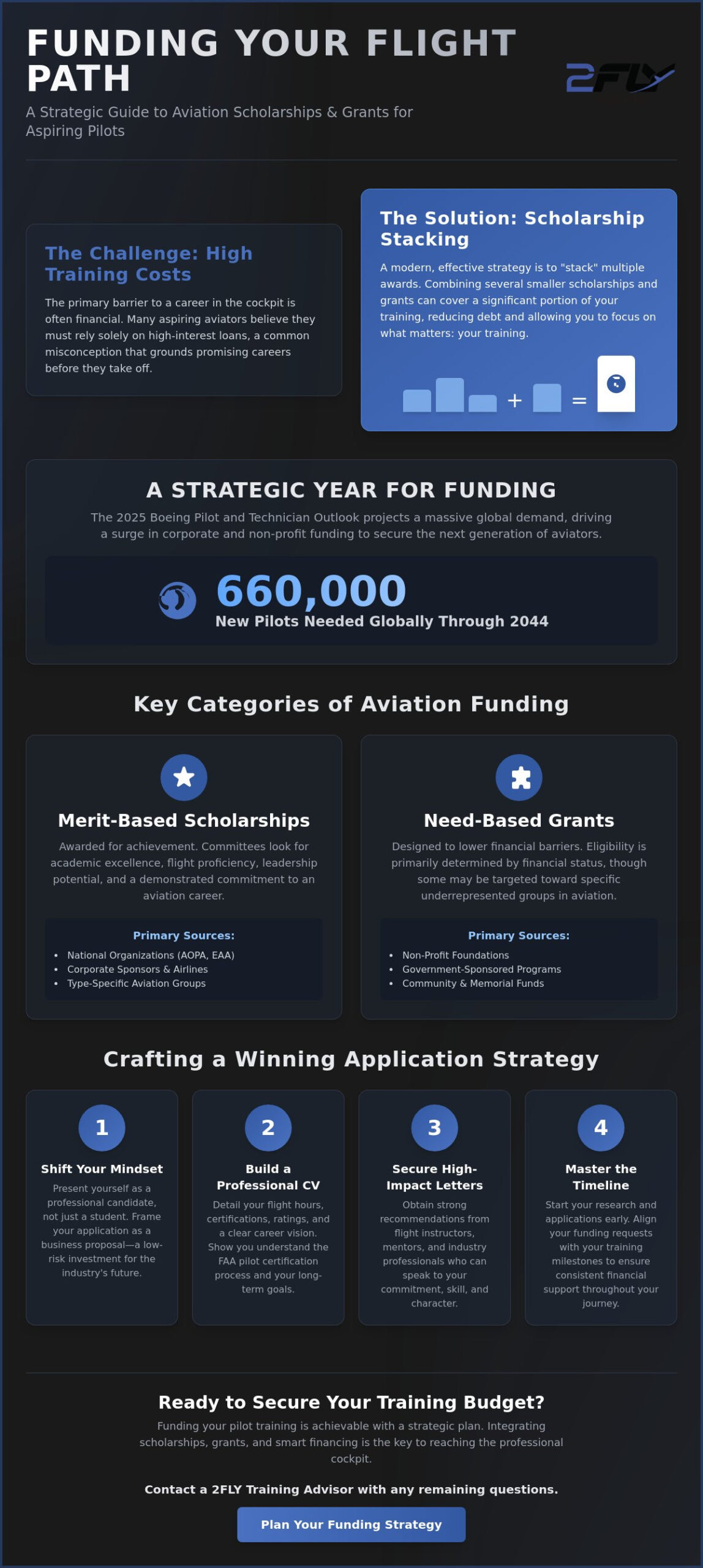
The current industry climate is shifting toward accessibility. Aviation organizations and corporate sponsors are actively seeking ways to lower the barriers to entry for dedicated candidates. One of the most effective strategies for modern students is “stacking” multiple flight school scholarships and grants. By combining several smaller awards, you can cover a significant portion of your training costs, reducing the need for traditional debt and allowing you to focus on your studies.
To gain a clearer perspective on how to identify these opportunities, watch this breakdown of the current funding environment:
The Shift from Student to Professional Candidate
Scholarship committees prioritize applicants who demonstrate a vocational commitment rather than a casual interest. They look for candidates who understand the FAA pilot certification process and have a clear vision for their career path. When you approach your search with a professional mindset, you present yourself as a low-risk investment with a high return for the industry.
Think of your application as a business proposal. Sponsors want to see that you’ve researched the specific requirements for your commercial certificates and ratings. Showing that you understand the long-term ROI of a commercial aviation career sets you apart from those who are only focused on the immediate cost of flight hours. This professional preparation signals that you’re ready for the discipline of a structured FAA airline pilot program.
Why 2026 is a Strategic Year for Funding
This year marks a significant turning point for aviation financing. The 2025 Boeing Pilot and Technician Outlook projects a demand for 660,000 new pilots globally through 2044. This massive requirement is driving a surge in corporate and non-profit funding designed to secure the next generation of flight deck crew. Organizations are more motivated than ever to provide flight school scholarships and grants to ensure the industry remains staffed with qualified professionals.
Starting your financial planning early in 2026 allows you to align your training milestones with these funding cycles. Many sponsors have updated their criteria to reflect the urgent need for international professional mobility. By researching your options now, you can integrate these awards into a broader financing strategy that supports your progression from a trainee to an industry-prepared professional. Early action is the key to capturing these resources before your training intensifies.
Key Categories of Aviation Scholarships and Grants
Securing the right flight school scholarships and grants requires a targeted approach. The aviation industry offers a diverse range of funding “buckets,” each designed to support different stages of a pilot’s development. By categorizing these opportunities, you can prioritize your applications based on where you currently stand in your training timeline.
Foundational support often comes from major national organizations. Groups like the Aircraft Owners and Pilots Association (AOPA) provide substantial awards for those starting their journey. Similarly, EAA Aviation Scholarships are instrumental for students seeking to earn their private pilot certificate or transition into more complex aircraft. These organizations value active participation and a clear track record of involvement in the local aviation community.
Professional Organization Scholarships
Specialized groups like Women in Aviation International (WAI) and the Organization of Black Aerospace Professionals (OBAP) offer some of the most competitive funding in the industry. Membership in these organizations provides access to exclusive scholarship cycles that specifically aim to increase diversity within the professional pilot ranks. These awards often cover advanced ratings, such as your Instrument Rating (IR) or Commercial Pilot Certificate (CPL).
Candidates looking toward the corporate sector should investigate the National Business Aviation Association (NBAA), which manages several grant programs. These are tailored for individuals who aspire to fly for flight departments or private charter operations. Engaging with these professional bodies early in your career creates a network of mentors who can guide your application process and provide the necessary recommendations for success.
Airline-Backed Funding Initiatives
Many regional airlines have established “bridge” programs that serve as a direct pipeline to employment. These initiatives often function as a hybrid between a financial grant and a future employment contract. They may offer tuition reimbursement or stipends once you reach certain milestones, such as becoming a Certified Flight Instructor (CFI).
Aligning with an airline-sponsored path provides a clear trajectory toward your goal of becoming a professional aviator. These programs help bridge the financial gap between earning your commercial certificate and reaching the 1,500-hour requirement for airline operations. By integrating these opportunities into your plan, you can significantly reduce the total out-of-pocket cost of an FAA airline pilot program.
Academic merit-based grants are another vital resource for those pursuing a degree alongside their flight training. These awards recognize students who maintain high standards of technical mastery and academic excellence. Combining these with demographic-specific funding ensures that your financial strategy is as robust as your flight training syllabus.
Crafting a Winning Scholarship Application Strategy
Securing flight school scholarships and grants is a competitive process that rewards the most disciplined applicants. It requires more than just filling out a form. It demands a strategic presentation of your professional potential. You should treat every application as a high-stakes interview for your future career.
Success begins with a comprehensive “Aviation CV.” Even if you’re a beginner, you must document your ground school progress, volunteer work at local aviation events, and any relevant leadership experience. This document serves as the foundation for your narrative. It proves to the committee that you’re already operating with the discipline required for professional flight training.
Organization is your greatest ally in this process. Maintain a meticulous calendar of deadlines to ensure early submissions. Many prestigious awards, such as the NBAA Charities Scholarships, have strict annual cycles. Missing a date by even an hour can disqualify an otherwise perfect candidate. Submit early to demonstrate your reliability and respect for the committee’s time.
The Anatomy of a High-Impact Personal Statement
Your personal statement must move beyond the cliché of “loving planes.” Committees want to know how you will contribute to the safety and growth of the industry. You should demonstrate a clear understanding of the professional path, including the specific steps of how to become a pilot. Structure your essay to highlight resilience, safety-mindedness, and leadership. Show them you’re a candidate who can handle the rigors of an international career.
Selecting the Right References
Impactful letters of recommendation are vital for a successful application. A letter from a Chief Flight Instructor or an industry professional carries significantly more weight than one from a family friend. These individuals can speak directly to your technical aptitude and professional conduct. Always provide your references with a “cheat sheet” of your accomplishments. This helps them write specific, evidence-based letters that validate your claims. Remember to maintain professional etiquette by requesting these recommendations at least three weeks before the deadline.
Finally, don’t underestimate the power of networking. Follow up with awarding organizations after you submit. Attend industry events where these sponsors are present. Building a relationship within the aviation community often opens doors to future funding and mentorship opportunities that aren’t advertised publicly. This proactive engagement reinforces your status as an industry-prepared professional.
Beyond Scholarships: Grants and Institutional Financing
While merit-based awards are excellent, they rarely cover the entire cost of training. Understanding the distinction between flight school scholarships and grants is essential for a complete financial plan. Scholarships reward your past achievements; grants often address financial need or specific vocational categories. You’ll need to explore all financing options to ensure your training remains uninterrupted.
Specialized aviation lenders play a critical role in bridging the gap after you apply your initial awards. These institutions understand the unique timeline of flight training and the high earning potential of professional pilots. They offer products designed to cover the costs of certificates and ratings, often with deferred payment options while you build hours. This allows you to focus on your technical mastery without the immediate pressure of repayment.
Federal and State Grant Opportunities
FAFSA eligibility is a major factor for students pursuing a degree program with airline pilot training. When flight hours are integrated into a university curriculum, federal Pell Grants and subsidized loans become accessible. You should also research state-specific workforce development grants. These localized programs are frequently less competitive than national scholarships and focus on technical vocational training for high-demand industries.
The Advantage of Structured Training for Funding
Lenders and donors show a clear preference for students enrolled in a structured FAA Professional Pilot Program. This preference stems from the higher success rates found in Part 141 training environments. Unlike self-paced Part 61 training, a structured syllabus provides a predictable timeline and measurable milestones. This professional accreditation simplifies the verification process for financial institutions and donors alike, signaling that you’re an industry-prepared professional.
To learn more about how to structure your training for maximum financial support, review our specialized financing resources.
Integrating Financial Planning into Your Career Path
Approaching your financial plan with the same precision as a pre-flight checklist is the hallmark of a successful professional. You shouldn’t view the search for flight school scholarships and grants as a side task. Instead, treat it as your first official assignment in the aviation industry. This level of dedication ensures you aren’t just flying, but building a sustainable business model for your future self.
A multi-year budget is essential to account for all flight school costs. The “Zero to Hero” approach emphasizes that every dollar secured through grants today is a dollar that won’t accrue high interest tomorrow. By reducing your initial debt load, you protect your future earnings and accelerate your financial independence as a first officer.
Viewing your first commercial job as the start of your repayment phase changes your perspective on the initial investment. Instead of seeing training as a burden, you see it as the entry fee to a profession with high median salaries and long-term stability. This mindset allows you to make informed decisions about which ratings to prioritize and how to allocate your funds most effectively.
The Importance of a Debt-to-Income Strategy
Professional pilots must balance their training investment against their expected first-year salary. Pursuing a degree program with airline pilot training often provides access to more robust financial aid packages that traditional programs can’t match. This strategy helps you manage your debt-to-income ratio effectively from day one. You’ll also need to commit to living economically during your intensive training phase to maximize your available resources.
Your Next Steps Toward the Flight Deck
The most successful candidates use a “stacking” strategy to layer multiple funding sources. This involves combining small local grants with larger national awards to create a comprehensive financial foundation. Seek out professional mentorship to navigate these requirements, as experienced pilots often know about niche opportunities that aren’t widely advertised. Structured training environments also provide a clear timeline, which is vital for maintaining your financial plan.
The 2025 Boeing Pilot and Technician Outlook projects a demand for 660,000 new pilots globally through 2044. This long-term demand ensures that your investment in safe, structured training leads to a stable and lucrative career path. Your journey to the flight deck is a disciplined progression, and your financial planning is the engine that keeps that journey moving forward.
In summary, securing the necessary support for your aviation career requires a proactive strategy and a professional mindset. By identifying flight school scholarships and grants, building a strong budget, and selecting the right training path, you position yourself for international professional mobility.
Always prioritize safe, high-quality instruction as the foundation of your success. If you’re ready to take the first step toward your professional pilot goals, contact 2FLY Airborne to speak with a training advisor. For any remaining questions about your specific career path, reach out to a 2FLY Training Advisor today.
Secure Your Future in the Flight Deck
Funding your aviation career is a strategic process that requires the same discipline you’ll bring to the cockpit. By mastering the search for flight school scholarships and grants and stacking multiple awards, you can significantly reduce your financial burden. Focus on building a professional narrative that highlights your technical aptitude and commitment to safety to stand out to selection committees.
Choosing a training provider with FAA and EASA certified paths ensures you meet the highest international standards from your first hour of flight. Our professional mentor-based training environment is designed to prepare you for the rigorous demands of the global industry. With a proven track record of commercial airline placements, we provide the definitive gateway to your professional career.
If you have questions about funding your journey, speak with a 2FLY Training Advisor today. We are here to help you navigate the requirements and turn your ambition into a professional reality. Reach out to a 2FLY Training Advisor with any remaining questions to begin your ascent toward a career without limits.
Frequently Asked Questions
Are there scholarships specifically for commercial pilot training?
Yes, many industry organizations offer flight school scholarships and grants specifically for advanced certificates like the Commercial Pilot Certificate (CPL). These awards are designed to help student pilots bridge the gap between initial training and professional employment. Sponsors often look for candidates who have already completed their Private Pilot Certificate and demonstrate a clear commitment to a career in the flight deck.
Do I need to be a top student to win a flight school grant?
Academic excellence is a strong asset, but it isn’t the only factor committees consider. Many grants prioritize community involvement, leadership potential, and your specific career goals over a perfect GPA. Demonstrating a disciplined approach to your flight training and a strong safety mindset can be just as impactful as high grades during the selection process.
Can international students apply for US flight school scholarships?
International students are eligible for many awards, though some flight school scholarships and grants are restricted to US citizens or permanent residents. Organizations with a global perspective, such as Women in Aviation International, often provide funding that supports international professional mobility. Always review the specific residency and visa requirements for each scholarship before beginning your application to ensure you qualify.
How much of my flight training can realistically be covered by scholarships?
While it is rare to cover 100% of costs through a single award, many students successfully fund 20% to 50% of their training by stacking multiple grants. Realistically, you should expect scholarships to cover specific milestones, such as an Instrument Rating or Multi-Engine Rating. Combining these awards with structured financing allows you to maintain a steady training pace without financial interruptions.
What is the best time of year to apply for aviation grants?
The primary application season typically runs from October through February for the following year’s funding cycles. However, some niche grants and corporate awards have deadlines scattered throughout the calendar. You should maintain a professional calendar of deadlines and begin preparing your application materials at least two months before the submission window opens to ensure a high-quality entry.
Are there grants for older adults starting a second career in aviation?
Yes, several organizations offer “career changer” scholarships specifically for adults transitioning into aviation from other industries. These sponsors value the maturity, professional experience, and diverse skill sets that second-career pilots bring to the cockpit. These awards are an excellent way to offset the costs of a vocational transition while moving toward a professional pilot career.
Do airline cadet programs count as scholarships?
Airline cadet programs are usually considered employment-based financing initiatives rather than traditional “free money” scholarships. They often function as a hybrid model where the airline provides tuition reimbursement or stipends in exchange for a future employment commitment. These programs are highly effective for students who want a direct pipeline to a regional or major airline career.
What happens if I receive a scholarship but change flight schools?
The portability of your award depends entirely on the specific terms set by the donor. Some scholarships are tied to specific accredited institutions or Part 141 programs, while others are “portable” and can be used at any qualified pilot school. You must notify the awarding organization immediately if your training location changes to confirm that your funding remains valid under their policies.
Article by
2FLY Airborne
2Fly Airborne is a professional flight training organization dedicated to developing the next generation of skilled, confident, and safety-focused pilots. With decades of combined aviation experience, our team of certified instructors provides structured, real-world training designed to prepare students for both checkrides and long-term success in the aviation industry.
Content Disclaimer
Some blog content is generated with the assistance of automated tools and may not always be fully accurate or up to date. Please verify all aviation-related information with official sources or a certified instructor. For additional guidance or clarification, we encourage you to contact one of our training advisors at 2Fly Airborne.