You’re right to feel cautious. Between complex pay-as-you-go models and the fear of hidden fees after enrollment, the financial path to the flight deck often feels like flying through heavy fog. You want a career that offers an elite lifestyle, but you need to ensure the investment makes sense for your long-term debt-to-income ratio.
We’re here to provide the clarity you need to move forward with confidence. This guide offers a comprehensive breakdown of pilot training investments, from tuition to often-overlooked living expenses. You’ll gain a clear understanding of modern financing options and the substantial ROI that awaits a professional, airline-ready pilot. We’ll examine exactly how to budget for your certifications so you can focus on mastering the aircraft. If you’re ready to secure your future, we invite you to speak with a training advisor at 2FLY Airborne for personalized guidance on your professional journey.
Key Takeaways
- Understand the full spectrum of flight school cost for 2026, including the vital differences between base tuition quotes and the total investment required for a commercial career.
- Break down the financial milestones for each certification level to ensure you are prepared for the progression from a student pilot to an airline-ready professional.
- Identify often-overlooked variable expenses such as flight gear and administrative fees to build a realistic and sustainable budget that avoids financial surprises.
- Analyze the long-term ROI of an aviation career in light of the 2025 Boeing Pilot and Technician Outlook, which projects a global need for 660,000 new pilots by 2044.
- Discover how structured training environments and advanced simulation technology provide the cost certainty needed to accelerate your path to the flight deck.
The Reality of Flight School Cost in 2026
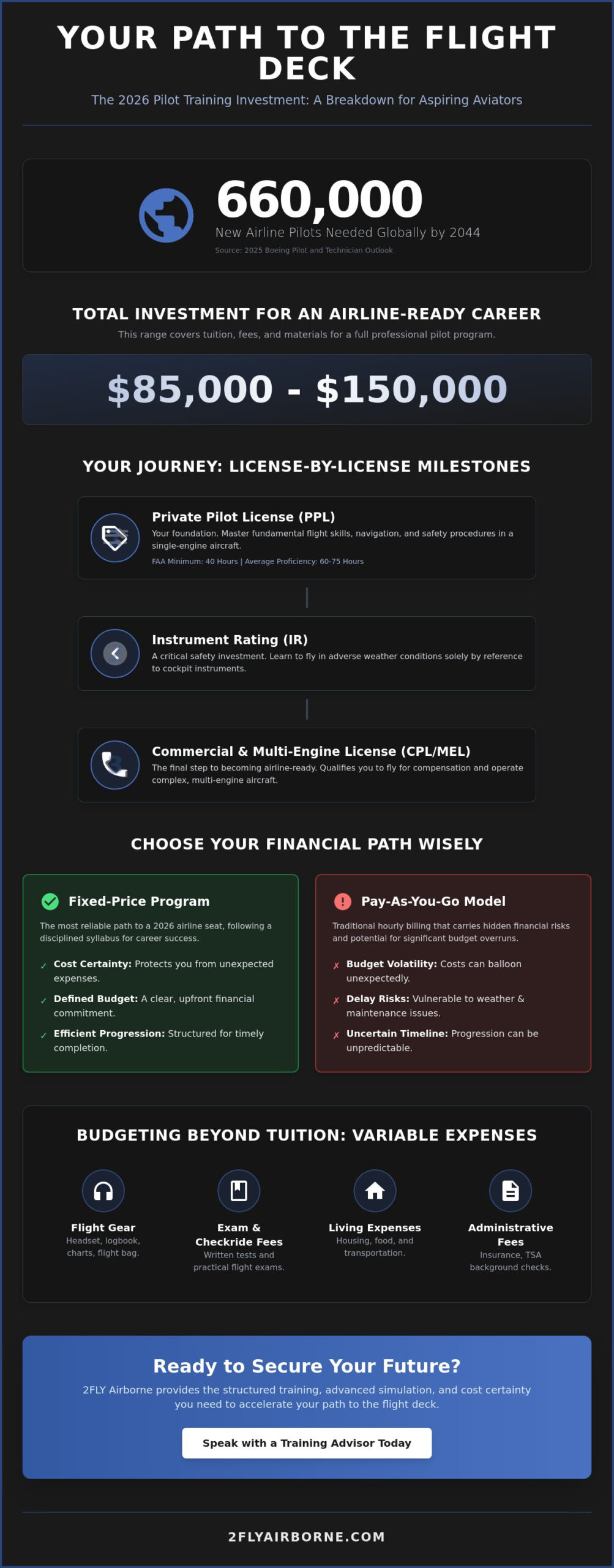
Becoming a commercial pilot is a significant investment in a high-growth career. According to the 2025 Boeing Pilot and Technician Outlook, the industry requires 660,000 new qualified pilots through 2044. Understanding the total flight school cost is the first step toward the flight deck. This figure isn’t just tuition. It encompasses aircraft rental, instructor fees, examination costs, and essential living expenses during your training months.
To better understand the financial commitment of professional training, watch this helpful video:
Aspiring aviators must understand the regulatory framework of Pilot certification in the United States to budget effectively for each rating. For those pursuing a full commercial career path, the total investment typically ranges from $85,000 to $150,000. While recreational lessons focus on basic maneuvers, "Airline-Ready" training focuses on the technical precision and crew resource management skills required by major carriers. The United States remains the global benchmark for cost-efficiency due to high aircraft availability and favorable training weather.
Total flight school cost varies based on the speed of your progression. Programs like the FAA Airline Pilot Program are designed to move students from zero experience to a commercial multi-engine rating with efficiency. This professional focus ensures every dollar spent contributes directly to your employability.
Fixed-Price vs. Pay-As-You-Go Models
Traditional hourly billing carries hidden risks. Weather delays, maintenance issues, or instructor turnover can cause your budget to balloon unexpectedly. In contrast, fixed-price professional pilot programs provide the security of a defined budget, protecting you from the volatility of individual flight hour costs. Structured training is the most reliable path to a 2026 airline seat, as it follows a disciplined syllabus designed for career success.
The Global Pilot Perspective
International students often face the unique challenge of budgeting for both FAA and EASA standards. Dual-certification paths offer immense value in the current global market, allowing pilots to work across different regulatory jurisdictions. Training in high-utility environments like Florida provides a distinct advantage. The consistent weather allows for more frequent flight hours, helping you complete your training faster and enter the workforce sooner. If you’re ready to begin, speak with a 2FLY Airborne training advisor for personalized guidance on your journey.
License-by-License Cost Breakdown
Mapping out the financial requirements for your aviation journey requires a clear understanding of each training milestone. The 2025 Boeing Pilot and Technician Outlook projects a global demand for 660,000 new qualified pilots through 2044. This massive industry need creates a stable backdrop for your investment, but you must plan for the specific expenses associated with each certification. The Federal Aviation Administration (FAA) establishes minimum flight hour requirements for every license level. You should remember that these are legal minimums, not necessarily the averages for completion. Most students require additional hours to reach the high level of proficiency required for professional standards.
Private Pilot and Instrument Ratings
The Private Pilot License (PPL) serves as your entry point into the cockpit. Your initial flight school cost will cover ground school materials, flight hours in a single-engine aircraft, and one-on-one instructor time. While the FAA minimum is 40 hours, many cadets graduate with 60 to 75 hours to ensure total mastery of the aircraft. For a transparent breakdown of every expense you’ll face at this stage, our guide to private pilot license cost in 2026 provides a detailed financial planning roadmap. Following the PPL, the Instrument Rating (IR) is the most critical safety investment you’ll make. It teaches you to fly solely by reference to instruments, which is a requirement for any airline career.
Training for the IR involves a strategic mix of simulator time and actual flight time. Simulators are highly effective for practicing complex procedures and emergency scenarios at a lower hourly rate than a live aircraft. This phase focuses on precision and decision-making in adverse weather. You can find a detailed analysis of these entry-level expenses in our Pilot Training Cost 2026: A Comprehensive Guide.
Commercial and Multi-Engine Certification
Earning a Commercial Pilot License (CPL) is the step that allows you to fly for compensation. This phase requires a total of 250 flight hours, involving significant time-building and advanced maneuvers. The flight school cost during this period often fluctuates based on how efficiently you manage your cross-country hours. You’ll transition from basic flight skills to professional-grade operations, focusing on the rigorous demands of commercial aviation. For a complete overview of how these certifications fit into your broader career trajectory, our guide to pilot training in 2026 and the professional path to a commercial aviation career provides a detailed map of the industry landscape.
The Multi-Engine (ME) add-on is where your training aligns with airline expectations. Most professional flight decks operate twin-engine aircraft, making this rating essential. Training typically utilizes a reliable platform like the Piper Seminole. These aircraft are more expensive to operate than single-engine trainers due to:
- Increased fuel consumption from dual engines.
- Higher maintenance and insurance requirements.
- Advanced systems training, including feathering and asymmetric thrust management.
While the hourly rate for multi-engine time is higher, it’s a non-negotiable step for those aiming for a First Officer position. If you’re ready to begin your professional journey, you can speak with a training advisor to build a personalized timeline for these certifications.
Beyond Tuition: Budgeting for Variable Expenses
A common frustration for new cadets is discovering the final flight school cost exceeds the initial tuition quote. This discrepancy exists because many institutions market "teaser" prices that only account for minimum flight hours and basic instruction. They often omit the essential variable expenses required to reach a professional standard. To build a realistic budget, you must look past the sticker price and account for the specialized tools and administrative requirements of a commercial aviation career. Elite training demands professional-grade equipment that ensures safety and performance from day one.
Aviation Gear and FAA Examination Fees
Becoming an airline-ready professional requires investing in high-quality equipment that lasts throughout your career. You’ll need a professional-grade noise-canceling headset, such as those from Bose or David Clark, to ensure clear communication and hearing protection during hundreds of flight hours. Most modern cockpits also rely on Electronic Flight Bags (EFB). You should budget for an iPad and a subscription to navigation software like ForeFlight. Beyond gear, you must factor in FAA written exam fees and the cost of the Designated Pilot Examiner (DPE). These checkride fees are paid directly to the examiner and are not typically part of school tuition. Understanding these flight training costs early prevents financial surprises during your critical checkride phases.
Housing, Visas, and Administrative Support
Living expenses and administrative fees can significantly impact your total investment. The 2025 Boeing Pilot and Technician Outlook projects a global demand for 660,000 new qualified pilots through 2044. This massive demand makes the commitment to full-time training a strategic career move, but it requires careful planning. For out-of-state or international cadets, on-campus residential housing provides a focused environment but adds to the monthly budget. International students also face specific costs for M-1 or F-1 visa processing and SEVIS registration fees. You’ll also need to budget for FAA medical certificates and potential administrative support for license conversions. These steps are vital to ensure you’re legally and physically cleared to reach the flight deck. If you’re planning your path, reviewing financing options can help you manage these diverse costs effectively. We encourage you to speak with a training advisor for personalized guidance on your specific training needs.
Financing Your Aviation Career and Long-Term ROI
The aviation industry is entering a period of unprecedented expansion. According to the 2025 Boeing Pilot and Technician Outlook, the global aviation sector will require 660,000 new qualified pilots through 2044. While the initial flight school cost represents a significant commitment, it’s a high-yield investment in a career with a defined trajectory. Unlike traditional four-year university degrees where graduates may struggle in saturated markets, airline-ready cadets enter a field with a critical labor shortage. This supply-and-demand imbalance has pushed starting compensation for regional First Officers to levels that often exceed entry-level corporate roles.
Pilot Training Loan Options
Securing capital for your training involves strategic planning. Most prospective cadets explore options through lenders like Sallie Mae or specialized aviation finance groups that understand the unique structure of flight training. These institutions offer both secured and unsecured student loans. Because flight school is an intensive, fast-paced commitment, lenders prioritize applicants with strong credit scores or qualified co-signers. A co-signer can often unlock lower interest rates, significantly reducing the long-term flight school cost. Explore your 2FLY Financing Options to determine which path fits your financial profile.
Calculating the Return on Investment
In the aviation industry, ROI is the speed at which a pilot reaches a major carrier seat. By 2026, First Officers at regional airlines are seeing average starting salaries between $90,000 and $100,000 when including signing bonuses and incentives. The "Seniority" factor is the most critical component of your lifetime earnings. Every month you delay training is a month of lost seniority at the top of the pay scale later in your career. Starting your journey early maximizes your time at the highest tier of captain pay at a major airline.
Many regional airline partners now offer "Tuition Reimbursement" programs to secure their future talent. These programs effectively pay back a portion of your training expenses once you reach specific flight hour milestones. It’s a direct pipeline to employment that helps offset your initial debt while you build the 1,500 hours required for your ATP certificate. This structure ensures that your transition from a student to an airline-ready professional is both efficient and financially supported.
Ready to map out your path to the flight deck? Speak with a 2FLY training advisor today for personalized guidance on financing your future.
The 2FLY Difference: Maximizing Your Training Budget
Investing in your future as a pilot is a major financial decision. While many students focus solely on the sticker price, the most successful cadets look at the long-term return on investment. The 2FLY FAA Professional Pilot Program is designed to provide cost certainty by utilizing a structured syllabus that minimizes wasted hours and redundant training. According to the 2025 Boeing Pilot and Technician Outlook, the industry needs 660,000 new qualified pilots through 2044. Meeting this global demand requires a training provider that prioritizes career-readiness over the lowest possible hourly rate.
Our training philosophy integrates state-of-the-art simulators early in the curriculum. These advanced tools allow you to master complex procedures and emergency scenarios in a controlled environment at a fraction of the price of an idling aircraft. This approach doesn’t just lower your total flight school cost; it ensures you’re better prepared for the rigors of the FAA Airline Pilot Program. You’ll arrive at your checkride with superior proficiency, which reduces the likelihood of expensive retakes and additional training hours.
Structured Career Pathways
2FLY utilizes a "Zero to Hero" timeline to move you from the classroom to the cockpit as efficiently as possible. Time spent in training is time spent not earning an airline salary, so we focus on high-tempo progression. By condensing the timeline, we help you minimize living expenses and housing costs. Our Florida training base provides a massive advantage, offering over 320 days of flyable weather annually. You won’t find your progress stalled by weeks of winter storms or low ceilings. This consistency is paired with a global recruitment network that connects our graduates with airline partners across multiple continents, ensuring you’re ready for immediate placement upon reaching your hour requirements.
Take the Next Step Toward the Flight Deck
Every pilot’s financial journey is unique. We encourage you to speak with a training advisor to receive a personalized estimate of your flight school cost based on your current experience and professional goals. Seeing our facilities firsthand and meeting our instructors is the best way to understand the 2FLY advantage. We invite you to attend an upcoming 2FLY Event to get your questions answered by industry experts. Don’t leave your career to chance. Contact a 2FLY Advisor Today to begin your transition from student to airline-ready professional.
Secure Your Future in the Global Cockpit
Navigating the financial landscape of aviation requires a strategic mindset. You’ve seen that while the initial flight school cost represents a significant investment, the long-term ROI is backed by unprecedented global demand. The 2025 Boeing Pilot and Technician Outlook forecasts a need for 660,000 new commercial pilots through 2044. This isn’t just a job; it’s a high-growth career path for those who train with precision and purpose.
2FLY Airborne removes the guesswork from your journey through fixed-price tuition transparency and elite FAA and EASA dual-certification expertise. You’ll graduate as an airline-ready professional prepared to command aircraft across multiple continents. Don’t let financial uncertainty stall your ambitions. Our team provides the clarity you need to move from the classroom to the flight deck with absolute confidence. We’re here to help you bridge the gap between your current location and your future career.
Speak with a 2FLY Training Advisor for a Personalized Cost Breakdown
The sky is waiting for your arrival. Take the first step toward your global aviation career today.
Frequently Asked Questions
How much does it cost to become a commercial pilot in 2026?
Becoming a commercial pilot in 2026 requires an investment that typically ranges from $80,000 to $110,000 for a comprehensive professional program. The 2025 Boeing Pilot and Technician Outlook projects a demand for 660,000 new pilots through 2044. This high demand makes the flight school cost a strategic investment in a stable, high-earning global career. Your total expenditure depends on your previous experience and the specific training track you select.
Can I get financial aid or loans for flight school?
You can access several specialized financing options to fund your journey to the flight deck. Many cadets utilize aviation-specific loans from lenders like Sallie Mae or Meritize, which offer flexible repayment terms during your training. If you choose a program integrated with a university degree, you may also qualify for federal financial aid. It’s best to speak with a training advisor to explore a personalized financial plan that fits your goals.
What are the hidden costs of flight training I should budget for?
You should budget for essential equipment and regulatory fees that fall outside standard tuition. These include an FAA Class 1 Medical Certificate, which generally costs between $150 and $200. You’ll also need a professional aviation headset, with prices ranging from $300 to $1,100 for high-end noise-canceling models. Other costs include digital chart subscriptions like ForeFlight, pilot supplies, and recurring TSA background check fees for certain training phases.
Is it cheaper to pay for flight school hourly or through a fixed-price program?
Fixed-price or "fast-track" programs offer significantly more financial predictability than paying an hourly rate. While pay-as-you-go models seem flexible, they often increase the total flight school cost due to training delays and lack of structure. Professional academies focus on efficiency to ensure you’re airline-ready as quickly as possible. This approach helps you enter the workforce sooner to meet the massive global demand for 660,000 new pilots.
How much is the Private Pilot License (PPL) on its own?
Obtaining a Private Pilot License typically costs between $15,000 and $20,000 in the current market. This price covers aircraft rental, instructor fees, and ground school materials for the required training hours. While the FAA minimum is 40 flight hours, most students require 60 to 70 hours to reach proficiency. For a complete breakdown of what to expect at this stage, our private pilot license cost financial planning guide walks you through every expense in detail. This license serves as the critical foundation for all advanced commercial ratings in your professional pilot training career.
Does flight school cost include housing and meals?
Most flight training quotes cover only the instructional and aircraft components of the syllabus. You’ll need to budget separately for your daily living expenses unless you enroll in a residential program. Some elite academies offer optional housing packages to keep you immersed in the training environment. Contact 2FLY Airborne to receive a transparent breakdown of what’s included in our professional programs so you can plan your budget accurately.
Are there scholarships available for aspiring commercial pilots?
Numerous aviation organizations award scholarships annually to help cadets offset their training expenses. Groups like Women in Aviation International and the Aircraft Owners and Pilots Association provide millions of dollars in funding to qualified applicants. These awards can cover specific ratings or even entire phases of your commercial training. We recommend starting your scholarship search early to maximize your chances of securing additional financial support for your career.
What is the cost of FAA checkrides and written exams?
FAA knowledge tests and practical exams are external fees paid directly to testing centers and examiners. Written exams currently cost approximately $175 per attempt at an authorized testing facility. Practical exams, or checkrides, are conducted by Designated Pilot Examiners and typically range from $800 to $1,500 depending on the complexity of the rating. Budgeting for these milestones is a vital part of managing your finances throughout your flight training.
Article by
2FLY Airborne
2Fly Airborne is a professional flight training organization dedicated to developing the next generation of skilled, confident, and safety-focused pilots. With decades of combined aviation experience, our team of certified instructors provides structured, real-world training designed to prepare students for both checkrides and long-term success in the aviation industry.
Content Disclaimer
Some blog content is generated with the assistance of automated tools and may not always be fully accurate or up to date. Please verify all aviation-related information with official sources or a certified instructor. For additional guidance or clarification, we encourage you to contact one of our training advisors at 2Fly Airborne.