

What if the biggest hurdle between you and the captain’s seat isn’t a complex flight maneuver, but a standard physical exam? It’s completely natural to feel a surge of anxiety when you first review the FAA medical certificate requirements. Many aspiring aviators worry that a minor vision correction or a past health hurdle might ground their dreams before they even reach the runway.
We believe that health standards shouldn’t be a source of mystery, but a professional baseline for a long and safe career. This guide will help you discover the exact health standards, certificate classes, and application steps required to secure your FAA medical and launch your aviation career. You’ll learn how to navigate the system with the precision of a seasoned professional.
We’ll provide a clear overview of the 2026 vision and hearing benchmarks, explain the MedXPress online application portal, and clarify the distinctions between the different certificate classes. This roadmap provides the technical details and procedural steps necessary to prepare for your appointment with an Aviation Medical Examiner, a doctor authorized to perform pilot physicals. You’ll gain the certainty needed to book your first flight lesson and take your first step toward an elite international career.
Key Takeaways
- Identify which of the three medical classes aligns with your specific career goals, from recreational flying to commanding international commercial jets.
- Understand the specific FAA medical certificate requirements for vision, hearing, and cardiovascular health to ensure you meet the professional baseline for safety.
- Navigate the MedXPress application and the Aviation Medical Examiner (AME) process with a clear, step-by-step roadmap that eliminates confusion.
- Learn how the FAA’s modernized approach to mental health documentation provides clearer pathways for candidates to secure their medical clearance.
- Master the renewal timelines and maintenance habits necessary to protect your medical status throughout a long and successful aviation career.
The Gateway to Flight: Why Every Pilot Needs an FAA Medical Certificate
Imagine the adrenaline of sitting in the cockpit for your first solo flight. You’ve mastered the pre-flight checks and the radio calls, but without the correct legal clearance, you won’t be leaving the ground. The FAA medical certificate is your official verification that you meet the rigorous health standards required for safe flight. It represents your professional commitment to the safety of yourself and your future passengers.
This dedication to safety is shared by other industry professionals, such as the team at RN MEDflights, who provide specialized medical support for passengers during international travel on commercial flights.
Securing this document is a vital first step in your journey toward a professional career. It serves as a non-negotiable prerequisite for your student pilot certificate and every rating that follows. Gaining a deep understanding of pilot medical certification ensures that your progression remains steady and uninterrupted. This process filters for health issues that could impact long-term career viability, making it a crucial screening tool for high-achievers.
Addressing the FAA medical certificate requirements early prevents costly delays in your pilot training. Many students wait too long, only to find that a minor administrative hurdle keeps them from their first solo flight. Proactive planning allows you to clear these medical benchmarks while you focus on ground school. This early certification provides the peace of mind needed to commit to a demanding training schedule.
Medical Certificate vs. BasicMed: What is the Difference?
BasicMed offers a simplified alternative for recreational flying, but it has significant limitations for those with career ambitions. Professional pilot programs almost always require a Class 1 or Class 2 certificate to ensure you are fit for the demands of commercial operations. International students must adhere to standard FAA medical certificate requirements to remain compliant with visa regulations and training standards.
The Connection to Your Student Pilot Certificate
You can certainly begin your ground school and initial flight lessons without a medical in hand. However, the FAA prohibits you from flying an aircraft solo until you have successfully passed your medical exam. This integration ensures that every pilot operating alone in the national airspace meets a baseline of physical and mental readiness. Your designated Aviation Medical Examiner (AME), a doctor authorized by the FAA to perform these exams, acts as a mentor in this process.
We recommend checking our guide on how to become a pilot to see where this step fits into the broader timeline. Completing your medical exam early is a hallmark of a disciplined, professional approach to aviation. It confirms your eligibility and gives you the confidence to invest fully in your future.
Classes of FAA Medical Certificates: Finding the Right Level for Your Career
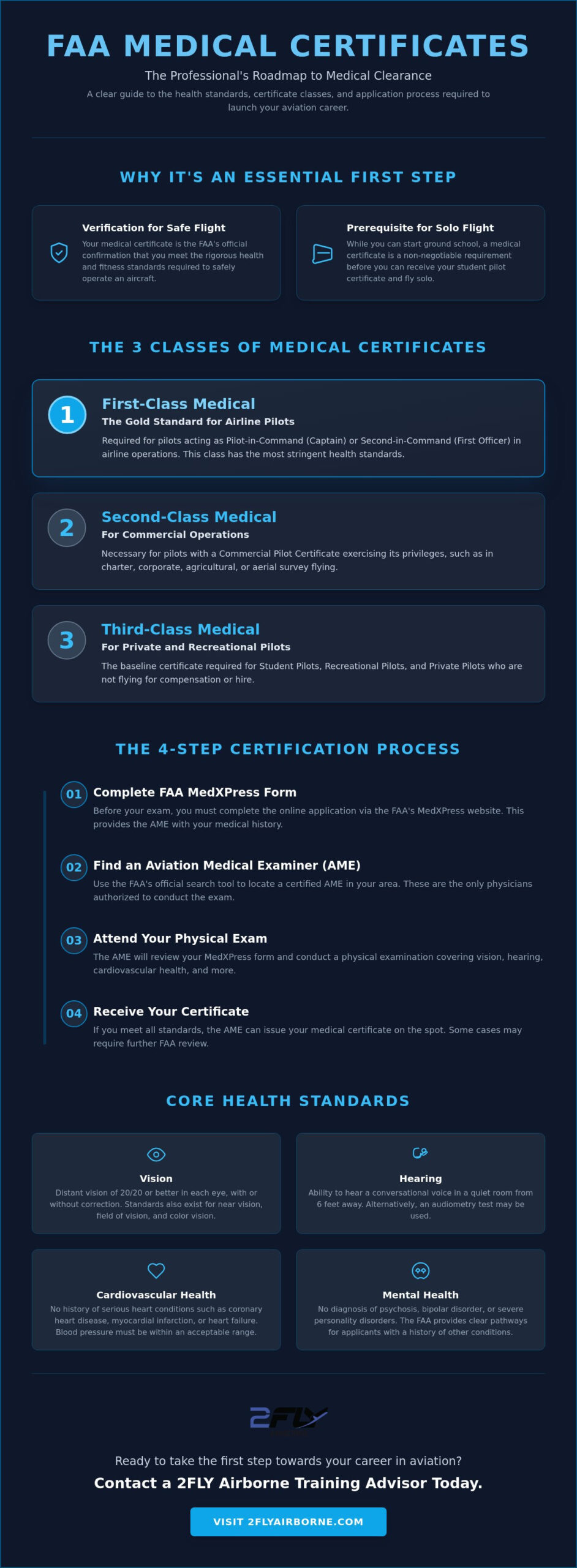
The FAA categorizes medical certificates into three distinct classes. Each level reflects the specific responsibilities and physical demands of different pilot roles. Your long-term career goals dictate which class you must maintain, but the initial choice is a strategic decision for any aspiring professional.
For anyone with professional ambitions, we recommend securing a First-Class medical certificate before investing heavily in flight hours. This proactive step ensures that no hidden medical disqualifiers exist that could halt your progress later. You can obtain a Medical Certificate by scheduling an appointment with an authorized Aviation Medical Examiner to verify you meet the necessary standards.
First-Class Medical: The Gold Standard for Airline Pilots
A First-Class medical is the non-negotiable standard for pilots exercising Airline Transport Pilot (ATP) privileges. It is a mandatory requirement for the FAA Airline Pilot Program and subsequent employment with major international carriers. This class involves the most rigorous evaluation of cardiovascular health and sensory systems.
Pilots must undergo an electrocardiogram (ECG) to screen for heart irregularities starting at age 35. After reaching age 40, this ECG becomes an annual requirement to maintain the highest safety benchmarks. For those under 40, the certificate remains valid for airline operations for 12 months. Once you reach 40, the validity period for First-Class privileges shifts to six months, reflecting the FAA’s commitment to proactive health monitoring.
Second and Third-Class Medicals: Commercial and Private Use
A Second-Class medical certificate serves as the minimum legal requirement for commercial pilots not flying for major airlines. This includes vital industry roles such as flight instructors, corporate pilots, or aerial photographers. If you are training for a commercial pilot license, you must hold at least a Second-Class medical to exercise those privileges professionally. These certificates remain valid for 12 months regardless of the pilot’s age.
Third-Class certificates are designed for private pilots and students who don’t intend to fly for compensation. While sufficient for personal travel or initial training, a Third-Class medical is not suitable for a professional career path. For pilots under 40, a Third-Class certificate is valid for 60 months. This duration decreases to 24 months for those age 40 and over, ensuring regular health reviews for general aviation safety.
Choosing the right class from the start sets the foundation for your journey. If you aim to join an elite airline crew, starting with the highest standard proves your readiness for the industry’s rigorous demands. You can explore our FAA Airline Pilot Program to see how these FAA medical certificate requirements integrate into a structured professional career path.
FAA Medical Certificate Requirements: Vision, Hearing, and Health Standards
Many candidates fear that a minor physical imperfection will end their career before it starts. The reality is that the FAA evaluates core physiological systems to ensure safe operations, but many supposed disqualifiers are manageable with proper documentation. While FAA medical standards are rigorous, they are designed to support a long-term career in the cockpit. These standards focus on your functional ability to handle the demands of flight rather than requiring an impossible standard of perfection.
Vision and Hearing Requirements
A common misconception is that you need perfect natural sight to fly. You must have 20/20 distant vision in each eye, but the FAA allows this to be achieved with glasses or contact lenses. Near vision must be 20/40 or better for all classes of certification. For hearing, examiners typically use a conversational voice test where you must hear an average voice from six feet away with your back turned. Color vision is also tested, though pilots with deficiencies often have alternative testing pathways to prove they can safely identify aviation signals.
Mental Health and Neurological Standards
The FAA has adopted a more modernized approach toward mental health in recent years. A history of conditions like ADHD, depression, or anxiety requires a detailed review but doesn’t lead to an automatic rejection. Providing thorough documentation and a clear medical history is essential for a successful evaluation. Always maintain complete honesty during the disclosure process to protect your legal standing and your license. These FAA medical certificate requirements are in place to ensure you can perform under the unique stresses of an international aviation environment.
Cardiovascular Health and General Fitness
Heart health is paramount for the endurance required in professional flying. Examiners check blood pressure and pulse to ensure they fall within safe limits during your physical exam. Even pilots with chronic conditions like diabetes can often secure a certificate through a process known as Special Issuance. A Special Issuance is a specific path that allows the FAA to certify pilots with certain medical histories who can demonstrate they can fly safely. Because regulations and individual health timelines vary, you should treat these benchmarks as a starting point for your personal medical journey.
The Step-by-Step Guide to the Medical Certification Process
Securing your medical clearance is a methodical exercise in professional preparation. By following a structured roadmap, you ensure that your “fit for flight” determination is handled with the precision required of an airline professional. This process eliminates common pitfalls, such as arriving without a confirmation number or missing critical documentation. A smooth medical exam starts long before you step into the doctor’s office.
Step 1: Completing the MedXPress Application
The journey begins with the MedXPress application, the FAA’s mandatory online portal for medical history disclosure. You must complete this form before your physical exam, as it generates the specific confirmation number your examiner needs. Be exceptionally thorough with your medical history to prevent future audits or administrative delays. Your submitted application remains valid for 60 days, giving you a generous window to schedule your appointment with a local examiner.
Preparation for your exam day should include a final check of your documentation. We recommend having the following items ready for your visit:
- Your MedXPress confirmation number and a valid government-issued photo ID.
- All relevant medical records or specialist reports for any previously disclosed conditions.
- Current corrective lenses if you use them for distance or near vision.
Step 2: Finding and Scheduling Your AME
An Aviation Medical Examiner (AME) is a physician specifically authorized by the FAA to conduct these evaluations. You can locate one near you using the official “Find an AME” search tool on the FAA website. We recommend choosing an examiner with extensive experience in First-Class certifications for career-track pilots. These professionals understand the specific nuances of FAA medical certificate requirements and have seen a wider range of health scenarios. An experienced AME can often provide better context on how certain conditions might affect your long-term career mobility.
Step 3: Handling Deferrals and Special Issuances
If an AME cannot issue your certificate immediately, they may defer your application to the FAA for a more detailed review. A deferral is simply a request for more information, not a final denial of your wings. It is a common part of the process for pilots with unique health histories. For static conditions like limb differences or certain color vision deficiencies, the FAA may issue a Statement of Demonstrated Ability (SODA). This permanent document proves you can safely perform pilot duties despite a specific medical trait. Pilots with manageable chronic conditions often utilize the Special Issuance path to maintain their professional standing through periodic reviews.
Taking the first step toward your medical is a commitment to your future. If you’re ready to begin your professional journey, explore our FAA Airline Pilot Program to see how we support your path to the cockpit.
Maintaining Your Medical and Launching Your Aviation Career
Achieving your initial medical certificate is a significant milestone, but maintaining it is a career-long discipline. Think of your personal health as an essential component of your aircraft’s airworthiness. As you progress through your FAA professional pilot program, staying healthy becomes a core part of your job description. This commitment ensures you are always ready when a major carrier presents a career-defining opportunity.
The global landscape for pilots remains incredibly promising for those who prioritize their professional readiness. The 2025 Boeing Pilot and Technician Outlook projects a demand for 660,000 new pilots globally through 2044. Consistently meeting the FAA medical certificate requirements is what allows you to capitalize on this massive international growth. Your medical eligibility is the key that unlocks these high-level vocational rewards.
Understanding Renewal Timelines
A First-Class medical certificate requires regular attention to remain valid for airline transport pilot duties. For pilots under the age of 40, your First-Class privileges last for 12 months. Once you reach age 40, this renewal cycle increases in frequency to every six months. This rigorous schedule reflects the FAA’s commitment to proactive health monitoring for the most demanding flight roles.
Second-Class certificates remain valid for 12 months regardless of your age. Third-Class certificates offer more flexibility, lasting 60 months if you are under 40 and 24 months if you are 40 or older. To avoid administrative grounding, always schedule your AME appointment at least 30 days before your current certificate expires. This buffer allows time for any unexpected paperwork or follow-up evaluations the FAA might require during the review process.
The Path Forward with 2FLY Airborne
Your journey toward the flight deck requires a balance of technical skill and physical readiness. The key takeaways for any aspiring pilot are simple: choose the highest medical class your career goals require, maintain absolute honesty with your AME, and stay proactive about your health. By treating your medical as a professional asset, you protect your career longevity and your ability to fly globally.
Achieving an international aviation career is a marathon, not a sprint. Safe, structured training provides the foundation you need to transition from a student to a mission-ready professional. If you have secured your medical and are ready to begin, we offer various financing options to help you launch your training without delay. This financial support, combined with your medical clearance, removes the final barriers to your success.
In summary, understanding the medical certification process is the first step in a lifelong professional commitment. Securing your First-Class medical early confirms your eligibility and sets the stage for a successful training experience. We believe that with the right preparation and health-conscious habits, the path to the captain’s seat is well within your reach. If you have any remaining questions about the medical process or our training programs, reach out to a 2FLY Training Advisor today.
Your Flight Path Starts with a Fit for Flight Determination
Securing your medical clearance is more than a regulatory hurdle; it’s the professional foundation of your entire career. By identifying the correct class early and navigating the application process with precision, you ensure your training remains on schedule. Mastering the FAA medical certificate requirements is the definitive first step toward joining an elite group of global aviators.
Since 1994, we’ve helped students transition into industry-prepared professionals through a structured career pipeline to major airlines. Our team provides expert guidance on both FAA and EASA regulatory compliance, ensuring your skills translate across international borders. This commitment to technical mastery and safety is why high-achievers choose us to launch their journey.
Ready to take the first step toward your career? Speak with a 2FLY Training Advisor today to discuss your professional goals. We look forward to helping you reach the highest levels of the aviation profession. Please reach out to a 2FLY Training Advisor with any remaining questions you may have about starting your training.
Frequently Asked Questions
Can I get an FAA medical certificate if I wear glasses or contact lenses?
You can absolutely obtain a certificate while wearing glasses or contact lenses. The FAA requires 20/20 distant vision, but this standard can be met with corrective lenses as long as you wear them while flying. Your certificate will simply include a limitation stating that you must wear corrective lenses during flight operations.
How long does a First-Class FAA medical certificate last for a pilot under 40?
For a pilot under the age of 40, a First-Class medical certificate is valid for 12 months. After this period, the certificate doesn’t expire entirely; instead, it “drops down” to the privileges of a Second-Class or Third-Class certificate for a set duration. This staggered timeline ensures that high-level commercial pilots maintain the most frequent health reviews.
What happens if my medical application is deferred by the Aviation Medical Examiner?
If your examiner cannot issue a certificate on the spot, they will defer your application to the FAA Aerospace Medicine Certification Division. This isn’t a denial; it’s a request for more detailed documentation or specialist evaluations. The FAA will contact you via mail to request specific records to complete your FAA medical certificate requirements.
Can I still become a commercial pilot if I have a history of ADHD or depression?
A history of ADHD or depression is not an automatic disqualification for a commercial career. The FAA has established clearer pathways for candidates to demonstrate stability and safety through specific psychological evaluations and documentation. You should prepare to provide a detailed medical history and work closely with an experienced examiner to navigate this specialized review process.
How much does an FAA medical exam typically cost for a student pilot?
The cost of the examination is determined by the individual Aviation Medical Examiner (AME). As of June 2026, the typical fee for an FAA medical exam ranges from $100 to $200. You should contact your chosen examiner directly to confirm their current rates for the specific class of certificate you require.
Is color blindness an automatic disqualification for a professional pilot career?
Color blindness is not an automatic disqualification for a professional career. Pilots who fail the standard Ishihara plate test can often take alternative “functional” tests, such as a light gun signal test at an airport. If you pass, the FAA can issue a Statement of Demonstrated Ability (SODA) that permanently clears you for professional flight duties.
What is the difference between an AME and a regular family doctor?
An Aviation Medical Examiner (AME) is a physician who has received specialized training and authorization from the FAA to perform pilot physicals. While your family doctor manages your general health, only an AME can verify that you meet the specific FAA medical certificate requirements for flight duty. They use a specialized database called MedXPress to process your official certification.
Do I need a medical certificate before I can start my first flight lesson?
You don’t legally need a medical certificate to take your very first flight lesson or begin ground school. However, you must have one in your possession before you can fly an aircraft solo. We highly recommend obtaining your certificate early to ensure you meet the physical standards before investing significant time and resources into your training.

Article by
2FLY Airborne
2Fly Airborne is a professional flight training organization dedicated to developing the next generation of skilled, confident, and safety-focused pilots. With decades of combined aviation experience, our team of certified instructors provides structured, real-world training designed to prepare students for both checkrides and long-term success in the aviation industry.
Content Disclaimer
Some blog content is generated with the assistance of automated tools and may not always be fully accurate or up to date. Please verify all aviation-related information with official sources or a certified instructor. For additional guidance or clarification, we encourage you to contact one of our training advisors at 2Fly Airborne.