
What if the most demanding part of flying through solid cloud cover has nothing to do with your hands on the controls? Many aviators assume instrument proficiency is built entirely in the cockpit, but real flight safety begins at the briefing desk. Fulfilling the FAA instrument rating ground school requirements is about far more than memorizing test answers. It develops the disciplined aeronautical decision-making you need when the horizon vanishes and air traffic control issues an immediate reroute.
Deciphering dense regulatory standards across FAR Part 61 and Part 141 can feel overwhelming, especially while balancing flight training and simulator sessions. Sifting through self-study software options while wondering how to qualify for an authorized instructor endorsement only adds to that friction.
This guide clarifies the exact ground training paths and regulatory benchmarks required to advance your aviation training. We’ll examine the mandatory aeronautical knowledge areas under 14 CFR 61.65, compare flexible study against structured ground school syllabi, and outline how to secure your endorsement for the FAA Instrument Rating Airman Knowledge Test.
Key Takeaways
- Discover why instrument ground training focuses on operational risk management and pilot-in-command judgment rather than simple test question memorization.
- Review the core aeronautical knowledge areas under 14 CFR 61.65 that satisfy official instrument rating ground school requirements.
- Compare flexible Part 61 study paths against structured 30-hour Part 141 academy syllabi to determine the right fit for your training goals.
- Follow a proven roadmap to secure an authorized instructor endorsement and pass the FAA Instrument Rating Airman Knowledge Test with confidence.
- Understand how deep theoretical systems and weather comprehension translate directly to success during your Airman Certification Standards checkride.
Understanding the Core Purpose of Instrument Ground School
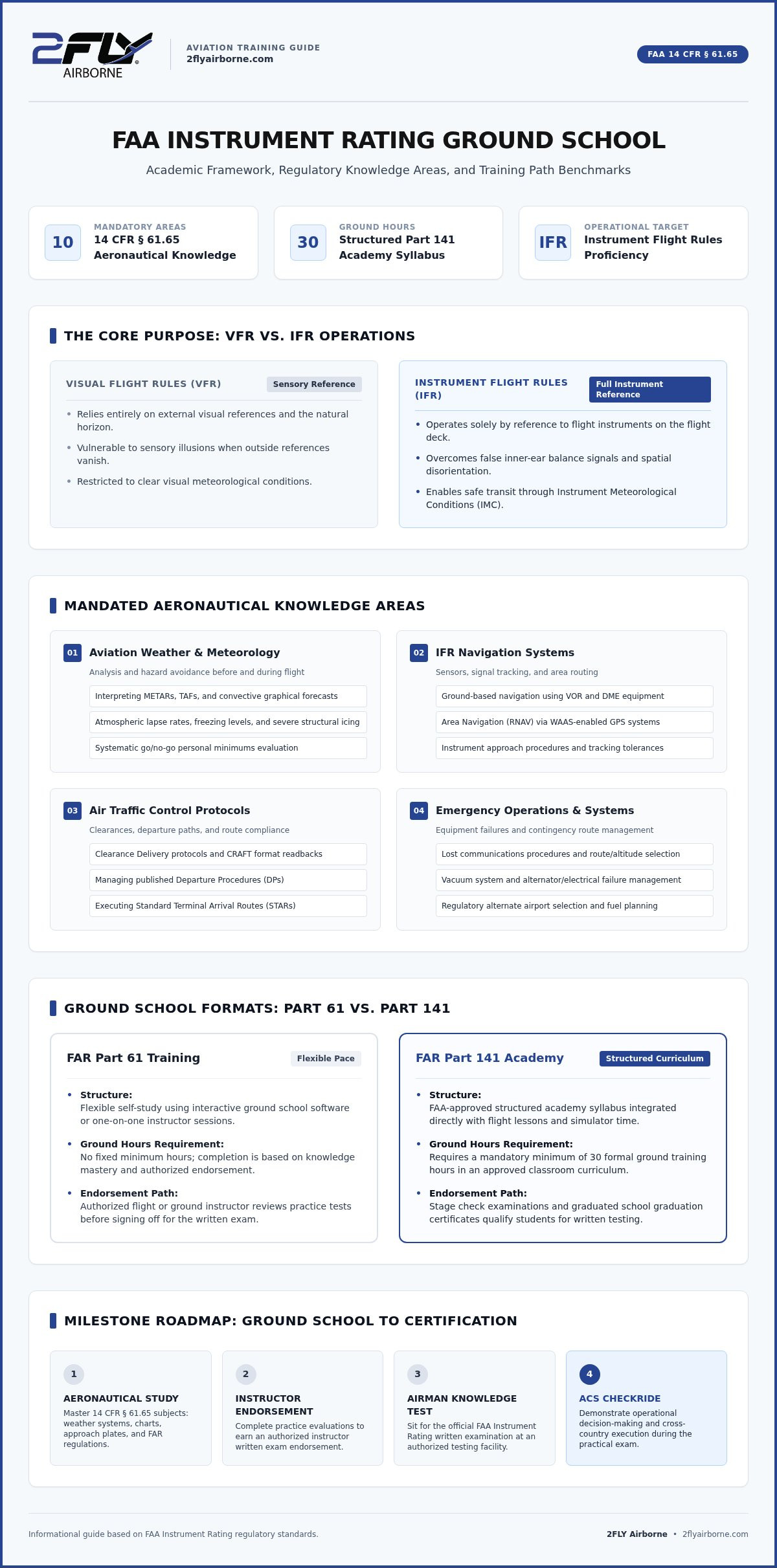
Earning an instrument rating marks the transition from recreational airmanship to disciplined, professional flight operations. Instrument ground school serves as the academic framework required to operate safely under Instrument Flight Rules (IFR). Rather than relying on outside visual horizon cues, pilots must learn to control an aircraft entirely by reference to flight deck instruments.
Fulfilling formal instrument rating ground school requirements ensures you master complex procedures before logging flight simulator or aircraft time. Ground education bridges the gap between basic stick-and-rudder handling and advanced avionics workflow management.
To visualize how these concepts translate directly to regulatory compliance and flight deck operations, watch this breakdown of practical IFR qualifications:
Visual Flying Versus Instrument Flight Operations
Visual Flight Rules (VFR) rely on human sensory input, primarily the natural horizon and ground checkpoints. In contrast, operating in Instrument Meteorological Conditions (IMC) strips away external references, quickly triggering physiological illusions and severe spatial disorientation. Without strict instrument interpretation training, natural balance signals from the inner ear will lie to your brain. Ground school teaches you to ignore false sensory feedback and trust your primary flight instruments implicitly.
The Academic Stepping Stone to Career Pilot Advancement
For aspiring career aviators, the instrument rating represents a foundational milestone toward earning a commercial pilot certificate. Commercial airline operations run around the clock across crowded airspace, requiring total precision with standard terminal arrival routes and published approach plates. Comprehensive aviation training programs, such as the FAA Airline Pilot Program, integrate rigorous classroom theory directly with flight lessons to prepare candidates for multi-crew airline cockpits.
Meeting standard instrument rating ground school requirements transforms how an aviator processes cockpit information. You build the systematic scan habits, communication protocols, and risk mitigation strategies required to operate safely in any weather environment.
FAA Aeronautical Knowledge Requirements Under 14 CFR Part 61.65
Federal regulations establish clear academic standards before an applicant can sit for the practical checkride. Under 14 CFR § 61.65, the FAA mandates training across ten distinct subject areas. Satisfying these instrument rating ground school requirements ensures you don’t merely memorize raw facts, but develop operational competency across complex cross-country flight profiles.
A complete instrument ground curriculum addresses several core disciplines:
- Aviation Weather: Interpreting METARs, TAFs, graphical convective forecasts, atmospheric lapse rates, and severe structural icing hazards.
- IFR Navigation: Tracking ground-based systems like VOR and DME, as well as satellite-based Area Navigation (RNAV) using WAAS-enabled GPS.
- Air Traffic Control Protocols: Managing departure procedures (DPs), standard terminal arrival routes (STARs), and clearance delivery expectations.
- Emergency Procedures: Executing lost communications routing, identifying alternator or vacuum failures, and selecting legally compliant alternate airports.
Meteorology and Adverse Weather Recognition
Weather analysis serves as the primary defense against spatial disorientation and inadvertent IMC penetration. Training focuses on assessing graphical forecasts, interpreting freezing levels, and spotting convective SIGMETs before taxiing out. You learn systematic go or no-go decision models, factoring in personal minimums and aircraft performance limits during rapid frontal passages.
Navigation Systems, Avionics, and Flight Instruments
Pilots must master both legacy pitot-static and gyroscopic instruments alongside modern electronic Attitude Heading Reference Systems (AHRS). While GPS satellite navigation simplifies en route airways and lateral guidance, it introduces new workload elements. Ground instruction teaches rapid instrument cross-checks, actively preventing scan errors like fixation, omission, and emphasis across primary displays.
Federal Aviation Regulations and IFR Airspace Rules
Instrument ground school codifies regulatory requirements, such as the 1-2-3 alternate airport rule, standard IFR fuel reserves, and minimum en route altitudes (MEAs). You review two-way radio failure procedures, known as the AVEF and MEA acronyms, to maintain predictable routing if communications drop. Aviators seeking to streamline this regulatory training often enroll in the structured FAA First Officer Program to combine theoretical airspace studies with professional line-oriented flight scenarios.
Meeting these comprehensive instrument rating ground school requirements gives you the technical depth needed to execute precise approaches down to published decision altitudes.
Ground School Formats: Part 61 versus Part 141 Training Paths
Choosing the right training framework determines how you absorb aeronautical theory and manage your study schedule. The FAA provides two regulatory routes to satisfy instrument rating ground school requirements: FAR Part 61 and FAR Part 141. While both avenues prepare you for identical testing benchmarks under the FAA Airman Certification Standards, their instructional delivery methods differ significantly.
The contrast centers on institutional structure versus self-paced flexibility:
- Part 141 Academies: Require a minimum of 30 hours of formal, FAA-approved classroom or ground instruction under Appendix C to Part 141. In exchange, minimum flight training hours drop to 35, and the 50-hour cross-country pilot-in-command requirement is waived.
- Part 61 Programs: Have no statutory minimum hour requirement for ground school under 14 CFR § 61.65(b). Instead, you must log instructor ground training or finish a home-study course covering all core knowledge areas to earn an endorsement.
The Structured Syllabus of Part 141 Flight Academies
Formal pilot school programs synchronize daily academic lessons with flight simulator and aircraft sorties. Ground instruction follows a sequenced syllabus with mandatory stage checks, preventing knowledge gaps before you tackle advanced instrument approaches. Immersing yourself in a professional cohort alongside future airline candidates creates accountability, mirroring the standard operating procedures of regional and major carriers.
The Independent Part 61 Training Model
Self-directed ground training appeals to pilots balancing outside careers or shifting personal schedules. Candidates rely on interactive digital courses, textbooks, and one-on-one briefings with an authorized flight instructor. However, staying on track without scheduled classroom milestones requires serious discipline. An instructor must thoroughly review your self-study practice scores and verify core subject mastery before signing off on your testing authorization.
Selecting the right path depends on your long-term aviation goals. Aviators seeking efficient, career-oriented advancement often favor the rigorous pacing of Part 141 curricula, which streamlines the transition to advanced pilot certifications.
Earning the Written Exam Endorsement and Conquering the Knowledge Test
Completing your study curriculum culminates in sitting for the FAA Instrument Rating Airplane (IRA) exam. This milestone requires completing specific procedural steps to convert classroom knowledge into testing credentials:
- Complete the Curriculum: Finish an approved Part 141 ground syllabus or an accredited Part 61 aeronautical study program.
- Validate Practice Scores: Consistently score 85 percent or higher on multiple full-length practice exams to verify readiness.
- Obtain the Endorsement: Secure a signed logbook endorsement (AC 61-65H) or a graduation certificate from an authorized flight instructor.
- Book the Testing Session: Create an FAA Tracking Number (FTN) in IACRA, then schedule your appointment through PSI Services.
- Pass the Knowledge Test: Complete the 60-question exam within the allotted two-hour limit, achieving at least a 70 percent passing score.
Following this structured approach guarantees you meet all instrument rating ground school requirements while eliminating unnecessary exam-day stress.
Securing the Certified Instructor Endorsement
An authorized instructor endorsement represents a legal statement certifying that you have covered all mandated subjects under 14 CFR § 61.65. Digital ground courses generate automated completion certificates after verifying test scores, whereas flight schools issue endorsements during pre-exam evaluations. Once earned, your Airman Knowledge Test Report (AKTR) remains valid for 24 calendar months, giving you a defined window to finish flight training and pass the practical checkride.
Understanding Test Result Learning Statement Codes
Passing the written exam is only half the battle. Your official AKTR will list specific Airman Certification Standards codes for every question missed. Under 14 CFR § 61.39, an authorized instructor must review these deficient areas with you and provide an endorsement certifying operational proficiency before checkride day.
Designated Pilot Examiners (DPEs) scrutinize these codes carefully during the oral examination. If you missed questions regarding icing conditions, alternate airport requirements, or holding patterns, expect detailed questions on those exact topics. Thorough ground preparation ensures you can explain the operational reasons behind the regulations rather than just recalling test answers.
If you want to combine comprehensive ground academics with an accredited higher education, consider pairing your aviation goals with a degree program with airline pilot training to fast-track your path toward commercial flight decks.
Mastering these instrument rating ground school requirements builds the academic foundation and personal confidence needed to excel when sitting across from your examiner.
Connecting Ground School Theory to Checkride Success and Airline Careers
Passing your knowledge exam is a necessary hurdle, but the practical checkride demands an entirely different standard of operational competence. During the FAA Airman Certification Standards oral examination, examiners quickly move beyond textbook definitions to probe your real-world judgment. Fulfilling rigorous instrument rating ground school requirements ensures you possess the systems depth and weather comprehension required to project authentic pilot-in-command authority when facing complex single-pilot IFR scenarios.
Ground school excellence serves as the bedrock for long-term professional flight deck careers. The 2025 Boeing Pilot and Technician Outlook projects a demand for 660,000 new pilots globally through 2044. Meeting this historic demand requires disciplined aviators who view academic training as career preparation rather than a collection of multiple-choice tests.
Transitioning Aeronautical Knowledge to Flight Simulators
Aviation training devices and flight simulators bridge the gap between classroom theory and real flight operations. Mastering clearance copying shorthand, localizer approaches, and missed approach procedures during ground briefings frees up crucial cognitive bandwidth inside the simulator. Instead of struggling to interpret chart legends while flying, you can focus on managing avionics systems, running emergency checklists, and responding to simulated alternator failures.
Building the Professional Mindset for Aviation Careers
The academic study habits you forge during your instrument ground school will accelerate your progress through commercial pilot certification, multi-engine training, and flight instructor ratings. Airline training departments place a premium on candidates who demonstrate structured self-study and deep systems comprehension from day one. Aspiring first officers can build this comprehensive professional foundation by enrolling in the FAA Airline Pilot Program.
Mastering early instrument rating ground school requirements sets the trajectory for your entire aviation journey. Take the next step toward the flight deck and connect with an experienced training advisor to plan your training syllabus.
Take Command of Your Instrument Ground Training
Mastering the federal instrument rating ground school requirements transforms how you evaluate risk, interpret adverse weather systems, and manage high-workload cockpits. Whether you choose the structured 30-hour curriculum of an FAA-approved Part 141 academy or an independent Part 61 study pathway, disciplined theoretical preparation lays the groundwork for checkride success. Solid academic habits build genuine command authority long before you encounter actual cloud cover.
Since 1994, 2FLY Airborne has prepared domestic and international aviators for airline flight decks through professional career tracks built to rigorous FAA standards. Our integrated training environment connects classroom instruction, advanced flight simulators, and modern aircraft fleets so you gain practical mastery at every stage. If you’re ready to advance your aviation credentials, speak with a 2FLY Training Advisor today to map out your training syllabus. Safe flying starts with structured preparation, and your journey to the flight deck begins with ground school excellence.
Frequently Asked Questions
How many hours of ground school are required for an FAA instrument rating?
Ground school hour requirements depend entirely on the regulatory framework you choose. Under FAR Part 141 Appendix C, the FAA mandates a minimum of 30 hours of structured classroom or ground instruction. In contrast, FAR Part 61 specifies no minimum hourly requirement. Instead, Part 61 candidates must log training or complete an approved home-study course covering all mandatory aeronautical knowledge areas to their instructor’s satisfaction.
Can I complete instrument rating ground school entirely online?
Yes, you can complete the theoretical coursework online through independent study platforms. Many home-study courses provide digital certificates that satisfy instrument rating ground school requirements for taking the FAA written exam. However, independent online courses cannot replace hands-on pre-flight briefings with an authorized instructor. You still need an instructor to review weak subject areas and verify your practical aeronautical knowledge before your final checkride.
What score is required to pass the FAA Instrument Rating Airman Knowledge Test?
You must achieve a minimum score of 70 percent to pass the Instrument Rating Airplane exam. The test consists of 60 multiple-choice questions administered through PSI Services, meaning you must answer at least 42 questions correctly within the two-hour limit. Most professional flight instructors recommend consistently scoring 85 percent or higher on full-length practice tests before attempting the actual exam to ensure true operational mastery.
How long is the FAA instrument rating written exam valid after passing?
Your passing score remains valid for 24 calendar months from the month you took the test, pursuant to 14 CFR § 61.39. You must complete your practical flight training and pass your instrument checkride before that expiration date. If your exam results expire before your practical test, you’ll have to retake the written exam and pay the testing fee again.
Do I need a private pilot certificate before starting instrument ground school?
No, you don’t need an active private pilot certificate to begin studying instrument theory. Any student can purchase study materials, enroll in ground school classes, or take the FAA knowledge exam once they obtain an authorized instructor endorsement. However, federal regulations require you to hold at least a private pilot certificate before you can take the practical flight test and earn your instrument rating.
What is the difference between Part 61 and Part 141 instrument ground school requirements?
The main distinction lies in curriculum structure and statutory hour requirements. Part 141 instrument rating ground school requirements mandate at least 30 hours of formal ground instruction following an FAA-approved syllabus, which waives the 50-hour cross-country pilot-in-command requirement. Part 61 allows self-paced, flexible study without a mandatory hour minimum, but requires pilots to independently log 50 cross-country pilot-in-command hours prior to the checkride.
What happens if I fail the FAA instrument rating knowledge test?
If you score below 70 percent, you receive an Airman Knowledge Test Report highlighting your deficient subject areas. You cannot immediately retest without remedial training. Under 14 CFR § 61.49, an authorized flight instructor must review your missed concepts, provide targeted ground instruction, and sign a fresh endorsement certifying you’re prepared. Once endorsed, you can reschedule your exam through PSI and pay the test fee to retest.
Article by
2FLY Airborne
2Fly Airborne is a professional flight training organization dedicated to developing the next generation of skilled, confident, and safety-focused pilots. With decades of combined aviation experience, our team of certified instructors provides structured, real-world training designed to prepare students for both checkrides and long-term success in the aviation industry.
Content Disclaimer
Some blog content is generated with the assistance of automated tools and may not always be fully accurate or up to date. Please verify all aviation-related information with official sources or a certified instructor. For additional guidance or clarification, we encourage you to contact one of our training advisors at 2Fly Airborne.