
Ready to turn your commercial flying skills into a professional qualification? The commercial pilot single engine land practical test asks you to demonstrate sound judgment, precise aircraft handling, and clear decision-making, not just recall procedures.
Prepare by understanding what the examiner evaluates and connecting each requirement to your training. Organized records and focused practice help you approach the test with a clear plan.
This guide covers FAA prerequisites, required documents and aircraft considerations, and the standards and flight tasks to review. You’ll also learn how to prepare for the evaluation and plan your next step toward a commercial aviation career.
Key Takeaways
- Check your eligibility and flight experience against the FAA requirements before scheduling the checkride.
- According to the Electronic Code of Federal Regulations (eCFR), the training requirements include 10 hours of dual flight time in a complex, turbine, or technically advanced airplane.
- Organize your application records and logbook so your training and experience are clearly documented.
- Prepare to demonstrate sound judgment and practical flying skills, including diversion procedures.
- Use the applicable test standards to guide your review of required knowledge and flight tasks.
FAA practical test prerequisites
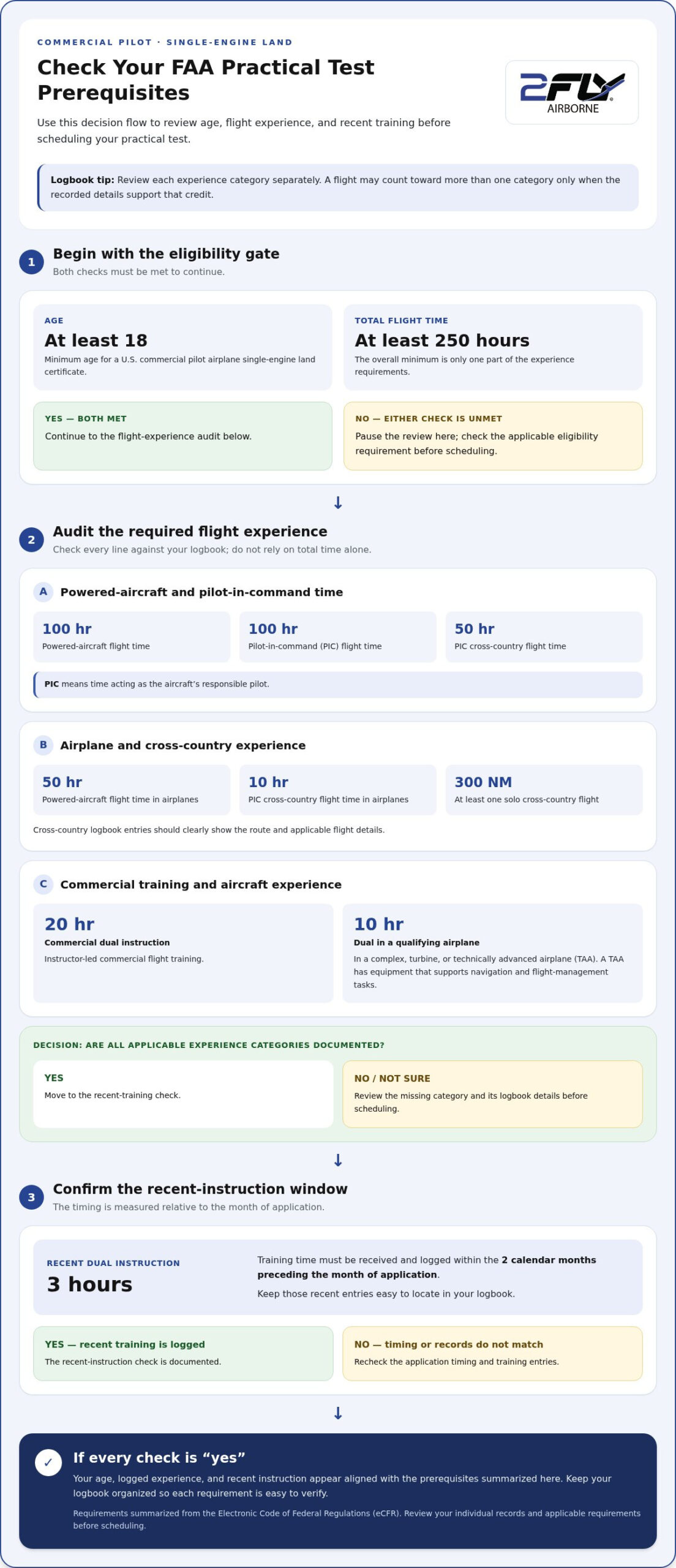
Before scheduling the commercial pilot single-engine land practical test, compare your age, flight experience, and training records with the eligibility requirements. The Electronic Code of Federal Regulations (eCFR) sets the minimum age at 18 years for a U.S. commercial pilot airplane single-engine land certificate. It also requires at least 250 hours of total flight time.
That total is only one part of the experience picture. Applicants also need specific kinds of flight time, including pilot-in-command (PIC) experience, meaning time acting as the aircraft’s responsible pilot. The listed requirements include at least 100 hours of powered aircraft flight time and 100 hours of PIC flight time. They also include 50 hours of PIC cross-country flight time.
For airplane experience, the checklist includes at least 50 hours of powered-aircraft flight time in airplanes and 10 hours of PIC cross-country flight time in airplanes. Cross-country entries should clearly show the route and applicable flight details in your logbook. A solo cross-country flight of at least 300 nautical miles is also an experience requirement, according to the Electronic Code of Federal Regulations (eCFR).
Training time must cover both instructor-led preparation and specific aircraft experience. The Electronic Code of Federal Regulations (eCFR) requires 20 hours of commercial dual instruction flight time. It also requires 10 hours of dual flight time in a complex, turbine, or technically advanced airplane. A technically advanced airplane has equipment that supports navigation and flight management tasks.
Other checklist items include solo flight experience, with additional categories to review. The listed preparation also includes three hours of dual instruction within the two calendar months preceding the month of application. Organize each category separately when reviewing your logbook. A flight may count toward more than one experience category only when its recorded details support that credit.
What is the typical cost? The total checkride expense depends on the case and is given after a quote request; cost factors include the examiner fee, aircraft use, and any preparation flight time.
Why might a candidate fail? Common problems include weak aircraft control, missed checklist items, poor judgment, or not meeting a required task standard. A rushed preflight or unstable maneuver, for example, can reveal gaps in preparation.
What happens after the test? After passing, the applicant proceeds toward receiving the commercial certificate. If the test is unsuccessful, the examiner identifies unsatisfactory areas to address before another attempt.
Required documents and preparation
Prepare your records, aircraft, and test-day materials before arranging the checkride. A complete packet connects your application details with the flight experience and training documented in your logbook.
Required Documents
Test documents establish your identity, application details, and pilot training history. Keeping them organized helps the examiner review your readiness without searching through scattered paperwork.
Gather your pilot certificate, medical certificate, government-issued photo identification, knowledge test report, application records, and logbook. Use the logbook to show the dates, aircraft, instructors, and experience supporting your eligibility. Keep endorsements and training records accessible so you can quickly find an entry when asked about a requirement.
Review the application against your logbook before the test. Confirm that names, certificate details, dates, and logged experience are consistent. The preparation checklist calls for training time to be received and logged within the 2 calendar months preceding the month of application. Keep those recent entries easy to locate, rather than relying on memory during the document review.
Flag logbook entries by experience category to make them easier to review. For example, separate cross-country, night, solo, and instructor-led entries with tabs or a clear index. This helps you explain how a flight meets a particular requirement. Bring original records in an orderly format, and avoid last-minute changes that could make entries difficult to interpret.
Aircraft and Equipment
The test aircraft is a single-engine land airplane used to demonstrate the required flight skills. Its condition and installed equipment matter because the evaluation includes airworthiness requirements for day and night VFR, or visual flight rules.
Before the practical test, review the aircraft’s operating information and the equipment required for the planned conditions. The airworthiness task covers instruments and equipment required for day and night VFR. Be prepared to identify relevant cockpit items and explain their purpose in plain language. A systematic cockpit check can help you spot missing, inoperative, or unfamiliar equipment before departure.
The airplane should match the single-engine land category being tested, and you should be familiar with its controls and equipment. Review the checklist, locate each control, and practice explaining how you would respond to an equipment issue. Know where to find relevant instrument indications and how they affect your planned flight.
Use a single-engine land airplane with equipment appropriate to the planned operation, and prepare to discuss day and night VFR airworthiness items. Organize paperwork and aircraft review as separate tasks. This keeps document questions from distracting you during the cockpit briefing and lets you focus on safe, deliberate flying.
What flight maneuvers and tasks are included in the FAA commercial pilot single-engine land practical test?
The test combines flight tasks with decisions and explanations that show how you operate an airplane. The examiner assesses your commercial-level knowledge, aircraft management, and response to changing conditions. Connect each task to real flight experience rather than memorizing a sequence.
Before departure, expect to discuss the airplane’s airworthiness and required equipment. The evaluation includes instruments and equipment required for day and night visual flight rules (VFR). Be ready to explain how you check an item and what its status means for the planned flight. For example, identify a relevant cockpit instrument and describe its role in monitoring the airplane.
Navigation tasks test more than following a line on a chart. The applicant is evaluated on diversion procedures, which involve changing the intended route to reach another destination. Practice identifying a suitable alternate, assessing the route, and explaining how you’ll manage the change. A clear diversion plan accounts for your position, terrain, weather information, and aircraft performance.
Flight-control tasks assess how accurately and consistently you handle the airplane. Maintain a deliberate scan, make coordinated control inputs, and correct deviations without abrupt overcorrection. During a maneuver, the examiner observes your setup, technique, awareness, and recovery. Explain its purpose when asked, then keep your attention on aircraft control.
Takeoff, approach, and landing tasks also demonstrate your planning and judgment. Brief the intended runway, review relevant conditions, and maintain a stable approach. If the airplane drifts from the desired path, correct smoothly and reassess. A sound landing starts well before touchdown, with disciplined energy management and a clear go-around decision when needed.
Commercial standards emphasize precision and risk management throughout the flight. The examiner looks at whether you recognize changing conditions, choose a safe response, and communicate your reasoning. For example, a developing weather concern should prompt a measured reassessment, not simply continuation of the original plan. Treat each task as part of one connected flight.
- Ground preparation: Explain airworthiness items and day or night VFR equipment.
- Navigation: Demonstrate diversion planning and explain the route change.
- Aircraft control: Use coordinated inputs, a steady scan, and timely corrections.
- Judgment: Reassess conditions and select a safe course of action.
Use the applicable FAA test standards to organize practice and identify weak areas. After each lesson, review what changed, what decision you made, and why. This builds transferable skills across maneuvers and scenarios instead of relying on a single rehearsed flight profile.
For the single-engine land practical test, the applicant is evaluated on diversion procedures. Make diversion a deliberate part of your preparation: shift attention to the new destination while keeping the task in focus. Be ready to describe the change and explain the choices behind it. Rehearse your reasoning, not just a sequence of actions, to make your response organized and easy to follow. During the evaluation, stay attentive and communicate your plan calmly and directly. A clear explanation helps demonstrate that you can manage a diversion as a practical flight task.
What are the FAA commercial pilot practical test standards or Airman Certification Standards for single-engine land?
FAA practical test standards describe the knowledge and skills an applicant must demonstrate during a certificate test. They help applicants, instructors, and examiners prepare for, review, conduct, and evaluate a checkride. The standards also identify experience prerequisites and study references, linking ground preparation with flight practice.
In the United States, 14 CFR part 61 specifies the areas where a commercial pilot applicant must demonstrate knowledge and skill. Practical test standards guide the evaluation of those areas. The FAA writes each Practical Test Standards publication, which specifies what an applicant must demonstrate before an examiner can issue a certificate or rating.
The airplane standards separate testing by aircraft category and class. Commercial airplane testing is divided into single-engine land and sea, and multiengine land and sea sections. Single-engine land is identified as ASEL, meaning Airplane Single-Engine Land. Use the correct section when reviewing standards, since sea or multiengine tasks may not apply to your land checkride.
Use the standards as a working study map, not just a list to memorize. For each task, review the required knowledge, plan how you’ll explain your decisions, and practice the associated skill with an instructor. For example, an airworthiness task covers instruments and equipment required for day and night VFR. Prepare to identify the equipment and explain its relevance to the planned operation.
Connect each written task to a specific training example. If a task involves navigation, explain the planning decision and practice it in flight. If it requires aircraft control, review the objective before flying and assess your performance afterward. This helps expose gaps between knowing a procedure and applying it under checkride conditions.
The standards also give instructors and examiners a shared evaluation structure. At flight training organizations like 2FLY Airborne, adherence to the practical test standards is mandatory when evaluating commercial pilot applicants. That makes the applicable single-engine land material central to preparation, not optional reading. Study its tasks alongside your training records and instructor feedback.
“Practical Test Standards” and “Airman Certification Standards” are names for FAA testing frameworks. Work from the applicable FAA material for your certificate and aircraft class. Focus your review on ASEL tasks, then use instructor-led practice to strengthen both technical execution and the reasoning behind each decision.
Flight instructors, FAA examiners, and FAA license applicants use the Practical Test Standards to prepare for, review, take, or issue a checkride. The standards support each stage of the process, from preparation and review to conducting or taking the checkride.
The Practical Test Standards list knowledge and experience prerequisites, required skill levels, and background study and reference materials. This means the standards set out what applicants need to know and what experience and skill levels are required, while also identifying materials for background study and reference. These elements bring prerequisites, expected performance, and supporting study resources together in the same standards, for use by instructors, examiners, and applicants.
How long does the commercial pilot checkride take?
The total time depends on completing both the knowledge discussion and flight evaluation. FAA test material defines what applicants must demonstrate, but it doesn’t set a duration for this single-engine land checkride. Plan your day around the full appointment, not just the time in the air.
The ground portion gives the examiner time to assess your understanding and decision-making. Questions may relate to the planned flight, including aircraft systems, route choices, or responses to changing conditions. For example, you may need to explain how a change in the flight plan affects your next decision.
The flight portion lasts as long as needed to conduct and evaluate the assigned tasks. A diversion, for instance, requires you to recognize a route change, select a suitable destination, and manage the airplane while explaining your choices. The commercial pilot single engine land practical test assesses task completion as well as judgment and control.
The appointment’s pace depends on the evaluation areas, aircraft briefing, and operating conditions. A task that needs clarification or a setup that must be repeated can extend the session. Careful preparation helps you move through each phase without rushing or overlooking instructions.
Use training time to prepare for both the oral discussion and flight portion. Review the applicable standards with your instructor, then practice concise explanations alongside each task. For example, rehearse how you’ll describe a diversion plan before applying it in flight. This connects your reasoning with your actions.
On test day, arrive with your materials organized and listen closely to the examiner’s briefing. Ask for clarification if an instruction is unclear, then focus on the assigned task. Allow enough flexibility in your schedule to complete each part of the evaluation deliberately.
- Ground discussion: Explain relevant knowledge and the reasoning behind flight decisions.
- Flight evaluation: Complete assigned tasks while demonstrating sound control and judgment.
- Preparation: Review standards and practice explaining your process.
- Scheduling: Set aside time for the full appointment, including briefing and evaluation.
Approach the checkride as a complete assessment, not a timed flight. A focused review of the test standards and a deliberate pace can help you demonstrate your preparation at every stage.
2FLY Airborne: FAA Professional Pilot Program
2FLY Airborne’s FAA Professional Pilot Program connects the requirements discussed here with structured training toward commercial aviation. It’s a relevant next step if you’re planning your pilot certifications and want to understand how your current experience fits a training pathway.
The program includes training options such as the Private Pilot Certificate (PPL), Instrument Rating (IR), and Commercial Pilot Certificate (CPL). These stages build toward professional flying, each developing different knowledge and skills. If you’re already training, consider how the commercial certificate fits your goals and preparation needs.
Review the program and consider discussing your training objectives with 2FLY Airborne. For more information, visit 2FLY Airborne online.
Take the Next Step Toward Your Pilot Goals
Turn your career goal into a training plan. Preparing for the commercial pilot single-engine land practical test can also clarify where you are in your aviation journey and which skills you want to build next.
2FLY Airborne offers an FAA Professional Pilot Program, with training options including the Private Pilot Certificate (PPL) and Instrument Rating (IR). These offerings can support pilots at different points in their development, from building foundational skills to progressing through advanced training.
Consider your current experience, the certificate you’re pursuing, and the training that aligns with your professional ambitions. A focused conversation can help you explore your next steps while keeping the discipline and preparation aviation demands in view.
Contact 2FLY Airborne to discuss your pilot training goals and explore a path forward. Keep building your skills with purpose, and approach the next stage of your aviation career with confidence.
Frequently Asked Questions
What are the FAA eligibility requirements for the commercial pilot single-engine land practical test?
Eligibility combines age, aeronautical experience, required training, and demonstrated knowledge and skill. The category matters: single-engine land differs from single-engine sea or multiengine privileges. Review the applicable airplane category and class requirements together, so your application and training records match the certificate you seek. Your instructor can help you identify how your experience fits the requirements before you apply.
What documents must a candidate bring to the commercial pilot checkride?
Bring the identity, pilot, medical, application, knowledge-test, and logbook records relevant to your application. Before test day, compare the names and identifying details across those records, then arrange them for efficient review. Keep required endorsements easy to locate rather than buried among unrelated entries. This final check can help prevent delays caused by mismatched or hard-to-find paperwork.
How can a candidate prepare for and arrange the commercial checkride?
Use instructor-led mock evaluations to practice explaining your decisions aloud, not just completing flight tasks. Ask your instructor to identify weak areas and focus practice on them. Once prepared, coordinate a test appointment through the appropriate examiner arrangements and leave room in your schedule for the full evaluation. Regulations and testing arrangements can change, so use current FAA materials as you prepare.

Article by
2FLY Airborne
2Fly Airborne is a professional flight training organization dedicated to developing the next generation of skilled, confident, and safety-focused pilots. With decades of combined aviation experience, our team of certified instructors provides structured, real-world training designed to prepare students for both checkrides and long-term success in the aviation industry.
Content Disclaimer
Some blog content is generated with the assistance of automated tools and may not always be fully accurate or up to date. Please verify all aviation-related information with official sources or a certified instructor. For additional guidance or clarification, we encourage you to contact one of our training advisors at 2Fly Airborne.