
You may have started with occasional rentals, but now your flying goals are taking shape. A block-hour aircraft rental for pilots can help you plan the next stage of your time in the cockpit.
Choosing a rental structure involves more than comparing rates. Your schedule, training needs, checkout requirements, and access to aircraft all affect whether a block fits.
This guide explains how block hours work, what to consider when comparing aircraft and rental terms, and how to coordinate flying with instruction. Use these points to assess your options and plan your next step.
Key Takeaways
- You can often transition from pay-as-you-go flying to a prepaid block; choose a size that matches your training or time-building plan.
- Understand how flight time is recorded and deducted so you can compare rental options on equal terms.
- Plan aircraft checkout and renter requirements before booking, especially when coordinating rental time with instruction.
- Review expiration, transfer, and refund terms before committing, and factor aircraft availability and maintenance downtime into your schedule.
- Compare the flexibility of hourly rental with the planning advantages of a block to decide which approach best supports your flying goals.
Coordinating rentals, flight instruction, and aircraft availability
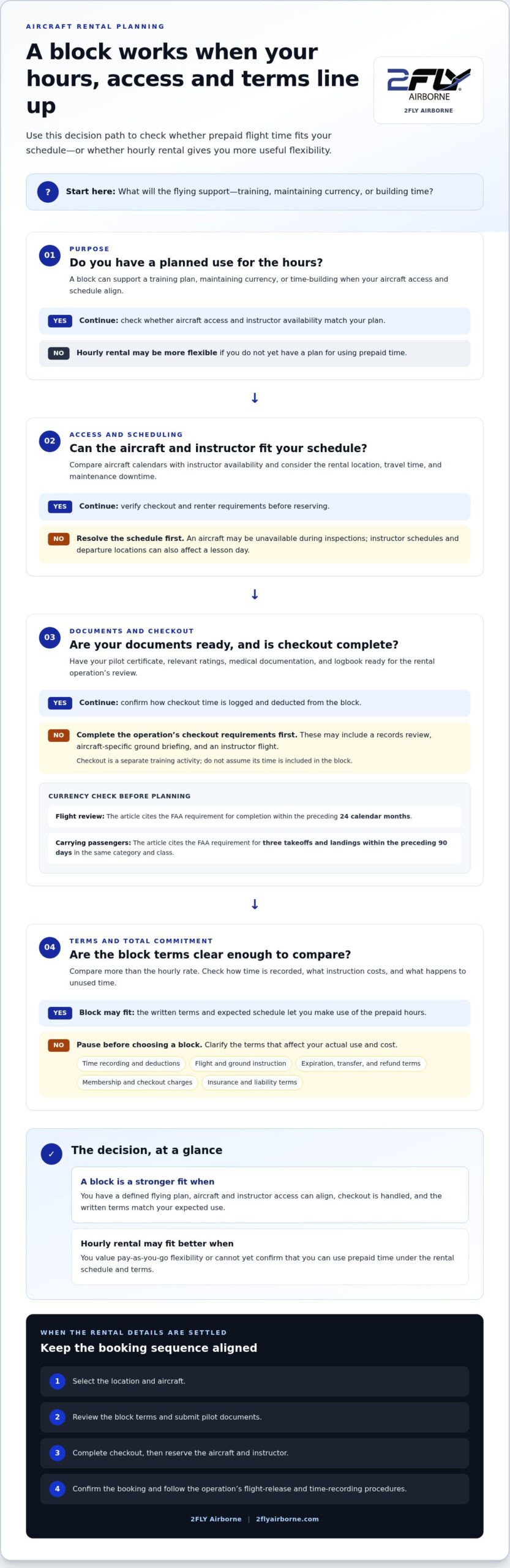
Plan block flying around aircraft access, instructor schedules, and the purpose of each flight, whether training or maintaining currency. A clear sequence helps you use prepaid time effectively and avoid scheduling conflicts.
Aircraft and instructor scheduling
Start by matching the rental location to your regular departure airport, then compare aircraft calendars with instructor availability. A flying club may operate from a different airport than a flight school, so travel time can affect a lesson day. Rental aircraft also need maintenance downtime, including annual and 100-hour inspections, which can temporarily remove an aircraft from the schedule.
For career planning, pilots commonly use time-building programs after earning a commercial certificate and before reaching the 1,500 flight hours described as the minimum for an Airline Transport Pilot (ATP) license, according to the Federal Aviation Administration. A block can support that goal when aircraft access and your schedule align.
Certificates, medical documents, and currency
Before booking, gather your pilot certificate, relevant ratings, medical documentation, and logbook. The rental operation reviews these against its aircraft and planned flight. Your certificate and ratings must match the intended flying. Requirements vary by aircraft and operation, so organize your documents before requesting a checkout.
The Federal Aviation Administration states that a renter needs a flight review completed within the preceding 24 calendar months. For carrying passengers, it states that a pilot needs three takeoffs and landings within the preceding 90 days in the same category and class. Track these dates in your logbook before planning passenger flights.
Flight and ground instruction
Review whether instruction is included in the block or billed separately. Find out whether dual flight time with an instructor and ground training are included, charged separately, or scheduled independently. For an instrument lesson, for example, coordinate the aircraft, instructor, and ground briefing before reserving a flight slot.
Any credit for referred flight training depends on the program’s written terms. Before counting it toward a future lesson, determine what activity earns credit, where you can apply it, and whether it expires.
Insurance and liability
Insurance coverage and liability depend on the rental agreement and applicable policy. Before operating the aircraft, review who is insured, any pilot qualifications or approved-use limits, and your responsibility for damage. The policy’s coverage terms and exclusions govern how a claim is handled; the rental contract sets out your obligations.
Rental Rate Comparison
Compare block hours with pay-as-you-go rental on more than the hourly rate. Check how flight time is recorded, which instruction is included, and whether unused time can be transferred or refunded. A discount is useful only if the terms and your expected schedule allow you to use the prepaid hours.
Booking and Using a Rental
Use a simple sequence: select a location and aircraft, review the block terms, submit your pilot documents, complete checkout, then reserve the aircraft and instructor. Before departure, confirm the booking and follow the operation’s procedures for flight release and time recording. This keeps aircraft access, training, and block deductions aligned.
Aircraft checkout and renter requirements
Buying a block doesn’t replace aircraft checkout. Before flying, complete the rental operation’s requirements for that aircraft and understand how membership, instruction, and checkride terms affect your commitment.
Documents and aircraft checkout
Organize your pilot certificate, ratings, medical documentation, and logbook before requesting checkout. The rental operation uses these records to assess your experience against its aircraft and procedures. For example, when moving between single-engine models, expect the checkout to cover the aircraft’s systems, performance, and cockpit procedures.
Get the checkout sequence and booking steps in writing. They may include a records review, an aircraft-specific ground briefing, and a flight with an instructor. The instructor can assess your ability to operate the aircraft safely and follow applicable procedures. Treat checkout as a separate training activity, not time automatically included in a block.
Checkout with a flight instructor
A CFI-led checkout provides structured practice with the aircraft’s controls, checklists, and emergency procedures. Before the flight, review the aircraft handbook and note any unfamiliar systems. During the flight, follow the instructor’s briefing and demonstrate the required procedures. Afterward, clarify any rental limitations and what further training is needed.
Log the checkout flight accurately and confirm how the rental operation deducts that time. If instructor time is billed separately, include it in your plan. This distinction helps you reconcile the block balance with the flights and training you’ve completed.
Checkride aircraft and guarantees
Aircraft coverage for a checkride is not a guarantee of passing. The Private Pilot Phase Option covers the aircraft for the checkride, according to the program terms. Confirm which aircraft and scheduling conditions apply, then coordinate the examiner, instructor, and aircraft reservation separately.
For other rental arrangements, read the written checkride terms before relying on a particular aircraft. A checkride reservation may involve preparation flights, instructor coordination, and aircraft availability. A block’s regular rental terms don’t automatically include checkride use.
Membership and checkout costs
Some rental operations require membership before scheduling; others arrange access through a rental program. Compare the written charges for membership, checkout, instructor time, and aircraft use. These are separate cost categories, so a low hourly rate alone won’t show the full commitment.
Before paying, get the payment schedule, block deduction method, and rules for unused time in writing. Check whether checkout flights draw from the block or are billed separately. Keep a clear record of each charge so you can compare the full terms with your planned flying.
What are Block Hours?
A block is prepaid flight time tracked in an account as you fly. Each rental reduces the balance according to the operation’s billing method, such as Hobbs time or tach time. Hobbs time generally tracks aircraft operating time, while tach time follows engine speed. The rental agreement states which measure applies.
Track deductions and the remaining balance
Before purchasing, check how each flight is recorded, including any rounding or minimum billing increments in the written terms. Compare your block balance with your logbook after every rental. If the account and logbook show different times, ask for the calculation before booking another aircraft.
Separate flight time from instruction and other charges. A Private Pilot lesson, for example, may list aircraft rental and instructor time as distinct entries. Knowing which charges reduce your prepaid hours helps you compare the stated hourly rate with your actual account activity.
Expiration and refund policies
Some flight schools require prepaid block hours to be used within six or twelve months. Check the start and expiration dates, and whether unused time expires at once or is handled through another written process. These terms matter if weather, maintenance, instructor schedules, or changes to your training plan limit your flying.
Read the expiration clause before paying and compare it with your likely schedule. A pilot taking regular lessons may use a block differently from someone who rents occasionally. Add the relevant dates to your calendar and review the balance before the deadline instead of assuming unused hours remain available.
Refund terms are separate from expiration terms. Check how the agreement treats unused hours if you stop flying, change plans, or can’t use the remaining balance. Note any deductions, deadlines, and required steps for requesting a refund. The written policy explains how each situation is handled.
Transfers and unused balances
Transfer rules determine whether another pilot can use hours in your account. Check whether the agreement allows transfers, who is eligible, and whether written approval is required. Don’t assume a friend or family member can use your balance just because they rent the same aircraft type.
For a practical review, find the account holder, transfer conditions, expiration date, and refund process in one place. If transfers are allowed, follow the stated steps before another renter books a flight. If they aren’t, plan the block around your own expected flying and training needs.
These terms affect a block’s value as much as the hourly rate. Compare the billing method, expiration period, transfer conditions, and refund process together. This helps you choose prepaid time that fits your plans, whether you’re continuing Private Pilot training or renting independently.
Block sizes for light sport and single-engine aircraft
For light sport and single-engine aircraft, rental blocks commonly come in 10, 25, or 50 hours. Time-building packages commonly use 50 or 100 flight hours, so choose a structure that matches your purpose and expected flying schedule.
Compare the common block sizes
A 10-hour block can suit a student planning a defined period of practice or a renter who flies occasionally. It limits the amount of time prepaid compared with larger blocks. A 25-hour block offers a middle option for pilots expecting more regular use, while a 50-hour rental block suits a longer training or flying plan.
Time-building has a different purpose. A 50- or 100-flight-hour package is intended for pilots planning sustained hour accumulation, rather than a short series of lessons. The larger commitment makes the expected schedule especially important. Compare the package’s aircraft access and billing terms with the flights you intend to complete.
Match hours to your flying objective
Start with the purpose of the flying. A student completing lessons may need regular access to the same aircraft type and an instructor’s schedule. A certificated pilot seeking experience may plan longer flights or repeated practice. A pilot building time can estimate the flight activity ahead, then compare that plan with the 50- or 100-hour package structure.
For example, consider a student choosing between 10 and 25 hours. The student should map expected lessons, solo flights, and any planned review flying before selecting a block. If training pauses or priorities change, a larger balance may be harder to use. The number of hours alone doesn’t determine value; the fit between the block and the plan does.
Check aircraft and billing details
Check which aircraft the block covers and whether it applies to more than one model. Engine, cockpit layout, and operating procedures can differ between single-engine aircraft. Checkout or instruction may also affect how quickly you use the balance, so understand what each flight deducts.
Confirm how the operation records time before comparing 10-, 25-, and 50-hour options. Hobbs time and tach time can produce different recorded totals because they measure aircraft operation differently. Use the stated billing method to estimate how flights affect your account, rather than treating the block’s face value as a guaranteed number of lesson sessions.
Choose a practical commitment
Use this sequence to compare options:
- Write down your training or time-building goal and expected flight schedule.
- Compare that plan with 10-, 25-, or 50-hour rental blocks, or 50- and 100-hour time-building packages.
- Review aircraft access, time accounting, and the written block terms before paying.
This approach helps students and experienced pilots choose prepaid hours deliberately. A smaller block can suit a short-term plan; a larger one can support regular flying when the schedule and aircraft access align.
How do block-hour rental rates compare with pay-as-you-go aircraft rental?
Pay-as-you-go rental charges each flight at the regular hourly rate; a block requires payment in advance. Block-hour packages may discount the regular rate by five to fifteen percent. That can benefit pilots who expect to fly consistently, but the prepaid commitment makes the schedule and contract terms part of the comparison.
Compare total expected rental costs
Estimate the cost of the flying you expect, not the maximum hours in a package. For each option, compare the hourly charge, aircraft access, and separate instruction or checkout costs. If a block has a lower stated rate, multiply it by the hours you expect to use, then review expiration and unused-balance terms.
For example, a student planning several lessons can compare the expected hours under both payment methods. The pay-as-you-go total reflects the hours flown at the regular rate. The block total depends on the prepaid amount and whether all the hours can be used. A discount is valuable only when the terms fit the student’s schedule.
Consider how much you plan to fly
Prepaid blocks can reduce total flight-training costs over 40 to 80 hours of flight time. This range can help pilots evaluate whether they expect enough flying to benefit from a lower hourly rate. It isn’t a promise of savings for every renter; the result depends on package terms, actual hours flown, and how unused time is handled.
Compare your likely training path with the block’s permitted aircraft and uses. If your lessons require an instructor, separate aircraft rental from instruction charges. If you fly intermittently, consider whether pay-as-you-go better suits your changing availability. The same discount can offer different value depending on your schedule.
Check the terms behind the rate
Before choosing, check how each flight is timed and deducted. Hobbs and tach time measure aircraft operation differently, which can change the balance charged for a flight. Use the method in the rental agreement to estimate your total, and compare payment options on the same basis.
Check whether the block covers your intended aircraft and whether checkout or instructor flights draw from the balance. Inspection downtime can affect access, so compare the block’s validity period with a schedule you can realistically maintain. These details determine whether a lower rate translates into usable flight time.
Choose by commitment, not discount alone
A larger prepaid commitment may suit regular, planned flying; pay-as-you-go ties each rental to a specific flight. Before paying, compare expected hours, billing method, aircraft access, and unused-time rules. This review helps you decide whether flexibility or a discounted rate better supports your training or time-building goal.
2FLY Airborne: FAA Professional Pilot Program
2FLY Airborne’s FAA Professional Pilot Program gives aspiring professional pilots a structured path through flight training and pilot certifications. It can be a natural next step if you’re ready to progress beyond arranging individual rental flights and want a connected training pathway.
Training options include the Private Pilot Certificate (PPL), Instrument Rating (IR), and Commercial Pilot Certificate (CPL). These stages build skills progressively, from foundational flying to preparation for commercial aviation. A structured program helps you understand how each certification fits your longer-term goals.
If you’re weighing independent rentals against a formal training plan, explore the program and consider how its certification sequence aligns with your objectives. Contact 2FLY Airborne with questions about the FAA Professional Pilot Program.
Build your next step around your flying goals
Choose a rental approach that supports your flying objectives and the training structure you want to follow. Clear terms, careful preparation, and consistent attention to safe aircraft operation help make each flight purposeful.
For pilots considering a professional training pathway, 2FLY Airborne offers an FAA Professional Pilot Program, Private Pilot Certificate (PPL), and Instrument Rating (IR). Reach out to a 2FLY Training Advisor with questions about your goals and possible next steps. Keep moving forward with focus, sound instruction, and safety at the center of every flight.
Frequently Asked Questions
Can I switch from pay as you go to block time later?
Rental operations may allow you to change payment arrangements for future rentals. Treat existing bookings and completed flights separately from a new block purchase. Before switching, find out how payments already made will be applied, whether upcoming reservations need to be rebooked, and when the new terms take effect. This keeps your account clear and avoids assuming earlier payments will convert automatically.
What are the costs?
The amount depends on the aircraft, rental arrangement, and services used. Request a quote for the specific rental to see the applicable pricing. To understand the total, separate aircraft use from instruction and other charges, then compare the same planned flight under each payment method. A dual lesson and a solo practice flight, for example, may involve different billable services even in the same aircraft.
What is block-hour aircraft rental for pilots?
Block-hour rental uses a prepaid account balance instead of separate payment after each flight. The balance decreases as eligible rental activity is recorded. It isn’t aircraft ownership and doesn’t by itself authorize you to operate a particular aircraft. You still need to follow the operation’s booking process and aircraft-specific requirements before flying.
How much does block-hour aircraft rental cost in the United States?
There’s no single standard rental price across the United States. Rates vary by aircraft and rental terms. For a meaningful comparison, request a quote for the aircraft and flying plan you’re considering. Compare the rental charges with any instruction or other services you expect to use, rather than relying on a headline hourly rate alone.
What aircraft types and hourly rates are available for block-hour rental?
Aircraft and rates vary by rental operation. For a useful comparison, identify the specific aircraft model, whether the flight will be solo or dual, and the timekeeping method used for billing. These details make comparisons more meaningful than broad aircraft categories. If you’re training, consider whether the aircraft suits the lesson objective, not just whether its hourly rate is lower.
How many hours must pilots buy upfront, and do block hours expire?
The required purchase and any expiration period depend on the rental program’s terms. Before committing, check whether your planned flights fit within the stated usage period, allowing for training breaks and schedule changes. Find out how the purchase date and remaining balance are recorded. This helps you assess whether the upfront commitment fits your expected flying pace.
What pilot certificates, ratings, and minimum flight hours are required to rent an aircraft?
There’s no single minimum flight-hour requirement for every rental. Requirements depend on the aircraft and the operation’s checkout criteria. Identify the aircraft you intend to rent, then review the certificate, ratings, and experience required for that flight. Distinguish those rental conditions from the privileges of your own certificate.
What is included in block-hour rental pricing, such as fuel, instructor fees, and landing fees?
Inclusions vary by rental agreement, so check each charge rather than assuming fuel, instruction, or landing fees are bundled. Ask for an itemized breakdown showing what the aircraft charge covers and what is billed separately. For example, compare the aircraft and instructor charges for a lesson with the rental charges for a solo flight. This gives you a clearer estimate of the full outing.
Article by
2FLY Airborne
2Fly Airborne is a professional flight training organization dedicated to developing the next generation of skilled, confident, and safety-focused pilots. With decades of combined aviation experience, our team of certified instructors provides structured, real-world training designed to prepare students for both checkrides and long-term success in the aviation industry.
Content Disclaimer
Some blog content is generated with the assistance of automated tools and may not always be fully accurate or up to date. Please verify all aviation-related information with official sources or a certified instructor. For additional guidance or clarification, we encourage you to contact one of our training advisors at 2Fly Airborne.