Planning a commercial pilot career and weighing two training paths? The right choice depends on more than a flight-hour minimum. Your schedule, learning style, and preferred course structure all shape the experience.
Commercial pilot ground school under Part 141 is part of an approved training framework, while Part 61 allows a more flexible approach. Understanding how each route organizes study and flight training can help you make a better-informed decision.
This comparison looks at training structure, course content, FAA requirements, and online ground study to help you assess which path supports your goals.
Key Takeaways
- Compare the structure and flexibility of Part 61 and Part 141 to identify which training framework fits your learning needs.
- Look beyond the total-hour minimum: course approval and completion requirements shape whether a reduced Part 141 pathway applies.
- Understand how an approved commercial syllabus organizes flight lessons, ground study, progress checks, and checkride preparation.
- Use FAA regulatory references to distinguish school certification rules from the requirements pilots must meet.
- See how online ground study can support the knowledge portion of training, and where 2FLY Airborne’s FAA Professional Pilot Program fits into a commercial training path.
What is Part 141 Flight Training?
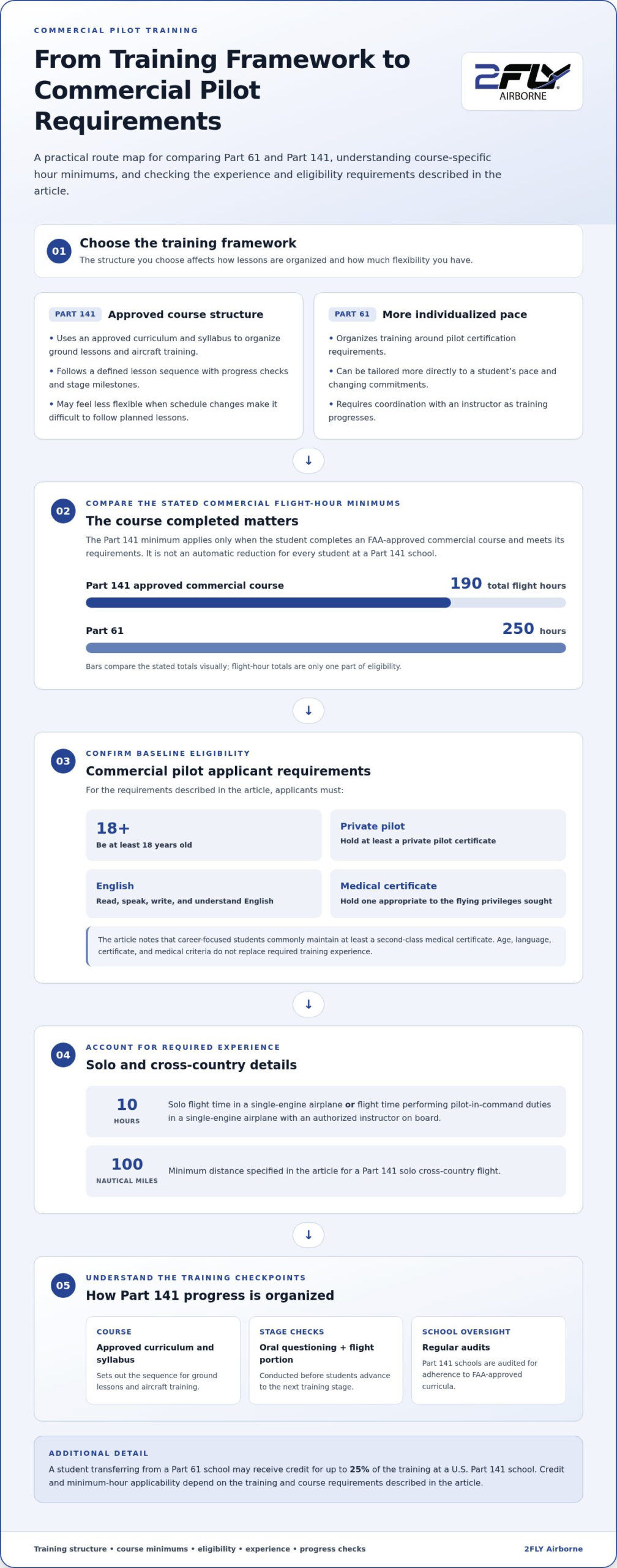
Part 141 is a U.S. flight-training framework built around an approved course, while Part 61 allows a more flexible training structure. Common drawbacks of Part 141 include less flexibility to change lesson order and a need to meet the school’s scheduled progress checks.
Structured Part 141 Training
Title 14 of the Code of Federal Regulations sets the rules for Part 141 pilot schools and their training requirements. A certificated school uses an approved curriculum and syllabus to organize ground lessons, aircraft training, and progress checks. The FAA issues an Air Agency Certificate and appropriate Training Specifications, or TSpecs, after a school meets certification requirements.
Part 61 also sits within Title 14, but it governs pilot and flight instructor certification rather than pilot-school certificates. Part 61 training can be tailored more directly to a student’s pace, while a Part 141 course follows its approved outline. Under either framework, commercial pilot applicants in the United States must be at least 18 years old, according to the Electronic Code of Federal Regulations.
Part 141 Benefits and Drawbacks
A defined syllabus gives Part 141 students a clear sequence of lessons and progress milestones. Stage checks help assess whether a student is ready to move to the next phase, making progress easier to track against the course outline. This structure may suit someone pursuing a focused commercial aviation path with a consistent study schedule.
The same structure can feel restrictive if work, family, or weather repeatedly disrupts planned lessons. A student may need to complete the syllabus in its required order rather than rearranging training freely. Part 61 may better fit someone who needs a more individualized pace, though its flexible structure places more emphasis on coordinating each step with an instructor.
| Training option | Structure | Schedule fit | Useful consideration |
|---|---|---|---|
| Part 141 | Approved curriculum, syllabus, and stage checks | Fits students able to follow planned training | Review the course sequence and progress requirements |
| Part 61 | Training organized around certification requirements | Can accommodate a more individualized pace | Coordinate lesson progression with the instructor |
Choose the framework that matches your career goal and the time you can consistently devote to training. For example, a student who can attend scheduled lessons and prefers defined milestones may value Part 141’s structure, while someone balancing changing commitments may prefer Part 61’s flexibility. Compare the curriculum, aircraft-training sequence, and progress expectations before committing to either model.
Certification follows a formal process: after meeting regulatory requirements, a certified Part 141 pilot school is issued an Air Agency Certificate and appropriate Training Specifications (TSpec); the listed value for this item is 8000-4. Part 141 flight schools undergo regular audits to check adherence to their FAA-approved curricula. Before students advance to the next training stage, schools conduct stage checks with an oral questioning portion and a flight portion.
A student transferring from a Part 61 school may receive credit for up to 25% of the training at a U.S. Part 141 school. The comparison also distinguishes instrument-rating cross-country requirements: Part 61 requires at least 50 hours of cross-country flight, while Part 141 has no minimum cross-country flight time.
Minimum flight hours for a commercial pilot license
The minimum depends on the training framework and, for Part 141, the approved course completed. Flight-hour totals are only one part of eligibility; required experience and course requirements also matter.
Part 141 Flight-Hour Minimums
An approved Part 141 commercial course may allow qualification with 190 total flight hours. Under Part 61, the commercial pilot minimum is 250 hours. The Part 141 figure applies only when students complete an FAA-approved commercial course and meet its requirements. It isn’t an automatic reduction for every student enrolled at a Part 141 school.
Compare the applicable course minimums with your logged experience and planned training. The framework matters, but how a minimum applies depends on the course you complete and the training you receive credit for.
Commercial Pilot Eligibility Requirements
For Part 141 commercial training, applicants must meet the commercial pilot requirements and the course requirements. In the United States, applicants must be at least 18 years old, according to the Electronic Code of Federal Regulations. They must also hold at least a private pilot certificate and be able to read, speak, write, and understand English.
You need a medical certificate appropriate to the flying privileges you seek. Career-focused students commonly maintain at least a second-class medical certificate. Eligibility requirements differ from flight-hour minimums: meeting age, language, certificate, and medical criteria does not replace the required training experience.
Solo and cross-country experience contribute to that experience. The Federal Aviation Administration states the requirement as ten hours of solo flight time in a single engine airplane, or 10 hours of flight time while performing the duties of pilot in command in a single engine airplane with an authorized instructor on board. For a Part 141 solo cross-country flight, the Federal Aviation Administration specifies at least 100 nautical miles.
Approved training devices may count toward some applicable training hours, subject to limits. According to the Electronic Code of Federal Regulations, full flight simulator training in an approved commercial pilot course may be credited for up to 30% of the applicable total flight training hours, whichever is less. Training in a flight training device that meets § 141.41(a) may be credited for a maximum of 15 percent of the total flight training hour requirements of the approved course, or of this section, whichever is less, according to the Electronic Code of Federal Regulations.
To assess a training plan, separate aircraft flight time from any approved device credit, then compare logged experience against course requirements. Instrument training, cross-country flying, and prior private-pilot experience may affect the path, but the approved syllabus determines how training is applied. This distinction helps aspiring commercial pilots compare a structured program with Part 61’s higher stated minimum and plan their career progression around the actual requirements.
Commercial pilot course curriculum
A Part 141 commercial course combines ground instruction with flight lessons under an approved syllabus. Its curriculum connects aviation knowledge, aircraft practice, and preparation for the commercial pilot practical test.
FAA-Approved Course Curriculum
A Part 141 pilot school uses an FAA-approved curriculum, set lesson plans, classrooms, and certified instructors. For a commercial course, training covers applicable Federal Aviation Regulations, day and night operations, cross-country flying, instrument work, commercial maneuvers, and checkride preparation.
Ground subjects include aerodynamics, navigation, and flight regulations. In the aircraft, students practice maneuvers such as chandelles, lazy eights, steep spirals, eights on pylons, and power-off 180 accuracy landings. The syllabus ties these knowledge areas and flight skills to planned course progress.
Ground School Requirements
Part 141 ground school follows the approved course syllabus, rather than a single universal hour figure for every commercial program. The curriculum determines the ground instruction and how it supports flight lessons, including study of aerodynamics, navigation, and regulations affecting commercial privileges and operations.
When comparing courses, review the subjects covered and how ground lessons connect with aircraft training. Navigation instruction, for example, supports cross-country planning, while regulation lessons cover the privileges and limitations of commercial flying. A structured program lays out these components in its approved curriculum.
To find FAA-approved Part 141 commercial pilot schools near you, narrow the search by location, then compare schools’ Air Agency Certificates, Training Specifications, and approved commercial course curricula. Check that the course covers the training path you intend to follow.
FAA Knowledge Test Preparation
Ground school prepares you for the FAA knowledge test by teaching aviation subjects, but completing instruction alone does not satisfy the testing requirement. Before a commercial pilot practical test, applicants must complete the required ground and flight training, pass the FAA knowledge test, and obtain the required instructor endorsements.
Use the syllabus to track ground subjects alongside flight lessons, then flag topics that need more review before the knowledge test. This keeps course completion distinct from test completion: studying regulations and navigation builds knowledge, while passing the FAA test is a separate step toward the practical test.
A practical way to assess a course is to compare its approved syllabus with your learning needs, connect each ground subject to its use in flight, and track test preparation separately. This makes the commercial course structure easier to evaluate and keeps the knowledge and aircraft-training components aligned.
Commercial airplane single-engine training typically includes instrument training within the overall commercial pathway. When evaluating a course, note how instrument work fits into that pathway and the broader commercial preparation described in the syllabus. This helps you assess instrument training as part of commercial preparation, not as a separate objective.
U.S. FAA Part 141 commercial pilot training includes instruction on Federal Aviation Regulations that apply to commercial pilot privileges, limitations, and flight operations. This instruction addresses the regulatory side of commercial training, linking privileges and limitations with the flight operations covered by the regulations. When comparing courses, look for coverage of these subjects and consider how they relate to the commercial pathway being pursued.
FAA advisory circulars and regulatory references
Part 141 references help students distinguish pilot-school certification from the rules governing an individual pilot license. For a commercial course, focus on the school’s course authority, the applicable curriculum requirements, and any specific exceptions relevant to training.
FAA Advisory Circular AC 141-1B details the five phases of Part 141 pilot-school certification, from pre-application through certificate issuance. The circular can help readers understand how a school’s certification process is organized. It is separate from the regulations that describe approved courses and their requirements.
For course ratings, the central reference is 14 CFR Part 141, §141.11, together with appendices A through J and M. These provisions identify the courses for which Part 141 school ratings are issued. A student comparing training options can use these identifiers to locate the relevant course category, then compare it with the school’s stated training path.
Section 141.5(d) is another useful reference: under U.S. FAA Part 141 rules, commercial pilot course training must meet its requirements for training quality. Read it alongside the specific course provisions rather than treating a school certificate as proof that every course follows the same outline. Course scope and rating matter.
Application references can also clarify how a pilot school seeks certification. The application uses FAA Form 8420-8, Application for Pilot School Certification. AC 141-1B organizes the process into its phases, while the form provides the named application document. These references relate to school certification, not an individual student’s instrument rating or commercial pilot certificate.
A practical reading sequence keeps the references distinct:
- Use AC 141-1B to understand the pilot-school certification phases.
- Use §141.11 and appendices A through J and M to identify course-rating references.
- Use §141.5(d) when reviewing the commercial course’s training-quality requirement.
- Review §61.111 for the stated exception involving U.S. FAA Part 141 commercial pilot cross-country training.
Section 61.111 matters because it connects a Part 141 commercial course with an exception to the cross-country training requirement. It should be read as a specific regulatory reference, not as a general waiver of course requirements. The broader Part 61 framework governs pilot and flight instructor certification; Part 141 governs pilot-school certificates and training requirements.
For a student, the key is to match each question with the right reference. School certification points to AC 141-1B and Form 8420-8; course ratings point to §141.11 and its appendices; training quality points to §141.5(d); and the cross-country exception points to §61.111. This method makes federal procedures easier to follow without confusing school approval with individual pilot eligibility.
Part 141 commercial pilot online ground school
Online study can support a commercial pilot ground school under Part 141 by helping students organize knowledge subjects around flight lessons. Its value depends on how the material connects to the approved course syllabus and aircraft training.
Online Ground School
Online lessons can help you study regulations, navigation, aerodynamics, and other commercial aviation subjects. Unlike aircraft lessons, online study builds knowledge, not practical flying skills.
For example, a student studying navigation online can apply those concepts during cross-country flight planning. The syllabus determines how ground instruction fits the approved course. An online course alone doesn’t establish that it forms part of a specific school’s Part 141 curriculum.
Ground School Cost
The cost of Part 141 commercial pilot ground school in the United States depends on the case and is provided after a quote request. Factors include course structure, the ground instruction included, and how study fits with the broader commercial pilot program.
Compare what each course includes rather than treating online access as the full cost of training. Ground-school instruction may accompany flight lessons and other course requirements. The syllabus clarifies whether the education covers knowledge instruction alone or supports a broader pilot-certificate pathway.
Ground School Duration
There’s no single duration that applies to every Part 141 commercial ground-school course. The approved syllabus, lesson sequence, study pace, and student progress through required subjects all affect the schedule.
Online access lets you review material between scheduled lessons, but it does not determine when the full course ends. You may need a different study rhythm for revisiting regulations or navigation than for progressing steadily through lessons. Keep ground-school progress aligned with the course’s flight-training sequence.
Ground School Enrollment
To enroll in a commercial pilot ground school under Part 141, identify a pilot school and its commercial course. Review how the ground syllabus connects to the program, including classroom or online instruction and related flight training.
Then follow the school’s enrollment process and course sequence. Confirm that ground instruction is part of the intended Part 141 course rather than assuming any online aviation education carries that status. Part 141 approval applies to the school’s specified training course and curriculum.
Use the syllabus to evaluate a course before choosing an online study routine. Review its subjects, how they connect to aircraft lessons, and how progress fits into the commercial pilot program. This helps you understand the training involved without mistaking study convenience for the complete requirements for a pilot certificate.
2FLY Airborne: FAA Professional Pilot Program
2FLY Airborne’s FAA Professional Pilot Program connects pilot training milestones, from foundational skills to commercial aviation preparation. It may suit students planning a structured progression through the Private Pilot Certificate (PPL), Instrument Rating (IR), and Commercial Pilot Certificate (CPL).
As you compare Part 61 and Part 141, consider how your chosen training path aligns with your schedule, learning preferences, and career goals. A training advisor can help you understand how these certifications fit into your progression and what to consider before beginning.
Contact 2FLY Airborne or visit 2flyairborne.com to discuss your pilot training questions.
Build a Training Plan That Moves You Forward
Your next step is to turn your aviation goal into a plan you can follow. As you evaluate commercial pilot ground school under Part 141, consider how you learn best and how to maintain steady progress while keeping safety central to every stage.
Structured training is most valuable when you approach each lesson with preparation, discipline, and respect for safe flying practices. Write down questions about your goals and discuss them with a 2FLY Training Advisor to clarify your next steps.
Contact 2FLY Airborne to talk through your aviation training questions and move forward with purpose.
Frequently Asked Questions
Part 61 vs Part 141: What’s the Difference?
Part 61 and Part 141 are different regulatory frameworks for pilot training. Part 61 focuses on pilot certification requirements and permits training to be arranged more individually. Part 141 applies to certificated pilot schools using approved courses. For example, a student balancing irregular work hours may value Part 61’s flexibility, while a student seeking formal course milestones may prefer Part 141’s defined structure. Compare how each fits your schedule and learning approach.
What topics are covered in a Part 141 commercial pilot ground school curriculum?
A Part 141 commercial ground curriculum covers subjects such as aerodynamics, navigation, and flight regulations. Commercial study also addresses rules affecting pilot privileges and operations. These topics support practical training: navigation knowledge informs cross-country planning, while understanding regulations helps pilots apply operational limits. Course material should connect classroom learning with flight exercises and practical-test preparation, giving students a clear way to apply each concept in an aviation setting.
What is the difference between Part 141 and Part 61 commercial pilot ground school?
The main difference is how ground study fits into the training framework. Under Part 141, ground lessons follow the school’s approved commercial course syllabus. Part 61 training is organized under pilot-certification rules and can be arranged more individually. An online ground course alone doesn’t establish Part 141 status; the relevant question is whether its instruction is part of the school’s approved course. Consider the syllabus connection before choosing a study format.
Article by
2FLY Airborne
2Fly Airborne is a professional flight training organization dedicated to developing the next generation of skilled, confident, and safety-focused pilots. With decades of combined aviation experience, our team of certified instructors provides structured, real-world training designed to prepare students for both checkrides and long-term success in the aviation industry.
Content Disclaimer
Some blog content is generated with the assistance of automated tools and may not always be fully accurate or up to date. Please verify all aviation-related information with official sources or a certified instructor. For additional guidance or clarification, we encourage you to contact one of our training advisors at 2Fly Airborne.