What if the most expensive mistake you make in your aviation career isn’t choosing the wrong aircraft, but choosing the wrong payment structure? You’ve likely spent hours on forums reading horror stories of students who ran out of funding just as they were reaching their final checkrides. It’s a common fear, especially when you are trying to calculate the total zero to atpl cost in a shifting 2026 economy.
We understand that you need more than just a rough estimate; you need a strategic financial plan. This guide provides a detailed breakdown of the total investment required to transition from zero experience to a professional airline pilot career. You’ll gain the confidence to choose a program that fits your budget while ensuring your training leads directly to employment.
We’ll explore the critical differences between FAA and EASA pathways, the reality of fixed-price tuition, and the essential living expenses you must account for. From initial training phases to the moment you earn your first officer salary, this is your definitive financial roadmap for 2026. You’ll move forward with the clarity needed to turn your ambition into a world-class career.
Key Takeaways
- Understand the step-by-step progression of FAA certifications to keep your career timeline on track from your first flight.
- Discover how fixed-price tuition models protect your total zero to atpl cost from unexpected fuel price hikes and market shifts.
- Account for essential non-tuition expenses like housing, specialized gear, and international visa requirements to avoid mid-training budget gaps.
- Evaluate the latest financing and loan options to turn your professional flight training into a manageable vocational investment.
- Identify the key differences between training models to ensure you’re choosing a direct pipeline to international airline employment.
Navigating the Financial Reality of the Zero to ATPL Journey
The phrase “Zero to Hero” often sounds like a catchy marketing slogan, but in the aviation industry, it represents a very real, high-speed career trajectory. For many, the ultimate goal is the Airline Transport Pilot License (ATPL), the gold standard required to captain a commercial airliner. A common misconception is that you simply pay a fee and graduate with an ATPL in hand, but the reality is a structured progression through specific FAA certifications.
While the path is clearly defined, it’s important to understand that individual timelines and specific regulatory requirements can vary. Factors such as your personal learning pace, regional weather conditions, and training location will naturally influence the speed of your progression. This sequence is vital for accurately calculating your total zero to atpl cost in 2026.
Understanding the 1,500-Hour Rule
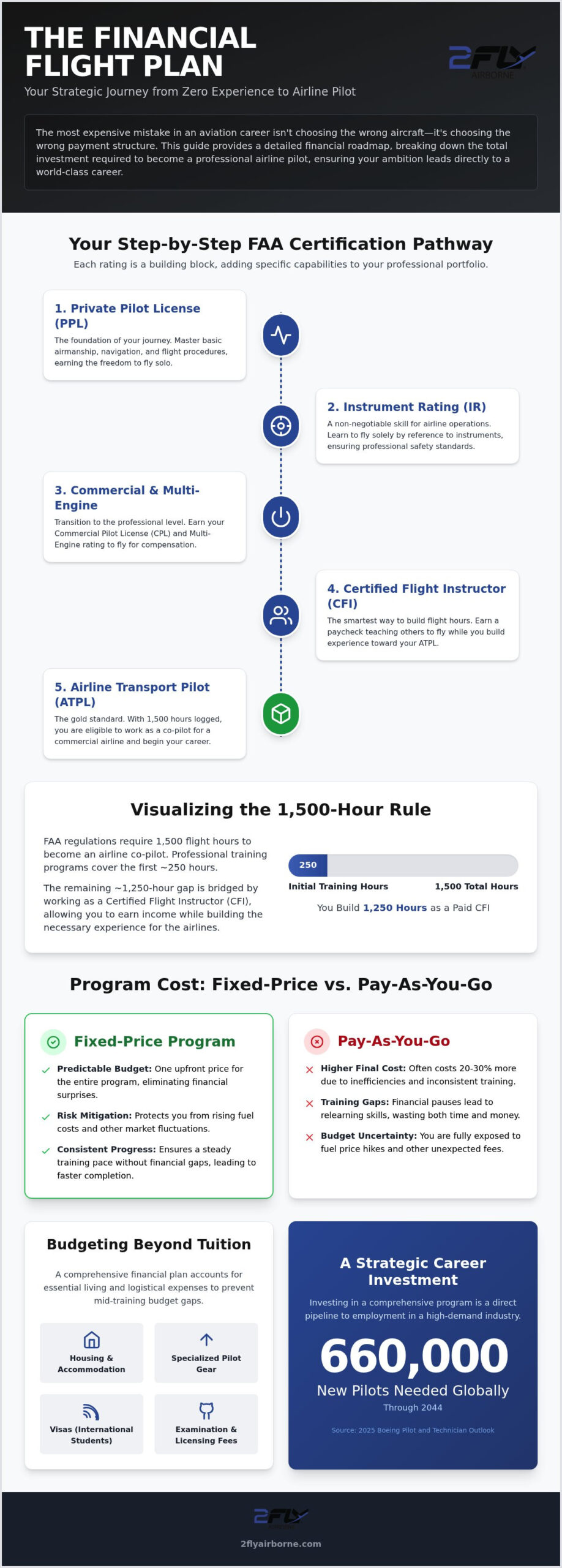
Under FAA regulations, pilots generally need 1,500 flight hours to act as a co-pilot for Part 121 operations, which refers to scheduled commercial airline services. Most professional flight training programs conclude when a student reaches approximately 250 hours with a Commercial Pilot Certificate. To bridge the 1,250-hour gap, savvy students transition into the FAA Professional Pilot Program which includes a Certified Flight Instructor (CFI) phase. This allows you to build the necessary hours while earning a paycheck, effectively letting the industry fund the final stretch of your journey.
Total Cost of Ownership vs. Tuition
Aspiring pilots often focus solely on tuition, but the actual cost of training involves much more than aircraft rental and instructor fees. A “pay-as-you-go” model might seem flexible, but it frequently leads to training gaps that can increase final costs by 20% to 30%. When training is inconsistent, you spend more time and money relearning skills from previous lessons. This inefficiency can significantly inflate your total zero to atpl cost over the duration of your training.
A fixed-price model serves as a critical risk-mitigation strategy. It provides a shield against rising fuel costs and ensures you aren’t hit with unexpected surcharges mid-program. When evaluating your investment, ensure your budget includes non-tuition essentials like on-campus residential accommodation. This comprehensive view prevents financial exhaustion before you reach the finish line and ensures you are industry-prepared for professional employment.
Breaking Down the Cost of Flight Training Phases
Think of your flight training syllabus as a building-block process. Each rating you earn adds a specific set of capabilities to your professional portfolio. You start by mastering basic airmanship before moving into the complex world of instrument flight and multi-engine operations. This structured approach ensures your zero to atpl cost remains a controlled investment rather than an unpredictable expense.
Tuition costs are primarily driven by the tangible assets required for your development. You’re paying for modern aircraft rental, aviation fuel, and high-fidelity simulator time. Expert instruction from seasoned pilots also accounts for a significant portion of the investment. When you choose an integrated program, these costs are managed more effectively than if you were to approach them individually at retail rates.
The 2025 Boeing Pilot and Technician Outlook projects a demand for 660,000 new pilots globally through 2044. This massive demand highlights why investing in a comprehensive program is a strategic career move. A professional syllabus doesn’t just teach you to fly; it prepares you for the rigorous standards of the airline industry. By focusing on a direct pipeline to employment, you ensure that every dollar spent contributes to your long-term vocational success.
The Foundation: Private Pilot and Instrument Ratings
The journey begins with the Private Pilot Certificate (PPL). This phase is often the largest hurdle for beginners as they adjust to the intensive environment of a pilot school. For a deeper look at this initial phase, you can read more about What is a Private Pilot License (PPL)? to understand the requirements and expectations.
Once you’ve secured your PPL, you move into the Instrument Rating (IR). This phase is critical for professional safety and long-term employability. It teaches you to fly solely by reference to instruments, a skill that’s non-negotiable for airline operations. Mastering this rating is where your technical mastery begins to mirror the standards of a professional flight deck.
The Professional Level: Commercial and Multi-Engine Ratings
As you progress to the Commercial Pilot Certificate (CPL), you’ll transition to complex aircraft. These planes feature retractable landing gear and controllable-pitch propellers, which naturally leads to an increase in hourly rental rates. This phase refines your maneuvers and precision to a professional standard, preparing you for the demands of commercial transport.
The Multi-Engine (ME) rating is often considered the “golden ticket” for airline recruitment. Most regional and major carriers require significant multi-engine experience before you can step into a first officer seat. The FAA Professional Pilot Program combines these professional ratings into a single, cohesive track. This integration reduces your total zero to atpl cost by optimizing your time in expensive multi-engine aircraft and simulators.
Multi-engine training involves mastering asymmetrical thrust and complex system management under pressure. Airlines look for this specific technical proficiency because it demonstrates your ability to handle heavy, fast aircraft in a commercial environment. If you’re ready to see how these phases fit into your personal career timeline, consider exploring the FAA First Officer Program for a detailed look at the syllabus.
Fixed-Price Programs vs. Hourly Rates: Which is Better?
In a volatile economy, the “hourly rate” model can be a dangerous financial trap for students. Many aspiring pilots enter training with a quote that looks manageable on paper, only to see it balloon as market conditions shift. Choosing a fixed-price program provides a vital shield against rising fuel costs and instructor availability issues.
Standardized training in a Part 141 environment often leads to higher pass rates and lower total flight hours. This designation refers to a highly structured, FAA-approved training environment that follows a rigid syllabus and rigorous oversight. Professional academies like 2FLY Airborne leverage a large fleet to ensure students aren’t grounded by maintenance delays, which is a cornerstone of managing your total zero to atpl cost effectively.
The Hidden Danger of the Pay-As-You-Go Model
Training regression happens when your progress is interrupted by a lack of funds or aircraft availability. When you stop flying for weeks to save for the next lesson, you spend the first few hours of your return just relearning forgotten skills. This cycle of “one step forward, two steps back” is the primary reason modular programs often exceed their initial budgets.
Fuel surcharges and fluctuating examiner fees can inflate a modular budget by thousands of dollars without warning. This volatility is exactly why the fixed-price tuition provided by 2FLY Airborne is the preferred choice for career-oriented students. It allows you to focus entirely on technical mastery rather than checking the price of aviation fuel every morning.
Efficiency and the Value of Time
Every month you aren’t at an airline is a month of lost senior-level salary. The “cost of delay” is a real financial metric that modular students often overlook when comparing programs. Structured programs get you to the flight deck 6 to 12 months faster than fragmented, modular paths by removing the administrative and financial bottlenecks of pay-as-you-go training.
Reaching the cockpit sooner allows you to capitalize on the current industry hiring cycle during your peak earning years. You can find a more detailed breakdown of these milestones in our guide on How Long is Flight School? to see how different paths impact your career start date. Prioritizing efficiency today secures your seniority and long-term earning potential.
Accounting for Non-Tuition Expenses and International Logistics
A realistic financial plan for your pilot career must look beyond the hangar doors. While your tuition covers the core instruction and aircraft time, your total zero to atpl cost will include secondary items like noise-canceling headsets and electronic flight bags. These essentials are part of the vocational kit required for every industry-prepared professional.
You should also account for third-party fees that are independent of your flight school. Fees for your FAA medical certificate and the Designated Pilot Examiner (DPE) for check-rides are paid directly to those professionals. Budgeting for these items early ensures that your training progression remains smooth and uninterrupted by administrative costs.
Living Expenses and Residential Housing
Finding accommodation in a competitive real estate market can be a significant hurdle for students. Many candidates researching flight schools in Florida find that on-campus housing provides the most stable and predictable monthly expense. This residential model allows you to stay focused on your studies while living in a community of like-minded high-achievers.
Living on-site also minimizes transportation costs and maximizes your time in the flight training environment. By removing the stress of a daily commute, you can dedicate more hours to the simulator and ground school. This immersive approach is a key factor in completing your training within the projected timeline.
Administrative and Visa Costs for Global Students
International candidates face specific administrative requirements, including the SEVIS fee. This refers to the Student and Exchange Visitor Information System, which is the government system used to track international students and exchange visitors while they are in the U.S. You will also need to factor in the costs for your M-1 or F-1 visa application and the required TSA background checks.
For those aiming to return to Europe, the EASA Flight School USA pathway offers a strategic advantage. It ensures your training meets international regulatory standards while you benefit from the efficiency of the American training environment. This foresight prevents costly administrative delays when you are ready to transition to an international airline career.
If you are coordinating your move from abroad, 2FLY Airborne provides comprehensive support for these logistical steps. Navigating the visa process early is essential for securing your place in the FAA Professional Pilot Program. Taking these proactive steps ensures your focus remains entirely on technical mastery and career preparedness.
Investing in Your Future: Financing and ROI
Viewing flight training as a mere expense is a common mistake that can cloud your long-term career vision. High-achievers approach their training as a strategic capital investment with a quantifiable Return on Investment (ROI). When you calculate your total zero to atpl cost, you aren’t just paying for flight hours; you’re purchasing a seat in a high-demand, high-paying profession. The 2025 Boeing Pilot and Technician Outlook projects a demand for 660,000 new pilots globally through 2044. This massive demand has driven median annual wages for airline pilots to $226,600, with first-year First Officers at regional airlines often earning between $95,000 and $130,000 in 2026.
Exploring Financing and Degree Options
Securing the necessary capital is a hurdle that most professional pilots overcome through specialized lending. There are several financing resources tailored specifically for flight students, offering both fixed and variable interest rates. Lenders typically look for a well-structured training plan that demonstrates a clear path to employment, which is why integrated programs often see higher approval rates than modular ones. Preparing a comprehensive financial plan that includes living expenses and third-party fees is essential for a successful loan application.
You might also consider a degree program that integrates flight training with academic credentials. While this path may extend your time in school, it provides a broader educational foundation that can be beneficial for long-term career mobility. A degree can also unlock access to federal financial aid and student loan programs that aren’t available to stand-alone flight schools. It’s a balanced approach for those who value both technical mastery and academic achievement.
The Final Verdict: Is the Investment Worth It?
The decision to pursue a career in the sky is a significant one, but the financial data for 2026 suggests the rewards far outweigh the initial zero to atpl cost. By choosing a school with a global recruitment network, you’re ensuring that your training is a direct pipeline to employment. You’re trading the uncertainty of the “cheapest” option for the security of a structured, professional environment that prioritizes safety and industry readiness. The value of reaching the flight deck 6 to 12 months sooner cannot be overstated in a market where seniority is everything.
Your journey to the flight deck is a marathon, not a sprint. Investing in a high-quality foundation today ensures you don’t face costly delays or retraining later in your career. Safe, structured training under the guidance of expert mentors is the most reliable way to secure your future. Take the first step toward your international career with the confidence that you’ve chosen the most efficient and effective path to the cockpit.
If you have any remaining questions about your specific career path or funding options, reach out to a 2FLY Training Advisor today to discuss your next steps.
Take Command of Your Aviation Career Path
Achieving your dream of becoming a professional pilot in 2026 requires a strategy that balances technical mastery with financial precision. By prioritizing the security of fixed-price tuition, you protect your investment from the volatility of fuel prices and training delays. This structured approach ensures that your zero to atpl cost leads directly to a rewarding career rather than unexpected financial hurdles.
Success in this industry is built on a foundation of safe, professional training and a clear pipeline to employment. Utilizing a global recruitment network and training to both FAA and EASA standards provides the international professional mobility you need to thrive. Every hour spent in a structured, expert-led environment brings you closer to the flight deck of a major airline.
If you’re ready to transition from a trainee to an industry-prepared professional, it’s time to take the first step. Speak with a 2FLY Airborne Training Advisor to get your personalized cost breakdown and begin your journey. We look forward to supporting your ambition and helping you reach the highest levels of the profession. Please reach out to a 2FLY Airborne Training Advisor with any remaining questions you may have.
Frequently Asked Questions
What is the average total cost for a zero to ATPL program in 2026?
The total zero to atpl cost in 2026 typically ranges from $80,000 to $130,000 across the industry. Accelerated programs often sit at the higher end of this spectrum because they utilize modern aircraft and high-fidelity simulators to speed up your progression. Choosing a structured program helps you avoid the common financial traps found in fragmented, modular training paths.
Does the fixed-price tuition include FAA examiner fees and medical exams?
Fixed-price tuition generally excludes third-party costs such as FAA medical certificate exams and Designated Pilot Examiner fees. These professionals operate independently from flight schools to maintain regulatory integrity. You’ll pay these fees directly to the examiners at each stage of your training, so it’s vital to include them in your comprehensive financial plan.
Can international students work in the US after completing their training?
International students’ ability to work in the U.S. depends on their specific visa designation. Students on an F-1 visa may qualify for Optional Practical Training, which allows them to work as flight instructors to build the 1,500 hours required for airline employment. M-1 visa holders typically return to their home countries or seek employment in regions that recognize FAA certifications.
How much extra should I budget for housing and living expenses?
You should budget approximately $1,000 to $1,500 per month for housing and basic necessities. Selecting a program with on-campus residential accommodation can reduce your logistical stress and eliminate the need for a personal vehicle. This immersive environment ensures you stay focused on your training while keeping your monthly living expenses predictable and manageable.
Is it cheaper to do flight training modularly or in an integrated program?
Integrated programs are often more cost-effective because they eliminate the expensive training regression caused by long gaps between lessons. Modular paths might seem cheaper upfront, but students often face a 20% to 30% increase in final costs as they spend extra hours relearning skills. A structured syllabus is the most efficient way to manage your total zero to atpl cost.
What happens if I need more hours than the program includes?
If you require additional flight time beyond the standard syllabus, those hours are usually billed at the school’s current hourly aircraft and instructor rates. While most professional programs are designed to reflect national averages, individual progress can vary based on consistency and aptitude. Staying focused and flying frequently is the best way to remain within your initial budget.
Are there scholarships available for professional pilot training?
Scholarships are available through major aviation organizations such as AOPA, EAA, and Women in Aviation International. Many regional airlines also offer tuition reimbursement or signing bonuses to help students offset their training investment. We recommend starting your scholarship search at least six months before you plan to begin your professional pilot program.
How do I start the application process for an M-1 visa?
To begin the M-1 visa process, you must first be accepted into an FAA-approved school that provides visa sponsorship for international students. After your acceptance, the school will issue a Form I-20, which allows you to pay the required SEVIS fee and schedule an interview at a U.S. Embassy. This process is methodical and requires careful attention to detail to ensure a smooth transition.
Article by
2FLY Airborne
2Fly Airborne is a professional flight training organization dedicated to developing the next generation of skilled, confident, and safety-focused pilots. With decades of combined aviation experience, our team of certified instructors provides structured, real-world training designed to prepare students for both checkrides and long-term success in the aviation industry.
Content Disclaimer
Some blog content is generated with the assistance of automated tools and may not always be fully accurate or up to date. Please verify all aviation-related information with official sources or a certified instructor. For additional guidance or clarification, we encourage you to contact one of our training advisors at 2Fly Airborne.