Imagine reaching the final stages of your training only to discover your credentials don’t align with your dream airline’s requirements. It’s a significant concern for many aspiring professionals weighing the EASA vs FAA pilot license options for their 2026 career start. You probably recognize that both certifications represent excellence, but the regulatory maze between European and American standards can feel overwhelming.
We’ve designed this definitive guide to help you bypass the confusion surrounding ‘frozen’ ATPLs and the intense 14-exam EASA ground school requirements. You’ll gain a clear understanding of where each license allows you to work and how to build a cost-effective training strategy that maximizes your time in the air. We break down the practical differences in flight hours, conversion costs, and the specific advantages of training in the United States. By the end, you’ll have the confidence to choose a 2026 roadmap that leads directly to a professional flight deck.
Key Takeaways
- Understand the fundamental differences between the FAA’s practical focus and EASA’s theoretical intensity to align your training with your 2026 career goals.
- Evaluate the EASA vs FAA pilot license requirements, including the 14 theoretical exams and flight hour variations, to choose the most efficient path for your timeline.
- Identify the specific global regions where each certification is recognized to ensure your license provides the professional mobility you need for an international career.
- Discover why training in the United States offers significant advantages, such as consistent flying weather and superior aviation infrastructure, for both FAA and EASA candidates.
- Learn how to transition from a trainee to an industry-prepared professional by choosing a structured environment that prioritizes vocational readiness over simple hour building.
What are EASA and FAA Pilot Licenses? The Global Regulatory Landscape
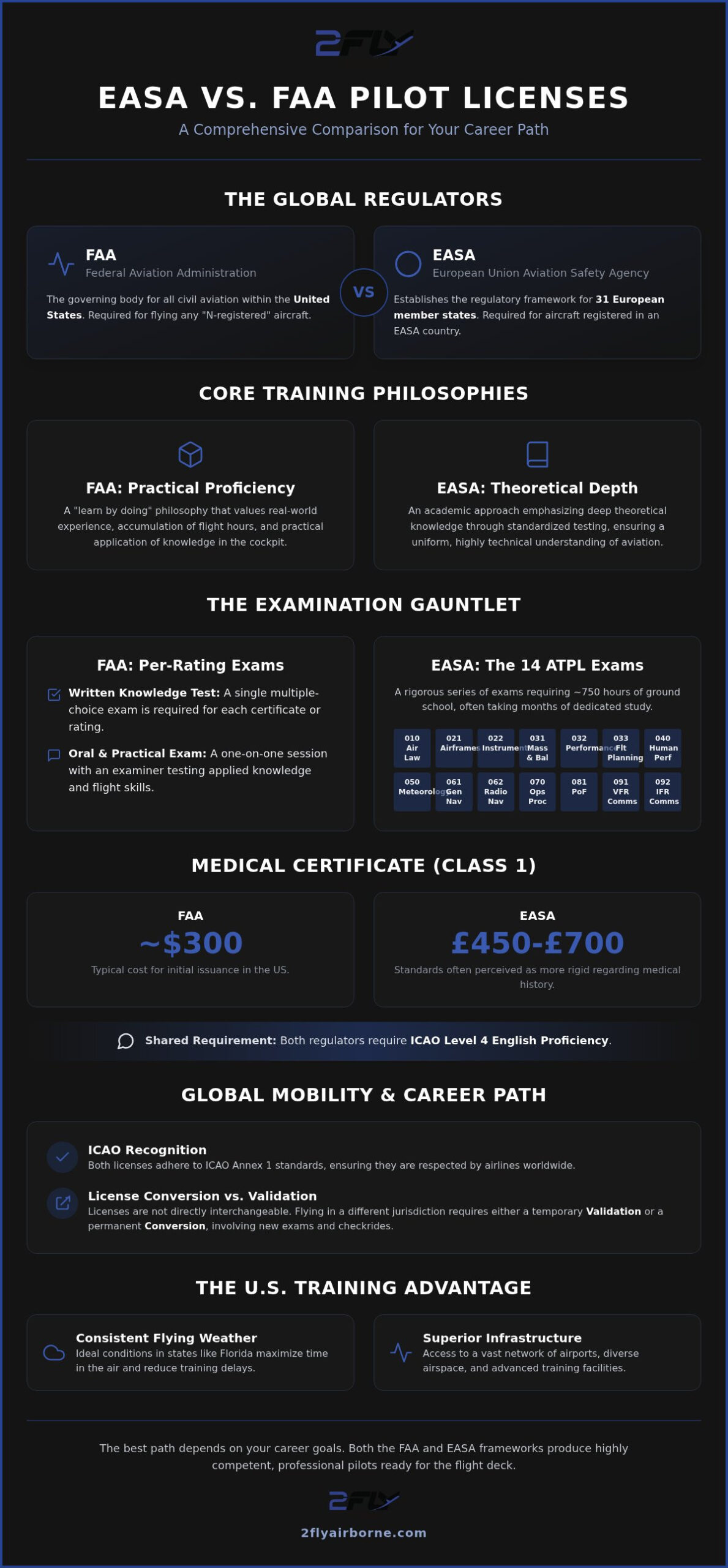
The Federal Aviation Administration (FAA) is the governing body for all civil aviation within the United States. It manages everything from pilot certification to airspace safety with a focus on practical application. Across the Atlantic, the European Union Aviation Safety Agency (EASA) establishes the regulatory framework for 31 European member states. This dual system creates two distinct paths for every aspiring aviator.
Many aspiring pilots find their calling through initial discovery flights; for those exploring the European sector, Ciel ÉVASION provides a variety of exceptional aerial experiences across France that can help spark a lifelong passion for aviation.
Choosing between an EASA vs FAA pilot license isn’t just a matter of personal preference; it’s a legal requirement based on aircraft registration. Aviation law dictates that the license held by the pilot must match the country where the aircraft is registered. If you’re flying an “N-registered” aircraft, you need an FAA certificate. Conversely, a plane registered in an EASA member state requires an EASA license.
Don’t fall for the common misconception that one path is universally easier than the other. While the FAA route is often praised for its streamlined practical training, it demands high levels of self-discipline and airmanship. EASA training is famously rigorous in its academic requirements, but both paths lead to the same high standards of professional competency. Your decision should rest on where you intend to build your career.
The Role of ICAO in Global Recognition
The International Civil Aviation Organization (ICAO) provides the foundation for Global pilot licensing standards. Because both the FAA and EASA adhere to ICAO Annex 1, their licenses are respected by airlines worldwide. However, international respect doesn’t mean these licenses are directly interchangeable without additional work.
It’s vital to understand the difference between a “validation” and a “conversion” in a professional context. A validation is typically a temporary permit allowing you to use your foreign license in a specific country for a limited time. A conversion is a more permanent process where you earn a new license based on your existing experience. This usually involves passing specific written exams and a flight check.
The Core Philosophical Differences
The FAA prioritizes practical proficiency and the accumulation of flight hours. It’s a “learn by doing” philosophy that values real-world experience in various weather conditions and airspaces. This approach often allows students to progress quickly through ratings like the Private Pilot Certificate (PPL) or Commercial Pilot Certificate (CPL).
EASA takes a more academic approach, emphasizing deep theoretical knowledge and standardized testing. Candidates must master 14 intensive ground school exams to prove their technical expertise. This system ensures every pilot has a standardized, highly technical understanding of aerodynamics and meteorology. Your choice depends on whether you thrive in a cockpit-first environment or a classroom-intensive structure.
The Technical Breakdown: Comparing Requirements and Exams
Have you ever wondered why some trainees spend months in a library while others are constantly in the cockpit? The technical divide between these two certifications is most visible during the examination phase. Understanding the granular details of the EASA vs FAA pilot license requirements is the first step toward building your training budget and timeline for 2026.
EASA requires mastery of 14 intensive theoretical exams covering subjects like General Navigation, Meteorology, and Human Performance. These tests are centralized and strictly scheduled, often requiring months of dedicated full-time study. In contrast, the FAA utilizes a single written knowledge test for each rating. This is followed by a rigorous oral exam conducted by a Designated Pilot Examiner during the practical checkride, where your ability to apply knowledge in the cockpit is tested.
Your professional journey begins with a medical certificate. An FAA Class 1 medical typically costs around $300, while an initial EASA Class 1 medical at an Aero-Medical Center can range between £450 and £700. Both require excellent vision and cardiovascular health. In addition to these certifications, many aspiring pilots enhance their safety profile with first aid training; for those based in Ireland, frontlinemedical.ie offers certified courses that build essential emergency response skills. However, EASA standards are often perceived as more rigid regarding historical medical documentation. Both regulators require you to meet ICAO Level 4 English proficiency, the international baseline for aviation communication.
Ground School and Theoretical Knowledge
EASA ground school is the primary hurdle for many European candidates, involving approximately 750 hours of theoretical instruction. The FAA approach focuses on the practical application of knowledge during flight hours. Students looking for an efficient way to manage this academic workload often find that a structured FAA Professional Pilot Program provides the necessary balance between theory and airmanship.
Flight Hour Thresholds and Training Structure
The FAA system offers flexibility through Part 61 and Part 141 flight schools. Under Part 141, you can earn a Commercial Pilot Certificate in as few as 190 hours, compared to the 250 hours required under Part 61. EASA typically requires 200 hours for a CPL. While these numbers are close, the path to the 1,500-hour Airline Transport Pilot milestone differs significantly between regions. You should review the official FAA pilot certification requirements to see how these hours are categorized for American licenses.
Strategic Career Mapping: Where Do You Want to Fly?
Where do you see yourself in five years? Your answer to this question determines which certification you should pursue first. While the EASA vs FAA pilot license debate often focuses on the difficulty of exams, the real decision rests on your desired employment geography.
If your goal is to fly for a major carrier in the United States or Canada, an FAA license is non-negotiable. North American airlines operate almost exclusively on N-registered aircraft, requiring pilots to hold FAA credentials. Conversely, European legacy carriers and low-cost airlines require EASA certifications to operate their European-registered fleets.
The Middle Eastern and Asian markets offer a unique middle ground for international aviators. Many airlines in these regions operate mixed fleets and frequently hire pilots with either FAA or EASA backgrounds, though they may require a local validation. The 2025 Boeing Pilot and Technician Outlook projects a demand for 660,000 new pilots globally through 2044. This massive requirement means that having a flexible, internationally recognized license is your greatest asset.
The Dual-License Advantage
Some high-achieving pilots choose to hold both FAA and EASA credentials simultaneously. This strategy provides the ultimate level of professional mobility, allowing you to move between continents as market conditions shift. It makes you an exceptionally attractive candidate to global recruitment offices looking for versatile flight crews.
Maintaining two licenses does require extra effort, as you must manage two sets of medical records and keep your ratings current in both systems. However, the investment often pays off in career longevity and salary potential. Many students find that starting with a structured FAA Professional Pilot Program provides a solid foundation for this dual-path strategy.
License Conversions and TIP-L Agreements
The Technical Implementation Procedures for Licensing (TIP-L) is an agreement that simplifies the conversion process between the FAA and EASA. It focuses primarily on Private Pilot and Instrument ratings, reducing the number of exams and flight hours needed to switch systems. This makes the transition significantly more efficient than it was in previous decades.
To begin a conversion, you must first navigate the FAA foreign license verification process. This ensures your existing credentials meet the necessary safety and training standards before you proceed with local checkrides. Starting with an FAA base often allows you to build hours in a cost-effective environment before converting to EASA for a career in Europe.
The US Advantage: Why Train in America for an International Career?
Why do so many international students choose Florida over their home countries for flight training? It isn’t just about the lifestyle; it’s about the sheer volume of flight hours you can log in a single month. Evaluating the EASA vs FAA pilot license options often reveals that the logistical benefits of training in the United States are the deciding factor for global candidates.
In Northern Europe, a student might wait weeks for a clear weather window to complete a solo cross-country flight. In the American market, particularly in Florida, consistent flying weather allows for rapid program completion. You can often finish a professional syllabus in months rather than the years it might take in less favorable climates. This efficiency gets you into a paying cockpit much sooner.
The cost-efficiency of the US aviation industry is another significant draw. Lower fuel prices and competitive aircraft rental rates mean your training budget goes much further here than in the European market. Additionally, the high density of airports and specialized aviation infrastructure provides a superior training environment. You’ll navigate complex airspaces and varied approaches that build the confidence required for a global career.
Immersion in an English-speaking environment is a critical professional advantage. Since English is the international language of the sky, training in the US ensures you’re comfortable with complex radio telephony from day one. This total immersion prepares you for the rigorous communication standards of major international airlines.
Visa Support and International Student Life
Navigating the M-1 or F-1 student visa process is a hurdle that requires expert guidance. 2FLY Airborne provides comprehensive support, assisting you from the initial application through to your graduation. We understand the unique needs of international students and provide managed on-campus housing to make your transition seamless. This supportive environment allows you to focus entirely on reaching the highest levels of your profession.
EASA Training in the USA
You don’t have to sacrifice the benefits of US flight conditions to earn a European qualification. Many students choose EASA-compliant programs based in Florida, which combine the best of both worlds. You’ll complete your ground school and flight training in the US before finishing with EASA-authorized examiners. For a detailed breakdown of this path, read our EASA Flight School USA guide.
Ready to take the first step toward your international career? View our FAA Professional Pilot Program to see how we bridge the gap between trainee and industry professional.
Launching Your Career: Path to the Flight Deck
Have you ever felt that a single choice could define your next twenty years? In aviation, selecting between an EASA vs FAA pilot license is exactly that kind of decision. It’s the difference between a career spent crossing the Atlantic or one exploring the regional routes of North America. Your success depends on matching your credentials to your target market while optimizing where you learn.
Success in the cockpit requires more than just logging flight time. Training in a professional, structured environment ensures you aren’t just building hours; you’re developing the discipline required for a major airline flight deck. This vocational preparedness is what sets elite candidates apart during the recruitment process. The 2025 Boeing Pilot and Technician Outlook projects a demand for 660,000 new pilots globally through 2044. Starting your journey in 2026 positions you perfectly to meet this rising demand as senior captains retire and global fleets expand.
Choosing the Right Professional Program
A structured FAA Professional Pilot Program offers a clear, linear path that modular training often lacks. When evaluating academies, look for an institution with a large, modern fleet and instructors who prioritize industry readiness. You can explore a deeper breakdown of these steps in our guide on How to Become a Pilot. Choosing an environment that mirrors airline operations will prepare you for the rigorous demands of your future career.
Next Steps for Aspiring Aviators
Your roadmap should be as unique as your professional goals. Speak with a mentor who can help you navigate the logistics of visas, medicals, and training timelines. It’s important to have a clear financial plan before you begin your journey. Explore various financing options to ensure your training remains consistent and uninterrupted. Your career starts with a single, well-informed decision that prioritizes safety and professional excellence.
In summary, choosing between an EASA vs FAA pilot license requires a clear understanding of your long-term goals. Prioritize safe, structured training to build a foundation that lasts a lifetime. Reach out to a 2FLY Training Advisor with any remaining questions to begin your journey today.
Charting Your International Flight Path for 2026
Selecting the right credential is the most critical strategic decision you’ll make at the start of your aviation journey. While the EASA vs FAA pilot license debate involves complex regulations, the choice becomes clear when you align your training with your ultimate career destination. The American training environment provides the speed and cost-efficiency needed to reach your professional milestones faster than anywhere else in the world.
We’re committed to transforming your ambition into a professional reality through our Fixed-Price Career Paths and comprehensive M-1 Visa Sponsorship for international students. Our Global Recruitment Network serves as a direct pipeline, connecting industry-prepared professionals with leading carriers across the globe. You don’t have to navigate these regulatory hurdles or ground school exams alone when you have an expert mentor by your side.
Ready to start your international aviation journey? Speak with a 2FLY Training Advisor today to secure your place in the cockpit and begin your roadmap for 2026. Reach out to a 2FLY Training Advisor with any remaining questions.
Frequently Asked Questions
Can I fly in Europe with an FAA license?
You can fly in European airspace using an FAA license if the aircraft you’re operating is registered in the United States. To fly for a European airline on aircraft registered in an EASA member state, you’ll need to convert your credentials to an EASA license. This process ensures you meet the specific regulatory standards of the region where the aircraft is based.
Is an EASA license harder to get than an FAA license?
The difficulty of each path depends on whether you prefer academic study or practical application. EASA is often considered more theoretically demanding because it requires passing 14 intensive ground school exams. The FAA focuses more on practical airmanship and hands-on proficiency during the EASA vs FAA pilot license evaluation. Both regulators maintain high safety standards that require significant dedication.
How long does it take to convert an FAA license to EASA?
A professional license conversion typically takes between six and twelve months to complete. This period includes the time needed to master the theoretical knowledge and pass the required flight checks. Your individual timeline will vary based on your existing flight experience and how quickly you can progress through the ground school syllabus.
Which license do Middle Eastern airlines like Emirates or Qatar prefer?
Major carriers in the Middle East generally accept both FAA and EASA licenses for their recruitment programs. Once hired, you’ll usually undergo a local validation process to convert your certificate to the national standard. These airlines prioritize candidates who have trained in a professional, structured environment regardless of the initial regulator.
Can I do EASA ground school in the USA?
You can complete EASA-compliant ground school in the United States through academies that maintain specific European approvals. This approach allows you to enjoy the consistent flying weather of the US while meeting the academic requirements for a European career. It’s a strategic way to manage your EASA vs FAA pilot license requirements efficiently.
What is a ‘frozen’ ATPL and does the FAA have an equivalent?
A ‘frozen’ ATPL is an EASA term indicating that a pilot has passed all theoretical exams but hasn’t yet logged the 1,500 hours required for a full license. The FAA doesn’t use this terminology. In the American system, you simply hold a Commercial Pilot Certificate until you reach the 1,500-hour milestone for your Airline Transport Pilot certificate.
Do I need a university degree to become a pilot with either license?
A university degree isn’t a legal requirement to hold a pilot license from either the FAA or EASA. While many major airlines prefer candidates with a degree, you can begin your flight training immediately after secondary school. Many successful professionals choose to earn their pilot certificates first and pursue higher education later in their careers.
Which license is more expensive to obtain in 2026?
EASA licenses are generally more expensive due to higher exam fees and the length of the mandatory ground school. Training for an FAA license in the United States is often more cost-effective because of lower operational costs and a more competitive training market. Many international students find that the American path provides a faster and more affordable route to the flight deck.
Article by
2FLY Airborne
2Fly Airborne is a professional flight training organization dedicated to developing the next generation of skilled, confident, and safety-focused pilots. With decades of combined aviation experience, our team of certified instructors provides structured, real-world training designed to prepare students for both checkrides and long-term success in the aviation industry.
Content Disclaimer
Some blog content is generated with the assistance of automated tools and may not always be fully accurate or up to date. Please verify all aviation-related information with official sources or a certified instructor. For additional guidance or clarification, we encourage you to contact one of our training advisors at 2Fly Airborne.