

Student pilot housing amenities and dorm options range from shared rooms with basic furnishings to private accommodation and off-campus apartments.
Choosing where to stay involves more than the room itself. Wi-Fi, laundry, parking, study space, and airport access can shape your daily routine as much as rent, especially during focused flight training.
This guide compares furnished rooms, shared spaces, and off-campus housing, and explains which amenities can support study and rest. It also covers how utilities, transportation, and short-term costs affect your budget, helping you plan your training stay with greater confidence.
Key Takeaways
- Compare shared rooms, private accommodation, and off-campus apartments by both cost and how well each supports your training routine.
- Look beyond the bed and desk: study spaces, computer access, printing, laundry, parking, and Wi-Fi can make a practical difference.
- Build a short-term budget that accounts for housing, food, transportation, and utilities, not rent alone.
- Review lease length and airport travel time before choosing a place, especially if your training schedule is accelerated.
- Clarify which services are included in housing fees so you can plan your living arrangements with fewer surprises.
Computers, printing and community rooms
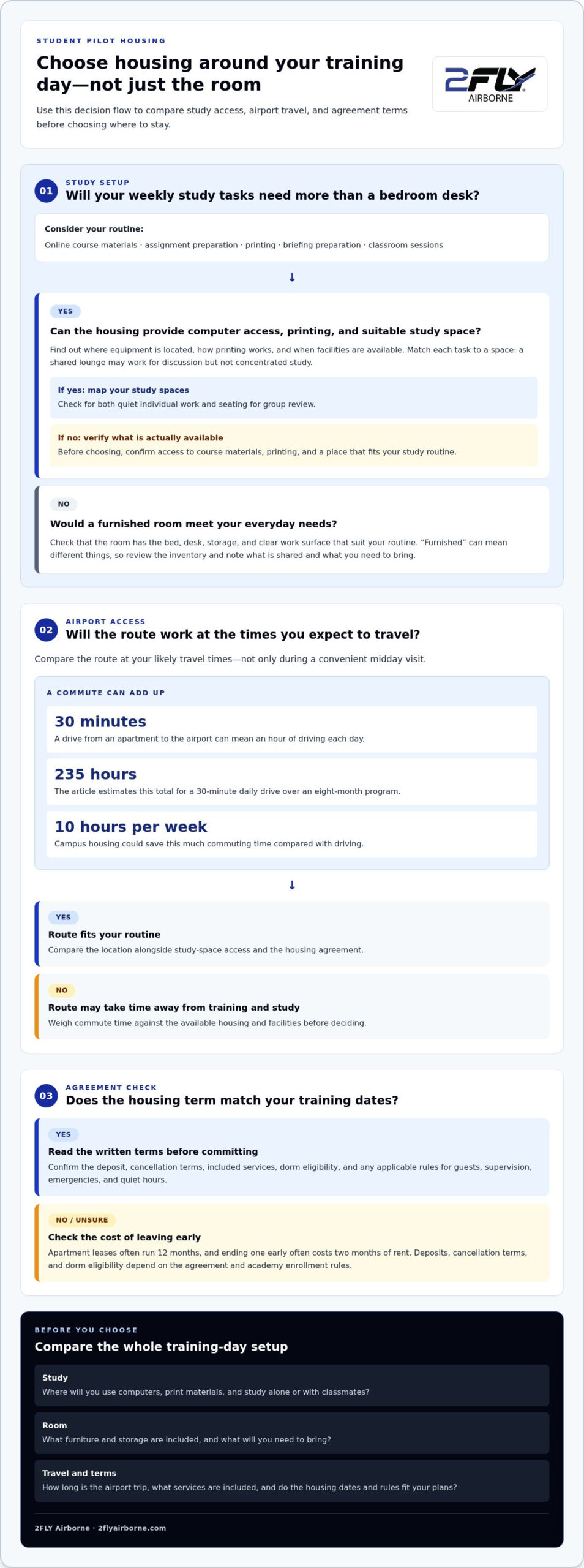
A flight-training day might include online study, a briefing, and a classroom session. A computer station, reliable printing access, and a shared study room can help you move between tasks without relying on a bedroom desk. Before choosing housing, map out where you’ll complete each task and whether the available spaces suit your routine.
Use a practical three-step check. First, identify where you’ll access course materials and prepare assignments. Next, find out how printing works, where equipment is located, and when it’s available. Finally, consider whether a community room has quiet space for focused work as well as seating for group review. A shared lounge may suit discussion but not concentrated study.
Community rooms can make peer support part of your routine. Two students preparing for a weather briefing, for example, could review notes together, then continue individual study in a quieter area. Classmates can help clarify difficult material, while structured instruction remains the foundation of flight training. Look for spaces that make both collaboration and independent work practical.
Apartment leases often run 12 months, and ending one early often costs two months of rent. Deposits, cancellation terms, and dorm eligibility depend on the housing agreement and the academy’s enrollment rules. Read those terms before committing, especially if your training program has a defined end date.
Safety, supervision, guest access, and quiet hours depend on each dorm’s written rules. Before moving in, review the housing agreement for guest limits, supervision arrangements, emergency procedures, and designated quiet periods.
Airport location matters as much as the study room. A 30-minute drive from an apartment to the airport can mean an hour of driving each day, while a 30-minute daily drive amounts to 235 hours over an eight-month program. Campus housing could save 10 hours of commuting per week, an advantage when flight slots and study sessions shape your schedule. Compare the route at the times you expect to travel, not only during a convenient midday visit.
- List the study tasks you’ll handle weekly, such as online coursework, printing, and briefing preparation.
- Match each task to a space, then assess whether it supports quiet study or group work.
- Compare the airport commute with access to computers and community rooms before choosing housing.
International students should keep their approved housing address current with their school and SEVIS. A reliable study setup, clear dorm expectations, and a manageable route to the airport can help you focus on the next stage of aviation training.
Furnished rooms with a bed and study desk
A furnished room can reduce what you need to bring before flight training begins. Match the layout to your routine: a bed for rest, a desk for coursework, and storage for clothing and study materials. If you keep charts, notebooks, and a laptop together, for example, you’ll need a clear work surface. Check that there’s enough room to move comfortably around the furniture.
“Furnished” can mean different things. One room may include a bed and desk, while another may have additional furniture or shared household equipment. Read the inventory and note what belongs to the room, what’s shared, and what you’ll need to bring. A desk chair, task lighting, and space for course materials can make a study setup more practical.
Think through a typical evening before choosing a room. You might return from training, organize lesson notes, prepare for the next briefing, and then wind down. Keeping study supplies in a designated place can make the transition easier. If you use paper charts or printed materials, check whether there’s enough storage to keep them orderly and accessible.
Short-term furnished accommodation can mean a private room, a room in a shared home, or a furnished apartment. The differences go beyond furniture: a shared home involves common areas and household routines, while an apartment provides a separate residential space. Choose based on your privacy needs, what you’re comfortable bringing, and how the arrangement fits the length of your stay. For those planning a more permanent move rather than a temporary let, working with local property specialists such as FSG Estate Agent can provide valuable guidance when buying residential property.
Before committing, compare the written room description with the actual setup. Consider furniture condition, storage, desk placement, and the overall layout. If you can’t visit, use an inventory or photographs to make a packing list. Separate essentials, such as clothing and study supplies, from belongings you can bring later, once you know how much space is available.
- Make a list of included furniture and personal items you’ll need to bring.
- Picture a study session with your laptop, notes, and course materials arranged on the desk.
- Compare a private room, shared home, and furnished apartment by privacy and household setup.
Keep housing expenses separate from aviation-training costs so each part of your plan is clear. A furnished room is practical when its layout fits your study habits, belongings, and expected stay. Identify what you need for daily use, then choose accommodation that supports a consistent routine without unnecessary purchases or extra furniture.
Short-term housing costs during accelerated flight training
For a short stay, compare the billing period with your training dates before choosing accommodation. A weekly rate may align more easily with a focused training block than a long residential agreement. Check how the housing period fits your start date, expected finish, and any transition between training stages.
Housing costs depend on the arrangement. Shared accommodation means sharing space with roommates, while a private room or apartment offers a different balance of privacy and shared facilities. The total also depends on what the housing fee covers and whether household expenses are billed separately. Compare each option in writing, separating housing charges from other living costs and noting the billing period for each.
Accelerated training schedules can shift as lessons, weather, aircraft availability, and student readiness affect the order of activities. Choose housing terms that fit the expected training period without assuming every milestone will happen on a fixed date. If your plan has multiple stages, consider whether you can stay in the same accommodation or will need to move between them.
Checkride timing is another planning factor. A checkride is the practical test that evaluates a student’s pilot skills and knowledge. Timing depends on readiness, training progress, examiner scheduling, weather, and completed paperwork. Continue studying and coordinating with your flight school while arranging your stay. Don’t treat a predicted test date as a guaranteed move-out date.
Before choosing, use this short-term housing review:
- Match the weekly or monthly billing cycle to the dates in your training plan.
- Compare private and shared arrangements, including roommate responsibilities.
- Separate the housing fee from costs billed outside the agreement.
- Consider how a schedule change or checkride delay could affect your stay.
Ask how the accommodation agreement handles changes to your planned stay, payment dates, and departure arrangements. Read all the terms, not just the advertised rate. If you share a home, clarify how household costs and common areas are managed. A clear budget shows which expenses recur, which depend on use, and which apply only to the housing arrangement.
For accelerated flight training, choose accommodation around the program structure and your realistic study routine. A short-term option works best when its billing period, location, and terms fit your training plan. Keep your plans flexible, and coordinate housing decisions with the milestones that shape your progress through flight school.
Student housing amenities
Assess amenities by how you’ll use them during a training week, not by how many appear in a housing description. A student with an early aircraft booking, for example, may value convenient parking and building access more than a decorative lounge. A room that supports your actual schedule can be more useful than one with features you rarely use.
Consider internet access in practical terms. A connection might work well for reading course notes but struggle during a live online lesson, especially when roommates are online too. Think about where you’ll study and whether the signal reaches that space. If you rely on digital materials, a weak signal in your room could make a common area your regular study spot.
Shared facilities should fit your routine. An on-site laundry room can be convenient, but its location, access rules, and shared use affect how easily you can plan around it. Parking may help you get to training, yet the route from your room to your vehicle matters when carrying bags or study materials. Picture the steps involved rather than judging amenities by name alone.
Building access matters when your daily plans can shift. Review the entry rules and consider how they fit an early departure, a late return, or studying elsewhere. In shared accommodation, residents may keep different routines. Think about how access works for everyone and whether the arrangement supports individual schedules as well as household expectations.
Look closely at common areas. A lounge with conversation and shared activity may suit peer discussion, while a quieter corner may work better for reviewing a lesson alone. Notice the seating, lighting, and available surfaces. A student preparing notes on a laptop may need a stable table, while a short break between activities may call only for comfortable seating.
- Match each listed feature to a real task in your weekly routine.
- Consider where you’ll study and whether the internet reaches that location.
- Walk through the route between your room, shared facilities, and parking.
- Choose common spaces based on whether you need quiet study or conversation.
Find out how residents report routine maintenance concerns and what happens next. A clear process matters when a shared facility needs attention or something in a room stops working. Then rank amenities by practical value: daily essentials first, occasional conveniences second. This makes it easier to compare accommodation based on how well it supports your training routine, not on broad descriptions or an impressive-sounding list.
Are utilities, internet, meals, or transportation included in housing fees?
A housing fee covers only what’s listed in the agreement. One dorm rate might include utilities, while an apartment’s rent may leave electricity, water, and internet as separate expenses. Read the fee breakdown line by line and mark each cost as included, separately billed, or paid directly by you. This makes the actual monthly commitment easier to compare.
Utilities can significantly change the total. Check which services the estimate covers, such as electricity or water, and whether charges are shared among roommates. A shared apartment may split a utility bill, for example, while a private unit may assign the full bill to one tenant. In older residential buildings, structural efficiency also dictates heating and cooling expenses; property owners and landlords often rely on upgrades like window replacement new jersey to minimize drafts and keep recurring energy costs manageable.
Give internet its own line in your budget. A housing agreement may bundle Wi-Fi, but check the connection’s speed and any data caps. If internet is billed separately, include it alongside rent and utilities. This is important when training materials, online lessons, and video briefings rely on a stable connection.
Meals may be a separate expense. The cost depends on your eating habits, access to meals, and how often you prepare food at home. A shared kitchen can support grocery-based meals, while a meal plan changes how you manage food spending.
Treat transportation as a separate budget item. Distinguish routine commuting from occasional rides or errands. A student who drives to flight lessons, for example, should consider fuel and parking, while someone using local transit needs to account for routes and schedules.
- Read the agreement and mark utilities, Wi-Fi, meals, and transport as included or separate.
- Compare the rent with the additional monthly expenses, not rent alone.
- For shared housing, clarify how roommates divide household bills.
- Build a food and transportation budget that matches your routine.
Use a simple monthly worksheet before signing. Start with rent, then add any separate utility, internet, food, and transportation costs. Keep one-time deposits apart from recurring bills so they don’t distort your monthly estimate. Compare the total for each housing option and choose based on the complete cost and the services you’ll actually use.
2FLY Airborne: FAA Professional Pilot Program
2FLY Airborne offers the FAA Professional Pilot Program for students preparing for a career in commercial aviation. Its training pathway includes the Private Pilot Certificate (PPL), Instrument Rating (IR), and Commercial Pilot Certificate (CPL). These certifications build from foundational aircraft handling to instrument flight and commercial-level training.
Use your housing plan to support your training progression. Compare the program schedule, airport commute, study environment, and length of stay together. A clear monthly budget helps you plan living expenses separately from flight training.
If you’re ready to explore structured pilot training, review the program details and consider how each certification fits your goals. Contact 2FLY Airborne or visit 2flyairborne.com to learn more.
Prepare for the Next Stage of Your Pilot Journey
Your housing choice can support more than day-to-day comfort. It can help establish a routine that protects time for focused study, rest, and the demands of flight training. When comparing student pilot housing amenities and dorm options, connect your living plan to the training pathway you want to pursue.
2FLY Airborne offers an FAA Professional Pilot Program, as well as the Private Pilot Certificate (PPL) and Instrument Rating (IR). These offerings can help you map your next steps toward professional aviation training. Consider how your study environment and daily routine can support that ambition.
Take the next step by discussing your training plans and housing questions with 2FLY Airborne. Contact 2FLY Airborne to continue planning your path. A considered start can give your aviation goals a strong foundation.
Frequently Asked Questions
What Types of Housing Can You Actually Expect?
Student pilots may choose shared rooms, private rooms, academy housing, or off-campus apartments. The right fit depends on your privacy preferences, commute, and length of stay. A shared room may suit someone prioritizing affordability, while a private room can offer more personal study space. Compare the actual room setup and shared facilities rather than relying on labels such as “dorm” or “student accommodation.”
Which flight schools offer on-campus dorms or student housing?
Housing options vary by flight school, so distinguish school-operated dorms from nearby rentals and other arrangements. Start with the school’s enrollment and housing information, then identify the property location, access arrangements, and whether it’s reserved for enrolled students. A room described as “near campus,” for example, may still require a daily drive. Treat housing as part of your training logistics, not as a feature every flight school provides.
What amenities are included in student pilot housing?
Included amenities vary by property and agreement. Furnishings, internet, utilities, laundry, parking, meals, and shared study areas may be handled separately. Before committing, make a checklist and mark each item as included, shared, or separately paid. A room may have a desk but rely on a shared kitchen, for example. Also review Wi-Fi data limits and building access rules, as both can affect coursework and daily routines.
How much does student pilot housing cost per month?
Location and whether accommodation is shared or private affect the overall cost. Treat rent as one budget line, then account separately for food, transportation, and utilities if they’re excluded.
What are the dorm room types, occupancy options, and bathroom arrangements?
Rooms may be shared or private, while bathroom access depends on the property layout. Check whether you’ll share a room or bathroom and whether the kitchen or lounge is communal. Review a floor plan or written room description before deciding. A private bedroom doesn’t necessarily mean a private bathroom, so compare those details separately.
How does flight school housing compare with nearby apartments and homestays?
Flight school housing can simplify access to training, while apartments provide a separate residential setting and homestays place students in a household. Compare the full monthly budget, commute, privacy, and shared responsibilities. A homestay’s arrangements depend on the household terms, so evaluate its rules and included services individually.
How far is student housing from classrooms, aircraft, and local services?
Distances depend on where housing, classrooms, and aircraft operations are located. Map each route separately rather than assuming instruction and aircraft access share an address. You might live near classrooms but still need transportation to the airport. Also identify routes to groceries, laundry, and other routine services. Compare travel methods and schedules with your expected training day to see whether the location works in practice.
Is housing available for international students, families, or students with accessibility needs?
International students should keep their approved housing address current with their school and SEVIS.

Article by
2FLY Airborne
2Fly Airborne is a professional flight training organization dedicated to developing the next generation of skilled, confident, and safety-focused pilots. With decades of combined aviation experience, our team of certified instructors provides structured, real-world training designed to prepare students for both checkrides and long-term success in the aviation industry.
Content Disclaimer
Some blog content is generated with the assistance of automated tools and may not always be fully accurate or up to date. Please verify all aviation-related information with official sources or a certified instructor. For additional guidance or clarification, we encourage you to contact one of our training advisors at 2Fly Airborne.