By 2044, the global aviation industry will require 660,000 new commercial pilots to maintain the world’s fleet according to the Boeing 2024 Pilot and Technician Outlook. You likely recognize the immense potential in this career, yet the process of obtaining your pilot license often feels buried under a mountain of conflicting flight school brochures and regulatory jargon. It’s natural to feel anxious about the financial investment or the distinction between hobbyist and professional tracks.
This article replaces that confusion with a definitive roadmap for 2026. You’ll master the step-by-step process of earning your credentials, from your first solo flight to the commercial flight deck. We provide a clear chronological checklist of certifications and help you understand the return on investment of an elite training program. We also compare FAA and EASA regulatory paths so you can choose the right gateway for your global career. Prepare to transition from a student to an airline-ready professional with precision and confidence.
Key Takeaways
- Understand the critical distinction between FAA certificates and licenses while adopting the "Global Pilot" mindset required for the 2026 aviation market.
- Navigate the essential milestones of flight training, from securing your medical clearance to mastering the maneuvers required for your private pilot license.
- Discover why the commercial multi-engine rating is the vital technical bridge that prepares you for the rigors of the modern airline flight deck.
- Compare international training standards to see how earning EASA credentials in Florida can provide a cost-effective and strategic advantage for your career.
- Explore the "Zero to Hero" training model and professional financing options designed to transform aspiring cadets into airline-ready professionals.
Understanding the Pilot License Landscape in 2026
Securing a pilot license in 2026 involves navigating a highly regulated and rapidly evolving industry. While most people use the term "license," the FAA officially issues "certificates." This distinction is critical because a certificate represents a professional qualification that requires ongoing currency and medical fitness. Success in this field demands a "Global Pilot" mindset. You aren’t just training for a local job; you’re preparing for a worldwide industry. The Boeing 2025 Pilot and Technician Outlook projects a demand for 660,000 new commercial pilots by 2044. This scale of growth means your training must meet the highest international standards from day one.
The FAA (Federal Aviation Administration) is the primary regulatory body for US-based flight training. Its rigorous oversight makes FAA certification the gold standard for aviators across the globe. Your specific career goals determine which path you take. If you aim for the flight deck of a major carrier, your roadmap will be vastly different than someone flying for personal enjoyment. Choosing the right program early on prevents wasted time and ensures every flight hour counts toward your ultimate destination. Professional training centers focus on producing "airline-ready" graduates who can transition seamlessly into high-pressure environments.
The Difference Between Recreational and Professional Tracks
Aspiring career pilots should generally avoid Sport and Recreational licenses. These certifications come with significant restrictions, such as limits on aircraft size, passenger capacity, and the inability to fly at night. They don’t provide a foundation for professional advancement. Instead, the Private Pilot License (PPL) serves as the essential building block for all serious aviators. It’s the first step where you learn the core physics of flight and navigation. While a PPL doesn’t allow you to fly for compensation, it’s the prerequisite for advanced training like the FAA Airline Pilot Program. Understanding the privileges and limitations of each level ensures you don’t stall your career before it begins.
Regulatory Bodies: FAA, EASA, and Beyond
Deciding between FAA and EASA (European Union Aviation Safety Agency) regulations is a pivotal choice for international students. FAA certifications offer a streamlined path and are widely accepted by airlines globally, especially when paired with the right conversion training. 2FLY Airborne bridges the gap for international students in Florida by providing a training environment that meets these global demands. Our instructors help you understand the nuances of different jurisdictions so you remain competitive in any market. Obtaining a professional pilot license requires a structured approach to meet these 2026 industry requirements. If you’re ready to map out your journey, speak with a training advisor at 2FLY Airborne to discuss which regulatory path fits your residency and career goals.
Step-by-Step: How to Progress Through Your Primary Pilot Certificates
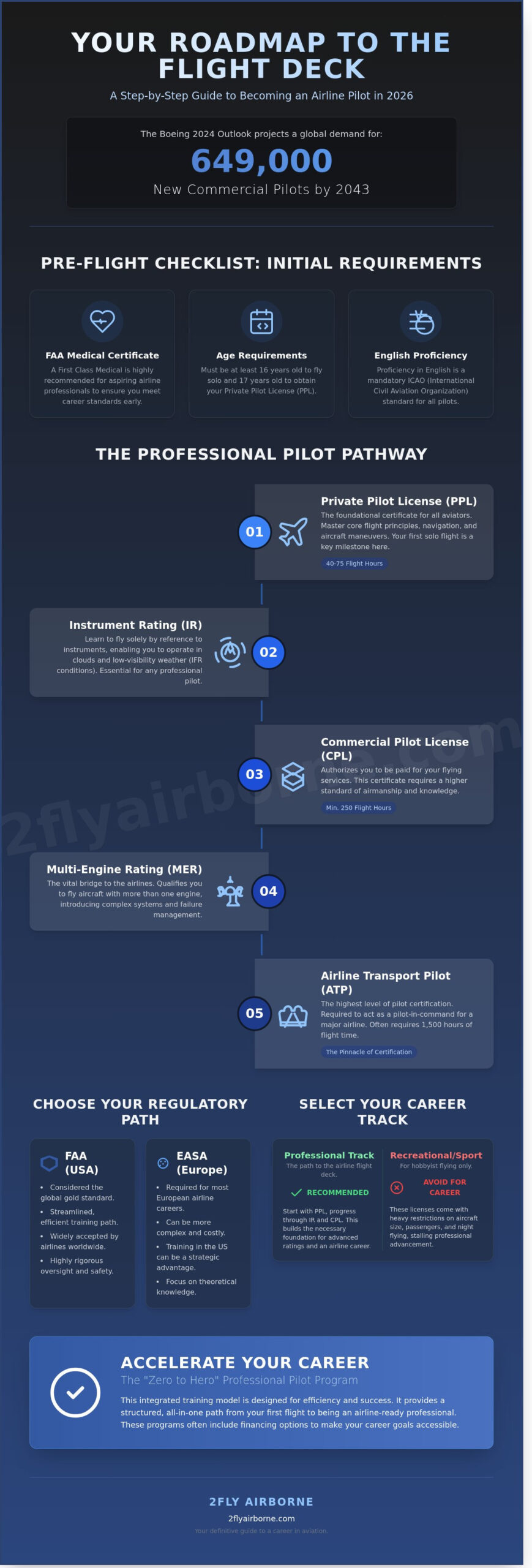
Your journey to the flight deck begins with a structured series of certifications. Each milestone builds the technical proficiency and mental discipline required for a career in the skies. You’ll move from a novice observer to a command pilot capable of managing complex systems in challenging environments.
Phase 1: The Foundation (Student & PPL)
Before you ever touch the controls for a solo flight, you must secure two critical documents: the Student Pilot Certificate and an FAA Medical Certificate. Aspiring professionals should aim for a First Class Medical early. This ensures you meet the physical standards required for an airline career before investing significant time in training. To begin, you must be at least 16 years old to solo and 17 to earn your pilot license, while demonstrating English language proficiency as required by ICAO standards.
The Private Pilot License (PPL) is your entry point into the aviation world. You’ll balance intensive ground school theory with 40 to 75 hours of actual flight time. Ground school covers aerodynamics, weather patterns, and federal regulations. In the cockpit, you’ll master basic maneuvers and cross-country navigation. The first solo flight remains the most significant psychological milestone in a pilot’s life. It’s the moment your instructor steps out and trusts you to command the aircraft alone. This phase culminates in a checkride, a practical exam with an FAA evaluator that verifies your ability to operate safely and confidently.
Phase 2: Building Professionalism (IR & CPL)
Once you hold a private pilot license, the focus shifts toward professional precision. The Instrument Rating (IR) is often cited by cadets as the most demanding phase of training. You’ll learn to fly solely by reference to your flight instruments, ignoring physical sensations to rely on data. This skill is vital for airline operations, allowing you to fly through clouds and low-visibility conditions. Mastering IFR (Instrument Flight Rules) transforms you from a fair-weather flyer into a versatile professional.
The transition to the Commercial Pilot License (CPL) marks your evolution into a pilot who can fly for "hire or reward." This stage isn’t just about more hours; it’s about higher standards. You’ll perform advanced maneuvers like power-off 180-degree landings and steep spirals with surgical accuracy. To qualify for the FAA Commercial certificate, you must reach a minimum of 250 total flight hours under Part 61 regulations, or fewer in a structured Part 141 environment. This phase prepares you for the high-stakes environment of commercial aviation, where safety and efficiency are paramount.
The global demand for these skills is accelerating. According to the 2025 Boeing Pilot and Technician Outlook, the industry requires hundreds of thousands of new pilots to meet upcoming fleet expansions. If you’re ready to begin this progression, you can speak with a training advisor at 2Fly Airborne to map out your specific timeline.
The Commercial Multi-Engine Rating: Bridging the Gap to Airline Readiness
Earning a single-engine commercial certificate is a major milestone, but it’s rarely the final stop for those targeting a major carrier. Regional and international airlines prioritize candidates with experience in multi-engine environments. This rating transforms your pilot license from a basic credential into a professional toolset capable of handling heavy, fast, and complex machinery. It represents the shift from flying for fun to flying for a living. Most airline recruiters require a specific block of multi-engine time before they’ll even review an application, making this rating a non-negotiable step for the career-minded aviator.
Mastering Complex Aircraft Systems
Transitioning to a multi-engine platform introduces a higher level of cockpit management and technical responsibility. You’ll master systems like constant-speed propellers, retractable landing gear, and cowl flaps. Training often centers on the Piper Seminole, a reliable twin-engine trainer that mimics the operational logic of larger transport-category jets. The most critical skill you’ll develop involves managing asymmetric thrust. When one engine fails, the aircraft naturally wants to yaw and roll toward the dead engine. You must react with precision and muscle memory to maintain control. This technical mastery is what separates general aviators from elite professionals.
The Pathway to the Right Seat
This rating acts as the primary currency for airline recruitment. Recruiters look for multi-engine blocks in your logbook to verify you can handle the high-workload environment of a commercial flight deck. Obtaining your multi-engine pilot license endorsement is a foundational requirement for meeting Airline Transport Pilot (ATP) standards. According to the 2024 Boeing Pilot and Technician Outlook, the industry needs 674,000 new pilots over the next 20 years. Having this rating puts you at the front of that hiring wave.
Modern training utilizes high-fidelity simulators to drill emergency procedures safely and effectively. These sessions allow you to practice engine-out climbs and instrument approaches until they become second nature. This specialized training is a core component of the FAA First Officer Program. It ensures you’re ready for the right seat of a regional jet immediately after graduation.
If you’re ready to elevate your career and secure your future in the sky, contact a 2Fly Airborne training advisor today. Our team is ready to help you map out a syllabus that turns your ambition into a professional reality. Don’t wait to start your journey toward the flight deck.
FAA vs. EASA: Comparing International Pilot License Standards
Choosing where to earn your pilot license is a strategic career decision that dictates your future employment geography. Most aspiring aviators choose between the Federal Aviation Administration (FAA) standards in the United States or the European Union Aviation Safety Agency (EASA) regulations. While both jurisdictions produce elite professionals, the training environment and regulatory requirements differ significantly. Understanding these nuances helps you select the path that aligns with your long-term goals at the flight deck.
The Florida Advantage for International Students
Many European students choose to enroll in an EASA flight school USA program based in Florida to bypass the limitations of training in Europe. Florida provides more than 300 days of flyable weather annually, which prevents the seasonal delays that often stall training in Northern Europe for months. This consistency allows you to complete your hours on a much tighter timeline. Lower fuel prices and reduced airport landing fees in the US also offer a clear cost benefit. By training in a residential academy, you enter a total immersion environment where you live and train alongside other global cadets, fostering a professional mindset from day one.
Choosing Your Career Jurisdiction
Your choice of license should match the headquarters of your target airline. If you plan to fly for a major European carrier, an EASA license is essential. However, the FAA pilot license carries immense global recognition. Many airlines in Asia and the Middle East prioritize FAA-trained pilots because of the high standard of American instruction. While regulations differ, the physics of flight remains constant across all jurisdictions. You must decide if you want to be a specialist in one region or a versatile professional capable of operating under multiple regulatory frameworks.
Moving between these licenses involves a conversion process. This typically requires passing specific theoretical exams and a flight skills test to prove your proficiency under the new jurisdiction’s rules. For international students, the visa process is the first practical step. The M-1 visa is the standard for vocational flight training, while the F-1 visa is available for those who choose a degree program with airline pilot training. According to the 2025 Boeing Pilot and Technician Outlook, the industry will need 674,000 new pilots by 2044. Training in an efficient, high-volume environment like Florida ensures you’re ready to meet this demand ahead of your peers.
Ready to start your journey toward a global aviation career? Contact a 2Fly Airborne training advisor to discuss your international licensing options today.
Launching Your Career: Choosing the Right Professional Pilot Program
Transitioning from a student to a professional aviator requires a strategic pathway. The "Zero to Hero" model serves as this roadmap, providing an integrated curriculum that streamlines the journey to your pilot license. Instead of fragmented training sessions, these programs offer a full-time, immersive environment that mirrors airline operations from day one. This structure doesn’t just save time; it builds the professional discipline required in a commercial cockpit. Before committing to any program, it’s worth reviewing a comprehensive flight school selection guide to ensure your chosen academy meets the rigorous standards that airlines expect from their future pilots.
Success in this field relies on understanding the long-term industry trajectory. The Boeing Pilot Outlook projects a global need for 674,000 new commercial pilots by 2043. To meet this demand, you’ve got to prepare for the financial commitment. Evaluating the pilot training cost early allows you to explore funding options, including specialized aviation loans and scholarships. Once you’ve earned your initial ratings, the Certified Flight Instructor (CFI) rating becomes your primary tool for career growth. It provides a reliable way to build the 1,500 flight hours required for airline placement while earning a living and refining your own technical knowledge.
The Value of an Accredited Program
Choosing between fixed-price tuition and pay-as-you-go models is a critical financial decision. Fixed-price programs provide a clear budget, reducing the risk of unexpected costs during your training. For those looking to maximize their credentials, a degree program with airline pilot training combines flight certifications with academic achievement. You should also evaluate the school’s infrastructure. Look for modern fleets equipped with glass cockpits and advanced flight simulators that prepare you for the technology found in modern jets.
Your First Step Toward the Flight Deck
The journey begins with a single action. Schedule a Discovery Flight to experience the cockpit environment firsthand or attend upcoming aviation events to meet instructors and current cadets. A high-tier flight academy offers more than just flight hours. It provides a community of mentors and recruitment support to help you navigate the hiring process. These connections are often the bridge between finishing your training and securing a seat at a commercial airline. Your future in the sky is waiting, and the right partnership ensures you’re ready to lead it.
Ready to take control of your future? Contact a 2FLY Airborne training advisor today for a personalized career roadmap and begin your journey toward a professional pilot license.
Take Command of Your Future in the Flight Deck
The road to a professional aviation career requires more than just passion; it demands a structured, strategic approach to your training. By 2026, the global demand for airline-ready professionals will continue to rise, making your choice of academy a critical career decision. You’ve explored how to navigate the complex landscape of FAA and EASA standards and the importance of a multi-engine rating in bridging the gap to the airlines. Securing your pilot license is the definitive first step toward a global career that offers both technical mastery and immense professional reward.
At 2FLY Airborne, we provide an elite training environment designed to transform cadets into industry leaders. Our programs are both FAA and EASA approved, ensuring you meet the highest international standards. You’ll train at our Florida base, where we benefit from over 300 flying days per year to keep your progression on schedule. Our fixed-price professional pilot programs provide the transparency and reliability required for serious career planning.
Don’t leave your ambitions to chance. Speak with a 2FLY Airborne Training Advisor to start your journey and join the next generation of elite aviators. We’re ready to help you reach the flight deck.
Frequently Asked Questions
What is the minimum age to get a pilot license?
You can begin flight training at any age, but the FAA requires you to be at least 17 years old to earn a private pilot license. For those pursuing a career, the minimum age for a commercial certificate is 18. If your goal is the captain’s seat, you must reach age 23 to obtain an unrestricted Airline Transport Pilot (ATP) certificate. Contact a 2Fly Airborne advisor to plan your timeline today.
How much does a commercial pilot license cost in 2026?
Total investment for professional flight training varies based on the training track and aircraft type used. According to 2024 industry data from the Aircraft Owners and Pilots Association (AOPA), professional training paths often range between $80,000 and $110,000. These figures cover the progression from initial flight through commercial certification. Since costs fluctuate with fuel prices, speak with a 2Fly Airborne training advisor for a current breakdown.
Can I get a pilot license if I wear glasses?
You can absolutely earn a pilot license if you wear glasses or contact lenses. The FAA requires that your vision is correctable to 20/20 in each eye for a first-class medical certificate. During your medical examination, an Aviation Medical Examiner (AME) will verify that your sight meets these professional standards. Many elite airline pilots fly daily using corrective lenses without any impact on their career progression.
How long does it take to go from zero experience to a commercial pilot?
A dedicated student in an accelerated Part 141 program can move from zero experience to a commercial pilot in approximately 7 to 10 months. This timeline requires a full-time commitment to ground school and flight maneuvers. Factors like weather conditions and individual aptitude influence the exact duration of your training. Our team at 2Fly Airborne helps you maintain a structured schedule to reach your professional goals efficiently.
What is the difference between a PPL and a CPL?
The primary difference lies in your ability to receive compensation for your flight services. A Private Pilot License (PPL) allows you to fly for personal enjoyment and carry passengers, but you can’t be paid for it. In contrast, a Commercial Pilot License (CPL) is a professional credential that permits you to act as a pilot for hire. This certification is the essential foundation for any career in the flight deck.
Is a college degree required to become an airline pilot?
A college degree isn’t a legal requirement under FAA regulations to fly for an airline, but major carriers still prefer candidates with a four-year degree. Regional airlines often hire pilots based on their flight hours and certifications alone. In the 2026 hiring environment, focusing on high-quality flight training is the fastest way to enter the industry. You can always complete a degree online while working as a professional pilot.
How many flight hours are required for an ATP certificate?
You need 1,500 total flight hours to qualify for an unrestricted Airline Transport Pilot (ATP) certificate in the United States. Certain approved collegiate programs allow for a Restricted ATP at 1,000 or 1,250 hours. These hours include specific requirements for cross-country, night, and instrument flight time. Reaching this milestone is the final step before you’re eligible to serve as a first officer for a Part 121 air carrier.
Can international students train for a pilot license in the USA?
International students are welcome to train in the United States by obtaining an M-1 or F-1 vocational visa. You must first apply to an FAA-approved flight academy that’s authorized to issue Form I-20. Once your visa is approved, you’ll undergo a Transportation Security Administration (TSA) background check before starting your flight lessons. 2Fly Airborne specializes in helping global cadets navigate these requirements to launch their international aviation careers.
Article by
2FLY Airborne
2Fly Airborne is a professional flight training organization dedicated to developing the next generation of skilled, confident, and safety-focused pilots. With decades of combined aviation experience, our team of certified instructors provides structured, real-world training designed to prepare students for both checkrides and long-term success in the aviation industry.
Content Disclaimer
Some blog content is generated with the assistance of automated tools and may not always be fully accurate or up to date. Please verify all aviation-related information with official sources or a certified instructor. For additional guidance or clarification, we encourage you to contact one of our training advisors at 2Fly Airborne.