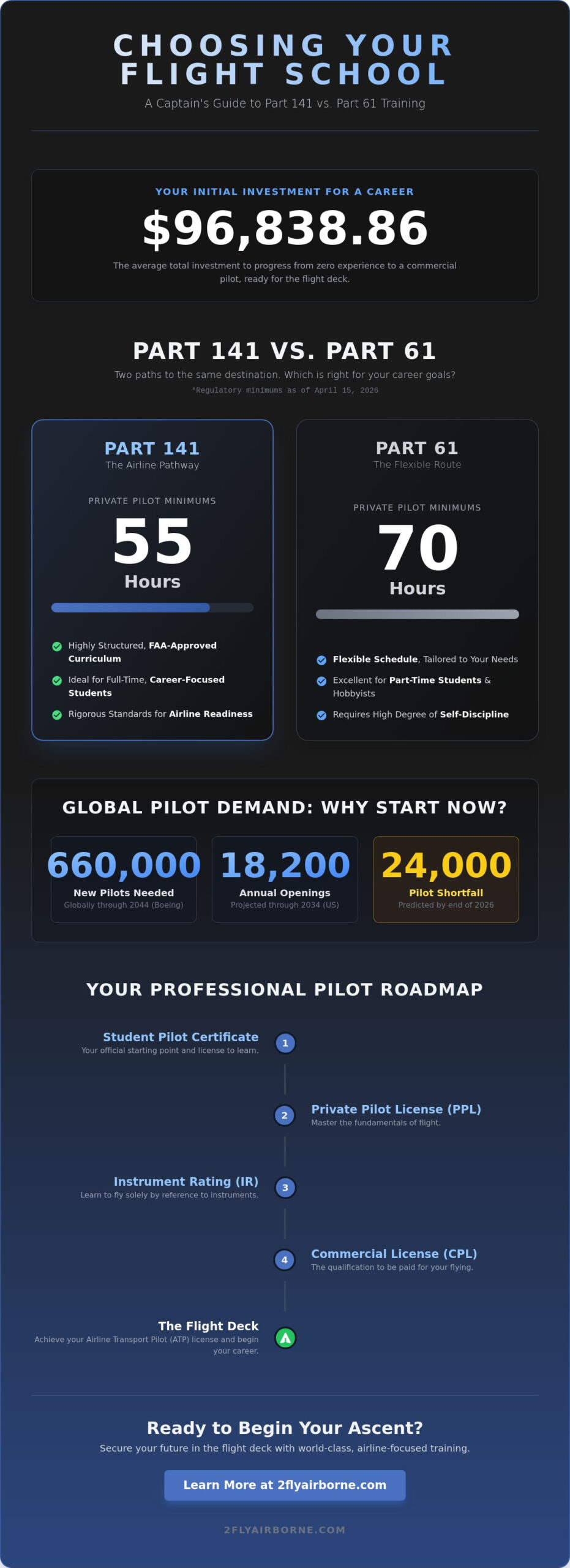
Selecting a flight school is the single most important investment you’ll make before ever stepping into a cockpit. You likely feel the weight of this choice as you weigh the $96,838.86 total investment against the dream of reaching the flight deck. It is understandable to feel confused by the regulatory shifts updated on April 15, 2026, such as the FAA reducing Part 141 private pilot minimums to 55 hours while increasing Part 61 requirements to 70 hours. You want to be certain that your training environment matches the high standards of the airlines that will eventually hire you.
Earning your commercial certificate is a major achievement, but you still need to bridge the gap to the 1,500-hour requirement for the Airline Transport Pilot (ATP) certificate in the US. Many graduates choose to become a Certified Flight Instructor (CFI) to build these hours efficiently. Teaching new students solidifies your own aeronautical knowledge and refines your stick-and-rudder skills. This period of professional development is where you transition from a skilled operator to a true leader in the cockpit, and utilizing platforms like LogFlightPro can help you manage your digital logbooks and career services. Choosing a flight school that offers a clear pipeline from student to instructor can significantly accelerate your timeline to the airlines.
We promise to help you cut through the noise and approach this decision with the mindset of a captain. This guide provides a definitive roadmap to master the criteria for evaluating elite academies and securing your commercial pilot license with confidence. We will examine the latest 2026 financing options, vet training environments for airline readiness, and provide a step by step plan to ensure your chosen school leads directly to a global career. You’ll gain a clear checklist to evaluate instructors, aircraft fleets, and safety records before you log your first hour.
Key Takeaways
- Contrast recreational flying clubs with professional academies to select a training environment that supports long-term career objectives.
- Evaluate the benefits of a structured Part 141 flight school curriculum designed to meet the rigorous demands of commercial aviation.
- Identify the step by step progression of ratings and certificates necessary to transition from zero experience to the flight deck.
- Compare fixed-price training models against hourly rates to secure your financial investment and ensure budget transparency.
- Adopt a “Global Pilot” mindset by choosing an institution that emphasizes international standards and airline-ready professional development.
Understanding the Flight School Landscape: Your Gateway to the Flight Deck
A professional flight school is much more than a place to rent an airplane; it is a structured educational environment where you acquire essential aeronautical knowledge and practical skills. While recreational flying clubs offer a casual atmosphere for hobbyists, professional pilot academies provide the rigorous training required for a commercial career. Choosing the right environment ensures you develop the discipline expected by major carriers. The FAA Student Pilot Certificate is the regulatory starting point for all US flight training.
To better understand how to select the right environment for your goals, watch this helpful video:
Immersion in a professional atmosphere is critical for those seeking a career on the flight deck. You need to grasp the details of Understanding Pilot Certification to navigate the different stages of your education effectively. Elite academies prioritize safety, standardized procedures, and technical precision from day one. This high standard prepares you for the demands of flying multi-million dollar jets across international borders. It also instills the professional habits that airline recruiters look for during the hiring process.
The Role of the Flight Academy in Career Development
An academy acts as your mentor and primary gateway to the global aviation industry. It facilitates the transition from a student with zero experience to an airline-ready professional who possesses the maturity to lead a crew. This journey involves more than logging hours; it requires a deep understanding of crew resource management and advanced systems. You can explore the specific steps required in our guide on How to Become a Pilot: The Comprehensive 2026 Guide to Aviation Careers. Choosing an institution that focuses on global standards ensures you are prepared for employment anywhere in the world.
Aviation Career Outlook: Why Start Now?
Flight training is a long-term commitment that typically spans between 12 and 24 months. Because airline careers are strictly governed by seniority, your date of hire determines your schedule, pay, and aircraft assignments for decades. Starting your training today positions you to fill the 18,200 annual openings projected through 2034. The 2025 Boeing Pilot and Technician Outlook projects a demand for 660,000 new pilots globally through 2044. Building a professional pipeline now is the most effective way to secure your future in a field facing a predicted shortfall of 24,000 pilots by the end of 2026. This urgency makes the selection of a high-quality training program a vital first step for your long-term success.
Evaluating Training Environments: Part 61 vs. Part 141 Flight Schools
Does the structure of your training environment actually impact your hiring potential at a major airline? The answer lies in the regulatory framework the flight school operates under. You’ll primarily choose between FAA Part 61 and Part 141 programs, each offering a distinct approach to pilot development. Understanding these differences is vital to ensure your training aligns with FAA Pilot Training Standards while meeting your career timeline.
Part 61 training is characterized by its flexibility and is often led by individual instructors. It’s an excellent choice for part-time students who need to balance flight hours with other professional commitments. As of April 15, 2026, the minimum flight hour requirement for a Private Pilot Certificate under Part 61 is 70 hours. While adaptable, this path requires a high degree of self-discipline to ensure all aeronautical knowledge is mastered without a rigid schedule.
In contrast, Part 141 flight schools utilize a highly structured, FAA-approved curriculum. These programs are designed for professional cadets who intend to fly for the airlines. Because of the increased oversight and mandatory stage checks, the FAA allows for reduced flight hour minimums; currently 55 hours for a private certificate. Airlines often prefer graduates from these environments because the syllabus mimics the rigorous, standardized training used by commercial carriers. If you are aiming for a career-track program, exploring an FAA professional pilot program can provide the consistency you need.
Vetting the Academy: Fleet, Facilities, and Instructors
A modern training fleet should feature “glass cockpit” technology like the Garmin G1000 to prepare you for contemporary airliners. You should also evaluate the instructor-to-student ratio to avoid training delays. A ratio of 1:4 or better typically ensures you receive the dedicated attention necessary for steady progress. For a deeper look at vetting specific locations, read our guide on Choosing a Pilot Academy in Florida: The 2026 Professional Guide.
Safety Culture and Regulatory Compliance
Professional academies must implement a Safety Management System (SMS) to proactively manage risks. This system isn’t just a manual on a shelf; it’s a living culture where safety concerns are reported and addressed without penalty. Ask potential schools about their aircraft availability and maintenance schedules to ensure you won’t be grounded by mechanical issues. Transparent safety records and a commitment to rigorous maintenance are non-negotiable standards for any elite institution. You deserve to train in an environment where safety is the foundation of every mission.
The Professional Pilot Roadmap: How to Progress Through Your Ratings
Many aspiring aviators are drawn in by “Zero to Hero” marketing that promises a seamless transition to the flight deck. However, becoming an elite pilot requires mastering a series of specific regulatory milestones, each serving as a building block for the next. This structured progression ensures you develop the technical proficiency and decision-making skills needed for a global career. You can find a detailed breakdown of these milestones in our 2026 Guide to Obtaining Your Pilot License. While timelines vary based on your dedication and local weather conditions, following a proven syllabus at a reputable flight school is the most reliable path to success.
Step 1: The Private Pilot Certificate (PPL)
The Private Pilot Certificate is the essential foundation of your entire aviation journey. During this stage, you focus on Visual Flight Rules (VFR), which involve navigating by looking outside and mastering basic aircraft handling. It’s vital to obtain your FAA medical certificate early in this phase to ensure there are no regulatory hurdles to your solo flight. This initial certification proves you can safely operate a single-engine aircraft in fair weather. Industry resources like How to Choose a Flight School emphasize that your performance here sets the tone for your professional discipline.
Step 2: Instrument Rating (IR) and Commercial Certificate (CPL)
Once you’ve mastered VFR, you transition to the Instrument Rating (IR). This phase teaches you to fly solely by reference to your flight instruments, allowing you to operate safely in clouds and low-visibility conditions (IFR). This is a critical skill for any “airline-ready” professional. Following the IR, you work toward your Commercial Pilot License (CPL). This milestone is significant because it’s the legal requirement that allows you to fly for compensation or hire. Most career-focused students also complete a Multi-Engine Rating (ME) at this stage, which is a standard prerequisite for regional and major airlines.
Step 3: Building Experience and the CFI Path
Earning your commercial certificate is a major achievement, but you still need to bridge the gap to the 1,500-hour requirement for the Airline Transport Pilot (ATP) certificate in the US. Many graduates choose to become a Certified Flight Instructor (CFI) to build these hours efficiently. Teaching new students solidifies your own aeronautical knowledge and refines your stick-and-rudder skills. This period of professional development is where you transition from a skilled operator to a true leader in the cockpit. Choosing a flight school that offers a clear pipeline from student to instructor can significantly accelerate your timeline to the airlines.
Managing the Investment: Financing and Logistics for Full-Time Training
Professional flight training is a significant financial commitment that requires a strategic approach to budgeting. The current total cost for a professional airline pilot program is $96,838.86, covering tuition and non-tuition expenses. Choosing a flight school that offers “fixed-price” or “flat-fee” programs provides much better budget certainty than paying hourly rates. Hourly rentals for a Cessna 172 currently range from $180 to $220, while instructor rates are between $60 and $90 per hour. These variable costs can quickly spiral if training is delayed by weather or maintenance. A fixed-fee model locks in your costs, allowing you to focus entirely on your performance in the cockpit.
Funding Your Training: Loans and Scholarships
Most cadets secure funding through specialized aviation loan providers like Sallie Mae or Meritize. As of May 1, 2026, federal student loan interest rates for the current school year are 6.39% for undergraduate students. Private lenders offer a wide range of options; Sallie Mae provides fixed rates from 2.89% to 17.64% APR depending on credit history. Having a co-signer is often essential to secure the most competitive rates and higher loan limits. Beyond tuition, you must budget for “hidden” costs such as FAA checkride fees and essential pilot supplies like headsets and flight bags. You can explore your professional funding options and begin the application process at 2FLY Financing to see which path fits your career goals.
International Students: Visas and M-1/F-1 Requirements
Aspiring pilots from outside the United States face additional administrative requirements before they can begin training. You’ll need a flight school with a dedicated international department to handle SEVIS registration and visa sponsorship. Most professional training is conducted under an M-1 vocational visa, while F-1 visas are generally reserved for academic degree programs. The administrative support for these documents is vital to ensure your legal status remains secure throughout your stay. Immersion is equally important for your success. Opting for on-campus housing allows you to live and breathe aviation alongside your peers, maximizing your focus on the curriculum. This environment fosters the “Global Pilot” mindset necessary for a transition to an international airline career.
Transitioning to the Airlines: The 2FLY Airborne Professional Advantage
Reaching the flight deck of a major airline is the ultimate goal of your training journey. At 2FLY, we focus on developing “Global Pilots” who possess the technical versatility to excel in any international aviation environment. This philosophy ensures you aren’t just passing a checkride; you’re preparing for a lifelong career. The 2025 Boeing Pilot and Technician Outlook projects a demand for 660,000 new pilots globally through 2044. Choosing a flight school that prioritizes this long-term vision is the most effective way to secure your place in the industry.
Our FAA Airline Pilot Program is specifically designed for rapid and efficient career entry. It takes you from zero experience to a commercial multi-engine pilot, providing a structured pipeline to the airlines. Success in this field depends on the quality of your foundation. Safe, structured training is the only reliable path to a sustainable career as a professional aviator.
The Global Pilot Concept: FAA and EASA Integration
A significant advantage of training with a global perspective is the ability to navigate different regulatory standards. While you earn your FAA certificates in the United States, we provide a clear pathway for those seeking European (EASA) certification. You can learn more about this process in our pillar article, EASA Flight School USA: The 2026 Guide to European Pilot Training in Florida. This dual perspective makes you a more versatile and employable candidate for international carriers.
Final Steps: Speaking with a Training Advisor
Your journey to the cockpit is unique and deserves a personalized plan that accounts for your specific goals and timeline. A Training Advisor acts as your mentor, helping you bridge the gap between your current experience and your first day of training. They can answer questions about financing, housing, and the daily rhythm of the flight school environment. Reach out to a 2FLY Training Advisor to begin your transition from a student to an airline-ready professional. Success in aviation begins with the quality of your foundation, and we’re here to help you build it.
In summary, choosing the right training environment requires vetting the fleet, understanding regulatory structures, and securing a clear financial plan. By following a structured roadmap through your private, instrument, and commercial ratings, you build the discipline required for the flight deck. Always prioritize schools that offer a professional atmosphere and a direct pipeline to employment. If you have any remaining questions about starting your career, please reach out to a 2FLY Training Advisor for expert guidance.
Secure Your Future on the Flight Deck
Selecting a flight school is the most critical decision you’ll make in your early aviation career. By focusing on a structured training environment and a verified roadmap of ratings, you set the stage for long term success. You must ensure your chosen academy offers the right balance of safety, modern technology, and financial transparency. This professional rigor is what separates a hobbyist from an airline-ready pilot.
2FLY Airborne delivers this elite experience through FAA and EASA compliant training options and a large aircraft fleet. Our state of the art flight simulators provide the technical depth required for modern cockpits. We maintain a global recruitment network to support our graduates as they transition into professional roles. You possess the ambition; we provide the gateway to your global career.
Ready to start your journey? Speak with a 2FLY Training Advisor today to map out your path to the airlines. It’s the best way to get personalized answers for your specific situation. We suggest reaching out to a 2FLY Training Advisor with any remaining questions you have about the process. Your future in the sky begins with a single, professional step.
Frequently Asked Questions
How long does it take to complete flight school?
It typically takes 12 to 24 months to progress from zero experience to a commercial pilot ready for professional employment. A Private Pilot Certificate alone usually takes approximately 3 months of dedicated full time training. Your individual timeline depends on your training frequency, local weather conditions, and the specific syllabus of your chosen flight school.
What is the difference between a Part 61 and a Part 141 flight school?
The primary difference lies in the level of structure and FAA oversight required for the training. Part 141 schools follow a strictly approved syllabus and allow for reduced flight hour minimums, such as 55 hours for a private certificate. Part 61 schools offer more flexibility for part-time students but require 70 hours for private pilots as of April 2026.
Can I get financial aid or a loan for flight school?
Yes, you can secure financing through federal student loans or private lenders like Sallie Mae and Meritize. As of May 1, 2026, federal undergraduate loan rates are 6.39% for the current school year. Many students utilize a co-signer to access the most competitive private rates, which can start as low as 2.89% APR for highly qualified applicants.
Do I need a college degree to become a commercial pilot?
You don’t need a college degree to earn your commercial pilot license or work for regional airlines. However, many major legacy carriers still prefer or require a four-year degree for competitive hiring. You can often combine your flight school training with an accredited degree program to maximize your long-term career prospects at the highest levels of global aviation.
What are the medical requirements for attending flight school?
You must obtain an FAA Medical Certificate from an authorized Aviation Medical Examiner to fly solo and earn your licenses. Commercial pilots typically need a First-Class Medical, which evaluates vision, hearing, and cardiovascular health. Recent updates on April 15, 2026, have expanded BasicMed rules, providing more flexibility for certain student and private pilot applicants in specific situations.
Can international students attend flight school in the United States?
International students can attend US academies by obtaining an M-1 or F-1 student visa. Your academy must be authorized by the Student and Exchange Visitor Program to issue the required Form I-20. This process involves a background check by the TSA and proof of financial responsibility for the duration of your professional pilot training program.
What is the “1,500-hour rule” for airline pilots?
The 1,500-hour rule is a federal regulation requiring pilots to log 1,500 total flight hours before they can act as a first officer for a US airline. This requirement is necessary to earn the Airline Transport Pilot certificate. Most graduates work as flight instructors after completing their commercial training to build these hours while earning a professional income.
What happens if I fail a checkride during training?
Failing a checkride, which is the final practical test with an examiner, is a hurdle but not a career ending event. You’ll receive additional training in the specific areas where you didn’t meet the standards and then retake the exam. While airlines do review your training record, a single failure followed by a successful recheck is a common occurrence in professional development.
Article by
2FLY Airborne
2Fly Airborne is a professional flight training organization dedicated to developing the next generation of skilled, confident, and safety-focused pilots. With decades of combined aviation experience, our team of certified instructors provides structured, real-world training designed to prepare students for both checkrides and long-term success in the aviation industry.
Content Disclaimer
Some blog content is generated with the assistance of automated tools and may not always be fully accurate or up to date. Please verify all aviation-related information with official sources or a certified instructor. For additional guidance or clarification, we encourage you to contact one of our training advisors at 2Fly Airborne.