What if the sticker price you see on a flight school website is only sixty percent of the actual check you’ll write before reaching the flight deck? It’s a common realization that often comes too late for many aspiring aviators. You’ve likely spent hours wondering how much does faa pilot training cost while trying to decode complex tuition tables and equipment lists.
We know the anxiety that comes with a major career investment. The fear of running out of funds mid-training or being blindsided by hidden FAA fees is a significant hurdle for many future captains. You’re looking for more than just a price tag; you’re looking for a predictable financial roadmap to a commercial career.
This 2026 financial guide promises to strip away the confusion by providing a transparent breakdown of total investment costs, from ground school to your final checkride. You’ll learn the difference between basic tuition and total expenses, helping you choose a career-track program with absolute confidence. We will examine the essential differences between pay-as-you-go models and structured, fixed-price pipelines that maximize your return on investment.
Key Takeaways
- Decode the primary cost drivers of flight school, including aircraft rental rates and instructor fees, to build a realistic training budget.
- Discover exactly how much does faa pilot training cost by accounting for often overlooked expenses like FAA written exams and DPE checkrides.
- Evaluate the benefits of fixed-price professional pilot programs that offer financial protection against fluctuating fuel prices and training delays.
- Understand how logistical factors like on-campus housing and administrative support influence your total investment and overall focus.
- Assess the long-term career value and return on investment of earning your commercial certificates in a structured, high-standard environment.
The Core Components of FAA Pilot Training Costs
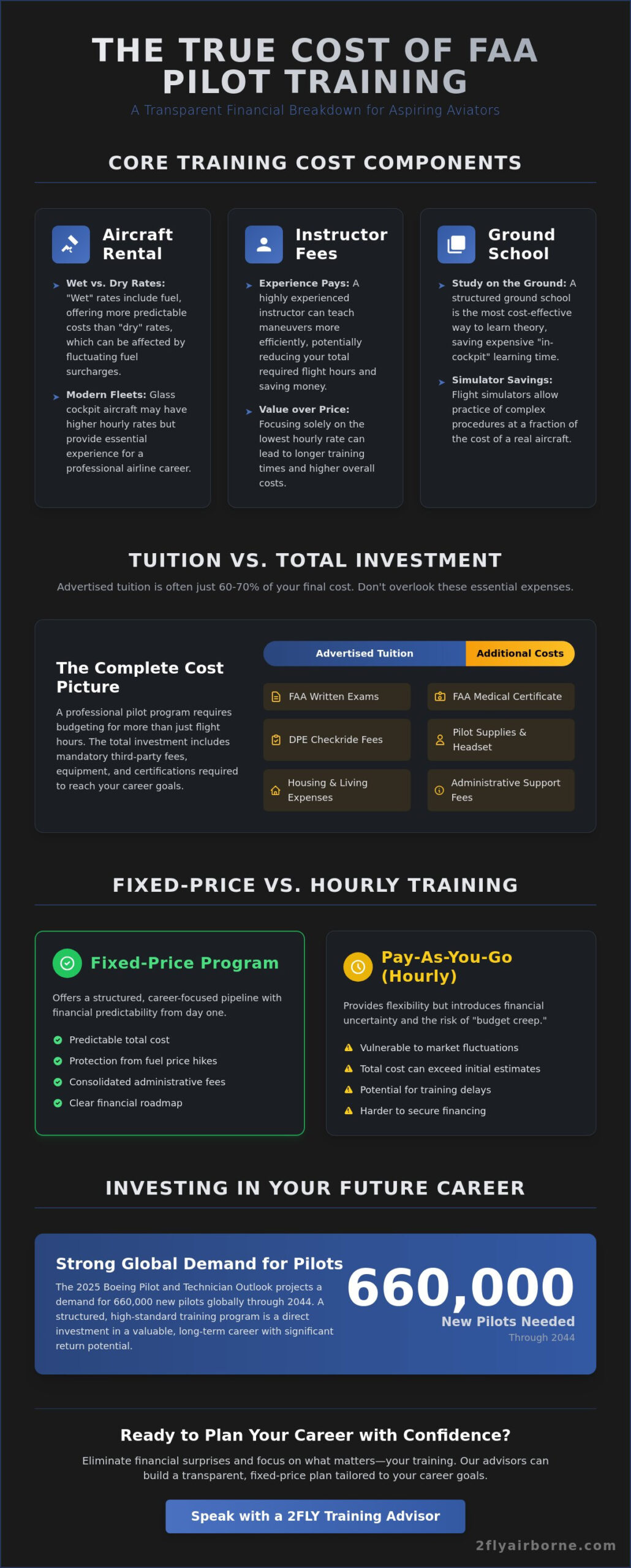
Understanding the financial commitment of flight school requires looking past a single total number. You’re investing in three distinct areas: the aircraft, the instructor’s expertise, and the theoretical knowledge gained on the ground. These pillars form the basis of your training budget and determine the overall efficiency of your progress.
When researching how much does faa pilot training cost, it is essential to recognize that flight hour requirements vary based on the training syllabus. Most students follow specific FAA pilot certification requirements which mandate a minimum number of flight hours for each rating. While the FAA sets a baseline, the national average often exceeds these minimums, directly impacting your total spend.
To better understand how these costs accumulate in a real-world scenario, watch this helpful video:
Aircraft Rental and Instructor Fees
Aircraft rental is usually the largest expense, often quoted as a “wet rate” or a “dry rate.” A wet rate includes the cost of fuel, whereas a dry rate requires you to pay for fuel separately based on your consumption. In many hourly training models, schools apply a fuel surcharge that fluctuates with the market, meaning your final bill could change month to month.
You should also account for the hourly rate of your flight instructor. While it might be tempting to find the lowest price, experienced instructors often help you master maneuvers faster, which reduces your total hours in the plane. Modern fleets equipped with glass cockpits carry a higher hourly price but provide the technical mastery required for a professional career. This technical preparedness is a vital factor when evaluating how much does faa pilot training cost in the long run.
Ground School and Theory Materials
Ground school is where you build the intellectual foundation for your flying. Investing in a structured ground school program prevents “learning in the cockpit,” which is the most expensive way to study. When you arrive at the aircraft fully prepared, every minute of engine time is spent on practical skill development rather than theoretical explanations.
Budgeting for this phase includes digital training kits, textbooks, and essential pilot tools like a high-quality noise-canceling headset. Advanced flight simulators also play a critical role in controlling expenses. They allow you to practice emergency procedures and instrument approaches in a controlled environment at a fraction of the cost of a running aircraft. This efficiency ensures you remain on track both operationally and financially.
Tuition vs. Total Investment: Calculating the Real Bottom Line
Many students enter flight school looking only at the tuition rate for a specific certificate. However, the true answer to how much does faa pilot training cost involves looking beyond the classroom and the cockpit. You must prepare for a series of external fees that are mandatory but often excluded from a school’s advertised tuition prices.
A “zero to hero” approach requires a different financial mindset than modular, pay-as-you-go training. While modular training allows for smaller upfront payments, the administrative “budget creep” can be significant as you move between different ratings. Enrolling in a structured FAA Professional Pilot Program often provides a more cohesive financial roadmap, as it consolidates these transition costs into a single, career-focused track.
Understanding these ancillary costs early allows you to focus on your training rather than your bank balance. The Federal Aviation Administration (FAA) provides the regulatory framework for these requirements, but many associated fees are paid to third-party providers or government agencies. Planning for these from the start ensures your training remains uninterrupted by financial surprises.
FAA Certification and Examination Fees
Every milestone in your training concludes with two critical tests: a written knowledge exam and a practical checkride. Currently, the FAA written exam fee is approximately $175 per attempt. These tests are administered at authorized centers and the fee is paid directly to the testing provider, not your flight school.
The practical exam, or checkride, is conducted by a Designated Pilot Examiner (DPE). These independent professionals typically charge a fee of $750 per exam, though this can vary by region and certificate level. It’s vital to remember that failing a checkride incurs the cost of remedial flight hours and a second examiner fee, making high-quality initial instruction a wise financial safeguard.
Medical and Regulatory Prerequisites
Before you even begin your first flight, you must secure an aviation medical certificate. For those pursuing a commercial career, a First Class Medical certificate is the industry standard and typically costs around $150. This exam ensures you meet the physical standards required to operate commercial aircraft safely and should be completed early to avoid future training delays.
International students face additional administrative layers, including visa processing and SEVIS registration fees. Background checks through the TSA are also a standard requirement for all flight students in the United States. While these individual fees may seem small, they are essential components of your total investment. If you’re concerned about managing these variables, exploring flight school financing options can help you secure the necessary capital for a smooth, uninterrupted training experience.
Fixed-Price vs. Hourly Training: Which Path Saves More?
When calculating how much does faa pilot training cost, many students fall into the “bill shock” trap. They start with an hourly quote that looks affordable but find the total price ballooning because they need extra hours to master specific maneuvers. Hourly models often penalize students for slower progress or unavoidable weather delays, leading to financial stress at the most critical stages of training.
Choosing a structured FAA Professional Pilot Program eliminates this uncertainty. It provides a flat rate for a defined syllabus, protecting you from fluctuating fuel prices or administrative surcharges. This model is typical of Part 141 schools, which follow a rigid, FAA-approved curriculum. These programs are designed for efficiency, often allowing students to graduate with fewer total flight hours than the more flexible but less structured Part 61 schools.
Full-time immersion training in a professional environment ensures high-frequency flying. A student completing a program in six months often spends significantly less than someone stretching a modular path over eighteen months. The momentum of daily flight operations builds muscle memory faster and keeps your training on track, ensuring you reach the flight deck as an industry-prepared professional.
The True Cost of Training Delays
Skill retention is a major factor in your final bill. If you only fly once a week, you spend the first thirty minutes of every lesson relearning what you forgot since the last flight. This “rust” adds up to thousands of dollars in wasted engine time over the course of a year. High-frequency flying ensures that each lesson builds directly on the previous one without the need for repetitive remedial sessions.
A professional training environment provides the discipline required to maintain this momentum. When you fly daily, you stay in a “flying mindset” that accelerates your technical mastery. This efficiency is why a six-month intensive program is often more cost-effective than a long-term modular path, even if the monthly payments seem higher at first glance.
Predictability in Career Planning
Financial security is paramount when making a major career investment. Fixed-price tuition allows you to secure exact funding amounts, making it easier to manage 2FLY Financing options without the fear of running out of money before your final checkride. You can plan your life and your future employment timeline with certainty when you know the total investment required from day one.
Organizations like the AOPA offer resources for financing your flight training, which can complement a structured payment plan. Having a clear end-date and a known total cost gives you the confidence to focus entirely on your technical skills. This clarity serves as the definitive gateway to a stable and rewarding international aviation career.
Budgeting for Success: Beyond the Flight Deck
Imagine securing your commercial certificates only to realize you spent twenty percent more than planned on local logistics and living expenses. While flight hours are the primary driver of how much does faa pilot training cost, your residential and administrative choices can quietly erode your budget. Transitioning from a trainee to an industry-prepared professional requires a stable environment that supports intense study and early morning flight blocks.
Success in a fast-paced training environment depends on your ability to focus entirely on the flight deck. Managing daily living expenses and transportation during full-time training is just as important as mastering a steep turn. If you don’t account for these ‘hidden’ residential costs, your financial plan might face unnecessary strain before you reach your final checkride.
Housing and Residential Logistics
On-campus housing is often the most strategic choice for career-track students. It removes the stress of local transportation and places you in a community of high-achievers who share your professional goals. Staying on-campus maximizes your study time and ensures you are always ready for those critical early-morning flight slots.
Private rentals might offer more independence, but they come with the burden of managing utilities, internet, and fluctuating commuting costs. When you factor in the time lost to traffic and the administrative effort of managing separate bills, the school-managed option often proves more economical. A predictable residential cost allows you to focus your energy on your technical mastery.
International Student Financial Requirements
International candidates often ask how much does faa pilot training cost when factoring in visa sponsorship for M-1 or F-1 status. The US government requires verifiable evidence of funds before issuing these documents to ensure you can complete your syllabus without interruption. You should also account for SEVIS registration fees and the logistics of international wire transfers or currency exchange rates.
The 2025 Boeing Pilot and Technician Outlook projects a demand for 660,000 new pilots globally through 2044. This massive international need highlights why the administrative investment in a US-based pilot school is a direct pipeline to a global career. This focus on your professional end result ensures that every dollar spent is an investment in your future mobility.
If you are ready to begin this journey with a clear financial roadmap, explore the FAA Professional Pilot Program to see how we help streamline the transition for our international cadets.
Investing in Your Future: Financing and Career ROI
Viewing flight school as a simple expense ignores the rapid transition from student to professional earner. Once you secure your Commercial Pilot Certificate and progress to becoming a Certified Flight Instructor (CFI), you shift from paying for flight hours to being paid to build them. This phase is the primary engine for your return on investment; it allows you to reach the 1,500-hour airline requirement while earning a professional wage.
When analyzing how much does faa pilot training cost, you must also weigh the interest rates and repayment terms of your funding. Choosing a school with a proven track record of airline placements can often lead to more favorable terms from specialized aviation lenders. A structured path reduces the total time spent in training, which in turn minimizes the total interest accrued on your investment.
Global Demand and Salary Potential
The 2025 Boeing Pilot and Technician Outlook projects a demand for 660,000 new pilots globally through 2044. This sustained demand has driven starting salaries for first officers at regional and major carriers to historic highs. For a detailed look at these industry trends and the data driving this growth, you can review the full Boeing Outlook PDF.
A career in the cockpit offers a unique financial trajectory where your earning potential increases significantly with every year of seniority. While the initial investment is substantial, the long-term rewards of a global aviation career far outweigh the startup costs for those with the drive to succeed. This focus on the end result is what distinguishes high-achievers in the industry.
Your Next Steps Toward the Cockpit
Every pilot’s financial situation is unique, making a personal consultation an essential step before you begin your journey. You should prepare your financial documents and proof of funds early to ensure a seamless application process. This preparation allows you to move through the enrollment phase with the same precision you will eventually bring to the flight deck.
In summary, while understanding how much does faa pilot training cost is vital, selecting a safe and structured training environment is the most efficient way to reach your goals. A disciplined approach ensures you graduate as a highly skilled professional ready for the international stage. We suggest reaching out to a 2FLY Training Advisor with any remaining questions to develop a tailored financial plan that aligns with your professional ambitions.
Take Command of Your Aviation Career
Transitioning from a trainee to a commercial professional requires a clear understanding of your total investment. We have explored how identifying the real answer to how much does faa pilot training cost involves looking beyond basic hourly rates to include examiner fees, residential logistics, and regulatory prerequisites. Choosing a structured, high-standard environment ensures you don’t face the financial “bill shock” that often derails modular students.
Since 1994, our organization has maintained a proven airline placement history by focusing on technical mastery and vocational preparedness. By utilizing fixed-price tuition models for career-track programs, we provide the financial predictability you need to focus entirely on the flight deck. Our comprehensive on-campus housing and visa support further streamline the process for international candidates seeking a global career path.
Your future in the cockpit is a direct result of the disciplined choices you make today. You should speak with a 2FLY Training Advisor to receive a personalized cost breakdown and career plan. Please reach out to a 2FLY Training Advisor with any remaining questions as you prepare to take flight. The sky is no longer the limit; it is your new office.
Frequently Asked Questions
Is it cheaper to do flight training Part 61 or Part 141?
Part 141 programs are frequently more economical for those pursuing a commercial career because they follow a more efficient, FAA-approved syllabus. While Part 61 offers flexibility for hobbyists, the rigid structure of Part 141 often results in students completing their ratings with fewer total flight hours. This efficiency directly translates to a lower total investment for career-track aviators.
Can I get a student loan to cover the entire cost of flight school?
You can secure specialized aviation loans to cover the full cost of professional training. Lenders like Sallie Mae or Meritize provide financing options that include tuition, materials, and even housing for qualified students. Most candidates require a co-signer to secure the best interest rates and ensure their training remains uninterrupted by financial hurdles.
How much should I budget for pilot supplies like headsets and iPads?
Expect to spend between $1,500 and $2,500 on your initial pilot toolkit. A high-quality noise-canceling headset, which is vital for long-term hearing protection and clear communication, accounts for about $1,100 of this budget. You’ll also need an iPad with a cellular GPS chip, digital flight planning software, and a durable flight bag.
What happens to my money if I decide to leave flight school early?
Refund policies are governed by your individual training contract and vary significantly between flight schools. Most professional academies refund any unspent balance on your account, though they may retain a small administrative fee. It’s essential to understand these terms before starting your syllabus to ensure your capital remains protected.
Do international students pay more for FAA pilot training?
International students pay the same base tuition as domestic students but must budget for additional regulatory and travel expenses. These include SEVIS registration, visa processing fees, and international medical insurance. These costs are a standard part of the transition into the US training environment for global candidates seeking professional mobility.
Are there scholarships available for commercial pilot training in 2026?
Numerous scholarships are available through industry groups like the Aircraft Owners and Pilots Association (AOPA) and Women in Aviation International (WAI). These awards can range from a few thousand dollars to full tuition coverage for specific ratings. Leveraging these resources is a smart way to manage how much does faa pilot training cost while building your professional resume.
How much do FAA checkrides and written exams cost on average?
FAA written exams currently cost $175 per attempt, while practical checkrides with an examiner typically range from $750 to $1,000. These are external fees paid directly to the testing provider or the Designated Pilot Examiner. You should budget for these separately from your flight school tuition to avoid surprises at the end of each rating phase.
Does the cost of flight school include housing and meals?
Most flight school quotes cover only the cost of instruction and aircraft rental. Residential programs may offer on-campus housing and meal plans as a consolidated package to provide cost certainty for the duration of the program. When calculating how much does faa pilot training cost, always ask for a breakdown that specifies whether housing is included in the total quote.
Article by
2FLY Airborne
2Fly Airborne is a professional flight training organization dedicated to developing the next generation of skilled, confident, and safety-focused pilots. With decades of combined aviation experience, our team of certified instructors provides structured, real-world training designed to prepare students for both checkrides and long-term success in the aviation industry.
Content Disclaimer
Some blog content is generated with the assistance of automated tools and may not always be fully accurate or up to date. Please verify all aviation-related information with official sources or a certified instructor. For additional guidance or clarification, we encourage you to contact one of our training advisors at 2Fly Airborne.