What if the most challenging part of your aviation journey isn’t the first solo landing, but simply mapping out the flight plan to get there? Many talented candidates feel stalled by complex FAA regulations and the uncertainty of medical eligibility. Mastering the specific steps to get a pilot’s license is the critical first move in building a career that spans the globe.
You’ve likely felt the weight of conflicting advice regarding training costs and flight school structures. It’s essential to distinguish between a casual hobby and the disciplined progression required for a professional flight deck. We promise to demystify this process by providing a definitive roadmap from your initial training to your commercial certification.
This guide breaks down the essential milestones of professional development, including the Private Pilot Certificate and the Commercial Pilot License. You’ll gain the clarity needed to approach your training with the mindset of an industry leader. This roadmap provides the confidence to take that first step toward the cockpit and launch your international career.
Key Takeaways
- Identify essential FAA eligibility requirements, including age and medical standards, to confirm your path toward a professional career is clear.
- Navigate the critical steps to get a pilot’s license by understanding the progression from a student pilot to a certified commercial aviator.
- Evaluate the structural differences between Part 61 and Part 141 flight schools to select the environment that maximizes your training efficiency.
- Secure a realistic perspective on the financial commitment required in 2026 and explore strategic options for funding your professional aviation education.
- Learn how an integrated Professional Pilot Program serves as a direct pipeline to global employment opportunities in the modern aviation industry.
Meeting the Prerequisites: Are You Eligible for Flight Training?
Every professional aviator’s journey begins on the ground with a reality check of eligibility. While the dream of flight is universal, the FAA maintains specific standards to ensure safety and operational excellence across the industry. Taking a discovery flight is the unofficial first step, allowing you to experience the cockpit environment before committing to the formal pilot licensing and certification process. It’s the moment where passion meets the practical reality of the controls.
To better understand the initial progression and what to expect during your first hours, watch this helpful video:
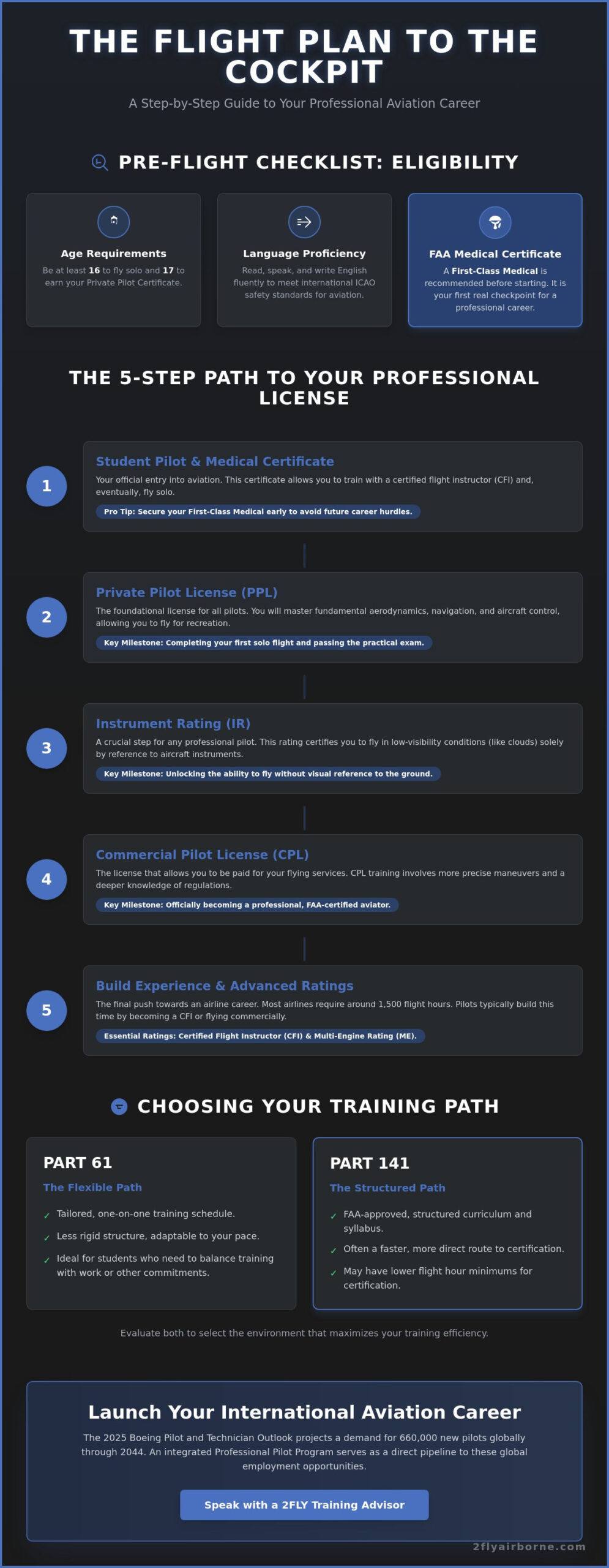
To begin your training, you must be at least 16 years old to fly solo and 17 years old to earn your Private Pilot Certificate. You also need to demonstrate the ability to read, speak, and write English fluently to meet international standards. These foundational requirements represent the first steps to get a pilot’s license and transition into a professional career. If you meet these basic criteria, you’re ready to secure your medical clearance and begin your technical education.
The FAA Medical Certificate: Your First Real Checkpoint
The FAA medical exam is a non-negotiable checkpoint that validates your physical readiness for flight. There are three distinct classes: Third-Class for private pilots, Second-Class for commercial activities, and First-Class for airline transport pilots. If your goal is a professional career, we recommend obtaining a First-Class medical certificate before your very first lesson. This proactive approach ensures no underlying health issues will prevent you from reaching the captain’s seat years down the road.
You must visit an Aviation Medical Examiner (AME) to complete this physical, which includes vision, hearing, and cardiovascular checks. Common disqualifiers often involve certain neurological conditions or chronic cardiovascular issues, but many conditions are eligible for special issuance. Securing this certificate early provides the confidence to invest in your training without fear of future medical grounding. It’s a vital part of the steps to get a pilot’s license and maintain your professional standing.
Educational and Language Requirements
Aviation operates on global standards, making English proficiency mandatory for clear communication with Air Traffic Control. The International Civil Aviation Organization (ICAO) sets these language standards to ensure safety during international professional mobility. While a high school diploma is the minimum requirement for flight training, the path to a major airline often involves higher education. Many top-tier carriers prefer candidates with a college degree, though the specific field of study is less important than the degree itself.
Your technical aptitude and discipline during flight school are the true indicators of your potential as a professional pilot. Success in this field requires a commitment to lifelong learning and a high degree of professional responsibility. You don’t need to be a math genius, but you must be comfortable with mental calculations and spatial awareness. Focus on building a strong foundation in these areas to excel in the rigorous ground school environment.
The 5 Essential Steps to Get a Professional Pilot License
Achieving a seat on a commercial flight deck is a mission of strategic progression rather than a single event. While many aspiring aviators focus solely on the initial solo, the true path involves a series of technical hurdles designed to build professional resilience. Understanding the exact steps to get a pilot’s license allows you to allocate your resources effectively and avoid the common pitfalls of unstructured training.
This roadmap is designed to transform a student pilot into an industry-prepared professional. Each certification builds upon the last, creating a comprehensive skill set that meets international standards. By following this structured sequence, you ensure that every hour in the air contributes directly to your ultimate career goals.
Step 1 & 2: From Student Pilot to Private Pilot
Before you can earn your wings, you must navigate ground school and the FAA written exam. This phase builds the theoretical knowledge required for navigation, weather interpretation, and aircraft systems. These initial steps to get a pilot’s license set the tone for your entire career, proving you can handle the aircraft independently during your first solo. Earning the Private Pilot Certificate (PPL) requires meeting minimum flight hour requirements and passing a rigorous checkride.
Step 3 & 4: Mastering the Instruments and Going Pro
The Instrument Rating (IR) is the gateway to professional capability, allowing you to fly through clouds and in low-visibility conditions. It demands a high level of mental discipline and precise control. Once you’ve mastered instrument flight, you will work toward the flight hours required by FAA regulations for commercial pilots. The Commercial Pilot License (CPL) introduces advanced maneuvers and holds you to the exacting standards expected of a paid professional.
Step 5: Multi-Engine and Advanced Ratings
Transitioning to a twin-engine aircraft like the Piper Seminole is the final step in your initial professional training. This Multi-Engine Rating (ME) is essential because airlines prioritize pilots who have demonstrated competence in complex systems and engine-out procedures. Many students find that enrolling in an FAA Airline Pilot Program provides the most efficient route through these certifications. To reach the 1,500-hour mark for the airlines, many graduates also obtain their Certified Flight Instructor (CFI) ratings to gain valuable experience while building their logbooks.
Choosing Your Path: Part 61 vs. Part 141 Flight Schools
Does the structure of your flight school actually impact your future employment? While the end goal remains the same, the framework you choose is a pivotal component of the steps to get a pilot’s license. Selecting between Part 61 and Part 141 training isn’t just about cost; it’s about matching your training environment to your professional ambitions. High-achievers often find that a structured setting mirrors the precision required by major airlines.
Understanding the career path for pilots involves recognizing that modern aviation demands standardized excellence. The 2025 Boeing Pilot and Technician Outlook projects a demand for 660,000 new pilots globally through 2044, and the training path you select today determines how quickly you can meet that demand. Whether you prefer a flexible schedule or a rigid syllabus, your choice should align with the long-term rewards of the profession.
Part 61: Flexibility for the Independent Learner
Part 61 training is governed by general regulations that allow for a highly personalized schedule. It’s often conducted at local flying clubs where you work one-on-one with an instructor at your own pace. This path is ideal for those who have other full-time commitments or prefer to pay as they go. However, the lack of a rigid syllabus can sometimes lead to training plateaus, potentially extending the time it takes to reach your goals.
- Pros: Maximum flexibility for those balancing external careers or family.
- Cons: Potential for inconsistent progress and higher total flight hours due to less structure.
- Best for: Recreational pilots or independent learners who don’t have a strict timeline for employment.
Part 141: The Fast-Track to a Commercial Career
Part 141 schools operate under a specific, FAA-approved syllabus that mandates a structured progression. This collegiate-style environment is designed for students whose primary goal is vocational preparedness and international professional mobility. Because of the oversight and rigorous standards, Part 141 programs allow you to earn certifications with fewer total flight hours. For example, a Commercial Pilot License requires only 190 hours under Part 141 compared to the 250 hours mandated under Part 61.
At 2FLY Airborne, we utilize these structured programs, such as our FAA Airline Pilot Program, to ensure students are industry-prepared. Training in high-density airspace, which is typical for flight schools in Florida, prepares you for the complex radio communications and traffic patterns found at major international airports. This exposure is invaluable for those transitioning from a trainee to a professional aviator ready for the global stage.
Financing and Planning Your Flight Training Investment
Have you ever wondered why some trainees finish their ratings months ahead of their peers? It often comes down to financial readiness rather than just raw flying skill. Securing your funding before beginning the first steps to get a pilot’s license prevents training interruptions that can lead to costly skill decay. A well-planned budget is the foundation of a disciplined professional career.
The 2025 Boeing Pilot and Technician Outlook projects a demand for 660,000 new pilots globally through 2044. This historic demand suggests that the return on investment for high-quality training is exceptionally strong. A professional career path requires a realistic timeline, typically ranging from 10 to 18 months for an accelerated program. Maintaining momentum during this period is essential for retaining technical knowledge and flight proficiency.
Budgeting for More Than Just Flight Hours
Budgeting for flight hours is only one part of the equation. You must also account for FAA examiner fees, which are paid directly to the examiner for each practical test. Other costs include high-quality headsets, electronic flight bags, and digital charting subscriptions. Training at a local field often leads to “pay-as-you-go” traps where inconsistent funding leads to repeated lessons. For a detailed breakdown of these expenses, consult our Flight School Cost Guide.
Beyond the aircraft rental and instructor rates, you must consider the cost of living during your training. If you are training in a premier location like Florida, you may need to budget for short-term housing and transportation. High-quality programs often integrate these logistics into their planning to help you maintain a singular focus on your certifications. Understanding these variables early is a hallmark of a disciplined professional who values technical mastery.
Financing Your Future
Financing a professional career is a standard practice for most high-achieving candidates. Specialized lending partners understand the aviation industry and offer loan structures tailored to the training timeline. When you compare the earning potential of a senior captain to the initial training investment, the vocational value becomes clear. You can Learn about financing options that align with your specific career goals and international mobility.
Traditional four-year degrees often involve high costs without a direct pipeline to a specific profession. In contrast, flight training is a targeted vocational investment that places you in a high-demand job market immediately upon completion. Many airlines now offer tuition reimbursement or signing bonuses for qualified candidates who have completed their training at reputable institutions. This financial support can significantly offset the initial costs of your ratings. Take the time to assess your financial roadmap today to ensure a seamless transition from the classroom to the cockpit. Check out our FAA Airline Pilot Program to see how our structured approach maximizes your training budget.
The 2FLY Path: Launching Your International Aviation Career
The journey from a student pilot to a professional aviator is a complex mission that requires more than just checking boxes on a list. While the general steps to get a pilot’s license are well-defined, the quality of your training environment determines your ultimate success in the airline recruitment process. Choosing to train with an organization that acts as a definitive gateway to an international career ensures you aren’t just learning to fly, but preparing for a lifelong profession.
Training in Florida offers a strategic edge that few other regions can match. Our location allows for maximum flight time and consistent progress, which is vital for building the muscle memory and technical skills required of a commercial pilot. This environment fosters a sense of discipline and professionalism from day one, setting you apart from candidates who trained in less demanding airspaces.
The 2025 Boeing Pilot and Technician Outlook projects a demand for 660,000 new pilots globally through 2044. This massive requirement means that airlines are looking for pilots who have been trained to the highest standards of safety and proficiency. A mentor-led approach provides the guidance necessary to navigate FAA regulations and career transitions with confidence.
The FAA Professional Pilot Program Advantage
Our FAA Professional Pilot Program is designed to provide financial certainty and a clear path to the flight deck. By bundling ratings into a structured, all-inclusive format, you avoid the hidden costs often associated with modular training. You’ll also join a diverse, international community of high-achievers, fostering a network that will support you throughout your global career. This collegiate atmosphere is essential for those who value both technical mastery and long-term rewards.
Beyond the License: Career Support and Mentorship
Earning your ratings is only the beginning of your professional journey. We focus on the final transition to employment by preparing you for the technical and behavioral aspects of the airline interview process. Building a professional network during your time in school is just as important as your time in the simulator. These connections often lead to your first officer position and beyond, reinforcing the idea that your training is a direct pipeline to employment.
In summary, the steps to get a pilot’s license involve meeting prerequisites, selecting the right training structure, and committing to a rigorous sequence of certifications. Safe, structured training is the only reliable way to ensure you are prepared for the demands of the modern aviation industry. If you are ready to transform your ambition into a career, our team is here to guide you through every milestone. We encourage you to take the first step toward the flight deck today.
Reach out to a 2FLY Training Advisor with any remaining questions you have about starting your journey.
Chart Your Course to the Professional Flight Deck
Navigating the steps to get a pilot’s license is a disciplined journey that transforms a passion for flight into a specialized career. You now understand that your foundation rests on early medical eligibility and the strategic selection of a structured training environment. Balancing the technical demands of instrument and multi-engine ratings with a clear financial plan ensures you maintain the momentum necessary for professional success.
Founded in 1994, 2FLY Airborne provides FAA and EASA approved training designed to meet the rigorous standards of global aviation. Our Florida-based operations provide world-class weather and high-density airspace experience, while our focus on global recruitment creates a direct pipeline to international airlines. This comprehensive approach ensures you’re not just earning a certificate, but preparing for the long-term rewards of your chosen profession.
Ready to take command of your future? Speak with a 2FLY Training Advisor today. We specifically suggest reaching out to a 2FLY Training Advisor with any remaining questions to help refine your personal roadmap. Your future in the skies starts with a single, decisive step toward the flight deck.
Frequently Asked Questions
How long does it realistically take to get a pilot’s license?
A Private Pilot Certificate typically takes three to six months for modular students; however, an accelerated professional program can move a candidate from zero experience to a Commercial Pilot License in 10 to 18 months. Your timeline depends heavily on weather, instructor availability, and your personal training frequency. Consistency is the primary factor in reducing the total duration of your training.
Can I get a pilot’s license if I wear glasses or contacts?
You can absolutely earn a license while wearing glasses or contacts, provided your vision is correctable to 20/20 for a First-Class or Second-Class medical certificate. The FAA requires that you wear your corrective lenses while flying if your medical certificate specifies this limitation. Pilots with color vision deficiencies should consult an Aviation Medical Examiner to discuss specific testing options and potential operational restrictions.
What is the difference between a Private and Commercial Pilot License?
The primary difference is the authority to receive compensation for your flight services. A Private Pilot Certificate allows you to fly for personal or business transport but prohibits you from being paid for flight time or carrying passengers for hire. Earning a Commercial Pilot License is one of the essential steps to get a pilot’s license for a professional career, as it grants the legal right to work as a pilot.
Do I need a college degree to fly for a major airline?
A college degree isn’t a legal FAA requirement for any pilot certification, but most major airlines still view a four-year degree as a competitive advantage during the hiring process. Many regional airlines have removed this requirement to address pilot demand. Candidates often choose to complete their flight training first to enter the workforce quickly, sometimes pursuing a degree online while building flight hours.
How many flight hours are required to become an airline pilot?
To serve as an airline pilot for a Part 121 carrier, you must obtain an Airline Transport Pilot (ATP) certificate, which generally requires 1,500 total flight hours. Some graduates from approved collegiate or military programs may qualify for a Restricted ATP at 1,000 or 750 hours. This requirement is why many graduates become flight instructors to build the necessary experience while earning a living in the industry.
Is it better to train in a Part 61 or Part 141 flight school?
Part 141 schools are typically better for career-oriented students because they offer a structured, FAA-approved syllabus that often requires fewer total hours for certification. Part 61 schools provide more flexibility, which suits independent learners or those with unpredictable schedules. If your goal is an international career, the standardized environment of a Part 141 program better prepares you for the rigorous training of the airline industry.
What happens if I fail an FAA written exam or checkride?
Failing an FAA written exam or checkride is a hurdle, but it isn’t a career-ending event. You’ll need to receive remedial training from an instructor on the specific areas where you struggled and receive a new endorsement before retaking the test. While airlines do look for training consistency, a single failure followed by successful completion demonstrates resilience and a commitment to maintaining professional standards.
Can international students get a pilot’s license in the USA?
International students can certainly complete their training in the United States by securing an M-1 or F-1 visa and obtaining TSA clearance. The USA remains a premier destination for global flight training due to its world-class infrastructure and diverse weather conditions. This path is one of the most effective steps to get a pilot’s license for those seeking international professional mobility. The 2025 Boeing Pilot and Technician Outlook projects a demand for 660,000 new pilots globally through 2044, highlighting the immense value of this training.
Article by
2FLY Airborne
2Fly Airborne is a professional flight training organization dedicated to developing the next generation of skilled, confident, and safety-focused pilots. With decades of combined aviation experience, our team of certified instructors provides structured, real-world training designed to prepare students for both checkrides and long-term success in the aviation industry.
Content Disclaimer
Some blog content is generated with the assistance of automated tools and may not always be fully accurate or up to date. Please verify all aviation-related information with official sources or a certified instructor. For additional guidance or clarification, we encourage you to contact one of our training advisors at 2Fly Airborne.