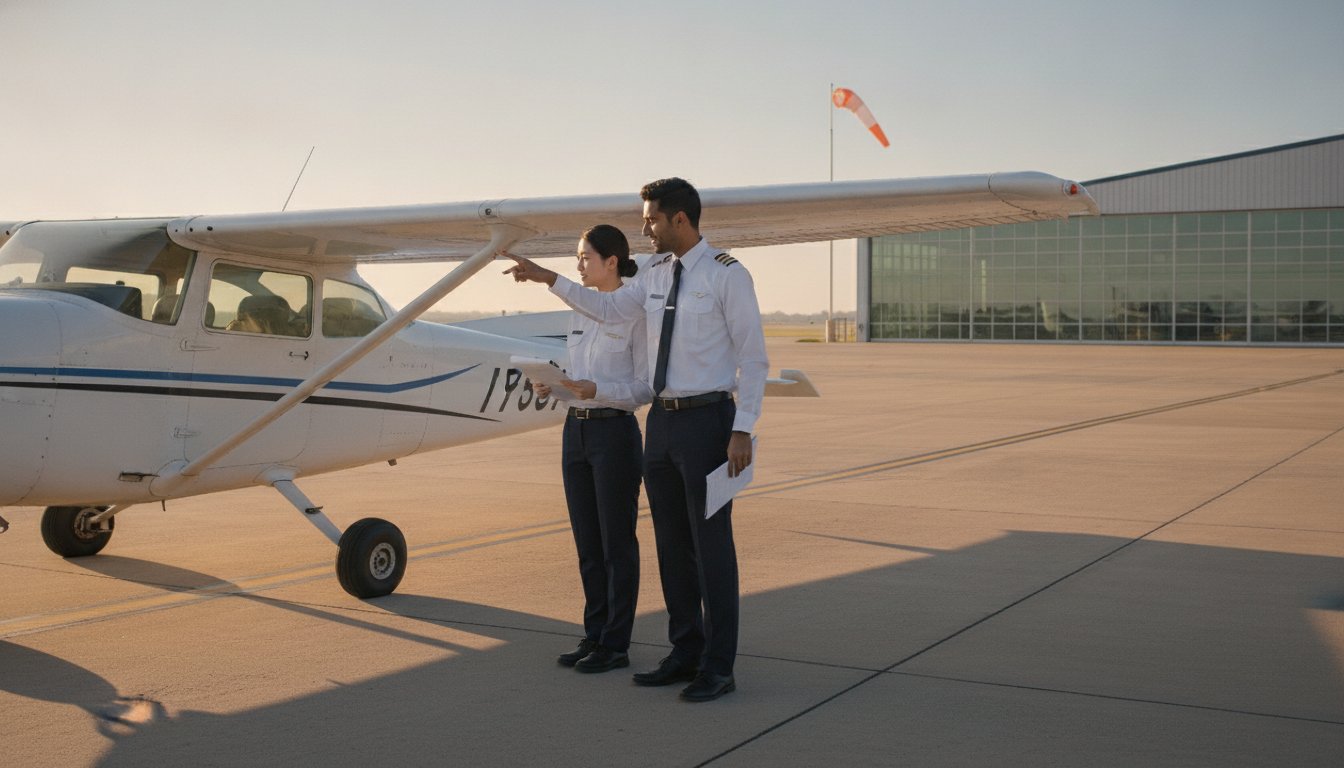
Imagine spending weeks mastering a complex maneuver, only to have a month of low ceilings and ice-covered runways erase your muscle memory. This is the primary reason why savvy students seek out year-round flight training USA to keep their progress on track. For many aspiring aviators, seasonal weather is more than a nuisance; it’s a significant barrier that leads to skill decay and rising costs.
You deserve a training environment that respects your ambition and your financial commitment. We understand that constant momentum is the key to professional mastery, and interruptions only serve to distance you from your career goals. By training in a climate that supports daily flight operations, you ensure your path to the flight deck remains both efficient and predictable.
This article explores how a structured, high-utilization environment allows you to complete your professional pilot journey in just 10 to 12 months. We’ll also look at how fixed-price budgeting and seamless logistics can transform your transition from a trainee into an industry-ready professional prepared for the global stage.
Key Takeaways
- Learn how a high-utilization training environment can condense your path to the commercial cockpit into a focused 10–12 month timeline.
- Understand how year-round flight training USA eliminates the “skill decay” typically caused by seasonal weather interruptions and long training gaps.
- Identify the hidden costs associated with seasonal flight schools, including extended housing leases and the financial burden of unnecessary refresher flight hours.
- Discover why on-campus housing and M-1 or F-1 visa sponsorship are essential components for a seamless international training experience.
- Explore the strategic advantage of fixed-price tuition models that protect your investment against industry cost escalations.
The Strategic Advantage of Continuous Flight Training in the USA
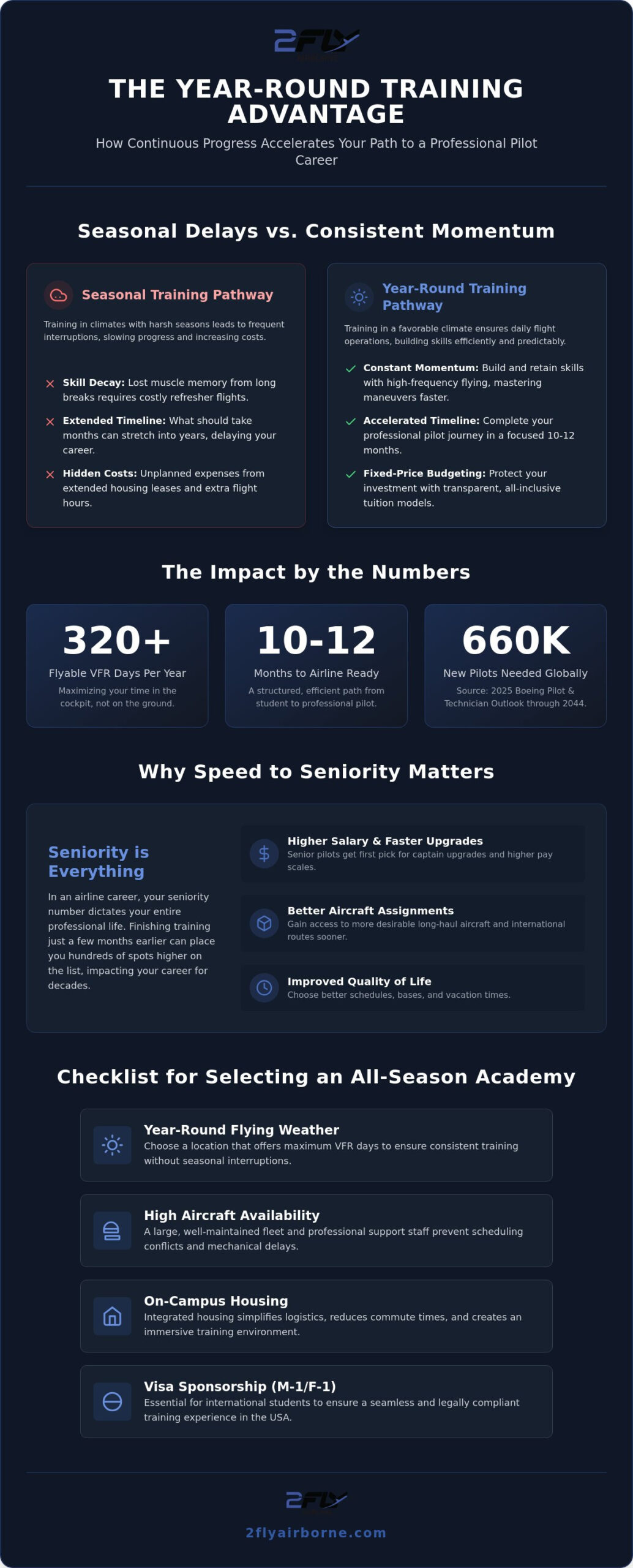
Success in the cockpit depends on consistency and repetition. Choosing year-round flight training USA allows candidates to fly upwards of 320 days per year, providing a level of continuity that seasonal programs simply cannot match. This approach eliminates the “three steps forward, two steps back” experience common in climates where winter storms or persistent low visibility ground students for weeks at a time. When training stops for extended periods, skill decay begins immediately, forcing students to spend extra money on refresher hours just to regain their previous proficiency.
Maintaining a high frequency of flight hours is essential for navigating the FAA pilot certification process with confidence. This continuous exposure builds the deep-seated muscle memory needed to pass checkrides on the first attempt. The United States offers a uniquely robust aviation infrastructure, featuring a vast network of secondary airports and air traffic control services designed to support high-volume training. This allows for a density of operations that ensures your transition from a student to a professional pilot remains unbroken.
To better understand this concept, watch this helpful video showing the results of consistent, focused training:
Why Timing Matters for Aspiring Commercial Pilots
In the airline industry, seniority is the primary driver of your career. It dictates your salary, your aircraft assignments, and your quality of life for decades. Entering the workforce even four months late can push you down hundreds of spots on a seniority list, potentially costing you a year of career progression at the captain level later in life. Training momentum is the preservation of muscle memory and cognitive procedures through frequent, uninterrupted practice. By choosing an accelerated path, you aren’t just finishing sooner; you’re securing a more lucrative and stable future.
- Reduced Refresher Costs: You won’t pay for “warm-up” hours to regain skills lost during a long winter break.
- Faster Certification: Moving through ratings without pauses keeps technical knowledge fresh for written exams.
- Professional Discipline: Daily flight operations mirror the rigorous rhythm of a commercial airline career.
Beyond the Sunshine: The Logistics of Consistency
Weather is only half of the equation for a successful training experience. Reliable progress requires a massive commitment to aircraft availability and professional maintenance. High utilization of a fleet means planes are flying constantly, which demands a dedicated support team working behind the scenes to ensure safety and reliability. At 2FLY Airborne, we meticulously manage every flight slot to ensure students in the FAA Airline Pilot Program never miss a scheduled training event. This level of logistical precision ensures that your development is never paused by mechanical delays or scheduling conflicts.
Maximizing VFR Days: The Science Behind Year-Round Progress
This reliability isn’t just about convenience; it’s about meeting a global need. The 2025 Boeing Pilot and Technician Outlook projects a demand for 660,000 new pilots globally through 2044. To meet this staggering requirement, training centers must operate with high efficiency. When the weather remains predictable, flight schools can maintain a strict syllabus, ensuring that every hour spent in the classroom is followed immediately by an hour in the cockpit. This synchronization is what prevents the “knowledge gap” that occurs when theory isn’t reinforced by action.
There’s a common misconception that training in consistently fair weather produces less capable pilots. In reality, the opposite is true. By mastering the fundamentals in a stable environment, you build a solid foundation of stick-and-rudder skills without the added stress of hazardous weather. Once these basics are second nature, you can then focus your cognitive energy on the complexities of instrument flight and advanced systems.
Understanding VFR vs. IFR Training Environments
While the Private Pilot Certificate (PPL) stage relies on clear horizons, the transition to an Instrument Rating (IR) introduces you to flying solely by reference to instruments. Predictable weather patterns in the USA actually help this transition. They allow instructors to choose specific days for “simulated instrument” work using view-limiting devices or to find consistent cloud layers for actual instrument conditions. This structured approach ensures you meet all official FAA pilot requirements while maintaining a steady pace. If you’re interested in how these pathways evolve, explore our guide on Pilot Training in 2026.
The Role of Advanced Flight Simulators
Modern training doesn’t stop when the sun goes down or if a rare storm rolls in. State-of-the-art flight simulators provide a “weather-proof” environment where you can practice complex procedures and emergency scenarios that would be too dangerous to attempt in a real aircraft. These sessions are a core part of the FAA First Officer Program, allowing you to refine your cockpit management skills in a controlled setting. This blend of real-world flying and simulator precision creates a highly disciplined pilot ready for the airline environment. If you’re ready to see how this structure fits your goals, speaking with a training advisor can clarify your next steps.
Comparing Seasonal Delays vs. Accelerated Year-Round Pathways
Choosing where to train is often a choice between a lower hourly rate and a lower total investment. While a local flight school in a seasonal climate might seem cheaper on paper, the “hidden costs” of weather delays quickly erode those savings. Every week spent on the ground due to snow or low ceilings represents more than just lost time; it translates to extended housing leases and the inevitable need for “refresher” flight hours to regain lost proficiency.
The difference between a structured Part 141 program and a flexible Part 61 approach becomes especially clear when evaluating year-round flight training USA. Part 141 academies follow a strict, FAA-approved syllabus that demands consistent progress, which is only possible when the weather cooperates nearly every day of the year. This structure provides a predictable path that allows students to focus on mastering the technical concepts found in FAA Aviation Handbooks & Manuals without the distraction of constant rescheduling.
Aspiring pilots often ask if training at a premier academy is more expensive than the alternative. When you account for the “living cost creep” of a program that drags on for two years, the accelerated model is frequently the more economical choice. At 2FLY Airborne, our fixed-price Professional Pilot Program provides financial immunity to training extensions. You won’t face unexpected invoices because a particularly rainy month required extra sessions to get you back up to checkride standards.
The ‘Momentum Gap’ and Your Training Budget
A student who flies three times a week builds muscle memory significantly faster than one who flies once every two weeks. This “momentum gap” is the silent budget killer of seasonal flight training. When lessons are frequent and consistent, you spend less time reviewing previous material and more time advancing through new ratings. This efficiency can save you thousands in “re-learning” hours, a factor we detail extensively in our guide to Flight School Costs.
Timeline Expectation: Seasonal vs. All-Season
Contrast the typical 18 to 24 month timeline of a seasonal school with the 10 to 12 month pace of an accelerated year-round program. Finishing your ratings in half the time means you enter the Certified Flight Instructor (CFI) phase much sooner. This allows you to start earning a salary and building the 1,500 hours required for airline entry while your peers in seasonal climates are still finishing their initial commercial certificates. For those ready to commit to this fast-paced environment, various Financing options are available to help bridge the gap between zero experience and a professional cockpit.
Essential Criteria for Selecting an All-Season Flight Academy
Many students assume that a flight school’s location is purely a matter of scenery. However, for those aiming for a commercial cockpit, the logistical ecosystem surrounding the airfield is just as critical as the weather above it. Choosing year-round flight training USA means entering a high-paced environment where you need a partner that handles the details so you can focus on handling the aircraft.
An elite institution acts as a gateway to an international career by managing the complexities that often stall a student’s progress. Look for schools that offer a global recruitment network and dedicated support for international candidates. This level of institutional reliability ensures you aren’t just another number in a large flight center. It creates a stable, professional foundation for your development from the very first day.
The Logistical Ecosystem: Housing and Visas
For many, the greatest hurdle isn’t the flying itself but the administrative burden of relocating. Living on-campus fosters a “total immersion” culture where “hangar talk” with fellow student pilots accelerates your learning outside of the cockpit. Sharing experiences and challenges with peers creates a supportive community that’s vital for maintaining high performance during intensive training. This residential model keeps you focused on your goal without the stress of external commuting or housing searches.
International applicants must prioritize schools that offer comprehensive M-1 and F-1 visa sponsorship. Navigating the SEVIS system and visa processing requires specialized administrative expertise that only established academies provide. This support is a non-negotiable requirement for anyone traveling from abroad to train in the United States. Without it, your timeline could be delayed by months of paperwork before you even reach the flight line.
Fleet Quality and State-of-the-Art Facilities
A promise of 300 or more flying days is meaningless if the aircraft are grounded due to maintenance backlogs. A robust fleet size and an in-house maintenance team are clear indicators of a school’s ability to deliver on a year-round schedule. High-utilization fleets must be maintained to the highest FAA standards to ensure safety and reliability for every scheduled flight slot. Reliability in your equipment is just as important as reliability in the weather.
Training at a facility that understands both FAA and EASA standards provides maximum career mobility for pilots looking to work across different global regions. The FAA Professional Pilot Program is a comprehensive pipeline designed to transition you from zero experience to an industry-prepared professional. This structured approach ensures you’re ready for the rigorous demands of a commercial airline. If you’re ready to start this journey, speaking with a training advisor can help you navigate the first steps.
Launching Your International Career with 2FLY Airborne
How does it feel to finally sit in a commercial cockpit after months of dedicated effort? The transition from a trainee to a professional is a defining moment in any aviator’s life. 2FLY Airborne acts as the definitive gateway to this milestone, merging optimal weather conditions with a rigorous curriculum and seamless logistics. By leveraging year-round flight training USA, we ensure your momentum never stalls, transforming your raw ambition into vocational preparedness.
Safe, structured training is the only viable foundation for a successful 30 year aviation career. Our environment is designed to mirror the professional standards you will encounter at major airlines, ensuring you are industry-ready from day one. By integrating every aspect of the student experience, we provide a stable and world-class setting for your professional development.
The 2FLY Difference: Fixed-Price Predictability
In an industry where costs often spiral due to unforeseen weather delays or mechanical issues, our fixed-price model offers a rare level of certainty. This flat-fee structure removes the stress of “ticking clocks,” allowing you to focus entirely on technical mastery rather than rising invoices. Knowing that your flight hours and simulator sessions are covered provides the mental clarity needed for high-stakes training environments. Reach out to a 2FLY Training Advisor with any remaining questions about our fixed-price paths.
Your Pathway to the Global Cockpit
Your journey begins with zero experience but quickly progresses through a structured syllabus toward becoming a Certified Flight Instructor (CFI). This phase is a critical bridge, allowing you to build the necessary hours for airline entry while gaining valuable teaching experience. Training in the USA under world-class standards affords you unparalleled international mobility, making you a competitive candidate for global carriers. The 2025 Boeing Pilot and Technician Outlook projects a demand for 660,000 new pilots globally through 2044.
This massive global demand highlights why starting your journey now is a strategic career move. We invite you to Speak with a Training Advisor about our Professional Pilot Program to learn how we can accelerate your path to the flight deck.
Summary of Key Takeaways:
- Year-round training preserves cognitive momentum and essential muscle memory.
- Fixed-price models protect your investment against “hidden” cost escalations.
- Seamless logistics, including on-campus housing and visa support, simplify the international student journey.
- A structured pathway from trainee to CFI leads directly to professional airline roles.
Choosing a safe and disciplined training environment is the most important decision you will make for your future. If you have any remaining questions about starting your career, please contact 2FLY Airborne to speak with a training advisor. We suggest reaching out to a 2FLY Training Advisor with any remaining questions to ensure you have the most accurate information for your specific situation.
Secure Your Future on the Flight Deck
Choosing the right environment is the most critical step in your journey toward a commercial airline role. Consistent progress isn’t just a luxury; it’s a strategic necessity that protects your muscle memory and your training budget. By prioritizing year-round flight training USA, you eliminate the unpredictable delays that stall careers and increase overall costs. You deserve a training partner that provides the infrastructure and mentorship required for international success.
At 2FLY Airborne, we provide a definitive pathway through our fixed-price tuition models and on-campus residential housing. Our expertise in both FAA and EASA standards ensures that you’re prepared for the global stage with maximum professional mobility. This structured approach reinforces the importance of safe, disciplined training as the foundation of your professional career. We invite you to contact a 2FLY Training Advisor to plan your year-round training path. We suggest reaching out to a 2FLY Training Advisor with any remaining questions you may have about starting your journey.
Frequently Asked Questions
Is it better to fly in the USA for pilot training if I am from Europe?
Training in the United States offers significant advantages in terms of aircraft availability and weather consistency. European students often choose year-round flight training USA to avoid the frequent groundings caused by seasonal cloud cover and icing. This path allows you to complete your ratings faster while still adhering to high training standards that are respected by international airlines.
How much does year-round flight training cost compared to seasonal schools?
While hourly rates might look similar on paper, seasonal schools often carry hidden costs. Students in colder climates frequently pay for additional “refresher” hours to regain skills lost during winter delays. Choosing an accelerated program with a fixed-price model provides financial predictability by covering all necessary flight and simulator hours without the risk of weather-related price hikes.
What are the visa requirements for international flight students in the US?
International students must enroll in a flight school that is authorized by the Student and Exchange Visitor Program (SEVP) to issue Form I-20. This document allows you to apply for either an M-1 or F-1 visa. You’ll also need to clear a Transportation Security Administration (TSA) background check before you can begin your actual flight training sessions.
Can I finish my commercial pilot license in less than a year with year-round training?
Yes, finishing within 10 to 12 months is a realistic goal in an accelerated, high-utilization environment. This speed is essential because the 2025 Boeing Pilot and Technician Outlook projects a demand for 660,000 new pilots globally through 2044. Completing your certificates quickly allows you to start building the 1,500 hours required for airline entry much sooner than your peers.
What happens if there is bad weather during my training in the USA?
Downtime is minimized by shifting focus to ground school modules or state-of-the-art flight simulators. These sessions allow you to practice emergency procedures and instrument navigation in a controlled environment regardless of the conditions outside. Even in regions known for sunshine, instructors use brief weather windows to teach students how to safely navigate around isolated storm cells.
Does training in a sunny climate prepare me for flying in snow or heavy rain?
Primary training focuses on mastering the fundamentals of flight in stable conditions to build a strong foundation of muscle memory. Once you progress to your Instrument Rating, you’ll use simulators and advanced avionics to learn how to fly in low visibility and rain. Airlines then provide specialized type-rating training to handle specific weather challenges like snow and ice on heavy jets.
Is housing included in the professional pilot program fees?
Housing availability varies by institution, but premier academies often provide on-campus residential options. 2FLY Airborne offers on-campus housing specifically designed to foster a total immersion learning environment. This setup eliminates the logistical stress of finding local rentals and allows you to live and study alongside fellow aviators who share your career goals.
What is the difference between M-1 and F-1 student visas for flight school?
The M-1 visa is specifically for vocational or technical training and is typically issued for the duration of the flight program. The F-1 visa is generally used for academic programs and may offer more flexibility for students pursuing a degree alongside their pilot certificates. Both visas require you to maintain a full course of study and follow strict FAA and Department of Homeland Security regulations.

Article by
2FLY Airborne
2Fly Airborne is a professional flight training organization dedicated to developing the next generation of skilled, confident, and safety-focused pilots. With decades of combined aviation experience, our team of certified instructors provides structured, real-world training designed to prepare students for both checkrides and long-term success in the aviation industry.
Content Disclaimer
Some blog content is generated with the assistance of automated tools and may not always be fully accurate or up to date. Please verify all aviation-related information with official sources or a certified instructor. For additional guidance or clarification, we encourage you to contact one of our training advisors at 2Fly Airborne.