
Choosing the path with the lowest sticker price could be the most expensive mistake of your aviation career. While many schools market themselves on hourly rates, the real debate of part 61 vs part 141 for career pilots isn’t just about money; it’s about time, structure, and professional readiness. You want to reach the flight deck of a major carrier as efficiently as possible without wasting resources on training that doesn’t serve your end goal.
It’s completely normal to feel overwhelmed by the maze of FAA regulations and conflicting advice from fellow students. You’re likely worried about choosing a route that airlines might overlook or spending more than necessary on flight hours you don’t actually need. This guide provides the clarity you need to move forward with confidence and authority.
Discover which training regulation aligns with your specific airline career goals, budget, and timeline in this comprehensive 2026 comparison. We’ll examine the 190-hour Commercial Pilot Certificate minimums under Part 141 versus the 250-hour requirement of Part 61. You’ll gain a clear decision-making framework to ensure your training serves as a direct pipeline to a professional career.
Key Takeaways
- Learn how the structured curriculum and Standard Operating Procedures of a Part 141 program prepare you for the rigorous environment of a commercial flight deck.
- Understand the specific regulatory requirements that allow you to earn a Commercial Pilot Certificate with significantly fewer flight hours than traditional methods.
- Evaluate the critical differences between part 61 vs part 141 for career pilots to ensure your training investment aligns with airline hiring standards.
- Discover why a transparent, verified training record is a valuable asset when navigating the recruitment process at major international carriers.
- Identify the essential features of a professional flight academy that provides a seamless transition from a student pilot to an industry-ready professional.
The Core Dilemma: Understanding FAA Training Regulations
Imagine standing on the sun-drenched tarmac of a flight school in Florida, looking at a fleet of Cessnas and Pipers. You aren’t just there for a hobby; you’re looking at those training aircraft as the first step toward a Boeing or Airbus cockpit. The path you take depends on your understanding of part 61 vs part 141 for career pilots. While both routes lead to the same FAA pilot certificates, the environment in which you learn will define your professional habits for years to come. It’s a choice between a flexible, self-paced journey and a rigorous, airline-style training syllabus.
The Federal Aviation Administration (FAA) provides these two distinct frameworks under the FAA Training Regulations. While a Part 61 school offers a more traditional, decentralized approach, a Part 141 school operates under a certificate that requires strict government approval of their curriculum and facilities. Choosing the right one is your first major executive decision as a future captain. It’s about more than just flying; it’s about selecting the regulatory framework that aligns with your timeline and professional ambitions.
To better understand how these two paths differ in a real-world training environment, watch this helpful breakdown:
What is Part 61 Training?
Part 61 is often described as a flexible, instructor-based approach to flight training. It focuses on individual student progression without a government-mandated syllabus, making it a popular choice for those who need to balance their hours with a full-time job. You can find more details on the initial steps of this journey in our How to Become a Pilot: The Comprehensive 2026 Guide. However, for those aiming for the airlines, the lack of a rigid structure can sometimes lead to longer training timelines and inconsistent progress.
What is Part 141 Training?
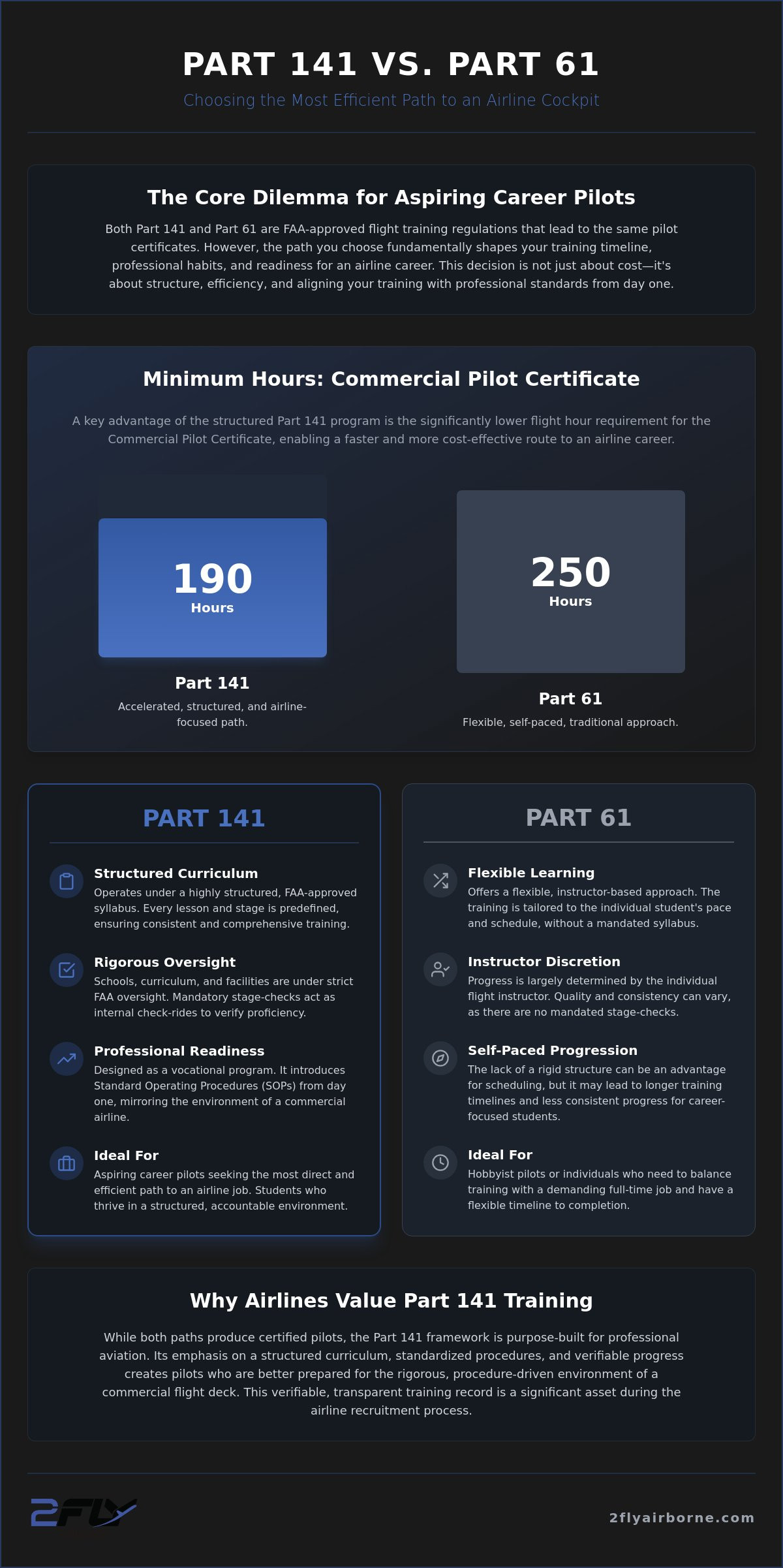
In contrast, Part 141 training is built around a highly structured, FAA-approved curriculum. These schools must meet exacting requirements for their training personnel, aircraft maintenance, and physical facilities. It’s a vocational approach designed specifically for professional pilot development. Because the FAA closely monitors these programs, students often benefit from lower flight hour minimums. For example, the FAA allows Part 141 students to earn a Commercial Pilot Certificate in as little as 190 hours, whereas Part 61 requires a minimum of 250 hours. This structure mirrors the training you’ll eventually face at a major airline, where every maneuver follows a standardized manual.
Structured Curriculum vs. Flexible Learning: Training Methodologies
Commercial airlines don’t operate on flexibility; they operate on Standard Operating Procedures (SOPs). From the moment you step into a professional cockpit, every action is choreographed, verified, and checked. Part 141 training introduces these SOPs from day one, building a professional foundation that mirrors the environment of a major carrier. This immersion in a standardized system is vital for long-term safety and operational efficiency.
In the debate of part 61 vs part 141 for career pilots, some view the rigorous documentation of a certified school as a burden. However, this standardization is actually a career asset rather than a hurdle. It ensures that your training is predictable, measurable, and meets the exact standards expected by airline recruiters. By training in a system that demands constant accountability, you’re preparing for the high-stakes world of commercial aviation.
The Airline-Style Environment of Part 141
Quality control in a Part 141 environment is maintained through a mandatory stage-check system. These internal evaluations act like mini-checkrides. They ensure you’ve mastered each phase of flight before the school allows you to advance. A mandated syllabus leaves no room for gaps in your aeronautical knowledge, covering everything from complex weather systems to high-altitude aerodynamics. Under the guidance of a Chief Flight Instructor, the entire academy follows the same high standards for every student, ensuring consistency across the entire fleet.
Personalized Progression in Part 61
Part 61 allows for a more modular approach, which can be beneficial for building specific skills or working around a non-traditional schedule. If you master a specific maneuver or concept quickly, you can move forward immediately without waiting for a syllabus schedule. Some career pilots utilize this path for specific add-ons or ratings, such as a Multi-Engine Rating, to fill specific gaps in their logbook. The trade-off is often a lack of institutional structure, which can lead to longer timelines if you aren’t exceptionally disciplined.
When Choosing a Flight School, consider whether you thrive in a self-guided environment or a structured professional academy. For those with a clear eye on the captain’s seat, the FAA Professional Pilot Program provides the structured discipline required to transition smoothly into a commercial role.
Flight Hour Minimums and Financial Realities
How much is sixty hours of your life worth? When you’re calculating the investment required for your flight deck career, the legal minimum flight time is often the deciding factor. The FAA establishes different thresholds for certification depending on the school’s regulatory oversight. This creates a significant gap in how quickly you can reach the 1,500-hour requirement for an Airline Transport Pilot (ATP) certificate.
In the comparison of part 61 vs part 141 for career pilots, the hour requirements are clear. Under Part 61, you must log at least 250 hours to earn your Commercial Pilot Certificate. In a Part 141 environment, the FAA allows you to achieve the same milestone in just 190 hours. This 60-hour reduction isn’t just about saving time; it’s about entering the job market sooner to capitalize on current hiring waves.
The 190-Hour Commercial Pilot Advantage
The efficiency of a Part 141 program stems from its structured syllabus. Because every flight hour is dedicated to a specific learning objective, the FAA trusts that students gain the necessary proficiency in less time. This acceleration is a major advantage for those on a professional track who want to minimize their time as a student and maximize their time as a paid professional.
- Part 141: 190 hours minimum for Commercial certification.
- Part 61: 250 hours minimum for Commercial certification.
Focusing on quality hours ensures you aren’t just “burning holes in the sky” to meet a number. Instead, you’re building the specific aeronautical experience that recruiters value. This streamlined approach allows you to transition into an instructor role or a regional airline position much faster than traditional modular paths.
Total Investment for Pilot Education
While a local flight club might offer a lower hourly rate for a single-engine aircraft, those savings often vanish when you factor in the extra 60 hours required by Part 61. Analyzing the true flight school cost involves looking at the total program investment. Career-focused students often prefer the predictability of an FAA Professional Pilot Program because it helps mitigate the hidden costs found in pay-as-you-go models.
Administrative fees, simulator time, and housing are often overlooked during the initial research phase. A structured academy typically bundles these into a more transparent package. This financial clarity allows you to focus entirely on your training rather than worrying about fluctuating fuel surcharges or maintenance delays. Gaining a professional perspective also means understanding the operational expenses of various aviation sectors, such as the specialized medevac services analyzed by aircraftcharter.com. The 2025 Boeing Pilot and Technician Outlook projects a demand for 660,000 new pilots globally through 2044. Investing in a structured path now positions you to meet that global demand with a verified, professional background.
Career Trajectories: How Airlines View Your Training Path
Do airlines care about the “Part” on your certificate? It’s a question that keeps many trainees awake at night. While it’s a common myth that major carriers only hire Part 141 graduates, the reality is that they hire the best-trained pilots regardless of the regulatory path. Recruiters prioritize your performance during their own evaluations, but your training background sets the stage for that performance.
A Part 141 training record acts as a professional passport for your early career. It’s organized, standardized, and significantly easier for an airline recruitment team to audit. When they review a history of successful stage checks, they see a pilot who is already accustomed to the scrutiny of a structured evaluation process. This clarity in part 61 vs part 141 for career pilots often becomes a deciding factor when a recruiter has limited time to verify your background.
Professionalism and the Standardized Training Record
Your stage checks aren’t just hurdles to clear; they’re dress rehearsals for your future airline checkrides. Training in a high-activity environment, such as a major flight school in Florida, prepares you for the complexities of busy, international airspace. This experience allows you to build a resume that highlights your readiness for the fast-paced operations of a commercial hub. By the time you reach your first interview, you’ll speak the language of professional standardization fluently.
Standardized training suggests to an airline that you can handle the rigors of their own internal training program. Carriers invest heavily in their new hires and want to minimize the risk of a candidate failing out of ground school. A history of training in a structured, FAA-approved environment provides the assurance they need. It demonstrates that you’ve already succeeded in a system that demands discipline and technical precision, a level of professional commitment also found in specialized training programs like those at Black Sky Tactical.
The Global Demand for Airline-Ready Pilots
As the industry shifts toward a more globalized workforce, training to international standards like those set by the FAA is essential. Airlines are searching for candidates who can transition from a trainer to a transport-category jet with minimal friction. They need pilots who understand not just how to fly, but how to operate within a complex corporate and regulatory framework. This vocational preparedness is what separates a hobbyist from a professional.
The 2025 Boeing Pilot and Technician Outlook projects a demand for 660,000 new pilots globally through 2044. This massive requirement means recruiters are looking for the most reliable pipelines of talent to fill their cockpits. Choosing a program that offers direct connections to recruitment offices can bridge the gap between your final checkride and your first officer’s seat. If you’re ready to transition into a professional cockpit, explore the FAA First Officer Program to see how a structured path leads directly to employment.
Selecting Your Flight Academy: The Career Pilot’s Checklist
Selecting your regulatory path is a critical first step, but the academy you choose is the engine that will drive your career forward. While the debate of part 61 vs part 141 for career pilots often focuses on hour minimums, the quality of the institution determines your actual readiness for the airlines. You need a partner that offers a seamless transition from your Private Pilot Certificate through to your Commercial ratings. Look for an environment that provides more than just aircraft; look for a comprehensive support system designed for professional success.
A world-class academy should provide robust administrative support to handle the complexities of a professional career path. This includes everything from meticulous record-keeping for future airline audits to assistance with international student requirements if you’re training from abroad. When all your training resources, such as simulators, a modern fleet, and dedicated ground schools, are in one location, you can focus entirely on achieving technical mastery. This centralization minimizes logistical distractions and maximizes your time in the cockpit.
Why Structured Programs Accelerate Career Growth
The benefit of immersion, living and breathing aviation on a professional campus, is significant for career growth. It allows you to absorb the industry culture long before you reach a regional airline. Facilities that offer on-campus housing foster a vital network of future colleagues and captains. These connections often prove invaluable as you progress through the ranks of the profession.
This collaborative atmosphere creates a sense of accountability and shared ambition. You aren’t just a student; you’re an industry-prepared professional in training. The 2025 Boeing Pilot and Technician Outlook projects a demand for 660,000 new pilots globally through 2044. Meeting this demand requires a training setting that mimics the high-stakes, high-standards environment of a global airline hub. Professionalism is not a switch you flip at your first interview; it is a habit you build during your training.
Consulting with a Professional Training Advisor
Every pilot’s journey is unique, and your training plan should reflect your specific goals and timeline. A personalized roadmap is essential for navigating the transition from a trainee to a first officer. Before committing to a path, it’s vital to discuss financing options to ensure your education is sustainable and well-planned. Transparency in costs and timelines is the hallmark of a reputable academy.
Preparing a list of detailed questions for a 2FLY Training Advisor is the best way to gain clarity on your future. Ask about fleet availability, maintenance standards, and how the school supports graduates during the hiring process. Safety and structure are the pillars of a long-term aviation career. By choosing an academy that prioritizes these values, you’re investing in a future defined by professional excellence and international mobility.
Charting Your Course to the Flight Deck
Deciding between part 61 vs part 141 for career pilots is the first executive decision of your professional journey. While Part 61 provides a modular approach for those with unique schedules, the structured efficiency of Part 141 offers a direct pipeline to the airlines. By choosing a path that emphasizes Standard Operating Procedures and lower flight hour minimums, you’re investing in your future as a commercial captain.
2FLY Airborne graduates currently fly for major airlines worldwide, a testament to our FAA and EASA certified training standards. Our students train with state-of-the-art flight simulators and a modern fleet to ensure they’re industry-ready from day one. This high-standard environment bridges the gap between a trainee and a professional first officer.
Ready to launch your aviation career? Speak with a 2FLY Training Advisor today to find the right path for you. If you have any remaining questions about your specific timeline or goals, please reach out to a 2FLY Training Advisor for expert guidance.
Frequently Asked Questions
Is Part 141 better than Part 61 for airline jobs?
Neither path is inherently superior in the eyes of the FAA, but Part 141 is often better suited for those on a professional timeline. It mirrors the standardized training environment of commercial airlines; this helps build the discipline and technical precision that recruiters look for. Most airline training programs are structured similarly to Part 141, making the transition to a jet cockpit feel more natural.
Can I switch from a Part 61 school to a Part 141 school mid-training?
Yes, you can switch schools, but your previous flight hours may not transfer on a one-to-one basis. Part 141 schools have strict syllabus requirements and must evaluate your proficiency through a formal placement test. Usually, you can only transfer a limited portion of your previous hours toward the specific requirements of a Part 141 course, so it’s best to plan your path early.
Why does Part 141 require fewer flight hours for a Commercial Pilot License?
The FAA allows lower minimums because Part 141 programs follow a highly structured, government-approved curriculum. For a Commercial Pilot Certificate, you only need 190 hours under Part 141 compared to 250 hours under Part 61. The increased oversight and mandatory stage checks ensure you reach the required proficiency levels more efficiently than a decentralized, self-paced program.
Do airlines prefer Part 141 graduates over Part 61?
Airlines prioritize the quality of your training and your performance in the cockpit rather than the specific regulatory “Part” you trained under. However, a Part 141 record is often easier for recruiters to audit because it follows a standardized format. This transparency can make your professional background appear more reliable during a competitive interview process for a first officer position.
Is Part 61 flight training cheaper than Part 141?
Part 61 may seem cheaper due to lower hourly rates at local clubs, but it often costs more when you calculate the total investment. The extra 60 hours required for a Commercial certificate under Part 61 can lead to higher overall expenses. When evaluating part 61 vs part 141 for career pilots, a structured academy often provides better financial predictability through fixed-price program options.
What happens if I fail a stage check in a Part 141 program?
Failing a stage check means you need additional training on specific maneuvers before advancing to the next phase of the syllabus. It’s a quality control measure designed to ensure you’re ready for the final FAA checkride. Your instructor will provide targeted remedial training to address any gaps in your performance, ensuring you maintain the high standards required for a professional career.
Does a Part 141 school provide a better ground school education?
Part 141 schools are required to provide a formal, structured ground school that meets specific FAA curriculum standards. This ensures a comprehensive education that leaves no gaps in your knowledge of regulations, weather, and complex systems. While Part 61 allows for self-study, the disciplined classroom environment of a certified academy often leads to higher scores on FAA knowledge tests and better long-term retention.
Article by
2FLY Airborne
2Fly Airborne is a professional flight training organization dedicated to developing the next generation of skilled, confident, and safety-focused pilots. With decades of combined aviation experience, our team of certified instructors provides structured, real-world training designed to prepare students for both checkrides and long-term success in the aviation industry.
Content Disclaimer
Some blog content is generated with the assistance of automated tools and may not always be fully accurate or up to date. Please verify all aviation-related information with official sources or a certified instructor. For additional guidance or clarification, we encourage you to contact one of our training advisors at 2Fly Airborne.