
The true expense of a flight career isn’t just the hourly rental rate; it’s the lack of a structured financial roadmap. Many aspiring aviators stall their training because they underestimate the total faa commercial pilot license cost. It’s a journey that requires more than just passion; it demands a precise understanding of the investment required to reach the flight deck.
You’ve likely felt the anxiety of seeing hourly rates fluctuate or wondered if hidden fees will ground your dreams before you earn your wings. The confusion between modular and integrated training models often makes it difficult to see the finish line clearly. It’s frustrating to feel like your budget is a moving target while you’re trying to focus on mastering complex maneuvers.
This guide provides a definitive breakdown of the total investment needed to transition from a student to a professional pilot in 2026. We’ll explore everything from initial private pilot training to the final commercial checkride. You’ll gain a clear understanding of financing options and the long-term return on investment that a career in the skies offers.
Key Takeaways
- Understand why calculating the cost of a standalone certificate is a common beginner’s mistake and how to budget for a complete professional path.
- Discover how modern flight simulators and multi-engine training impact your total investment and technical proficiency.
- Learn how an integrated, fixed-price model provides financial predictability and eliminates the hidden variables often found in the total faa commercial pilot license cost.
- Identify the essential administrative and living expenses, such as housing and visa requirements, that are often overlooked in standard training estimates.
- Evaluate the long-term return on investment by aligning your training with global pilot demand and minimizing the opportunity cost of delayed entry into the industry.
Defining the Investment: What Does ‘Commercial’ Really Cost?
Understanding the financial commitment of flight training requires a mental shift. You aren’t just paying for a single checkride; you’re investing in a professional trajectory. The most common mistake beginners make is looking at the faa commercial pilot license cost as a standalone figure. In reality, the CPL is the final piece of a complex puzzle that includes several prerequisite certifications.
To reach a professional standard, most students follow a “Zero to Hero” sequence. This structured path moves you from no experience to a fully qualified commercial pilot ready for employment. Attempting to price these stages in isolation often leads to budget overruns. Your final price depends heavily on personal proficiency and how often you fly. Consistency is your greatest financial asset in this process.
The Multi-Stage Certification Journey
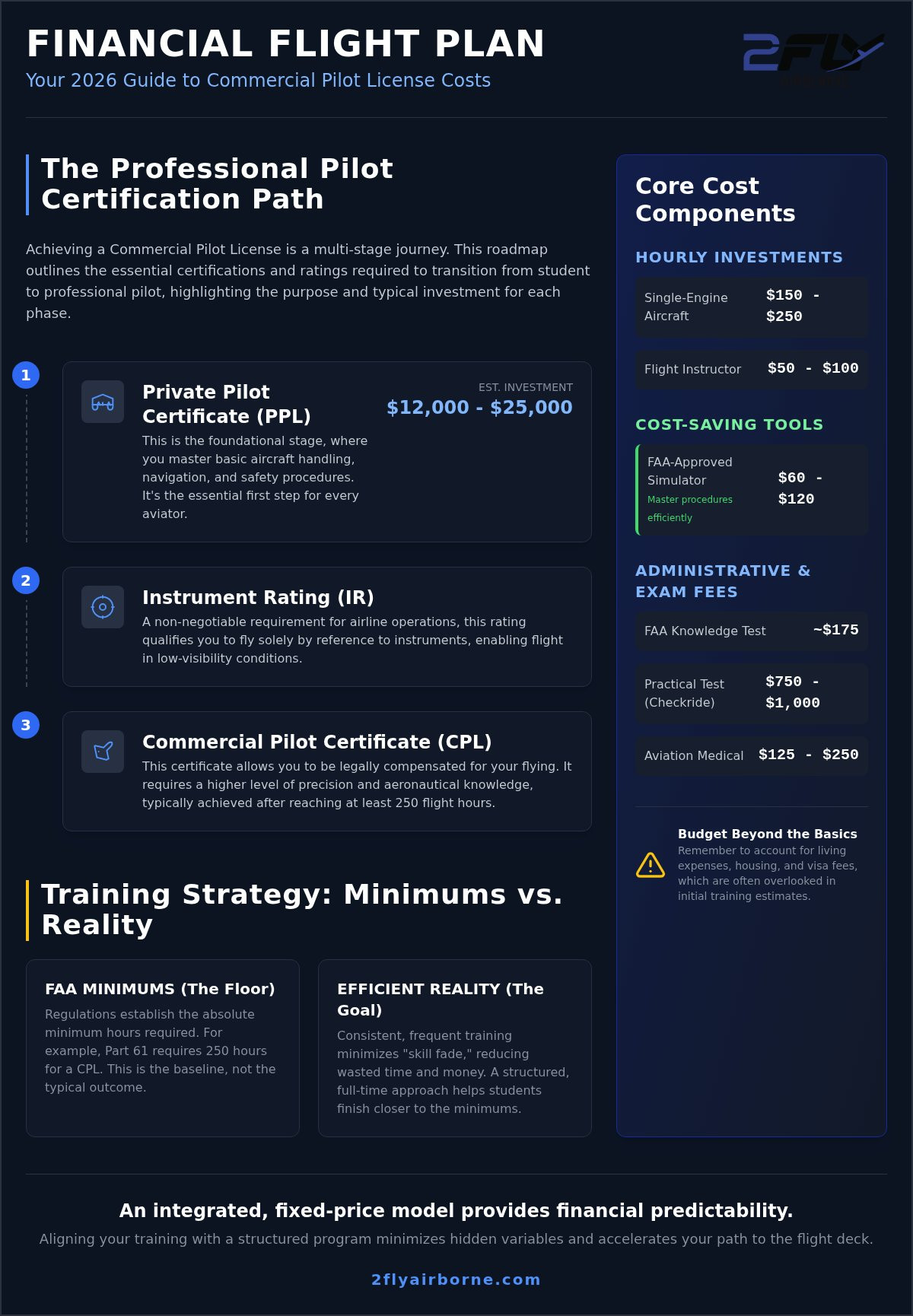
A professional pilot’s resume is built on three primary pillars. First, the Private Pilot Certificate (PPL) establishes your foundational skills in aircraft handling and navigation. This is where you learn the basics of flight before moving into more technical territory. It’s the essential first step that every aviator must master.
Next, you must earn an Instrument Rating (IR). This qualification allows you to fly solely by reference to instruments, which is a non-negotiable requirement for airline operations. Finally, you achieve the Commercial Pilot Certificate (CPL). This allows you to legally fly for compensation or hire. You can find a detailed breakdown of these FAA pilot certification requirements to better understand the technical hurdles at each stage.
FAA Minimums vs. Reality
FAA regulations establish the floor for training, not the ceiling. Under Part 61, you need at least 250 flight hours to earn a commercial certificate. Part 141 schools, which follow a more rigid and FAA-approved curriculum, may allow for lower hourly minimums due to the structured nature of the training. However, the national average for students often exceeds these minimums.
Individual factors play a massive role in your total faa commercial pilot license cost. If you train once a week, you’ll likely suffer from “skill fade,” spending more time relearning old maneuvers than progressing to new ones. High-achievers who treat flight school like a full-time job often finish closer to the minimums. This disciplined approach saves money and accelerates your transition into a paid cockpit seat. A structured environment helps you maintain momentum and keeps your budget predictable.
The 2026 Price Breakdown: Certifications and Ratings
Stepping into the cockpit for the first time is a significant investment in your future. To manage the faa commercial pilot license cost effectively, you must understand the granular expenses that constitute the total bill. Current market rates for single-engine aircraft rentals typically range from $150 to $250 per hour, while professional flight instructor fees generally fall between $50 and $100 per hour. When you add these figures to the cost of ground school materials and Electronic Flight Bags (EFBs), the importance of a detailed breakdown of flight training costs becomes clear.
Beyond the aircraft, administrative fees are mandatory. You’ll need to budget approximately $175 for each FAA knowledge test and between $750 and $1,000 for a practical test, often called a checkride, with a Designated Pilot Examiner. Don’t forget the aviation medical certificate; a third-class medical typically costs between $125 and $250. These smaller fees accumulate quickly, making it vital to choose a program that offers transparency from the start.
From Private Pilot to Instrument Proficiency
The PPL phase is your first major financial milestone, often ranging from $12,000 to $25,000 depending on your training frequency. However, many students find the Instrument Rating (IR) to be the most demanding phase. It requires extreme precision and mental stamina. To control your faa commercial pilot license cost during this stage, utilize FAA-approved simulators. These devices rent for $60 to $120 per hour, providing a high-value environment to master instrument procedures at a fraction of the cost of an actual aircraft.
Commercial Multi-Engine and Instructor Ratings
Airlines look for pilots with multi-engine experience. Training in a complex, twin-engine aircraft is more expensive, but it’s a critical requirement for professional mobility. Many graduates choose to earn their Certified Flight Instructor (CFI) rating immediately after their commercial checkride. This turns your training into a career; you’ll get paid to build the 1,500 hours required for your Airline Transport Pilot (ATP) certificate while mentoring the next generation of aviators. If you’re ready to see how these ratings fit into a structured timeline, you can explore the FAA Professional Pilot Program to plan your next move.
Modular vs. Integrated Training: Choosing Your Financial Model
Choosing the right financial model is as important as choosing the right aircraft. Your decision between modular and integrated training will dictate your total faa commercial pilot license cost more than any other factor. While the modular approach offers the freedom to pay for lessons individually, it exposes you to the unpredictable nature of the aviation market. Integrated training provides a structured path with a fixed-price guarantee, shielding you from the financial volatility that often grounds aspiring pilots.
A structured training environment does more than just secure your budget; it ensures your progression follows a logical, goal-oriented syllabus. Fixed-price programs protect you from sudden fuel surcharges and rental rate increases that can occur over a 12-month training period. This predictability allows you to focus on your technical skills rather than worrying about fluctuating market conditions.
The Risks of Pay-As-You-Go Training
Modular training is often perceived as the more affordable option because of its lower upfront commitment. However, this flexibility comes with significant risks. Without a locked-in rate, you’re at the mercy of rising fuel costs and aircraft rental increases. “Hour building” can quickly transform from a necessary step into an unplanned financial burden if your progress is interrupted by instructor turnover or maintenance delays.
Consistency is vital for meeting the FAA commercial pilot hour requirements efficiently. In a pay-as-you-go system, gaps in training lead to skill regression, requiring extra hours to regain proficiency. This cycle of “one step forward, two steps back” is a primary reason why modular students often exceed their initial budgets. For those seeking a more reliable timeline, the FAA Airline Pilot Program offers a streamlined alternative that prioritizes momentum.
The Fixed-Price Advantage
Professional pilot programs utilize an integrated approach to provide total financial transparency. You receive a comprehensive tuition quote that covers flight hours, ground school, and administrative support before you even step into a classroom. This model eliminates the “hidden cost” anxiety that plagues many trainees. It allows you to focus entirely on your technical mastery rather than checking your bank balance after every flight.
High-achievers often choose integrated models because they offer a direct pipeline to employment. These programs are designed to meet industry standards with precision, ensuring you’re prepared for the professional environment from day one. By choosing a fixed-price professional pilot program, you’re not just buying flight hours; you’re securing a predictable roadmap to your future career. This certainty is invaluable when calculating the long-term ROI of your faa commercial pilot license cost.
Accounting for Living Expenses and Administrative Fees
Training to become a professional pilot is a full-time commitment that extends far beyond the hangar. While many candidates focus exclusively on aircraft rental rates, the total faa commercial pilot license cost is heavily influenced by your choice of living arrangements and administrative requirements. Budgeting for these “soft costs” is essential for maintaining financial stability throughout your training syllabus.
One of the most critical variables is the “Time is Money” factor. A structured, intensive program may have a higher monthly cost, but completing your training in a shorter window significantly reduces your total expenditure on rent, utilities, and daily essentials. Conversely, a prolonged modular timeline can lead to a financial drain of living expenses that rivals the cost of the flight hours themselves.
Administrative fees also represent a non-negotiable part of the investment. Every candidate must factor in license processing fees and the cost of TSA background checks. These requirements ensure the security and integrity of the aviation industry; they must be accounted for in your initial financial roadmap to avoid mid-program surprises.
Housing and Residential Logistics
Choosing the right residential strategy can make or break your training experience. On-campus student housing offers an immersive environment where you live and breathe aviation alongside your peers. This proximity to the flight line often eliminates the need for a personal vehicle and protects you from the rising costs of private local rentals.
Managing your own lease often involves hidden burdens like utility deposits and long-term commitments that don’t align with your training schedule. A centralized training location with program-managed housing simplifies your logistics. This allows you to dedicate your mental energy to mastering complex flight maneuvers rather than managing household chores.
International Student Considerations
For those traveling from abroad, the administrative landscape includes specific regulatory requirements. Navigating M-1 and F-1 visa sponsorship is a specialized process that involves SEVIS registration and detailed documentation. These steps are vital for establishing your legal status as a student at an M1 visa approved flight school.
Understanding the costs associated with these international standards is crucial for a smooth transition to your training environment. If you’re planning your budget from outside the United States, you should explore options for Financing Your Training to ensure every administrative fee is covered before your arrival.
To get a personalized estimate of your total investment, including housing and visa support, you should speak with a training advisor about our all-inclusive residential options.
Maximizing Your ROI: The Path to the Flight Deck
The final phase of your training is where the investment begins to pay dividends. While the faa commercial pilot license cost represents a significant capital outlay, the long-term rewards are substantial for those who reach the flight deck quickly. The 2025 Boeing Pilot and Technician Outlook projects a demand for 660,000 new pilots globally through 2044. This massive requirement for talent creates a favorable environment for new graduates to secure stable, high-paying positions in a global industry.
Transitioning from a trainee to an industry-prepared professional requires a strategic approach to hour building. Earning your Certified Flight Instructor (CFI) rating is the most effective way to cross the gap between training and the airlines. Instead of paying for additional flight time out of pocket, you’ll earn a salary while mentoring new students. This role sharpens your technical knowledge and leadership skills, making you a more attractive candidate for major carriers who value instructional experience.
Professional mobility is the ultimate goal of any flight training program. By the time you complete your commercial ratings, you should be ready to integrate into a professional crew environment. This transition is not just about flying the aircraft; it’s about adopting the discipline, communication standards, and safety culture required by the world’s leading airlines. Your training is the definitive gateway to this international career path.
Accelerated Training and Career Entry
Speed is a critical factor in your overall return on investment. If you finish your training six months earlier, you gain an extra half-year of seniority and airline salary. This opportunity cost of slow training can easily exceed the price difference between modular and integrated programs. By enrolling in a structured FAA First Officer Program, you align your graduation with recruitment windows and maximize your lifetime career earnings. Seniority is everything in aviation; the sooner you start, the higher your career ceiling will be.
Final Financial Planning Checklist
Before you take the first step, ensure your financial strategy is robust and transparent. Review specialized flight school loans and financing options that are tailored for professional pilot candidates. A clear roadmap prevents the anxiety of hidden costs and keeps you focused on your technical mastery. Evaluating the faa commercial pilot license cost through the lens of a thirty-year career changes the perspective from an expense to a necessary entry fee. You can find more details on the initial steps and prerequisites in our guide on How to Become a Pilot.
Launching Your Professional Aviation Career
Navigating the financial landscape of flight training requires a shift from viewing costs as expenses to seeing them as strategic investments. We’ve explored how the faa commercial pilot license cost is best managed through integrated models that eliminate the anxiety of hourly rate volatility. By choosing a path that includes professional fixed-price tuition and state-of-the-art flight simulators, you ensure your training remains on schedule and within budget.
For international candidates, having dedicated visa sponsorship support removes the administrative hurdles that often delay career entry. It’s important to remember that every month saved during training translates directly into increased seniority and earnings at the airlines. The global demand for pilots is clear; the right training environment is the definitive bridge to that future. Your journey to the flight deck begins with a single, well-planned step.
Ready to secure your future in the sky? Speak with a 2FLY Training Advisor today. Reach out to our team with any questions and begin your transition to a professional aviation career with confidence.
Frequently Asked Questions
What is the average total cost of a commercial pilot license in 2026?
The total faa commercial pilot license cost for a zero-to-hero path typically ranges from $70,000 to $100,000 in the current market. This investment covers the Private Pilot Certificate, Instrument Rating, and Commercial Pilot Certificate. Factors such as training frequency and aircraft type significantly influence the final total. Choosing a structured, professional environment helps maintain a predictable budget while preparing you for a global aviation career.
Can I get a commercial pilot license without first getting a private pilot license?
No, you must earn a Private Pilot Certificate before you can qualify for a Commercial Pilot License. The FAA certification process is sequential, requiring you to master foundational skills before advancing to professional-level maneuvers. Most career-bound students also earn an Instrument Rating between these two steps. This progression ensures you have the necessary experience and technical proficiency to operate safely in a commercial environment.
Are there financing options or loans available for flight school?
Yes, several financing options and specialized flight school loans are available to help cover the cost of your training. Many students utilize private lenders that focus specifically on the aviation industry, offering flexible repayment terms that align with career progression. At 2FLY Airborne, we provide information on financing resources to help you secure the funding needed for your Professional Pilot Program. It’s a vital step in mapping your financial roadmap.
What are the biggest ‘hidden costs’ in pilot training?
Living expenses, such as housing and transportation, are often the largest unplanned costs for students. Beyond the cockpit, you should budget for FAA medical certificates and knowledge test fees. Designated Pilot Examiner fees for checkrides are also critical. Visa sponsorship and SEVIS registration are essential for international students at an M1 visa approved flight school. Planning for these items early prevents budget shortfalls during your training syllabus.
How much does it cost to add a Multi-Engine Rating?
A Multi-Engine Rating is a specialized addition to your commercial certificate that usually requires an investment between $3,500 and $7,000. This training is essential for those aiming for airline careers, as it covers the complexities of multi-engine aerodynamics and emergency procedures. The final cost depends on the hourly rental rate of the twin-engine aircraft and your ability to master the maneuvers within the required syllabus time.
Does the cost of flight school include the 1,500 hours for airlines?
No, the initial training cost generally covers the approximately 250 hours required for the Commercial Pilot Certificate. To reach the 1,500 hours required for an Airline Transport Pilot certificate, most graduates become a Certified Flight Instructor. This allows you to get paid while building the remaining time. It’s a direct pipeline to employment that turns your training into a professional career while gaining valuable instructional experience.
Is a fixed-price pilot program better than paying hourly?
A fixed-price program offers superior financial security compared to hourly, pay-as-you-go rates. While modular training feels flexible, it leaves you vulnerable to rising fuel costs and rental increases. A fixed-price model, like the one offered at 2FLY Airborne, provides total transparency by covering all ground school, simulator, and flight hours in one quote. This allows you to focus on your technical mastery without the anxiety of a fluctuating faa commercial pilot license cost.
How much should I budget for FAA exams and checkrides?
You should set aside approximately $3,000 to $5,000 to cover the full sequence of FAA knowledge tests and practical exams. Each written test costs about $175, while checkrides with a Designated Pilot Examiner typically range from $750 to $1,000 per attempt. These fees are paid directly to the testing centers and examiners. Budgeting for potential retakes is also a wise strategy to ensure you aren’t grounded by administrative costs.
Article by
2FLY Airborne
2Fly Airborne is a professional flight training organization dedicated to developing the next generation of skilled, confident, and safety-focused pilots. With decades of combined aviation experience, our team of certified instructors provides structured, real-world training designed to prepare students for both checkrides and long-term success in the aviation industry.
Content Disclaimer
Some blog content is generated with the assistance of automated tools and may not always be fully accurate or up to date. Please verify all aviation-related information with official sources or a certified instructor. For additional guidance or clarification, we encourage you to contact one of our training advisors at 2Fly Airborne.