What if the difference between a lifelong hobby and a seat in a commercial flight deck wasn’t just about how you fly, but how you train? Many aspiring aviators view a license as the final destination; however, a professional career requires a much more disciplined approach. Enrolling in a structured faa commercial pilot program is the most direct way to bridge the gap between being a student and becoming a highly employable first officer.
You’ve likely felt the confusion of trying to decode the sequence of ratings or the anxiety surrounding the total cost of flight school. It’s difficult to distinguish between the flexibility of Part 61 and the rigorous, time-saving structure of Part 141 regulations. We understand that you don’t just want to fly. You want a reliable roadmap that leads straight to a professional cockpit.
This guide will provide that clarity by outlining exactly how a comprehensive training syllabus prepares you for the demands of the international airline industry. We’ll explore the step-by-step certifications required, the financial planning necessary for success, and the specific advantages of a professional training environment. By the end, you’ll have a clear vision of your path from the ground to the flight deck.
Key Takeaways
- Learn why an integrated syllabus is superior to a single license for those aiming to become a professional airline pilot.
- Navigate the complete progression of pilot certifications, understanding how each rating builds the foundation for your ultimate career goals.
- Compare Part 61 and Part 141 training regulations to determine which environment best supports your timeline and professional ambitions.
- Discover how a structured faa commercial pilot program with fixed-price tuition offers the financial clarity needed to plan your flight training investment.
- Gain a clear roadmap for transitioning from a student to an industry-ready professional through a dedicated career-focused training pipeline.
What is an FAA Commercial Pilot Program?
An faa commercial pilot program is a comprehensive, professionally managed pipeline designed to take you from your very first flight to a seat in a commercial flight deck. It isn’t just a series of disconnected lessons. Instead, it functions as an integrated syllabus where every flight hour contributes to a specific career objective. This structured approach ensures that you develop the habits and discipline required of a professional aviator from the start.
The Federal Aviation Administration (FAA) serves as the regulatory backbone of this journey, setting training standards that are respected worldwide. Gaining a thorough understanding of pilot certification in the United States helps students recognize the difference between casual flying and professional training. By adhering to these strict benchmarks, programs produce pilots who are ready to handle the complexities of modern aircraft and international airspace.
The Distinction Between a License and a Career Program
While many people start their journey by picking up individual licenses one at a time, this modular approach often leads to significant delays. A structured career program offers a full-time, immersive environment that prevents the “skill decay” that happens when training is spread out over years. You’ll find that staying in the cockpit daily allows for much faster progress and better long-term retention of technical procedures.
These programs are intentionally designed to mirror the operating environment of a major airline. You don’t just learn how to land a small plane; you learn how to operate within a professional crew, follow standardized checklists, and manage complex systems. This vocational focus is what makes a program graduate stand out during the airline recruitment process. It’s about building a professional identity, not just checking boxes on a certificate.
The Global Demand for Commercial Aviators
Aviation is currently experiencing a transformative period where the need for skilled pilots has never been higher. This industry-wide shortage serves as a powerful catalyst for modern training programs that prioritize efficiency and high-level proficiency. Airlines are actively seeking new talent to fill vacancies created by a wave of mandatory retirements and a growing global middle class that demands more air travel.
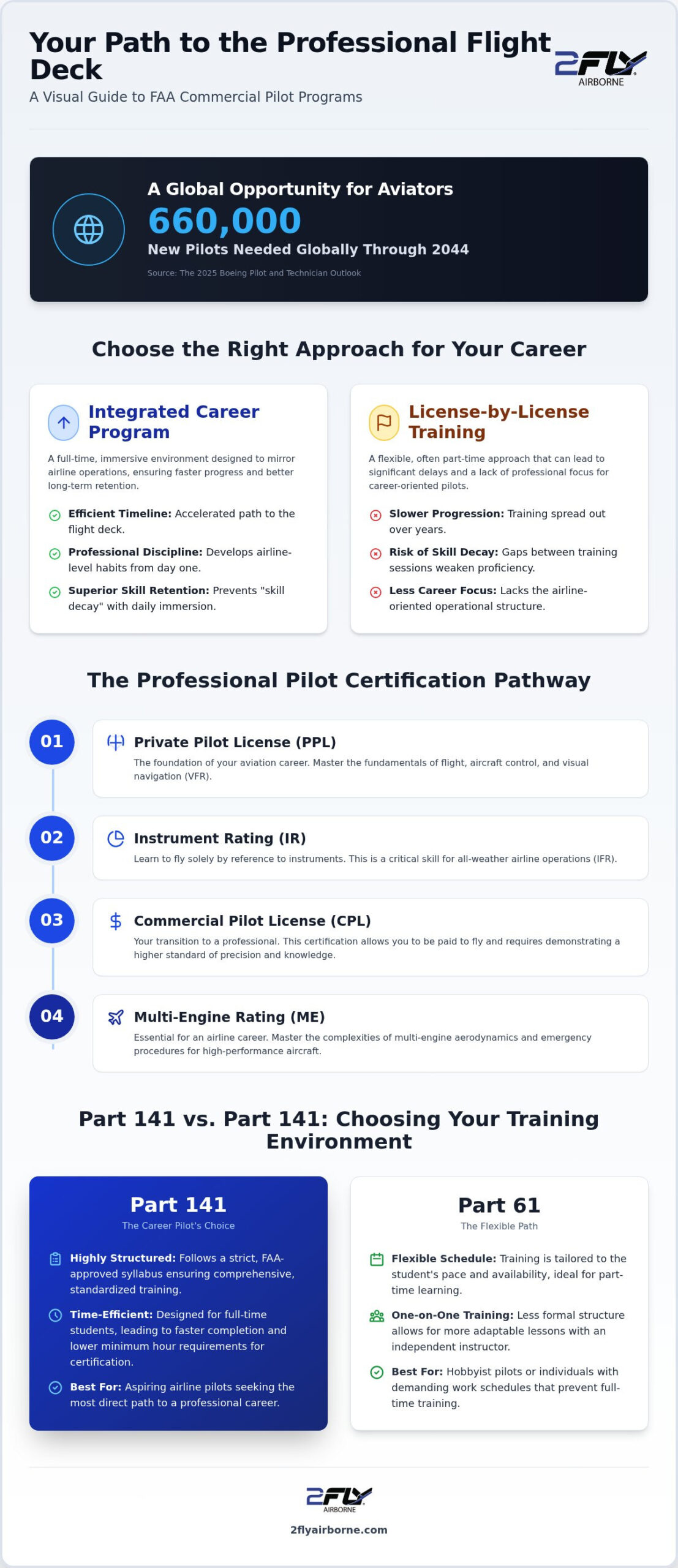
The scale of this opportunity is massive and well-documented by industry leaders. The 2025 Boeing Pilot and Technician Outlook projects a demand for 660,000 new pilots globally through 2044. This projection highlights a clear path for those who start their training today, offering a future defined by international mobility and professional growth. By choosing a dedicated career path now, you position yourself at the forefront of a stable, high-demand global industry.
Anatomy of a Professional Pilot Training Syllabus
Professional training is a linear progression designed to transform a novice into a captain. Unlike casual flight training, an faa commercial pilot program enforces airline-level standards from the first lesson. This ensures that safety, precision, and procedural discipline become second nature long before you reach the flight deck.
Core Certifications: PPL to CPL
The Private Pilot Certificate (PPL) serves as the bedrock of your career, where you learn the essential physics of flight and visual navigation. Once you’ve mastered the basics, you’ll move to the Instrument Rating (IR). This phase is critical because it teaches you to fly solely by reference to flight instruments, which is how professional airlines operate in all weather conditions.
Achieving the Commercial Pilot Certificate (CPL) marks your transition into a professional for hire. During this stage, you must meet rigorous FAA Commercial Pilot requirements regarding precision maneuvers and operational knowledge. You’re no longer just flying for fun; you’re learning to manage an aircraft with the efficiency and safety of a career professional.
Advanced Ratings and Instructor Courses
To be competitive in the global market, you’ll need a Multi-Engine Rating (ME). Since commercial airlines operate aircraft with at least two engines, mastering the complexities of multi-engine aerodynamics and emergency procedures is non-negotiable. This rating expands your technical range and prepares you for the high-performance environments of regional and major carriers.
Many graduates then pursue the Certified Flight Instructor (CFI) path. This is a strategic move that allows you to build the 1,500 hours required for the Airline Transport Pilot (ATP) certificate while honing your own skills by teaching others. It’s a proven method for consolidating your knowledge before moving into a jet cockpit.
Modern pilot education relies heavily on state-of-the-art flight simulators. These tools allow you to practice complex emergency scenarios that would be too dangerous to replicate in a real aircraft. They provide a safe, controlled environment to perfect your decision-making and crew coordination skills within a structured faa commercial pilot program.
If you’re ready to begin this journey, you might want to Learn more about the FAA Airline Pilot Program to see how these ratings fit into a cohesive career timeline.
Part 61 vs. Part 141: Choosing Your Training Environment
Choosing the right regulatory environment is one of the most critical decisions you’ll make when starting an faa commercial pilot program. The FAA provides two primary pathways for training: Part 61 and Part 141. While both lead to the same certificate, the experience and efficiency of these paths differ significantly for those pursuing a professional career.
Part 141 schools operate under a highly structured, FAA-approved syllabus. This rigorous oversight allows the FAA to permit lower flight hour minimums, requiring only 190 total flight hours for a Commercial Pilot Certificate. In contrast, Part 61 training is more flexible and less regulated, requiring a minimum of 250 total flight hours for the same certification.
Airlines often favor candidates from structured Part 141 backgrounds because they’ve been trained in an environment that mirrors professional airline operations. This preference is linked to the strong career outlook for commercial pilots, as carriers need recruits who can transition seamlessly into advanced jet training. The focus on standardization within an faa commercial pilot program at a Part 141 school prepares you for the discipline required in a multi-crew cockpit.
The Advantages of a Structured Part 141 Academy
Consistency is the primary benefit of a Part 141 environment. By following a dedicated syllabus, you avoid the “learning plateaus” that often occur in less structured environments. This focus leads to faster completion timelines, making it the ideal choice for full-time students who want to enter the workforce quickly.
The FAA maintains high training standards at 141 schools through regular audits and curriculum reviews. This level of oversight ensures that your training remains current with modern aviation practices and safety protocols. For many, this reliability provides the confidence needed to succeed in a demanding professional field.
Which Path Fits Your Goals?
Evaluating your personal timeline is essential. If you’re looking for a fast-track to the airlines, the structured nature of an academy is usually the best fit. If you need to balance training with other life commitments, Part 61 offers a flexible pace that some students prefer, though it often results in a longer journey to the flight deck.
Financial considerations also play a role in this choice. While the hourly rate at a Part 141 academy may seem higher, the reduced hour requirement can save you money in the long run. By completing your certificate in 190 hours instead of 250, you reduce the total investment needed to reach your goal. For more details on these early steps, see our guide on How to Become a Pilot: The Comprehensive 2026 Guide.
Financing and Planning Your Flight Training Investment
Investing in an faa commercial pilot program is a significant life decision that requires a precise financial strategy. Transparency is vital when you compare different academies because the final cost often extends beyond simple flight hours. Many students discover too late that hidden fees or training delays can inflate their initial budget.
A “fixed-price” tuition model provides a necessary layer of protection against these variables. This approach ensures your costs remain stable even if fuel prices rise or you require additional time to master a specific maneuver. It effectively eliminates the financial anxiety that often affects pilots training under a pay-as-you-go system.
When you evaluate a program, use this checklist to ensure you see the full picture:
- Does the price include all ground school materials and FAA exam fees?
- Are on-campus housing and administrative fees clearly defined?
- Does the tuition account for insurance and TSA processing?
- Is there a breakdown of aircraft types used for each specific rating?
Exploring Funding and Financing Options
Most professional aviators utilize specialized aviation loans to fund their education. These financial products are designed for the industry, often offering repayment structures that align with your entry into the airlines. Evaluating the return on investment becomes clear when you consider the high earning potential of a commercial pilot. You can explore pilot training financing options to find a plan that supports your professional goals.
Planning for International Students
Non-US residents must manage the administrative side of training with extra care. An elite academy should provide M-1 or F-1 visa sponsorship to facilitate your stay during the faa commercial pilot program. You’ll need to navigate SEVIS requirements and visa processing before your training can officially begin.
Planning your relocation involves more than just booking a flight. You must account for housing, insurance, and daily living expenses as part of your total career investment. For a more detailed breakdown, read our Flight School Costs: A Full Financial Guide.
If you have questions about funding your journey, contact a training advisor to receive a personalized financial breakdown for your flight training.
The 2FLY FAA Professional Pilot Program: Your Gateway
2FLY Airborne stands as the definitive mentor for both domestic and international students seeking a seat in a commercial flight deck. Our faa commercial pilot program is built on the “Zero to Hero” philosophy, designed specifically to streamline your progression from a beginner to a career-ready professional. We don’t just teach you how to fly; we prepare you to lead in a global industry with the confidence of an expert.
Training in a high-density aviation environment is a core component of our superior skill development. You’ll learn to navigate complex airspace and communicate with technical precision from your very first solo flight. This immersive experience ensures that you’re ready for the fast-paced realities of commercial airline operations where split-second decision-making is vital.
To support this intense focus, we provide on-campus housing that fosters a community of like-minded high-achievers. Living where you train allows for total immersion in aviation culture and provides easy access to our global recruitment network. This network serves as a direct pipeline, connecting our graduates with opportunities across the international aviation landscape.
From Trainee to Industry-Prepared Professional
Our faa commercial pilot program prioritizes the end result: your long-term professional career. We maintain a discipline-first culture that mirrors the rigorous standards of the world’s leading airlines. This ensures that the transition from a student to a first officer is seamless and predictable.
The global reach of our organization provides a unique perspective that modular schools often lack. We understand the specific regulatory and professional requirements of different regions, making our graduates versatile assets in the hiring market. This vocational preparedness is why 2FLY alumni are found in cockpits around the world.
Taking the First Step Toward Your Career
Success in aviation requires looking beyond the initial license to evaluate the entire training ecosystem. You need an environment that provides stable tuition, expert instruction, and a clear path to employment. Our training advisors are available to help you map out a personalized plan that fits your specific professional ambitions.
Don’t let confusion over regulations or costs delay your future any longer. We provide the structure and support necessary to turn your passion for flight into a rewarding international career. You can Learn more about the FAA First Officer Program to see how we bridge the gap between training and the flight deck.
Charting Your Path to the Professional Flight Deck
Choosing a structured faa commercial pilot program is the most efficient method for transitioning from an aspiring aviator to a career-ready professional. By prioritizing a Part 141 environment, you benefit from a rigorous syllabus that meets the highest international standards. This path provides the technical mastery and professional discipline required for a stable, rewarding career in the global aviation industry.
Since 1994, we’ve remained dedicated to delivering FAA and EASA compliant training that prepares students for the demands of modern flight decks. Our global recruitment offices are positioned to support your professional mobility, ensuring you have the resources needed to navigate the hiring market after graduation. We’re here to help you transform your ambition into a world-class aviation career through safe, structured training.
If you’re ready to begin your journey or have specific concerns about the training process, we’re here to help. Please reach out to a 2FLY Training Advisor with questions to receive personalized guidance on your path to the cockpit.
Frequently Asked Questions
How long does it take to complete an FAA commercial pilot program?
A full-time faa commercial pilot program typically takes between 10 and 12 months to complete from zero experience. This timeline covers the progression from a Private Pilot Certificate through to Commercial Multi-Engine Instructor ratings. Individual progress varies based on weather conditions and how quickly a student masters specific maneuvers. Choosing a structured academy environment ensures you stay on a consistent schedule to reach the airlines faster.
Can international students enroll in a US-based FAA pilot program?
International students can absolutely enroll in a US-based pilot program provided the school is authorized to issue M-1 or F-1 student visas. These visas allow non-residents to reside in the country for the duration of their vocational training. 2FLY Airborne specializes in supporting international candidates through the administrative processing and SEVIS registration required for flight training. This global accessibility makes the US a premier destination for high-quality aviation education.
What is the difference between a Part 61 and a Part 141 flight school?
The primary difference lies in the training structure and FAA oversight. Part 141 schools follow a strictly approved syllabus that allows students to earn a commercial certificate in as few as 190 hours. Part 61 offers more flexibility for part-time students but requires a minimum of 250 flight hours. Airlines often prefer the standardized discipline found in a Part 141 faa commercial pilot program because it mirrors professional cockpit operations.
What are the medical requirements for becoming a commercial pilot?
To fly professionally, you must obtain an FAA First-Class Medical Certificate from a designated Aviation Medical Examiner. This exam evaluates your vision, hearing, and cardiovascular health to ensure you can safely perform the duties of a commercial pilot. It’s recommended that you complete this medical exam before starting your flight training to confirm you meet all physical standards. Maintaining this certificate is a career-long requirement for all airline pilots.
How many flight hours are required to work for a major airline?
Most major US airlines require a minimum of 1,500 total flight hours to qualify for an Airline Transport Pilot (ATP) certificate. This requirement is often referred to as the 1,500-hour rule and is a mandatory milestone for those entering the Part 121 airline environment. Graduates of a commercial program often build these hours by working as flight instructors. This allows them to gain valuable experience while helping the next generation of students.
Is a college degree necessary to become a commercial pilot in 2026?
Is a college degree necessary to become a commercial pilot in 2026?
A college degree is not a legal requirement for obtaining pilot certifications under FAA regulations. While some major carriers historically preferred candidates with a four-year degree, many airlines have removed this requirement to address the current pilot shortage. Focusing on high-quality flight training and gaining multi-engine experience is often more critical for securing a first officer position. You can pursue a degree alongside your training if you choose a program with a university partner, and Top Colleges can assist students in navigating the admissions process for these academic programs.
A “Zero to Hero” program is an integrated training path that takes a student from no flight experience to a fully certified commercial pilot. These programs are designed for career-focused individuals who want to complete their ratings in the most efficient timeframe possible. By following a continuous syllabus, you move seamlessly from your first solo to advanced multi-engine operations. This immersive approach is the standard for those aiming for a professional airline career.
How much does it cost to get a commercial pilot license?
The total investment for a commercial pilot license varies depending on the school’s location, the aircraft fleet, and the student’s proficiency. It’s essential to look for programs that offer fixed-price tuition to protect yourself from unexpected hourly rate increases or fuel surcharges. A transparent budget should account for ground school, flight hours, simulator time, and administrative fees. Choosing a structured academy often provides the best financial predictability for your professional career.
Article by
2FLY Airborne
2Fly Airborne is a professional flight training organization dedicated to developing the next generation of skilled, confident, and safety-focused pilots. With decades of combined aviation experience, our team of certified instructors provides structured, real-world training designed to prepare students for both checkrides and long-term success in the aviation industry.
Content Disclaimer
Some blog content is generated with the assistance of automated tools and may not always be fully accurate or up to date. Please verify all aviation-related information with official sources or a certified instructor. For additional guidance or clarification, we encourage you to contact one of our training advisors at 2Fly Airborne.