Why do some aspiring professionals spend a year chasing an instrument rating while others master the flight deck in just a few weeks? If you’ve felt the frustration of inconsistent scheduling or weather delays at a local flight school, you aren’t alone. Enrolling in an accelerated instrument rating course is the definitive way to break through the plateau of slow progress. It’s about trading months of fragmented lessons for a focused, professional environment that mirrors the intensity of airline training.
You likely understand that time is your most valuable asset in the cockpit. Prolonged training doesn’t just delay your career; it often inflates your total costs through repetitive review sessions. We’ll show you how a structured, immersive curriculum allows you to achieve IFR certification within a fixed timeframe. You’ll build a technical foundation that meets international commercial standards while maintaining the momentum needed for a global aviation career.
This guide breaks down the transition from a private pilot to a sophisticated, instrument-rated professional. We’ll examine the logistical advantages of residential training and the specific metrics that define an elite program. By the end, you’ll have a clear roadmap to maximize your flight hour ROI and reach the next stage of your professional journey.
Key Takeaways
- Understand why the transition from VFR to IFR represents a critical mindset shift for pilots aiming for a professional aviation career.
- Learn how an accelerated instrument rating course utilizes a 10-to-14-day immersion window to eliminate the knowledge decay common in traditional training.
- Discover the strategic advantages of intensive flight schedules that maximize your rate of learning and overall return on investment.
- Identify the essential infrastructure and technology, such as glass cockpit aircraft, required to support high-performance instrument training.
- See how residential training environments create the total immersion necessary to transition from a trainee to an industry-prepared professional.
The Professional Pivot: Why an Accelerated Instrument Rating is Your Career Gateway
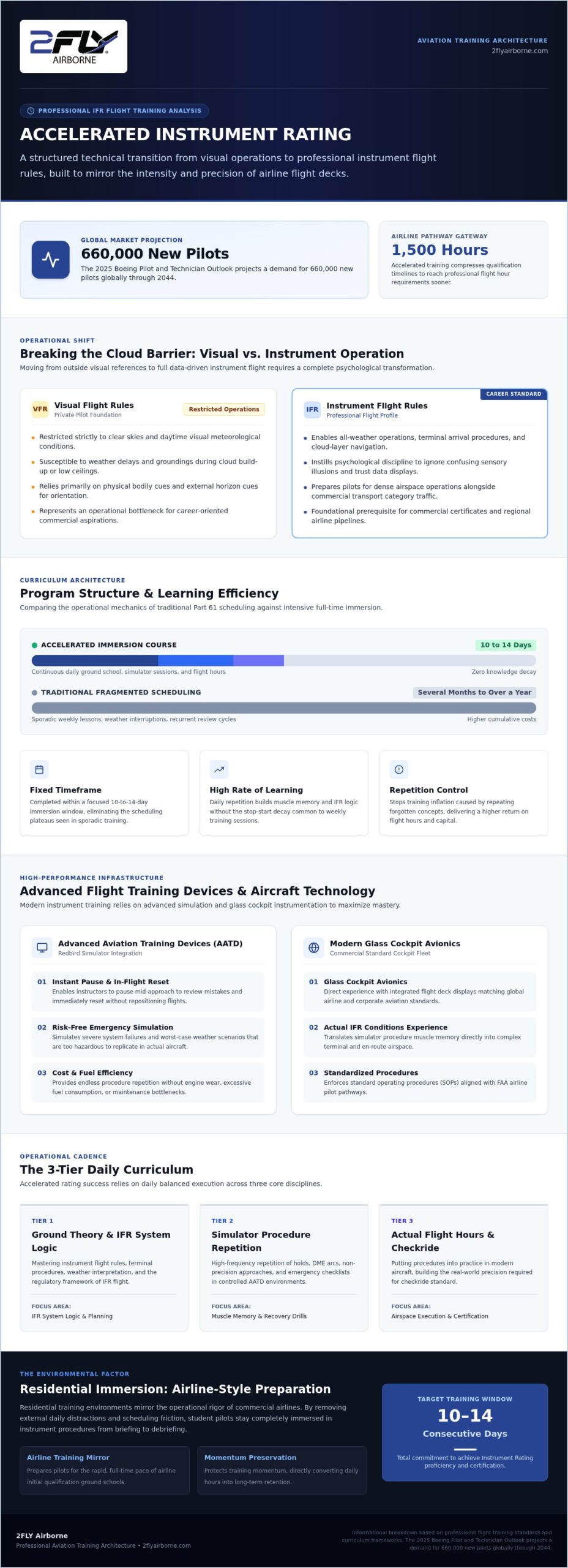
For many pilots, the Private Pilot Certificate is the entry ticket, but the Instrument Rating (IR) is the true foundation of a professional career. It’s the most significant technical hurdle you’ll face during your development. Transitioning from visual flight to an instrument flight rules rating requires more than just new skills; it demands a total psychological shift. You must learn to ignore your physical sensations and trust the precise data on your flight display.
An accelerated instrument rating course provides the high-intensity environment needed to cement this transition. Instead of dragging the process out over several months, you immerse yourself in the logic of the IFR system. This focus is exactly what commercial airlines expect from their flight crews. They don’t want pilots who merely “get by” in the clouds; they want professionals who thrive in them.
To better understand the pace and structure of this training, watch this helpful video:
VFR vs. IFR: Breaking the Cloud Barrier
A Private Pilot Certificate without an IR limits you to clear skies and daytime visibility. For a career-minded pilot, these restrictions are a major operational bottleneck. Mastering the ability to fly solely by reference to instruments expands your utility and safety profile. It ensures you can navigate complex weather patterns and busy terminal areas with the same precision as an airline captain. This proficiency is the bedrock of professional safety, preparing you for the rigorous demands of the FAA Professional Pilot Program.
The Market Demand for IFR-Proficient Pilots
The industry doesn’t just need pilots; it needs professionals who can operate in all-weather environments safely. The 2025 Boeing Pilot and Technician Outlook projects a demand for 660,000 new pilots globally through 2044. Meeting this demand requires efficient training pathways. By completing an accelerated instrument rating course, you shave months off your training timeline. This speed allows you to reach the 1,500-hour milestone sooner and positions you for early entry into regional or international carrier pipelines. It’s a strategic move to maximize your career mobility in a high-demand market.
Defining the Accelerated Instrument Rating Course Structure
An accelerated instrument rating course is a full-time professional commitment that demands total mental and physical immersion. Success in this environment relies on a structured philosophy where the student flies daily, often completing the entire rating in a 10-to-14-day window. This pace isn’t just about finishing quickly. It’s about maintaining a high rate of learning that traditional, sporadic lessons simply cannot match.
The curriculum balances ground school, simulator sessions, and actual flight time to ensure comprehensive proficiency. By choosing a structured accelerated instrument rating course, you eliminate the ‘stop-start’ nature of Part 61 schools that causes knowledge to decay between weekly lessons. You’ll spend your days living and breathing instrument procedures, which is exactly how professional airline training operates.
The Role of Advanced Aviation Training Devices (AATD)
Advanced Aviation Training Devices (AATD) are the secret weapon of efficient flight training. Simulators like the Redbird AATD allow for endless procedure repetition without the high costs of fuel or engine wear. You can pause the “flight” to discuss a mistake or reset an approach instantly to try again. This controlled environment is perfect for practicing emergency procedures and system failures that are too risky to simulate in the actual aircraft.
Beyond safety, simulators offer significant logistical advantages. Federal regulations under 14 CFR § 61.65 aeronautical experience requirements allow pilots to log a portion of their instrument time in these devices. This helps you meet FAA requirements efficiently while keeping your total training costs manageable. If you’re looking to maximize your budget, you can explore our professional pilot pathways to see how simulator integration works in practice.
Syllabus Integration: From Ground to Sky
Success starts before you ever step into the cockpit. We strongly recommend finishing the IFR written exam before the flight portion of the syllabus begins. This ensures your mind is clear to focus on the practical application of instrument flight rules. A typical day involves morning ground school sessions to cover theory, followed by afternoon flights or simulator sessions to apply that knowledge.
This back-to-back scheduling builds the muscle memory necessary for high-level aviation. When you practice an approach in the simulator at 2:00 PM and then fly the same procedure in the aircraft at 4:00 PM, the learning is reinforced instantly. This seamless transition from ground to sky is what transforms a trainee into an industry-prepared professional. Consistent, daily training ensures that every hour spent in the air moves you closer to your commercial goals.
Choosing between a traditional flight school and an accelerated instrument rating course is a strategic decision that impacts your entire career trajectory. Most pilots at local Part 61 schools struggle with the “stop-start” nature of weekly lessons. When you only fly once or twice a week, you spend a significant portion of each session just regaining the proficiency you had seven days prior. This knowledge decay doesn’t just slow you down; it increases your total flight hours and tuition costs.
In contrast, an accelerated program maximizes your rate of learning by keeping you in the cockpit environment daily. You don’t have time to forget the nuances of a holding pattern or the sequence of an ILS approach. This consolidation of training makes you more financially efficient. You’re paying for progress, not for repetitive review. Consider the opportunity cost of your time. Finishing in two weeks versus six months allows you to move toward your commercial goals with much greater speed.
Time ROI and Career Momentum
In the aviation industry, seniority is the primary driver of quality of life and earning potential. Saving four months in your training phase doesn’t just mean getting your certificate sooner. It means entering the job market four months earlier, which can translate to hundreds of spots on a seniority list at a major carrier. Maintaining focus on a single certification goal prevents the psychological burnout often associated with prolonged, multi-month training schedules.
By following the structured pathway outlined in the U.S. Bureau of Labor Statistics pilot career guide, you can see how each rating builds toward commercial eligibility. An accelerated approach ensures you don’t get caught in the “one step forward, two steps back” trap. You maintain a steady, professional momentum that prepares you for the fast-paced environment of the FAA First Officer Program.
Skill Retention and Checkride Readiness
Intensive training leads to higher first-time pass rates on the IFR checkride. This is because your skills are at their peak when you meet the examiner. You’ve spent the last two weeks refining your procedures with a single, dedicated instructor who knows exactly where your strengths and weaknesses lie. This consistency builds a level of confidence that is difficult to replicate in a part-time environment.
Managing the “firehose” of information is easier when you’re in a structured, residential program. You aren’t distracted by the demands of daily life or a separate job. You’re fully immersed in a community of high-achievers who share your vocational goals. This environment turns a high-pressure situation into a methodical, world-class development experience.
Selection Checklist: Evaluating Your IFR Training Provider
Selecting an accelerated instrument rating course is a significant investment in your professional future. You aren’t just looking for a school; you’re looking for a structured training ecosystem that can support the intensity of a condensed timeline. If the infrastructure is lacking, even the most motivated student will face delays that erode the benefits of an accelerated path. You must look beyond the marketing and evaluate the practical realities of the provider’s operations.
A primary concern for any career-track pilot should be the coordination of the final checkride. Ask potential providers how they manage Designated Pilot Examiner (DPE) availability. In many regions, examiner backlogs can stretch for weeks. A world-class institution will have established relationships and pre-coordinated slots to ensure you transition from training to testing without losing your edge. You can explore our Professional Pilot Program standards to see how we prioritize these logistical details.
Fleet Technology and Maintenance Standards
The aircraft you train in must mirror the technology you’ll encounter in a modern airline flight deck. Evaluating the fleet for glass cockpits, such as the Garmin G1000, is essential for vocational preparedness. Learning to manage digital flight displays and integrated avionics now will make your transition to commercial jets much smoother. It’s a critical step in becoming an industry-prepared professional.
Beyond technology, fleet size and maintenance reliability are non-negotiable. An accelerated program has no room for “down days” due to mechanical issues. Ensure the school maintains a large enough fleet to swap aircraft immediately if a maintenance squawk occurs. This redundancy protects your schedule and ensures your momentum remains unbroken throughout the syllabus.
Instructor Expertise and Continuity
The quality of your mentorship defines your success in the clouds. There is a profound difference between a standard flight instructor and a career-focused Certified Flight Instructor Instrument (CFII) mentor. You need a dedicated professional who will be with you every single day of your course. This continuity allows the instructor to identify subtle habits and refine your technique with precision.
Investigate the school’s track record with accelerated graduates. High first-time pass rates are often a byproduct of a standardized, professional-grade curriculum rather than individual luck. When you choose a provider with a global recruitment network and established standards, you’re aligning yourself with an elite institution. If you’re ready to take the next step, speak with a training advisor about our immersive IR options today.
The 2FLY Advantage: Integrating IR into a Professional Career
At 2FLY Airborne, we don’t view the Instrument Rating as an isolated certificate to be checked off a list. It is the definitive cornerstone of our FAA Professional Pilot Program. Our training follows a rigorous, professional-grade syllabus designed specifically to produce industry-prepared professionals. By choosing an accelerated instrument rating course within our ecosystem, you’re aligning your development with international airline standards from the very first hour.
We bridge the critical gap between initial certification and international airline recruitment. While other schools may focus solely on the checkride, we focus on the career. This means every briefing and every flight hour is conducted with the discipline required by commercial carriers. You aren’t just learning to fly in the clouds; you’re learning to operate as a crew member in a complex, high-stakes environment.
Residential Training and Total Immersion
The primary benefit of our residential approach is the elimination of daily distractions. We provide managed on-campus housing so that your commute is measured in steps rather than miles. This total immersion allows you to dedicate your entire mental capacity to the training syllabus. It creates a “flight deck mindset” that is essential for mastering the technical demands of instrument flight.
You won’t be training in a vacuum. Collaborating with a cohort of like-minded student pilots provides a unique support system that mirrors the camaraderie of a professional airline squadron. You’ll study together, review approaches together, and push each other toward excellence. To see how this fits into your budget, you can learn about our housing and financing options and how we support our students’ logistical needs.
Your Pathway to the Commercial Flight Deck
The instrument rating feeds directly into your Commercial Pilot Certificate and Multi-Engine Rating. It is the phase where you truly begin to look and act like a professional pilot. Once you’ve mastered IFR flight, the transition to complex, multi-engine aircraft becomes a natural progression rather than an overwhelming leap. We ensure that the habits you build during your accelerated instrument rating course serve as a stable foundation for the rest of your career.
The value of 2FLY’s global network cannot be overstated. We don’t just train you; we position you for success in a competitive market. Our established relationships within the industry help our graduates secure their first professional roles more efficiently. This accelerated IR is a high-intensity, high-reward investment that pays dividends throughout your entire vocational journey. It’s the moment your ambition meets a world-class training structure.
Take Command of Your Professional Timeline
Mastering instrument flight is the definitive pivot in your journey to the commercial flight deck. By choosing an accelerated instrument rating course, you replace the inefficiency of traditional training with a structured, immersive environment that mirrors the demands of the global airline industry. This path ensures you maintain momentum while reaching your commercial goals with greater speed.
Since 1994, 2FLY Airborne has provided a world-class gateway for high-achievers through both FAA Part 141 and Part 61 options. Our dedicated fleet of glass-cockpit aircraft and residential immersion programs allow you to focus entirely on technical mastery. Every hour of training is conducted in a safe, structured environment designed to transition you from a trainee to an industry-prepared professional.
Your future in the cockpit depends on the quality of the foundation you build today. To explore how our programs can elevate your career, Speak with a 2FLY Training Advisor to plan your accelerated path. Please reach out to a 2FLY Training Advisor with questions.
Frequently Asked Questions
Is an accelerated instrument rating course harder than traditional training?
An accelerated instrument rating course isn’t harder regarding the technical material, but it is significantly more intensive. You’ll move through the syllabus at a pace that mirrors professional airline training. This requires a full-time commitment and a high level of mental discipline. Students who thrive in this environment often find that daily repetition makes the complex procedures feel like second nature much faster than weekly lessons.
What are the prerequisites for starting an accelerated IFR program?
You must hold a valid Private Pilot Certificate and a current FAA medical certificate before beginning your training. Most programs also require a specific number of cross-country flight hours to meet federal aeronautical experience requirements. It’s essential to verify your logbook entries with a training advisor before starting to ensure you’re eligible for the checkride at the end of the intensive window.
How many hours of flight time are included in a typical accelerated course?
A standard program includes the 40 hours of actual or simulated instrument time required by the FAA. This time is typically divided between a dedicated fleet of aircraft and Advanced Aviation Training Devices. Using simulators allows you to practice complex approaches and emergencies with high frequency. This structured approach ensures you meet all regulatory requirements while building the proficiency needed for a professional career.
Can I really finish my instrument rating in just two weeks?
Completing the rating in a 10-to-14-day window is a realistic goal for motivated pilots. This timeline depends on your preparation and the completion of your written exam before arrival. While individual progress and weather conditions can cause variations, the immersion of a residential program is designed to reach the finish line quickly. It’s a high-intensity path that rewards those who arrive ready to fly daily.
Do I need to complete the IFR written exam before I arrive for training?
We strongly recommend finishing your IFR written exam before you start the flight portion of your accelerated instrument rating course. Having the theoretical knowledge out of the way allows you to focus entirely on the practical application of instrument procedures. You don’t want to spend your evenings studying for a written test when you should be preparing for the next day’s flight or simulator session.
How much does an accelerated instrument rating course typically cost?
Training costs depend on whether you choose a modular hourly rate or a fixed-price professional pilot program. 2FLY Airborne provides transparent pricing structures that include flight hours, instructor time, and simulator usage. You should also consider the costs of on-campus housing and FAA examiner fees. Speaking with a training advisor is the best way to get a clear picture of the investment required for your specific goals.
What happens if I don’t pass my checkride at the end of the course?
If you don’t pass your checkride, you’ll receive a notice of disapproval from the examiner outlining the specific areas that need improvement. You’ll then complete remedial training with your instructor to address those deficiencies. Once you’ve regained proficiency in those tasks, your instructor will sign you off for a re-check. Our goal is to ensure you meet the high standards required for an international aviation career.
Is the instrument rating mandatory for a commercial pilot career?
While you can technically earn a commercial certificate without it, an instrument rating is mandatory for any viable professional career. Without an IR, a commercial pilot is restricted from carrying passengers for hire at night or on flights over 50 nautical miles. The 2025 Boeing Pilot and Technician Outlook projects a demand for 660,000 new pilots globally through 2044, and virtually every one of those roles requires IFR proficiency.
Article by
2FLY Airborne
2Fly Airborne is a professional flight training organization dedicated to developing the next generation of skilled, confident, and safety-focused pilots. With decades of combined aviation experience, our team of certified instructors provides structured, real-world training designed to prepare students for both checkrides and long-term success in the aviation industry.
Content Disclaimer
Some blog content is generated with the assistance of automated tools and may not always be fully accurate or up to date. Please verify all aviation-related information with official sources or a certified instructor. For additional guidance or clarification, we encourage you to contact one of our training advisors at 2Fly Airborne.