Flying into a cloud layer for the first time is a defining moment in a pilot’s career, but the path shouldn’t feel like flying through a thick fog. Many aspiring professionals find themselves overwhelmed by the dense language of FAA regulations when trying to determine the exact instrument rating flight hours requirement. You deserve a clear, authoritative roadmap that translates complex rules into a strategic plan for your professional development.
Mastering the IFR environment is a critical milestone that separates recreational flyers from industry-prepared pilots ready for international careers. Whether you are pursuing a modular approach or an integrated professional program, knowing exactly what the FAA expects will save you both time and money. This guide provides a definitive breakdown of the current 2026 standards to help you train with precision and confidence.
We will examine the critical differences between Part 61 and Part 141 training paths, including how to leverage advanced flight simulators to reduce costs. You’ll gain a transparent checklist of the cross-country and specialized instruction hours needed to reach the checkride. By the end of this article, you’ll have the clarity required to navigate your training with the mindset of a professional aviator.
Key Takeaways
- Understand the fundamental FAA flight hour minimums, including the specific cross-country and instrument training time needed for certification.
- Compare the flexibility of Part 61 with the efficiency of Part 141 curricula to determine which path accelerates your professional career.
- Master the specific instrument rating flight hours requirement to avoid logging unnecessary time and optimize your training budget.
- Learn how to effectively utilize state-of-the-art flight simulators and specialized instruction from a CFII to meet regulatory standards.
- Discover how integrating your instrument rating into a structured professional pilot program creates a seamless transition toward commercial aviation.
Understanding the Core Instrument Rating Flight Hours Requirement
Transitioning from visual flight rules (VFR) to instrument flight rules (IFR) requires a significant shift in technical proficiency. The FAA establishes strict benchmarks to ensure you can manage an aircraft solely by reference to instruments. Meeting the instrument rating flight hours requirement is the first step in proving you possess the discipline required for a professional career. This phase of training transforms you from a pilot who avoids weather into one who can safely navigate through it.
The 50/40 Rule Explained
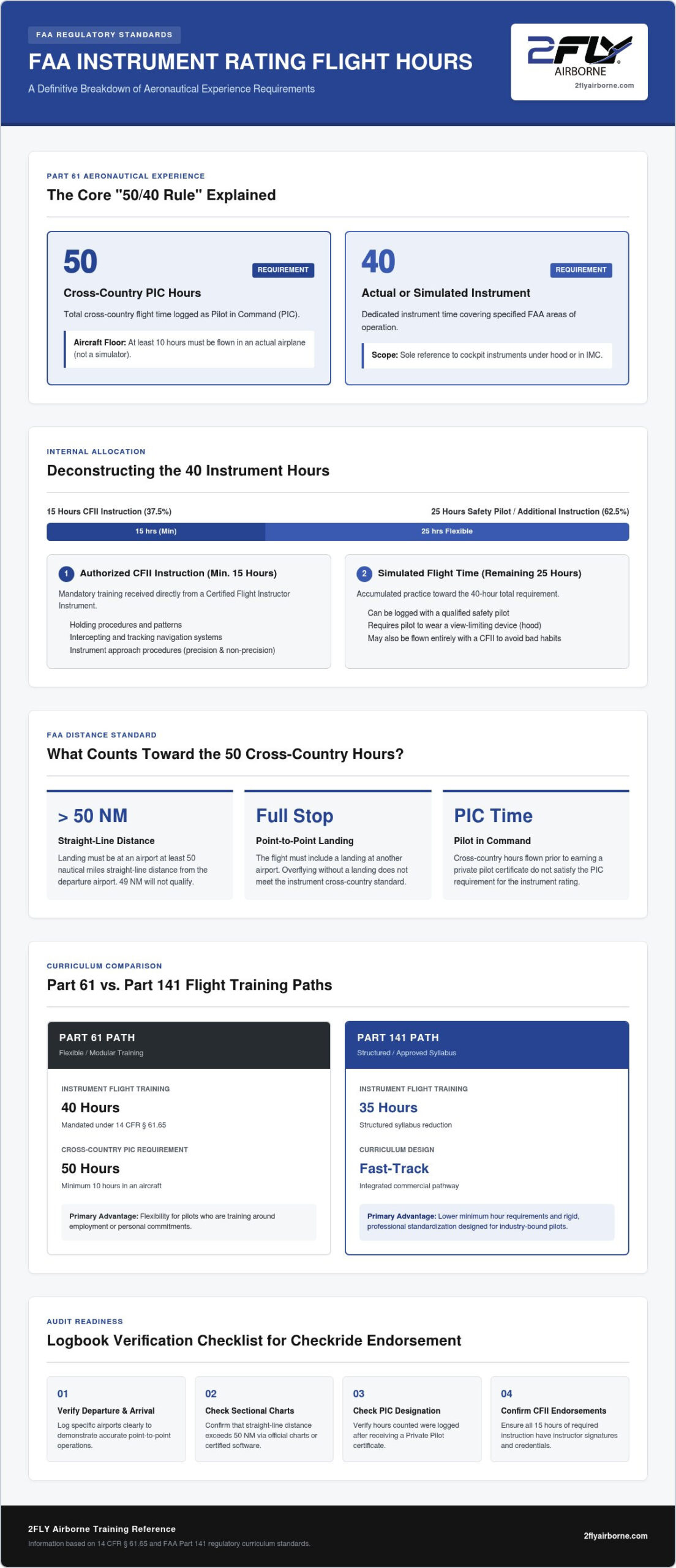
Under Part 61 regulations, the journey is often defined by the “50/40 rule.” This requires you to log 50 hours of cross-country flight time as pilot in command (PIC). At least 10 of these hours must be completed in an airplane rather than a simulator. Additionally, you must accumulate 40 hours of actual or simulated instrument time on the areas of operation specified by the FAA.
Many modular students view these numbers as a target, but experienced mentors treat them as the absolute floor. If you’re enrolled in a structured FAA Professional Pilot Program, you’ll learn that achieving these minimums is just the beginning. You can find an instrument rating overview that details how these hours prepare you for the operational privileges of IFR flight. Professional training focuses on the quality of these hours rather than just the quantity.
Within that 40-hour instrument block, you must receive at least 15 hours of instrument flight training from an authorized instructor (CFII). This instruction covers maneuvers like holding patterns, intercepting navigation systems, and various instrument approaches. The remaining 25 hours can often be logged with a safety pilot while wearing a view-limiting device, though many students choose to stick with a CFII for the entire duration to ensure they don’t develop bad habits.
Cross-Country PIC Requirements
Not all flight time away from your home airport qualifies for the instrument rating flight hours requirement. For this specific certification, the FAA defines cross-country time as a flight that includes a landing at an airport other than the point of departure. Crucially, the landing must be at an airport at least 50 nautical miles straight-line distance from the original departure point. If you land 49 miles away, those hours won’t count toward your instrument rating totals.
Logging PIC time effectively requires meticulous record-keeping in your pilot logbook. You must ensure every entry clearly states the departure and arrival points to prove the 50-nautical-mile requirement was met. It’s vital to verify your distances using official sectional charts or verified navigation software. Pilots who fail to verify these distances often face frustrating delays when it’s time for their checkride endorsement.
Common mistakes often involve logging cross-country time before earning a private pilot certificate. While those hours count toward your total time, they don’t fulfill the PIC cross-country requirement for an instrument rating. You must be the pilot in command, which typically means you’re already a certified private pilot. Building these hours strategically allows you to focus on precision and decision-making before you begin your formal instrument instruction.
Part 61 vs. Part 141: How Your Training Path Changes Hour Requirements
Choosing between Part 61 and Part 141 is one of the most critical decisions you’ll make when planning your training. While both paths lead to the same certificate, the way they handle the instrument rating flight hours requirement differs significantly. Part 61 offers flexibility for those training around a job, but Part 141 provides a fast-track designed for the professional industry.
The Part 141 Advantage
Part 141 schools operate under a highly structured, FAA-approved syllabus that allows for a reduction in total flight time. In a Part 141 environment, the minimum flight training requirement is typically 35 hours of specialized instrument training. This is a noticeable decrease from the 40 hours mandated under the 14 CFR § 61.65 aeronautical experience requirements found in Part 61.
Perhaps the greatest benefit is the modification of the 50-hour PIC cross-country requirement. Under Part 141, you don’t need to build those 50 hours of cross-country time before taking your instrument checkride. This allows you to advance through your certifications much faster, moving directly into instrument work once you’ve reached the necessary proficiency. It’s the most efficient way to transition from a trainee to an industry-prepared professional.
Which Path is Right for You?
If your goal is a career in the flight deck of a major airline, the structure of a Part 141 program is almost always the superior choice. You’ll progress through a methodical syllabus that mirrors the training environment of a commercial carrier. This consistency helps you develop professional habits early, ensuring you reach proficiency without the delays often found in modular training. It’s a disciplined approach that saves both time and financial resources.
While Part 61 offers the freedom to build hours at your own pace, it often results in higher long-term costs due to the extra flight time required. The FAA Professional Pilot Program: Your Career Starts Here leverages the Part 141 structure to provide a clear, cost-effective roadmap to your first officer position. Deciding which path fits your timeline is a conversation you should have with an experienced training advisor who understands your long-term ambitions.
Ultimately, the instrument rating flight hours requirement you face depends on your chosen training environment. Career-minded students usually find that the rigor of an approved curriculum provides the technical mastery needed for the next level of certification. You’ll find that the structured environment doesn’t just cut hours; it builds the technical precision required for the airlines.
Breaking Down the 40 Hours of Instrument Time
Building the 40 hours of instrument time is where you develop the technical precision needed for high-level flight. This instrument rating flight hours requirement isn’t just about logging time; it’s about mastering specific operational tasks under simulated or actual conditions. You’ll learn to manage the flight deck during high-workload scenarios without any external visual references.
Dual Instruction vs. Safety Pilot Time
The FAA mandates that at least 15 of your 40 instrument hours must be received as dual instruction from a Certified Flight Instructor Instrument (CFII). This instruction ensures you receive expert guidance on complex procedures like holding patterns and precision approaches. Professional pilot candidates often find that additional dual instruction builds a stronger foundation for their future commercial careers.
The remaining 25 hours can be logged as simulated instrument time using a view-limiting device while flying with a safety pilot. A safety pilot must hold at least a private pilot certificate and maintain a constant watch for other aircraft while you focus on the instruments. This arrangement allows you to refine your skills and build hours toward the instrument rating flight hours requirement more affordably. It’s an excellent way to practice procedures until they become second nature.
The IFR Cross-Country Requirement
A pivotal component of your training is the long IFR cross-country flight. This mission must cover a total distance of at least 250 nautical miles along airways or ATC-directed routing. It serves as a comprehensive rehearsal for the real-world demands of professional IFR operations. You’ll need to demonstrate stamina and high levels of situational awareness throughout the entire flight.
During this flight, you must perform three different types of instrument approaches at three different airports. This variety ensures you can handle diverse navigation systems, such as ILS, RNAV, or VOR, in a single mission. Referencing the FAA aviation handbooks and training manuals during your preflight planning will help you master the procedural nuances of these approaches.
Professional training programs structure this cross-country to maximize exposure to complex airspace and air traffic control communications. It’s your first real opportunity to operate as a professional pilot within the national airspace system. Proper execution of this flight demonstrates that you’re ready for the rigors of the instrument checkride. Mastery of these long-distance logistics is a hallmark of an industry-prepared professional.
Beyond the Cockpit: Ground School and Knowledge Requirements
While the physical cockpit is where skills are refined, the ground school is where the foundation of an instrument-rated professional is built. You must receive and log ground training from an authorized instructor or a comprehensive home study course. This theoretical knowledge is what allows you to interpret complex weather patterns and ATC instructions with absolute certainty.
The FAA Instrument Rating Knowledge Test
Before you can attempt the practical checkride, you must pass the FAA Instrument Rating Knowledge Test. This 60-question exam challenges your understanding of IFR navigation, weather reports, and federal regulations. Achieving a passing score of at least 70% requires a deep dive into IFR charts and approach plates. These documents serve as your visual roadmap, detailing every obstacle, frequency, and altitude minimum required for safe passage.
Ground school hours are designed to move you beyond rote memorization toward a functional understanding of the national airspace system. You’ll learn to analyze METARs and TAFs (weather reports and forecasts) to make critical go or no-go decisions. Mastering these technical details early ensures that your flight hours are spent refining maneuvers rather than struggling with basic concepts.
Using Simulators to Meet Hour Requirements
Modern technology has revolutionized how pilots satisfy the instrument rating flight hours requirement. FAA-approved Aviation Training Devices (ATDs) and Full Flight Simulators (FFS) offer a controlled environment to practice high-stress scenarios. Under Part 61, you can count up to 20 hours of instrument time logged in an approved Advanced Aviation Training Device (AATD) toward your 40-hour total.
Part 141 programs also leverage these devices, often allowing up to 50% of the instrument training to be completed in an approved simulator. Practicing emergency procedures, such as vacuum system failures or engine malfunctions in IMC (Instrument Meteorological Conditions), is safer and more effective in a simulator. This strategic integration ensures you are industry-prepared before you ever leave the ground.
The global aviation industry values pilots who combine technical stick-and-rudder skills with robust theoretical knowledge. The 2025 Boeing Pilot and Technician Outlook projects a demand for 660,000 new pilots globally through 2044. To ensure you are part of this next generation, you should explore our professional training paths to start building your credentials today.
Accelerating Your Career with the FAA Professional Pilot Program
The instrument rating is more than just another certificate in your logbook. It’s the moment you transition from a fair-weather flyer to a professional capable of operating in the complex international airspace system. This phase is often the most technically demanding part of your early training, setting the procedural standard for every flight that follows.
Integrating this rating into a structured career path ensures you don’t just meet the minimums but exceed industry expectations. Professional pilot programs are designed to mold you into a first-officer candidate from day one. You’ll move through your training with a clear focus on the technical mastery required by major commercial carriers.
From Private Pilot to Commercial Ready
After earning your Private Pilot Certificate, the instrument rating serves as the essential bridge to your Commercial Pilot Certificate. It introduces a level of precision and procedural discipline that airlines expect from their flight crews. Training in a structured, high-tempo environment prepares you for the rigorous demands of a professional flight deck where split-second decisions are the norm.
Professional academies emphasize Standard Operating Procedures (SOPs) that mirror those used by airlines. This standardization ensures that when you move into Multi-Engine or Commercial training, your instrument skills are already second nature. You can explore the full roadmap for this journey in our guide on How to Become a Pilot: The Comprehensive 2026 Guide.
Airlines value candidates who have trained in these disciplined environments because it reduces their training risk. When you can demonstrate high-level situational awareness and technical accuracy during the instrument phase, you prove your readiness for advanced aircraft. This phase of your education is where the “hobbyist” mindset is replaced by the “professional” standard.
Next Steps for Aspiring Aviators
Your first step is to evaluate your current logged time against the instrument rating flight hours requirement. If you’re building hours modularly, you must be diligent about tracking your cross-country PIC time to avoid any delays at the checkride stage. Choosing a training partner that offers an integrated path can streamline this process and ensure your hours are built efficiently.
Not every flight school provides the same level of career preparation or professional mentorship. You need a partner that offers more than just the minimum instrument rating flight hours requirement. Seek out institutions that provide access to state-of-the-art simulators and instructors who have real-world airline experience to guide your development.
The global aviation industry is waiting for the next generation of skilled, disciplined pilots. The 2025 Boeing Pilot and Technician Outlook projects a demand for 660,000 new pilots globally through 2044. By choosing a structured training path now, you’ll be prepared to meet that demand with the confidence and technical expertise of a seasoned professional.
Charting Your Course to the Flight Deck
Navigating the instrument rating is a transformative step in your aviation career. Whether you choose the flexibility of Part 61 or the streamlined efficiency of a Part 141 curriculum, understanding the specific aeronautical experience needed is vital. Mastering the instrument rating flight hours requirement ensures you spend your time building the precision required for international commercial operations.
Success in this industry demands a structured approach and access to the best resources. We provide FAA-approved Part 141 training curricula alongside a modern fleet and state-of-the-art simulators to prepare you for the highest levels of the profession. Our proven track record of career-ready graduates demonstrates that the right environment makes all the difference in your professional mobility.
If you’re ready to transition from a trainee to an industry-prepared professional, we’re here to support your journey. Please speak with a 2FLY Airborne Training Advisor about our FAA Professional Pilot Program with any questions you have about your training roadmap. Your future in the clouds is within reach.
Common Questions About Instrument Rating Requirements
Can I use simulator time to satisfy the instrument rating flight hours requirement?
Yes, the FAA allows you to use approved Aviation Training Devices to meet part of the instrument rating flight hours requirement. Under Part 61, you can log up to 20 hours in an Advanced Aviation Training Device (AATD). Part 141 programs often allow up to 14 or 17.5 hours depending on the specific syllabus. Using these devices reduces costs while allowing you to practice complex emergencies safely.
What is the difference between actual and simulated instrument time?
Actual instrument time is logged when you fly solely by reference to instruments in clouds or poor visibility. Simulated instrument time occurs when you use a view-limiting device, like a hood, while flying in clear weather. Both types of time count toward your certification. Professional training typically includes a mix of both to ensure you’re comfortable in real-world weather conditions and high-workload environments.
Does cross-country time logged during my PPL training count toward the IR requirement?
Cross-country time logged during private pilot training counts toward your total flight time, but it might not fulfill the PIC requirement for an instrument rating. Under Part 61, you need 50 hours of cross-country time as Pilot in Command. Since you aren’t PIC during dual instruction as a student pilot, only your solo cross-country hours apply. Most pilots build the remaining hours after earning their initial certificate.
How many hours of dual instruction do I need for an instrument rating?
You must log at least 15 hours of dual instruction from an authorized instrument flight instructor (CFII) under Part 61 rules. However, a structured Part 141 curriculum requires 35 hours of specialized instrument training. Most career-track students choose the Part 141 path because it integrates these hours more efficiently. High-achievers often exceed these minimums to ensure they’ve mastered the precision required for commercial aviation careers.
What are the specific requirements for the IFR cross-country flight?
The IFR cross-country must be a flight of at least 250 nautical miles along airways or ATC-directed routing. You must perform three different types of instrument approaches, such as ILS, VOR, and GPS, at three separate airports. Under Part 141, at least one segment must have a straight-line distance of 100 nautical miles between airports. This flight serves as a final rehearsal for the technical demands of your practical checkride.
Is it possible to complete the instrument rating in less than 40 hours?
You can complete the rating in less than 40 hours only if you’re enrolled in an FAA-approved Part 141 program. These structured courses have a minimum requirement of 35 hours of instrument training. Part 61 candidates must log the full 40 hours of actual or simulated time. Choosing a Part 141 school is the most efficient way to satisfy the instrument rating flight hours requirement while maintaining high professional standards.
Do I need a specific type of aircraft to log instrument flight hours?
You don’t need a specific model, but the aircraft must be properly equipped for IFR flight as per 14 CFR 91.205. This includes specific navigation equipment like a VOR or GPS and required instruments such as a sensitive altimeter. The aircraft must also have current inspections for its pitot-static system and transponder. Training in a modern glass-cockpit aircraft prepares you more effectively for the advanced systems used by airlines.
How long does it typically take to meet all instrument rating requirements?
Most pilots in structured programs complete their rating in approximately 15 weeks. The timeline varies based on your flight frequency, weather availability, and personal learning pace. Modular students training part-time often take longer to build the necessary cross-country PIC hours. Enrolling in a full-time professional pilot program provides the consistency needed to reach your goals on a predictable schedule while preparing for an international career.
Article by
2FLY Airborne
2Fly Airborne is a professional flight training organization dedicated to developing the next generation of skilled, confident, and safety-focused pilots. With decades of combined aviation experience, our team of certified instructors provides structured, real-world training designed to prepare students for both checkrides and long-term success in the aviation industry.
Content Disclaimer
Some blog content is generated with the assistance of automated tools and may not always be fully accurate or up to date. Please verify all aviation-related information with official sources or a certified instructor. For additional guidance or clarification, we encourage you to contact one of our training advisors at 2Fly Airborne.