
Planning your first flying lesson and trying to understand the cost? Dual flight instruction hourly rates vary with instructor qualifications and local demand, while aircraft rental and fuel may be separate charges. The hourly figure alone may not reflect the full lesson cost.
It’s natural to focus on the hourly rate when planning flight training. Comparing what a lesson includes gives you a clearer view of the cost and helps you plan your next steps. This guide explains what affects rates, how instructor qualifications relate to training goals, and what to consider as you work toward a pilot certificate.
Key Takeaways
- Compare instructor qualifications and local demand to understand why hourly charges differ between training locations.
- Match the instructor’s ratings and experience to your current training goals, rather than choosing by hourly rate alone.
- Separate instructor fees from aircraft rental and fuel when estimating the full cost of a lesson.
- Use your certification path and training needs to identify the right instructor type and lesson structure.
- Explore 2FLY Airborne’s FAA Professional Pilot Program and its Private Pilot Certificate, Instrument Rating, and Commercial Pilot Certificate training options as you plan your next step.
Flight instruction hourly rates
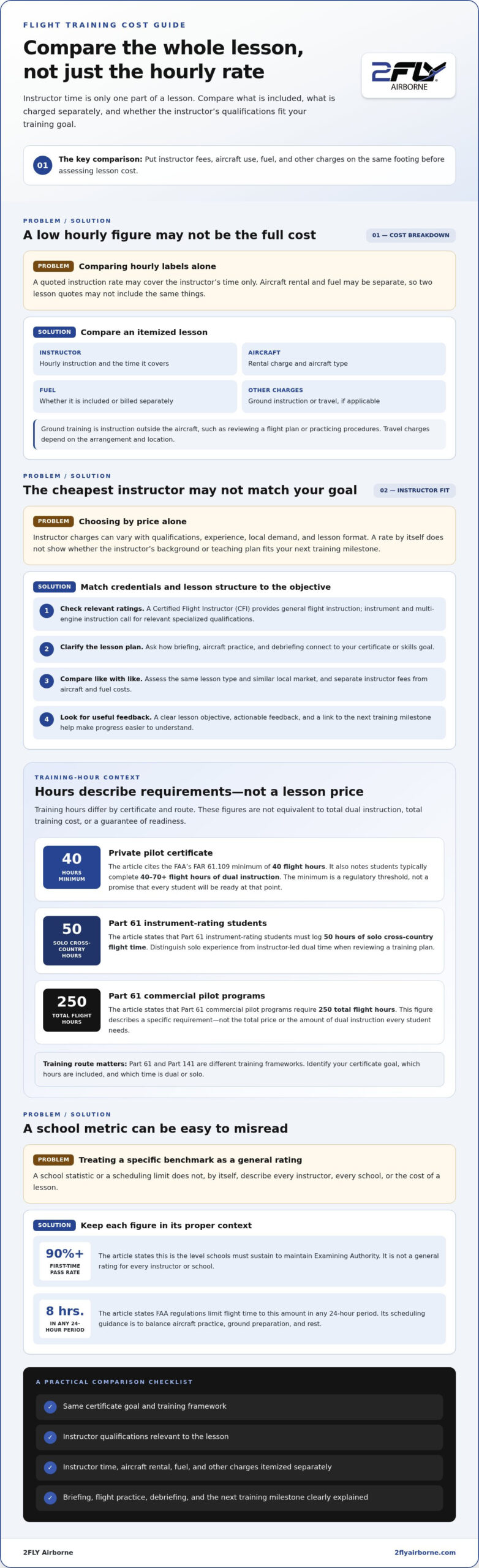
Dual flight instruction hourly rates vary with instructor qualifications, local demand, aircraft type, and what the lesson includes. A quoted instruction rate may cover the instructor’s time only, while aircraft rental and fuel can add separate charges. Compare the full lesson breakdown, not just its hourly label, before setting a training budget.
For a private pilot certificate, students typically complete 40-70+ flight hours of dual instruction. The Federal Aviation Administration states that FAR 61.109 sets a 40-hour minimum for a private pilot certificate. That minimum is a regulatory threshold, not a promise that every student will be ready to demonstrate required skills at that point.
The training route also affects required experience. According to the Federal Aviation Administration, Part 61 instrument-rating students must log 50 hours of solo cross-country flight time. The Federal Aviation Administration also states that Part 61 commercial pilot programs require 250 total flight hours. These figures describe specific requirements, not the total price of training or the amount of dual instruction every student needs.
Part 61 and part 141 refer to different training frameworks. When comparing a school’s plan, identify the certificate goal, the hours included, and which instruction is dual or solo. For example, a private pilot student should distinguish instructor-led aircraft time from required solo practice. That distinction makes the training plan easier to assess.
What governs flight instruction and logging dual received? FAA requirements vary by certificate and training path; the Federal Aviation Administration’s listed requirements include the 40-hour private pilot minimum and specific cross-country and commercial-hour requirements. Confirm that your training records distinguish dual instruction from solo flight time.
What are typical dual instruction rates for a Cessna 172 or another trainer? The hourly charge depends on the instructor’s ratings, local demand, aircraft model, and whether rental and fuel are included. Compare those components on the same basis rather than treating different lesson packages as equivalent.
Ground training and instructor travel may also affect the total. Ground instruction is teaching outside the aircraft, such as reviewing a flight plan or practicing procedures. Travel charges depend on the arrangement and location. Ask for an itemized breakdown of instruction, aircraft rental, fuel, ground training, and any travel costs before comparing plans.
Safety and training quality matter alongside the hourly figure. The Federal Aviation Administration states that schools must sustain a first-time pass rate of 90% or higher to maintain Examining Authority. This standard applies to that authority, so don’t treat it as a general rating for every instructor or school.
Daily scheduling has limits, too. According to the Federal Aviation Administration, flight time cannot exceed 8 hrs. in any 24-hour period under FAA regulations. A well-planned schedule balances aircraft practice, ground preparation, and rest, helping each lesson support the next step toward a pilot certificate.
Flight instructor hourly rates
Instructor charges depend on experience, ratings, location, and lesson format. A newly certificated flight instructor building experience toward an airline career may price differently from a seasoned instructor with advanced qualifications. Treat the instructor fee as one part of the training plan, then identify what instruction and preparation it covers.
Experience can shape the value of each lesson. An instructor with 5,000+ hours, multiple ratings, and specialized endorsement capabilities may bring broader expertise to training. That background can be especially relevant when a student’s goals extend beyond a private pilot certificate. Match the instructor’s qualifications to the skills and certificate you’re pursuing.
Location also matters. Market figures illustrate variation, not a guaranteed quote for a particular instructor or lesson.
Instructor rates can reflect local demand as well as credentials. In a larger market, demand and operating conditions may differ from those in a smaller one. Compare instructors in similar locations, and distinguish differences in qualifications from differences in local pricing.
A useful comparison starts with the lesson itself. Ask what the instructor’s hourly charge covers, then note any separate aircraft rental, fuel, ground preparation or simulator instruction. For example, an aircraft lesson may combine instructor time with aircraft use, while a simulator session has a different format. Comparing only the instructor fee can obscure these differences.
Use these steps to assess whether a rate fits your training goals:
- Match the instructor’s ratings to the certificate or skills you’re pursuing.
- Ask how the lesson plan connects briefing, aircraft practice, and debriefing.
- Compare the same type of lesson across instructors in the same market.
- Identify additional charges separately from the instructor’s time.
Students should also consider the teaching approach. A useful lesson plan sets clear objectives, gives actionable feedback and links each flight to the next training milestone. For a private pilot student, that could mean practicing a maneuver, reviewing performance afterward and identifying what to refine next time.
Instructor cost matters, but progress and fit matter too. A clear training plan helps students understand how each lesson supports a license goal. Before booking, ask about the instructor’s qualifications, lesson structure and itemized charges. This gives you a consistent basis for comparing options without confusing instructor expertise with aircraft costs.
Hourly instructor rates by instructor type
An instructor’s qualifications matter because they relate to different training objectives. A Certified Flight Instructor (CFI) provides general flight instruction, while instrument and multi-engine instruction call for relevant specialized qualifications. Match the instructor’s credentials to your lesson goal before comparing hourly charges. This keeps the comparison focused on the expertise your training requires.
For a student progressing from basic aircraft handling, a CFI can structure lessons around specific skills and review performance after each flight. A session’s value depends in part on the instructor’s ability to set clear objectives, explain corrections and connect practice to future lessons. Ask how a typical session is planned and reviewed.
An instrument-focused lesson has a different emphasis. A Certified Flight Instructor Instrument (CFII) can guide practice involving cockpit instruments and instrument procedures. Before choosing, identify the skills you need to develop and ask how the lesson will address them. A focused plan helps distinguish specialized instruction from a general flight lesson.
Multi-engine instruction has its own training context. A Multi-Engine Instructor (MEI) teaches skills related to aircraft with more than one engine. Compare instructors by asking which skills a planned lesson targets, how procedures will be explained and how progress will be reviewed. The qualification should match the training objective, not just the aircraft category.
Some schools also use training center instructors for structured sessions. This is a distinct format, so compare the session’s purpose with the instruction you need. Don’t assume a training center session and an aircraft lesson cover the same activities.
Use these questions to make a useful comparison:
- Which instructor qualification fits the skill you’re working on?
- What is the session’s learning objective?
- How will the instructor give feedback and track progress?
- Does the lesson take place in an aircraft, simulator, or training center?
For example, a student preparing for instrument training can compare proposed lesson plans by reviewing their objectives and feedback process. The instructor’s title is only a starting point. The planned instruction should address the student’s current needs and build toward the next milestone.
Rates can vary with instructor qualifications and local demand, so compare like with like. Keep aircraft lessons, simulator sessions, and structured training center sessions in separate categories. Then assess each instructor’s qualification, lesson purpose, and teaching approach alongside the hourly charge. This gives you a practical basis for selecting instruction that fits your next stage of training.
Instructor rates by tier
Instructor tiers are best treated as comparison categories, not universal labels. A rate may reflect teaching experience, specialized qualifications and the type of instruction involved. Compare the instructor’s background with your training objective, then consider whether the proposed lesson provides the expertise you need. This helps you evaluate value without assuming a higher tier automatically suits every student.
For foundational flight training, consider how an instructor explains procedures and responds to your performance. After a landing practice session, for example, useful feedback identifies what went well, what needs work and how to approach the next attempt. These details help you judge whether the instructor’s approach fits your learning needs.
Specialized instruction calls for a closer match between qualifications and goals. A student preparing for instrument procedures should look for relevant instrument teaching qualifications. Someone pursuing multi-engine training should seek instruction aligned with that aircraft and rating. The key question is whether the instructor’s experience applies directly to the skills planned for your lesson.
Comparing instructor tiers is easier when you understand the session itself. Ask what the lesson will cover, how the instructor will assess progress and what preparation happens before the flight. A defined objective, such as improving instrument scan or refining a maneuver, makes it easier to compare proposed training.
Use this practical comparison framework:
- List the certificate, rating, or skill you’re working toward.
- Note the instructor’s relevant qualifications and teaching experience.
- Compare the stated lesson objective and feedback process.
- Separate the instructor’s charge from other session components.
Consider a student choosing an instructor for an instrument lesson. One proposal may emphasize cockpit procedures, while another focuses on interpreting instruments during a specific exercise. Reviewing the planned content helps reveal whether the instruction matches the student’s immediate needs, beyond the label attached to the instructor’s tier.
Rate differences can also reflect how instructors organize preparation and follow-up. A briefing may establish the lesson’s purpose, while a debrief can identify skills to revisit. Ask how these parts fit into the instruction being offered. This gives you a fuller basis for comparing teaching value without assuming every instructor structures lessons the same way.
Choose by relevance, not status alone. An instructor with a specialized qualification may be the right fit for advanced training, while another may better support a student developing foundational skills. Compare credentials, lesson objectives, and feedback together. That tier-by-tier review can help you select instruction that supports your next training milestone and makes each session purposeful.
Are aircraft rental and fuel included in dual flight instruction rates?
An instructor’s fee usually covers teaching, not every expense of an aircraft lesson. Instructor charges may be separate from aircraft rental, fuel and other training expenses. Compare the complete lesson cost by adding each applicable charge, rather than treating the instructor’s hourly rate as the total.
For a Cessna 172 lesson, the instructor provides teaching while the aircraft is a separate cost component. Fuel may also be billed separately, depending on the school’s arrangement. The aircraft rental rate can depend on the model and how the school calculates flight time. Ask for the components in writing before comparing lesson plans.
A typical lesson may include more than time in the cockpit. At Van Nuys, a typical flying lesson involves about 1.5 hours of aircraft time on the Hobbs meter, the aircraft’s recording device. The lesson also includes roughly fifty minutes of briefing either side of that aircraft time. This example shows why scheduled time and billed aircraft time may differ.
Ground instruction is another possible charge. It covers preparation or teaching outside the aircraft, such as reviewing a flight plan or discussing maneuvers. Ask whether the instructor bills this separately or includes it in a lesson package. Clarify whether simulator time, aircraft rental, fuel and instructor time appear as separate line items.
Use this checklist to compare quotes consistently:
- Identify the instructor’s charge and the billing unit.
- Confirm the aircraft model and its rental charge.
- Ask how fuel is handled in the lesson total.
- Separate aircraft time from briefing, ground instruction, and simulator time.
- Check whether additional training expenses appear in the quoted total.
For example, two flight schools may quote similar instructor fees but differ in aircraft models, fuel arrangements or briefing practices. Compare the same lesson length and aircraft category. Then calculate the total using instructor time, aircraft rental, fuel and any ground or simulator session. This makes each option easier to assess on equal terms.
Part 61 and part 141 describe different training paths, but neither label alone tells you which charges a lesson includes. The practical comparison is the itemized breakdown. Ask how the school records aircraft time and whether the instructor’s fee changes for ground or simulator sessions. Those details clarify what each scheduled lesson covers.
Plan your training budget with the full lesson breakdown, not one hourly figure. Explore a structured FAA pilot training program to see how training can be organized around clear milestones.
2FLY Airborne: FAA Professional Pilot Program
2FLY Airborne offers an FAA Professional Pilot Program for aspiring professional pilots. It connects flight training with a clear progression through key pilot certifications, helping students plan beyond individual lesson costs.
When you’re ready to plan training toward a commercial aviation career, consider a structured program. The available FAA training pathways include the Private Pilot Certificate (PPL), Instrument Rating (IR) and Commercial Pilot Certificate (CPL). These milestones build skills progressively, from foundational aircraft handling to instrument procedures and commercial-level training.
Understanding instructor charges is one part of planning. Your next step is to consider which certificate or rating aligns with your goals and how structured training can support that progression. Contact 2FLY Airborne to discuss the FAA Professional Pilot Program and your training questions.
Take your next step toward the cockpit
Choosing a training path turns cost comparisons into a practical plan. Use what you’ve learned about dual flight instruction hourly rates to frame your questions around lesson structure, instructor fit and the milestones you want to reach. A clear goal helps you focus on training that supports your progress.
2FLY Airborne offers an FAA Professional Pilot Program, including training pathways for the Private Pilot Certificate (PPL) and Instrument Rating (IR). These milestones can help you build a foundation for continued aviation training and future professional goals.
Discuss your interests, training objectives, and questions about lessons directly with the school. Contact 2FLY Airborne to discuss lessons and take a confident step toward your aviation goals.
Frequently Asked Questions
How Much Are Flying Lessons Per Hour?
A flying lesson’s hourly cost combines instruction with aircraft-related charges, so one rate may not represent the full lesson. For example, compare a Cessna lesson by adding instructor time, aircraft rental, and fuel separately when budgeting with 2FLY Airborne.
What does a flight instructor (CFI) cost per hour?
A CFI’s hourly charge can vary with experience, qualifications and local demand. These figures describe different experience tiers, so compare instructors with similar qualifications and training responsibilities.
Why does flight training cost more in some regions?
Local demand and instructor qualifications influence hourly charges, while the aircraft and lesson arrangement affect the total students pay. Airport choice can also affect the lesson setup, including aircraft availability and rental arrangements. Compare training in similar settings and distinguish instructor fees from aircraft expenses.
What is the average hourly rate for dual flight instruction in the United States?
National averages provide a general benchmark for flight training expenses. A median is the midpoint of listed rates, not a guaranteed quote or the total cost of an aircraft lesson. U.S. dual flight instruction hourly rates vary by instructor qualifications and local demand. To estimate your lesson expense, account separately for aircraft rental, fuel, and any other applicable training charges.
How much do flight instructors charge per hour for airplane instruction?
The instructor’s fee pays for teaching, while aircraft use can add a separate charge. For a practical comparison, write down the instructor rate and aircraft rental as separate line items, then include fuel and any ground session in your lesson estimate.
How do dual flight instruction rates vary by region and airport?
Airport-level pricing can also vary with local demand, instructor qualifications, and aircraft rental arrangements. For example, compare instructors serving similar airports and training goals, then review what each quoted rate includes. Regional figures offer context, not a prediction of a specific airport’s charge.
How do rates compare between independent CFIs and flight schools?
There isn’t a single fixed rate distinction between an independent CFI and a flight school; qualifications, location and lesson arrangements affect the comparison. Treat that as a reference, not a universal school rate. Compare instructor time, aircraft access, rental, fuel and lesson structure separately to see how each option fits your training plan.
Article by
2FLY Airborne
2Fly Airborne is a professional flight training organization dedicated to developing the next generation of skilled, confident, and safety-focused pilots. With decades of combined aviation experience, our team of certified instructors provides structured, real-world training designed to prepare students for both checkrides and long-term success in the aviation industry.
Content Disclaimer
Some blog content is generated with the assistance of automated tools and may not always be fully accurate or up to date. Please verify all aviation-related information with official sources or a certified instructor. For additional guidance or clarification, we encourage you to contact one of our training advisors at 2Fly Airborne.