You’ve likely heard that becoming a professional pilot takes years of grueling study and thousands of hours in the cockpit. While the discipline required is absolute, the timeline is often much shorter than most realize when you enroll in part 141 commercial pilot training florida. The idea that you must spend a decade training before earning a paycheck is a common misconception that keeps many talented candidates on the ground.
It’s frustrating to face conflicting information about flight hour requirements or the fear of hidden delays that could stall your progress. You want a definitive answer so you can plan your transition from the classroom to the flight deck with certainty. Finding a structured program is the most effective way to streamline this journey and ensure you’re meeting rigorous international standards.
This guide provides a realistic 2026 timeline for earning your commercial pilot license and launching your career. We’ll break down the exact hour requirements, compare training pathways, and explain how to accelerate your path to employment. You’ll gain a clear understanding of how to move from a trainee to an industry-prepared professional in the most efficient way possible.
Key Takeaways
- Understand the critical distinction between reaching the Commercial Pilot License milestone and the subsequent flight hour requirements for airline employment.
- Learn how enrolling in part 141 commercial pilot training florida can significantly reduce your total required flight hours through a structured, FAA-approved syllabus.
- Compare the accelerated nature of high-intensity training programs against self-paced options to identify the most efficient route to your first professional flying job.
- Identify how strategic factors like regional weather patterns and aircraft fleet availability directly influence your daily training momentum and overall completion timeline.
- Discover how the FAA Professional Pilot Program streamlines the journey for international students by integrating specialized training with essential visa and administrative support.
Understanding the Commercial Pilot License Timeline
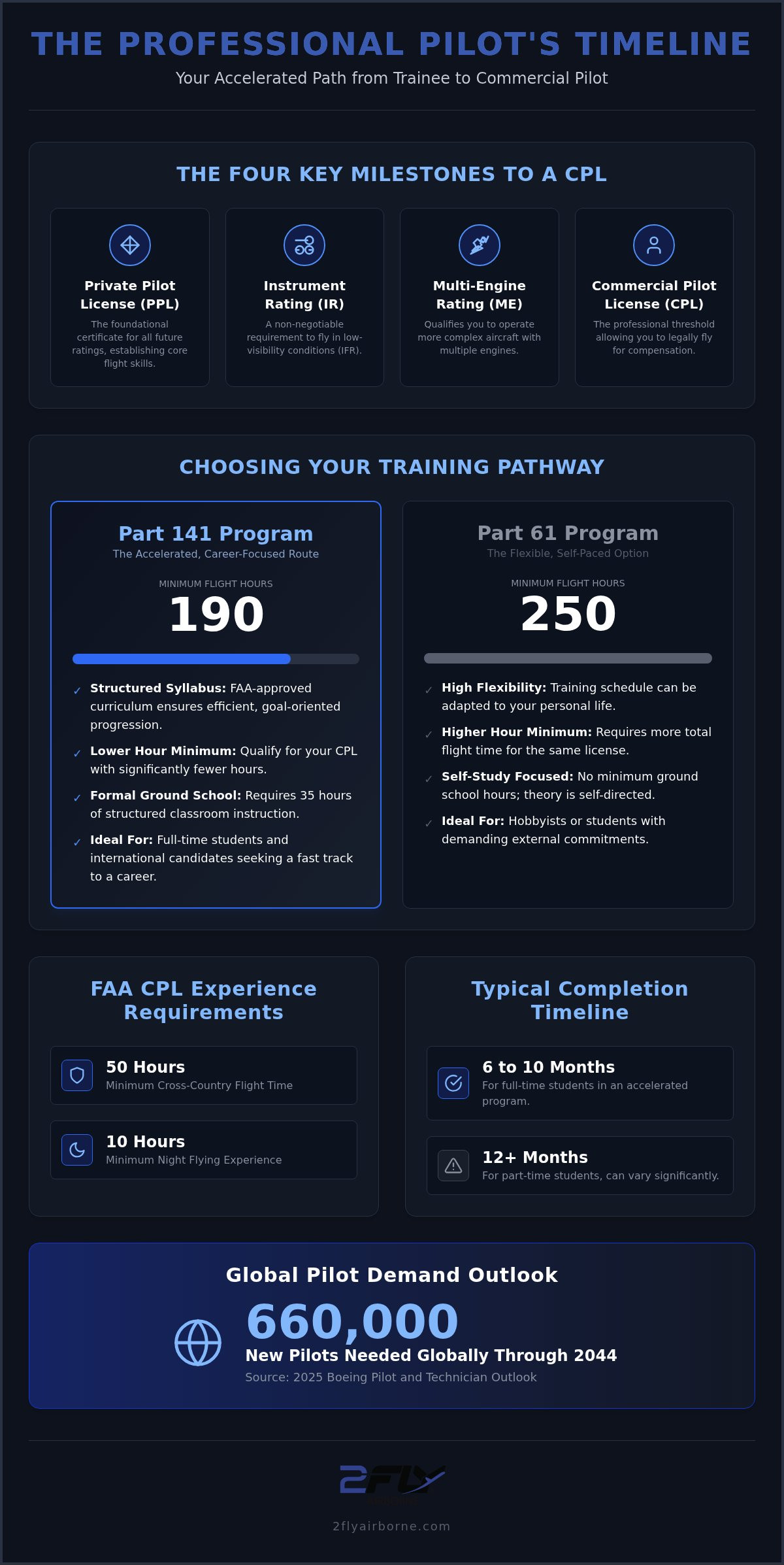
Earning a Commercial Pilot License (CPL) represents the pivotal legal threshold in an aviator’s journey. It’s the moment you transition from a hobbyist to a professional who can fly for compensation. Understanding the framework of Pilot certification in the United States is essential for mapping out your career. While a CPL typically requires approximately 250 hours of flight time under standard regulations, it’s often confused with the Airline Transport Pilot (ATP) certificate, which requires 1,500 hours.
A realistic timeline depends heavily on your training intensity. For most students, calendar time is a more critical metric than total flight hours. When you enroll in part 141 commercial pilot training florida, the focus shifts to a goal-oriented progression that maximizes your time in the air. Full-time training allows for daily immersion, whereas part-time schedules can lead to skill decay and a much longer path to completion.
License vs. Rating: The Chronological Order
Your journey begins with the Private Pilot Certificate (PPL), which establishes the foundational skills of flight. You can’t skip this step; it’s the prerequisite for all professional advancement. After the PPL, most candidates pursue an Instrument Rating (IR). This certification allows you to fly in low visibility and is a non-negotiable requirement for any serious career track. Finally, adding a Multi-Engine Rating (ME) ensures you can operate complex aircraft, completing the skill set needed for high-level employment.
The “Zero to Hero” Fast Track
Integrated professional programs offer the most efficient pathway for those seeking a rapid career launch. These “Zero to Hero” tracks combine all necessary ratings into one continuous syllabus. When you choose part 141 commercial pilot training florida, you benefit from a structured environment designed to move you through the ranks quickly. This structure is particularly beneficial for those aiming for international professional mobility.
Full-time students in these accelerated environments often complete their training in 6 to 10 months. This pace demands high discipline and a complete psychological transition from student to professional aviator. You’re not just learning to fly; you’re adopting the mindset of a commercial pilot who prioritizes safety and precision. The FAA Professional Pilot Program is specifically built to facilitate this rapid progression, turning trainees into industry-prepared professionals.
FAA Requirements: The Hours Behind the License
Understanding specific flight hour requirements is the first step toward your professional career. Under standard Part 61 rules, you’re required to log at least 250 hours of total flight time. This path is often self-paced, which can lead to longer calendar durations. However, choosing part 141 commercial pilot training florida offers a more efficient alternative. Because these programs follow a rigid, FAA-approved syllabus, you can often qualify for your certificate with as few as 190 total flight hours.
The FAA Commercial Pilot regulations detail specific experience requirements you must meet within those hours. You’ll need to log at least 50 hours of cross-country flight time and 10 hours of night flying. These milestones aren’t just boxes to check; they build the technical proficiency required for the high-stakes environment of commercial aviation. The 2025 Boeing Pilot and Technician Outlook projects a demand for 660,000 new pilots globally through 2044, making this training more valuable than ever.
Ground School and Theory Requirements
Success in the cockpit starts on the ground. A Part 141 commercial course requires at least 35 hours of formal ground training. This phase covers advanced aerodynamics, complex aircraft systems, and professional-level weather analysis. You’ll need to dedicate several weeks to consistent study to prepare for the FAA Commercial Pilot Knowledge Test. Treating ground school with the same discipline as flight sessions prevents unnecessary delays in your training timeline. If you have questions about the curriculum, you can always speak with a training advisor to see how the syllabus fits your goals.
Flight Proficiency and the Checkride
Part 61 vs. Part 141: Which Training Path is Faster?
Aspiring aviators often find themselves choosing between two distinct regulatory pathways. While Part 61 offers a flexible, self-paced approach, it often lacks the momentum required for a rapid career transition. In contrast, part 141 commercial pilot training florida follows a rigid, FAA-approved syllabus specifically designed for maximum efficiency. Professional academies almost exclusively utilize the Part 141 structure because it provides a predictable, audited pipeline for career-track students. For those seeking a proven and streamlined route, the FAA Airline Pilot Program serves as a prime example of this integrated methodology.
The AOPA Commercial Pilot guide highlights that while the legal requirements for a certificate are standard, the method of reaching those milestones varies significantly. Under Part 61, you are essentially the architect of your own schedule, which can lead to extended timelines if personal obligations or instructor availability intervene. Part 141 programs are meticulously structured to ensure every hour in the cockpit advances your progress toward the commercial certificate. This structured environment is why full-time students consistently reach their professional goals faster than those in modular programs.
The Efficiency of Integrated Training
Integrated training allows students to overlap specific phases of their education, such as instrument proficiency and commercial maneuvers. This synchronization can save between two and three months of total calendar time compared to modular training paths. By following a continuous syllabus, you ensure that the skills learned in one phase directly support the next.
- Access to a dedicated training fleet ensures that students in full-time programs have priority for aircraft scheduling.
- Standardized instruction methods across the school lead to higher first-pass rates on FAA checkrides.
- A daily learning environment keeps technical knowledge fresh and reduces the need for review sessions.
Flexibility vs. Momentum
The biggest obstacle to finishing flight school is the hidden time cost of inconsistent training. Students who fly only on weekends often experience regressive learning, where the first portion of every lesson is spent relearning skills from the previous week. This cycle extends the duration of the course and increases the total investment required to reach proficiency. Choosing part 141 commercial pilot training florida ensures you maintain the daily momentum necessary to master complex maneuvers quickly. If your goal is to reach the flight deck as fast as possible, an accelerated environment is the most logical choice for your career.
Variables That Impact Your Flight School Duration
Geography plays a decisive role in how quickly you earn your certificates. Florida’s high-sunlight climate is a strategic advantage for any student pilot. It minimizes weather-related cancellations that often plague northern schools during winter months. When you commit to part 141 commercial pilot training florida, you are choosing an environment designed to maximize your flyable days and maintain your training momentum.
Internal school factors are equally critical to your graduation date. A large, modern fleet ensures that if one aircraft is grounded for scheduled service, another is ready for your lesson. Instructor consistency also prevents “syllabus friction,” which occurs when changing mentors forces you to repeat maneuvers. A dedicated mentor who understands your specific learning style keeps you moving through the curriculum without unnecessary review sessions.
Financial interruptions are one of the most common reasons for training delays. Pausing your progress to secure more funds leads to skill decay and requires extra hours to regain proficiency. Securing financing your training before you start prevents these mid-program pauses. If you’re ready to see how our fleet and facilities can accelerate your timeline, contact a 2FLY Training Advisor today to discuss your career path.
The “Timeline Optimizer” Checklist
Success in an accelerated program requires a proactive approach to your daily schedule. Small adjustments in your habits can shave weeks off your total duration. Use this checklist to stay on track:
- Fly at least 3 to 5 times per week to ensure your technical skills remain sharp.
- Complete all FAA written exams before you begin the corresponding flight phase.
- Utilize on-campus housing to eliminate daily commute times and stay fully immersed in the aviation environment.
Handling Maintenance and ATC Delays
Large flight schools with in-house maintenance departments have a distinct advantage in keeping students in the air. Maintenance turnaround time refers to the duration required for a certified technician to inspect, repair, and return an aircraft to the flight line, directly dictating how quickly students can resume their training schedules. Schools with their own mechanics can often address minor issues in hours rather than days.
Operating in complex airspace is another variable that adds immense value to your training. While busy Air Traffic Control (ATC) environments might occasionally cause minor taxi delays, they prepare you faster for the realities of airline life. You’ll develop superior communication skills and situational awareness that simpler airspaces can’t provide. This exposure ensures you’re industry-prepared from the moment you earn your part 141 commercial pilot training florida credentials.
Starting Your Journey with 2FLY Airborne
Starting your aviation career requires more than just flight hours; it requires a strategic partnership with an institution that understands the global industry. Our FAA Professional Pilot Program is a streamlined, career-focused path designed to transform ambitious trainees into industry-prepared professionals. By enrolling in part 141 commercial pilot training florida, you’re entering a world-class environment that prioritizes your progression and professional mobility.
For our international candidates, we provide comprehensive administrative support to navigate the M-1 visa processing timeline. As an M1 visa approved flight school, we understand that moving to a new country is a significant milestone. We ensure the transition is seamless so you can focus entirely on your part 141 commercial pilot training florida and your future in the cockpit.
Staying on-campus in our residential accommodation further enhances your training experience. It eliminates daily commute times and keeps you immersed in a community of like-minded aviators. This immersion is a powerful tool for maintaining the momentum required to meet your graduation goals on schedule.
The Professional Pilot Program Advantage
- Our fixed-price tuition options remove the stress of fluctuating hourly costs, allowing you to plan your investment with certainty.
- The syllabus is meticulously crafted to take you from zero experience to a Commercial Pilot Certificate and beyond.
- You’ll benefit from our global recruitment network, which has been connecting graduates with opportunities since 1994.
- A structured environment ensures you’re not just earning a license but building a foundation for an international career.
Next Steps: From Inquiry to Cockpit
Your journey begins with a detailed consultation or an admissions interview to assess your aptitude and goals. We’ll help you align your training start date with your long-term career aspirations to ensure you’re entering the job market at the ideal time. If you’re still researching the basics, our guide on how to become a pilot provides a deep dive into the certification process.
We encourage you to consult with a 2FLY Training Advisor to build a custom plan that fits your professional timeline. Our team is ready to guide you through every step, from visa applications to your final checkride. Take the first step toward the flight deck today and join a legacy of successful pilots.
Launch Your International Aviation Career
Mapping your path to the flight deck requires balancing regulatory requirements with a realistic training schedule. You’ve learned that choosing part 141 commercial pilot training florida allows for a more efficient progression through a structured, audited syllabus. By prioritizing full-time immersion and leveraging Florida’s optimal flying weather, you can transition from a student to a commercial aviator in months rather than years. Success depends on selecting a program that offers the stability of modern fleets and the expertise of dedicated mentors.
2FLY Airborne provides a definitive gateway to the industry with comprehensive fixed-price professional programs and administrative support for M-1 and F-1 visa sponsorship. Our training environments adhere to rigorous FAA and EASA standards, ensuring you’re prepared for the demands of global aviation. Don’t let conflicting information or training delays hold you back from your goals. Contact a 2FLY Training Advisor today to start your professional pilot journey and take the first step toward your future in the cockpit. Your international career is within reach.
Frequently Asked Questions
How long does it take to get a commercial pilot license from zero experience?
You can typically earn your commercial license in 6 to 10 months when enrolled in a full-time, accelerated program. This timeline covers the progression from a private pilot certificate through instrument rating to the commercial milestone. While individual progress varies based on aptitude and dedication, the structured nature of professional academies ensures you move through each phase without the delays common in modular training.
Can I get my commercial pilot license in 6 months?
Yes, completing your training in 6 months is achievable in a highly structured, full-time environment. This requires flying at least five days a week and completing all ground school requirements ahead of schedule. Florida’s consistent flying weather is a major factor in meeting this ambitious goal, as it prevents the frequent weather cancellations that often stall progress in other regions.
What is the fastest way to get 250 flight hours?
The most efficient method is through an integrated professional program that schedules daily flight blocks and cross-country trips. However, part 141 commercial pilot training florida provides a significant advantage by allowing you to earn your commercial certificate in as few as 190 total hours. This reduction in required flight time is possible because the FAA approves the highly structured and rigorous nature of the syllabus.
How long is ground school for a commercial pilot license?
Commercial ground school generally lasts between 4 and 6 weeks. Under Part 141 regulations, you must complete at least 35 hours of formal classroom or home-study instruction. This phase focuses on advanced aerodynamics, complex aircraft systems, and professional regulations. Dedicated students often treat ground school as a full-time job to ensure they pass the FAA written exam on their first attempt.
Does a college degree make flight training take longer?
A college degree does not inherently extend the time spent in the cockpit, but balancing academic coursework with flight lessons can slow your overall pace. Many career-track students choose to complete their flight training first to enter the job market quickly. They then finish their degree online while working as a pilot, which allows them to build seniority at an airline as early as possible.
How many hours a day do you fly in flight school?
You will typically spend 1.5 to 3 hours in the aircraft each day. While this seems like a small window, a single flight involves several additional hours of pre-flight planning, weather briefings, and post-flight debriefings. The mental intensity of professional maneuvers means that flying more than two blocks a day often leads to fatigue and diminished learning returns for most students.
What happens if I fail my commercial checkride?
If you fail a portion of the checkride, you’ll receive a notice of disapproval and must receive remedial training on the specific maneuvers you missed. Once your instructor confirms you’ve reached proficiency, you can schedule a retest. While a failure is frustrating, it is a common part of the learning process. Structured programs focus on high first-pass rates to minimize these delays and additional costs.
Is it possible to work while getting a commercial pilot license?
Working while training is possible but generally not recommended for those in accelerated tracks. The intensity of part 141 commercial pilot training florida requires a full-time mental and physical commitment. Attempting to balance a job often leads to fatigue and missed flight windows, which eventually extends your timeline and increases the total cost of your education due to the need for extra review flights.
Article by
2FLY Airborne
2Fly Airborne is a professional flight training organization dedicated to developing the next generation of skilled, confident, and safety-focused pilots. With decades of combined aviation experience, our team of certified instructors provides structured, real-world training designed to prepare students for both checkrides and long-term success in the aviation industry.
Content Disclaimer
Some blog content is generated with the assistance of automated tools and may not always be fully accurate or up to date. Please verify all aviation-related information with official sources or a certified instructor. For additional guidance or clarification, we encourage you to contact one of our training advisors at 2Fly Airborne.