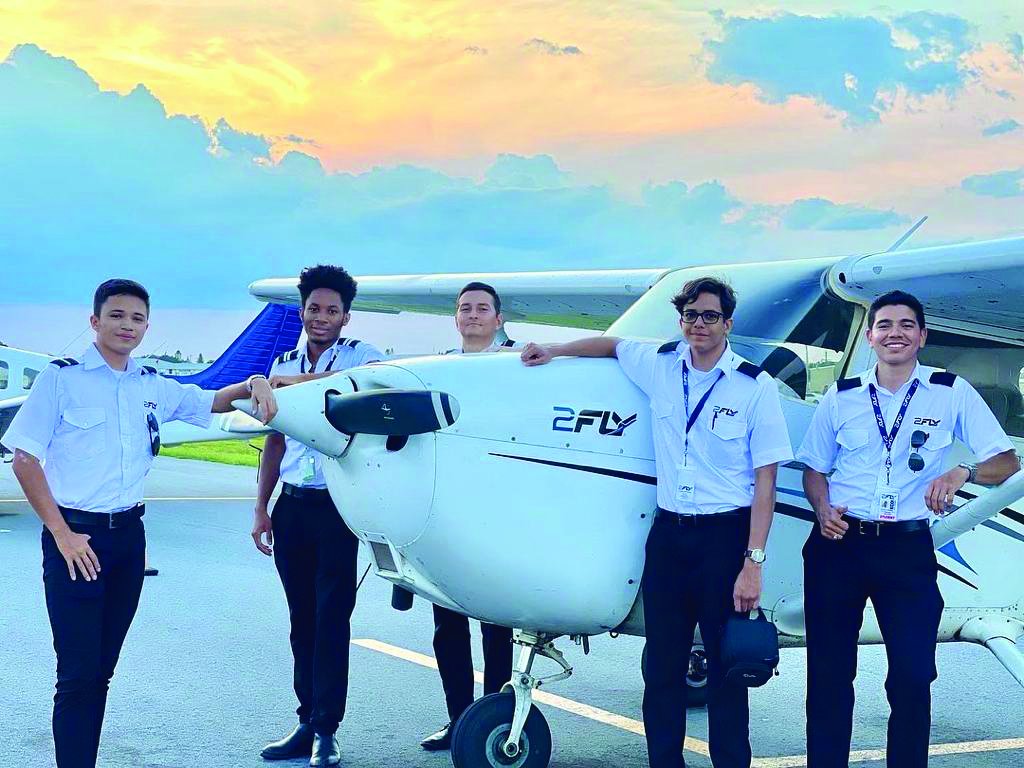
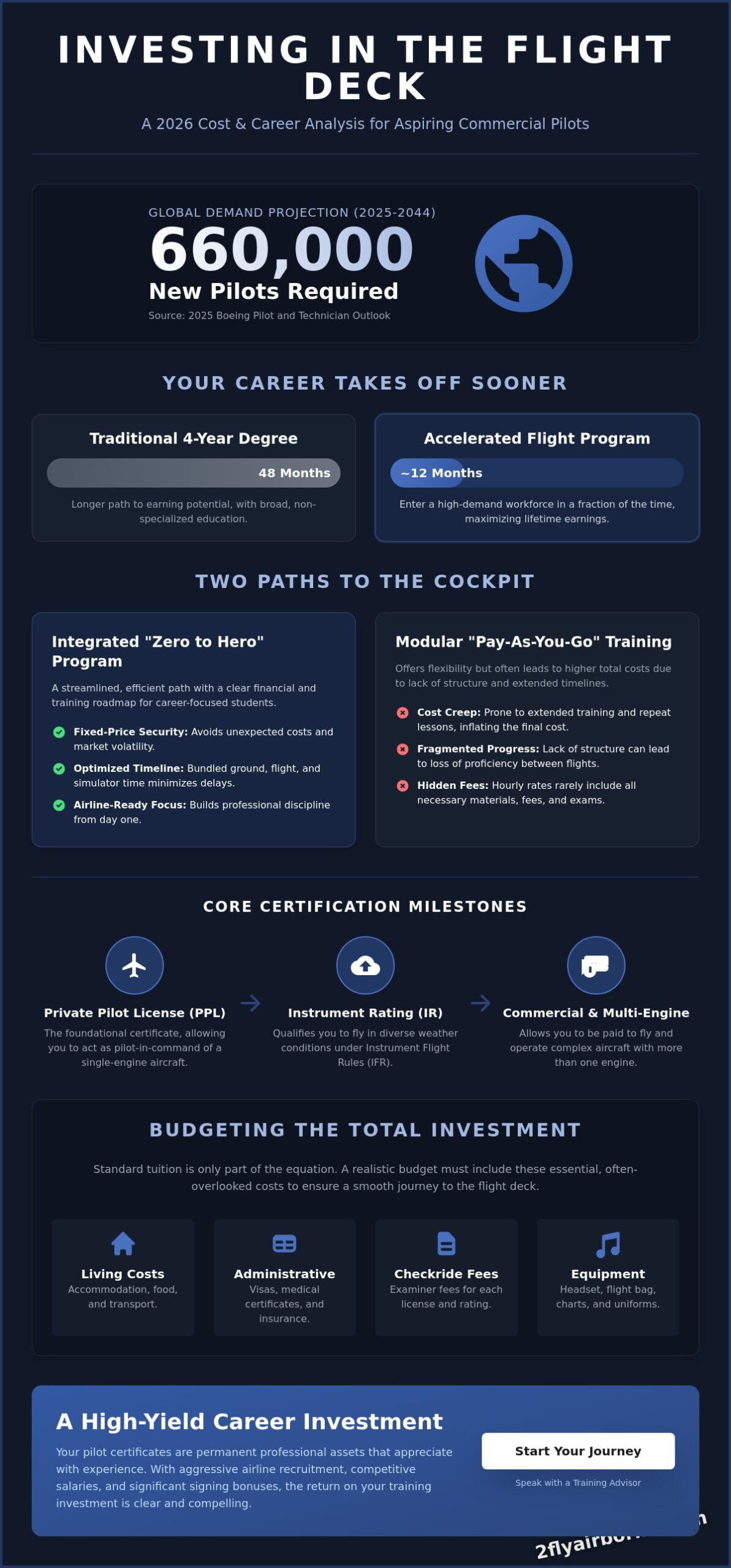
According to the 2025 Boeing Pilot and Technician Outlook, the global aviation industry requires 660,000 new qualified pilots through 2044. While this demand signals an elite career opportunity, the primary hurdle remains the initial investment. You need to know exactly how much is flight school to become a commercial pilot before you can commit to your first takeoff.
It’s natural to feel anxious about hidden costs or the complexities of loan repayments. You want a clear path forward without the stress of financial surprises. We promise to provide a comprehensive, realistic breakdown of the total investment required to transition from zero experience to an airline-ready professional in 2026.
We’ll analyze the specific costs of FAA and EASA certifications, compare modular and integrated training paths, and evaluate the modern financing options available to you. This breakdown ensures you understand the budget and the career ROI before you speak with a training advisor to start your journey.
Key Takeaways
- Align your career trajectory with the 2025 Boeing Pilot and Technician Outlook, which projects a global demand for 660,000 new pilots through 2044.
- Discover exactly how much is flight school to become a commercial pilot by analyzing the multi-stage investment required from initial training to professional certification.
- Learn to identify and budget for essential living and administrative costs that are often excluded from standard tuition brochures.
- Evaluate the financial security of fixed-price tuition models and explore specialized financing partners that support your transition to an airline-ready professional.
- Understand the strategic value of a professional pilot program and how speaking with a training advisor can streamline your path to a global aviation career.
The Financial Landscape of Commercial Pilot Training in 2026
Launching a career on the flight deck requires more than just passion; it demands a calculated multi-stage investment in professional certification. When you ask how much is flight school to become a commercial pilot, you’re essentially asking for the entry price into a high-yield global profession. This isn’t a standard tuition payment. It’s a strategic allocation of capital toward a specialized skill set that remains in high demand across the globe.
The current market context makes this investment particularly compelling. According to the 2025 Boeing Pilot and Technician Outlook, the aviation industry requires 660,000 new qualified pilots through 2044. This massive requirement serves as a powerful return-on-investment driver for new cadets. However, you must distinguish between the “sticker price” and the “total investment.” The sticker price often covers the minimum flight hours required for a license. The total investment encompasses the full path to becoming an airline-ready professional, including checkride fees, equipment, and advanced certifications.
Why Pilot Training is a Capital Investment
Professional flight training functions differently than a traditional four-year university degree. While a degree takes 48 months to complete, an intensive flight program can move a student from zero experience to a commercial multi-engine rating in a fraction of that time. This accelerated timeline allows you to enter the workforce and begin earning a professional salary much sooner than your peers in other industries.
- Speed to Market: Professional programs prioritize efficiency, getting you into a cockpit in months, not years.
- Airline-Ready Focus: Choosing an elite program like the FAA Airline Pilot Program ensures you learn airline standard operating procedures from day one.
- Asset Value: Your pilot certificates don’t expire; they are permanent professional assets that appreciate as you gain flight hours.
Understanding Market Volatility and Demand
The 2026 aviation market is defined by aggressive recruitment and competitive compensation packages. Airlines are currently offering significant signing bonuses and rapid career progression to secure qualified talent. To capitalize on these opportunities, you must choose an academy with a robust global recruitment network that connects students directly with hiring managers.
Success in this environment requires a specific mindset. A Global Pilot is a professional who possesses the technical mastery and regulatory certifications to operate as a high-value asset in any international aviation market throughout their career. This global perspective is what separates a basic pilot from an elite commercial aviator. If you’re ready to map out your specific path, contact a training advisor at 2FLY Airborne to discuss your professional goals.
Breaking Down the Tuition: From Zero to Commercial Pilot
Understanding how much is flight school to become a commercial pilot requires looking at the progression through specific milestones. Most students choose between two paths: pay-as-you-go training or integrated “Zero to Hero” professional programs. While hourly rates offer flexibility, they often lead to higher total costs due to extended timelines and lack of structure. Integrated programs streamline the process. They provide a clear financial roadmap from your first flight to your professional license. You can explore the specific curriculum stages in our Pilot Training Programs 2026 guide.
Professional programs are designed for efficiency. By bundling ground school, flight hours, and simulator time, these tracks minimize the downtime that often inflates costs in casual training environments. This structured approach isn’t just about saving money; it’s about building the discipline required for an airline flight deck. Cadets who train in a focused, full-time environment often reach their checkrides with fewer total hours than those who spread their training over several years.
The Core Certifications and Their Costs
The Private Pilot Certificate (PPL) serves as your foundation. It’s the first major investment. After earning your PPL, you’ll move to the Instrument Rating (IR), which allows you to fly in diverse weather conditions. The Multi-Engine (ME) add-on follows, providing the skills to handle larger aircraft. Finally, the Commercial Pilot License (CPL) is the legal requirement for getting paid to fly. According to the 2025 Boeing Pilot and Technician Outlook, the industry will need 660,000 new qualified pilots through 2044. Investing in these ratings now positions you to meet this massive global demand. Each stage builds technical proficiency and adds value to your professional resume.
FAA vs. EASA: Financial Implications
Training in the United States under FAA regulations often provides significant cost advantages compared to European EASA standards. Lower fuel costs and better weather for consistent flying hours reduce the overall time spent in school. International cadets frequently save thousands by completing their initial training in Florida before converting licenses. This geographic advantage allows for more frequent sorties and faster completion times. For a detailed breakdown of these savings, read our EASA Flight School USA guide. If you’re ready to map out your professional journey, speaking with a training advisor can help clarify your specific investment needs and timeline.
Beyond Tuition: Estimating Total Living and Administrative Costs
Calculating how much is flight school to become a commercial pilot requires looking past the sticker price of flight hours and instructor fees. Prospective cadets often overlook the ancillary costs that sustain a student during an intensive training program. With the 2025 Boeing Pilot and Technician Outlook projecting a demand for 660,000 new pilots through 2044, the investment is significant, but the financial planning must be precise. Total costs include everything from your daily meals to the specialized equipment required in the cockpit.
Living Expenses and On-Campus Housing
Most professional flight programs, such as the FAA Airline Pilot Program, operate on an intensive 10 to 12 month timeline. Budgeting for room and board during this period is critical. Choosing on-campus or managed student housing offers a distinct financial advantage. It eliminates the logistical friction of setting up individual utility accounts, finding short-term leases, or managing daily commutes.
Location significantly impacts your daily cost of living. Training in aviation hubs provides better weather for consistent flying, yet it requires a realistic look at local grocery and transport prices. Managed housing often bundles these complexities into a single monthly fee, allowing students to focus entirely on their ratings. This structured environment ensures you remain immersed in the aviation culture alongside fellow high-achievers.
FAA Exams, Medicals, and Supplies
Administrative and equipment costs represent another layer of the budget. You must account for several mandatory expenses that are usually paid to external parties rather than the school itself. In 2026, students should expect the following averages:
- FAA Written Exams: Approximately $175 per exam; multiple exams are required for different ratings.
- DPE Checkrides: Designated Pilot Examiners typically charge between $800 and $1,500 per practical test.
- First-Class Medical Certificate: Expect to pay $150 to $250 for this mandatory health clearance.
- Pilot Supplies: A quality aviation headset, an iPad for electronic flight bags (EFB), and flight bags can total $1,500 to $2,500.
For international aviators, administrative fees include M-1 or F-1 visa sponsorship and SEVIS processing. These regulations are subject to change, so you should consult with a training advisor to get the most current fee structures. Understanding how much is flight school to become a commercial pilot involves accounting for these “hidden” variables to ensure your path to the flight deck is fully funded from day one. For a complete picture of every expense you’ll encounter, our flight school cost 2026 financial guide provides a thorough breakdown from tuition to living expenses. Contact 2FLY Airborne today to discuss a comprehensive budget tailored to your career goals.
Financing Your Future: Funding Models and ROI
Becoming an airline-ready professional is a high-stakes investment that requires a strategic financial plan. The 2025 Boeing Pilot and Technician Outlook projects a demand for 660,000 new qualified pilots through 2044. This massive global need makes the question of how much is flight school to become a commercial pilot less about the immediate cost and more about the long-term career yield. Smart cadets view their training as a capital investment in a high-earning profession rather than a simple tuition expense.
Flight School Loans and Financial Aid
Lending institutions now offer specialized products for those pursuing the flight deck. You’ll typically choose between secured and unsecured loans. Secured loans require collateral, such as property, and often feature lower interest rates. Unsecured options rely on your credit profile and potential future earnings. Financing partners understand the aviation career path and structure payments to align with your training milestones. You can explore current financing options to see which model fits your personal budget and credit history. For a detailed look at how the total six-figure investment breaks down across each rating and what to expect from lenders like Sallie Mae, our ATP flight school cost guide for 2026 provides a transparent, milestone-by-milestone financial breakdown.
Scholarships and Airline Cadet Programs
Scholarships provide a vital way to offset the total cost of training. Organizations like the Aircraft Owners and Pilots Association (AOPA) and Women in Aviation International (WAI) award millions of dollars annually to aspiring pilots. Many regional carriers also offer cadet programs to secure their future talent pipeline. These initiatives often include tuition reimbursement or direct flow-through agreements to the right seat of a commercial jet. It’s vital to remember that while these programs provide a structured path, 2FLY does not guarantee specific employment outcomes.
The return on investment for a pilot career is exceptionally strong compared to traditional four-year degrees. By 2026, senior airline captains at major carriers are projected to earn salaries exceeding $350,000 annually. When you calculate how much is flight school to become a commercial pilot against a thirty-year career, the ROI is among the highest in any professional field. You’re not just paying for lessons; you’re buying a seat in a global industry with significant upward mobility. First officers often see their initial investment pay for itself within the first few years of major airline employment.
Success in aviation requires both technical skill and financial literacy. Planning your funding early ensures that your focus remains on the cockpit rather than the balance sheet. Contact a training advisor today to discuss your funding strategy and take the first step toward the flight deck.
The 2FLY Advantage: Professional Programs for Airline Readiness
Becoming a professional pilot requires more than just logging hours in a cockpit; it demands an immersive, structured environment that mirrors the high standards of the airline industry. The FAA Professional Pilot Program at 2FLY Airborne serves as the definitive career gateway for aspiring aviators. This program is designed to transform cadets into elite professionals ready for the flight deck. According to the 2025 Boeing Pilot and Technician Outlook, the aviation industry will require 660,000 new qualified pilots through 2044. This immense demand highlights the urgency for high-quality training that prioritizes both skill and safety. When you evaluate how much is flight school to become a commercial pilot, you must consider the quality of the institution and the career support it provides.
Fixed-Price Transparency
2FLY Airborne utilizes a flat-fee structure for its career programs to provide students with financial certainty. This model is a cornerstone of our commitment to transparency. It protects students from the volatility of fluctuating fuel prices and unexpected aircraft rental hikes that often occur in modular training environments. Knowing your total training costs upfront allows for precise long-term financial planning. You won’t have to worry about hidden surcharges or price increases mid-way through your multi-engine rating. It’s a stable approach that lets you focus entirely on your studies and flight maneuvers. This predictability provides the peace of mind necessary to succeed in a high-pressure training syllabus.
Global Network and Recruitment Support
Our academy supports students from the US, UK, and Europe through a network of global offices, ensuring a seamless experience regardless of your point of origin. We train cadets at state-of-the-art facilities equipped with advanced simulators that replicate modern airliner environments. This global perspective is vital in today’s interconnected aviation market. We don’t just teach you how to fly; we prepare you to be “airline-ready” from day one. Understanding how much is flight school to become a commercial pilot involves looking at the value of the recruitment support and mentorship you receive after graduation. Our instructors act as expert mentors who have navigated the same path you’re on now.
- Access to advanced flight simulation technology for procedural mastery.
- A professional training environment that mirrors airline operations.
- Comprehensive support for international students, including visa and housing guidance.
- A direct pipeline focused on transitioning students into professional pilot roles.
The journey to the captain’s seat is a marathon, not a sprint. It requires discipline, passion, and the right partnership. If you’re ready to turn your ambition into a career, the next step is to get the facts. Contact a 2FLY Airborne advisor today to receive personalized cost guidance and begin your journey toward the flight deck.
Take Command of Your Aviation Future
Investing in your professional journey requires a clear view of the flight path ahead. The 2025 Boeing Pilot and Technician Outlook projects a global demand for 660,000 new qualified pilots through 2044. This historic level of industry growth makes it a strategic time to earn your wings. While understanding how much is flight school to become a commercial pilot is a vital first step, it’s the quality of the training and the direct route to the cockpit that defines your long term success.
2FLY Airborne bridges the gap between ambition and employment with fixed-price tuition models for our career programs. Our global recruitment network and international visa support provide the infrastructure you need to transition into an airline-ready professional. We focus on delivering a disciplined training environment that mirrors the standards of major carriers. You’ll gain more than just certifications; you’ll gain a global perspective on the aviation industry. Your career on the flight deck is waiting for you to take the controls.
Speak with a 2FLY Training Advisor for a Personalized Career Plan
Frequently Asked Questions
Is flight school more expensive than a college degree?
Professional flight training often requires a higher upfront investment compared to a standard four year public university degree. While public university tuition averaged $11,260 per year for the 2023 to 2024 period, specialized aviation programs include aircraft rental and fuel costs. You’re paying for a technical certification that leads directly to a high earning career path. Speak with a 2FLY Airborne advisor to compare your specific options and career goals.
What are the hidden costs of becoming a commercial pilot?
Hidden costs typically include FAA medical examinations, checkride fees, and required pilot gear like noise canceling headsets. In 2024, a First Class Medical certificate can cost between $150 and $250 depending on the examiner. You should also budget for ground school materials and recurrent training requirements. These expenses are essential for maintaining your status as an elite, airline ready professional. Contact our team to get a detailed breakdown of these requirements.
Can I get a loan to cover the full cost of flight school?
Many students secure specialized aviation loans to fund their entire training journey from zero hours to commercial certification. Lenders often look for a solid credit score or a co-signer to approve these high value professional development loans. Because the 2025 Boeing Pilot and Technician Outlook projects a need for 660,000 new pilots through 2044, lenders view this as a stable investment. Our advisors can help you navigate the financing process.
How much does a private pilot license cost vs. a commercial license?
A Private Pilot License is the foundation, while a Commercial Pilot License requires significantly more flight time and advanced maneuvers. When asking how much is flight school to become a commercial pilot, you must account for the 250 total flight hours required by FAA Part 61 regulations. The commercial license involves more complex aircraft operations and rigorous testing. This progression ensures you’re prepared for the demands of a global aviation career.
Does the 2026 pilot shortage affect training costs?
The ongoing demand for pilots influences costs by increasing the value of flight instructors and modern training aircraft. With the 2025 Boeing Pilot and Technician Outlook forecasting 660,000 new pilots needed by 2044, academies are investing more in advanced technology to meet this demand. High demand for training slots can lead to price adjustments across the industry. Reach out to 2FLY Airborne to discuss current market conditions and training availability.
What happens if I need more flight hours than the program includes?
You’ll pay for additional hours at the school’s hourly rental rate if you require extra time to master specific maneuvers. FAA regulations set minimum hour requirements, but individual proficiency varies among cadets. It’s common for students to need a few extra hours to feel confident before a checkride. Our instructors focus on efficient, goal oriented training to help you stay on track for your airline career.
Are international student costs different from US domestic costs?
International students often face additional expenses related to M-1 or F-1 visa processing and SEVIS fees. In 2024, the SEVIS I-901 fee for M-1 students is $350. You also need to consider international health insurance and travel costs to training centers. We specialize in developing global pilots and can provide guidance on the specific requirements for training in the United States. Contact an advisor for personalized guidance.
Is the investment in flight school worth it in 2026?
The investment in flight school remains highly valuable due to the projected long term demand for qualified flight crews. Determining how much is flight school to become a commercial pilot is the first step toward a career with high earning potential and global mobility. The 2025 Boeing Pilot and Technician Outlook confirms that 660,000 new pilots are necessary by 2044. Contact 2FLY Airborne today to start your journey toward the flight deck.
Article by
2FLY Airborne
2Fly Airborne is a professional flight training organization dedicated to developing the next generation of skilled, confident, and safety-focused pilots. With decades of combined aviation experience, our team of certified instructors provides structured, real-world training designed to prepare students for both checkrides and long-term success in the aviation industry.
Content Disclaimer
Some blog content is generated with the assistance of automated tools and may not always be fully accurate or up to date. Please verify all aviation-related information with official sources or a certified instructor. For additional guidance or clarification, we encourage you to contact one of our training advisors at 2Fly Airborne.