You likely recognize that a career in aviation offers an elite global lifestyle, yet the path forward often feels obscured by conflicting FAA versus EASA standards. We’ve built this guide to demystify how to become a commercial pilot in 2026, providing the exact regulatory and educational steps to transition from a beginner to an airline-ready professional.
You’ll discover a chronological checklist of licenses, a clear breakdown of medical eligibility, and the criteria for selecting a world-class training academy. We’ll show you how to navigate the training process with confidence and precision. It’s time to stop wondering about the requirements and start planning your professional ascent into the skies.
Key Takeaways
- Analyze the 2025 Boeing Pilot and Technician Outlook to understand why a projected demand for 660,000 new pilots makes 2026 a pivotal year to start your journey.
- Master the definitive five-step roadmap on how to become a commercial pilot, moving from zero experience to a professional flight deck.
- Identify the non-negotiable prerequisites for entry, including the strategic importance of obtaining your FAA Medical Certificate before beginning training.
- Learn to evaluate flight training as a long-term investment by balancing academy quality, modern fleet access, and total career ROI.
- Discover how to select an elite training environment that prioritizes global standards to ensure you graduate as an airline-ready professional.
The 2026 Aviation Outlook: Why Now is the Time to Fly
Becoming a commercial pilot is about more than just steering an aircraft through the clouds. It’s a high-stakes profession that demands technical precision, leadership, and a deep commitment to safety. As we enter 2026, the path for those researching how to become a commercial pilot has never been clearer or more rewarding. You’re entering an industry that values elite training and global mobility. You won’t just be flying for a living; you’ll be managing complex systems and ensuring the safety of hundreds of passengers on every journey.
The current market data confirms this urgency. According to the 2025 Boeing Pilot and Technician Outlook, the world will need 660,000 new qualified pilots through 2044. This demand isn’t just a local trend. It’s a global requirement driven by a massive increase in fleet sizes and a wave of mandatory retirements. You aren’t just training for a job. You’re preparing for a role as a "Global Pilot" with the ability to work across international borders.
To better understand the career path, watch this helpful video:
The journey begins with understanding the standards of pilot licensing and certification. These regulations ensure every professional on the flight deck meets rigorous safety benchmarks. By mastering these requirements early, you position yourself as a top-tier candidate for the world’s leading airlines. Knowing how to become a commercial pilot requires a focus on these regulatory details from day one.
The Shift in Pilot Recruitment
Airlines have fundamentally changed how they find talent. Regional carriers used to be the only starting point, but now, major global airlines are creating direct pipelines for high-achieving cadets. They want "airline-ready" professionals who possess a strong professional foundation. You can find more detail on these foundational steps in our pillar guide to aviation careers. This shift means your transition from the classroom to the cockpit can happen faster than in previous decades.
Aspirational Career Milestones
The transition from a student pilot to an elite professional is marked by significant milestones. It starts with your first solo flight and culminates in earning your commercial multi-engine rating. The emotional reward of reaching the flight deck is matched only by the professional stability of the career. Whether you pursue FAA or EASA certification, the potential for international career paths is vast. You’ll join a community of experts dedicated to connecting the world. If you’re ready to start, take the first step by contacting 2FLY Airborne or speaking with a training advisor for personalized guidance.
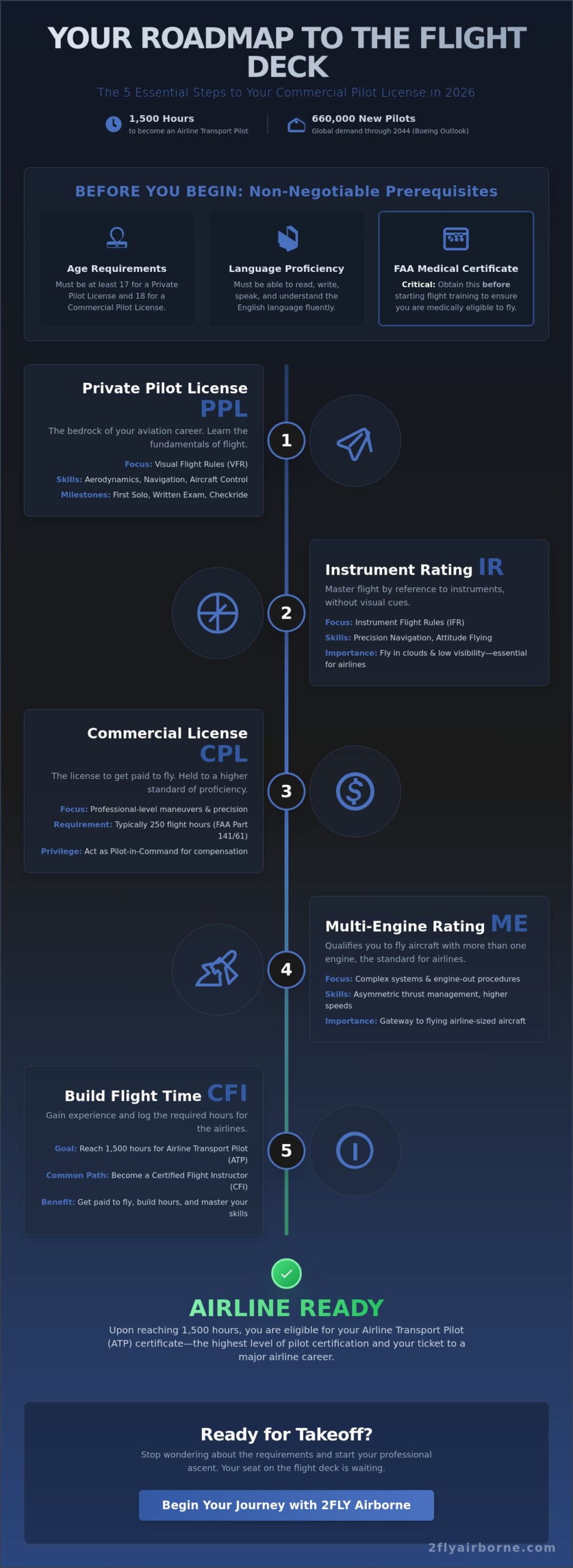
The 5 Essential Steps to Your Commercial Pilot License
Professional flight training follows a logical, chronological flow designed to build your skills from zero experience to airline readiness. To understand how to become a commercial pilot, you must view the process as a series of foundational layers. While the regulatory path is standardized, the quality of your instruction and the environment in which you train can vary significantly. A full-immersion training environment accelerates your learning by surrounding you with professional standards from day one, much like the structured FAA Airline Pilot Program offered at elite academies.
Step 1: Earning the Private Pilot Certificate (PPL)
The PPL is the bedrock of your aviation career. During this phase, you learn the fundamentals of aerodynamics, navigation, and aircraft control. You’ll complete ground school to pass a written exam, perform a solo flight, and eventually pass a practical checkride. Mastering Visual Flight Rules (VFR) is the focus here. You must learn to maintain safety by looking outside the cockpit before you ever rely on advanced onboard technology.
Step 2: Adding the Instrument Rating (IR)
The Instrument Rating is often described as the most challenging and rewarding phase of flight training. It grants you the ability to fly solely by reference to the flight instruments inside the cockpit. This transition from VFR to Instrument Flight Rules (IFR) operations is vital. It allows you to fly in weather conditions that would ground a private pilot, such as low clouds or fog; this makes you a much safer and more capable aviator.
Step 3: Achieving the Commercial Pilot Certificate (CPL)
The CPL is the legal milestone that allows you to be compensated for your services as a pilot. This stage requires a higher level of precision than previous ratings. You’ll practice advanced maneuvers that demonstrate total mastery of the aircraft. To qualify, you must meet the specific aeronautical experience requirements outlined in the FAA commercial pilot regulations. This is a pivotal moment in learning how to become a commercial pilot as it marks your transition from a student to a professional.
Step 4: Multi-Engine Rating and CFI Certification
Most airline-bound pilots must gain experience in aircraft with more than one engine. The Multi-Engine Rating focuses on managing complex systems and handling emergency procedures, such as engine failures. Following this, many candidates pursue their Certified Flight Instructor (CFI) rating. Teaching others is an elite way to solidify your own understanding of complex aviation concepts while building the flight hours necessary for the airlines.
The 2025 Boeing Pilot and Technician Outlook highlights a massive global demand for 660,000 new qualified pilots through 2044. This means the path you start today leads to a robust and growing industry. If you want to see how these steps fit your personal goals, you can contact a 2FLY training advisor for personalized guidance on your journey to the flight deck.
Professional Pilot Prerequisites: Meeting the Standards
Before you ever set foot in a cockpit, you’ll need to verify that you meet the rigorous eligibility criteria set by aviation authorities. Learning how to become a commercial pilot involves more than just mastering flight maneuvers; it requires a commitment to physical health and regulatory compliance. The 2025 Boeing Pilot and Technician Outlook projects a massive demand for 660,000 new qualified pilots through 2044. To join this elite group, you’ve got to clear several specific hurdles before your first solo flight.
Medical and Physical Standards
Your health is your most valuable asset in the flight deck. The FAA requires all pilots to hold a valid Medical Certificate issued by an Aviation Medical Examiner (AME). There are three main tiers to understand. A First-Class Medical is the gold standard for airline transport pilots. A Second-Class is typically required for commercial activities like cargo operations or flight instruction. A Third-Class is the entry-level requirement for student and private pilots. You don’t need perfect natural vision to fly. Most cadets operate successfully with glasses or contacts, provided their vision is correctable to 20/20. We recommend scheduling an appointment with an AME before you invest in training. This ensures no underlying health conditions will stall your career before it truly begins.
Education and Background Checks
The requirements for academic background have evolved. While many regional airlines hire pilots with a high school diploma and the necessary flight hours, a four-year degree remains a significant competitive advantage for major global carriers. Many successful cadets choose degree program options that allow them to earn a Bachelor’s degree while completing their flight training. This dual-track approach builds the leadership skills airlines value. Data from the Bureau of Labor Statistics indicates that the field is growing, but security remains a top priority. You’ll undergo extensive background checks and mandatory drug screenings. Any history of substance abuse or significant criminal records will likely disqualify a candidate from professional employment.
Age limits are another critical factor in how to become a commercial pilot. You must be at least 18 years old to earn a Commercial Pilot License (CPL). Most airline positions require an Airline Transport Pilot (ATP) certificate, which carries a minimum age requirement of 23. Some collegiate graduates may qualify for a restricted ATP at age 21. If you’re ready to see if you meet these standards, contact a training advisor at 2FLY Airborne to discuss your specific path to the flight deck.
Planning Your Investment: Timeline and Financing Realities
Deciding how to become a commercial pilot requires a shift in perspective. You aren’t just paying for lessons; you’re investing in a high-yield professional asset. According to the 2025 Boeing Pilot and Technician Outlook, the global industry needs 660,000 new qualified pilots through 2044. This massive demand suggests a strong long-term return on investment for those who enter the flight deck now. While the initial costs are real, the career-long earnings of an airline captain represent a significant financial upside.
The Accelerated Training Timeline
Traditional modular training allows you to learn at your own pace, but it often takes years to reach airline minimums. Accelerated career programs condense this journey into a full-time commitment. By immersing yourself in a daily flight schedule, you build muscle memory and technical knowledge faster. You should review our guide on how long flight school takes for detailed schedules and phase breakdowns. Most full-time cadets finish much quicker than part-time students, though we don’t guarantee exact graduation dates. Factors like local weather patterns and your individual learning aptitude will naturally influence your pacing.
Financing Your Aviation Future
Securing the capital for flight training is a critical step in your career strategy. Many students utilize specialized financing and loan options designed specifically for professional pilot programs. These loans often feature deferred payment structures that align with your future airline salary. You’ll encounter two primary tuition models: fixed-price and pay-as-you-go. Fixed-price models offer more predictable budgeting, while pay-as-you-go provides flexibility for those balancing other commitments. Don’t forget to budget for living expenses during your training. Full-immersion training is demanding, and most cadets find they can’t maintain outside employment while training at an elite level.
Becoming an airline-ready professional is a marathon, not a sprint. Proper financial planning ensures you stay focused on the horizon instead of the balance sheet. If you’re ready to map out your specific path of how to become a commercial pilot, speak with a 2FLY training advisor to discuss your personalized financing and timeline options.
Launching Your Global Career: Choosing an Elite Academy
Selecting the right training environment is the final, most critical step in learning how to become a commercial pilot. Your choice of academy dictates the quality of your skills and the speed of your career progression. The 2025 Boeing Pilot and Technician Outlook forecasts a demand for 660,000 new qualified pilots through 2044. To stand out in this competitive market, you must train at a facility that operates like an airline. This means looking for a large, modern fleet equipped with glass cockpit technology. Training on advanced avionics ensures you’re prepared for the flight decks of modern transport aircraft from day one.
Elite academies employ an "Airline-Ready" philosophy. This approach moves beyond the minimum FAA requirements to focus on the professional standards airlines expect. You’ll learn Crew Resource Management (CRM), standardized callouts, and complex systems management early in your syllabus. Mentorship is equally vital. Learning from experienced airline professionals provides insights into the industry that a textbook can’t offer. These mentors don’t just teach you to fly; they mold you into a captain who can handle the pressures of a global career.
The Advantage of Professional Immersion
Success in aviation requires total focus. Professional immersion means living and breathing flight operations alongside fellow cadets who share your ambition. This collaborative environment fosters accountability and rapid knowledge sharing. You’ll spend significant time in state-of-the-art simulators, which are essential for mastering high-risk scenarios in a controlled setting. A global recruitment network is the final piece of the puzzle. It connects you with international carriers, transforming your training into a direct pipeline for employment. It’s about building a professional reputation before you even apply for your first job.
Next Steps: Speaking with a Training Advisor
Researching how to become a commercial pilot is only the beginning. It’s time to move from theory to action. Contact a 2FLY Airborne training advisor to discuss your specific career goals and timeline. Prepare a list of questions regarding fleet availability, instructor-to-student ratios, and graduate success stories. We invite you to attend our aviation events to experience our training culture firsthand. Seeing the fleet and meeting the instructors will help you decide if you’re ready to commit to this elite path. Your journey to the flight deck starts with a single, informed decision.
Take Command of Your Aviation Career
The path to the cockpit is more promising than ever. The 2025 Boeing Pilot and Technician Outlook projects a global demand for 660,000 new qualified pilots through 2044. Success in this high-stakes field requires more than just passion. It demands mastering essential prerequisites, securing strategic financing, and choosing an academy that upholds elite standards. You’ve now seen the roadmap for how to become a commercial pilot in today’s competitive market.
Since 1994, 2FLY Airborne has utilized a global network of training facilities to develop airline-ready professionals. We focus on the technical precision and disciplined mindset that modern carriers expect from their flight crews. Our curriculum isn’t just about passing tests; it’s about preparing you for a lifelong career in the skies. You’ll join a legacy of excellence that spans decades and continents.
Don’t let your ambitions stay grounded. Speak with a 2FLY Training Advisor to start your journey today. Your future on the flight deck is waiting.
Frequently Asked Questions
Do I need a college degree to become a commercial pilot in 2026?
You don’t need a four-year college degree to earn your pilot certificates or work for many regional carriers in 2026. While major airlines historically preferred a bachelor’s degree, the 2025 Boeing Pilot and Technician Outlook highlights a demand for 660,000 new pilots through 2044. This massive requirement has led many companies to prioritize flight hours and professional certifications over academic degrees. You should focus on high-quality training to ensure you’re airline-ready.
How much does it cost to become a commercial pilot from zero experience?
The cost to become a commercial pilot varies based on your training path and location. Industry data from 2024 suggests that professional flight training from zero experience to a commercial multi-engine rating typically ranges between $80,000 and $110,000. This investment covers ground school, aircraft rental, and instructor fees. You should speak with a 2FLY Airborne advisor to discuss your specific training needs and potential financing options for your journey.
Can I become a pilot if I wear glasses or have less than perfect vision?
You can definitely become a pilot if you wear glasses, provided your vision is correctable to 20/20. The FAA requires commercial pilots to hold a first-class medical certificate, which mandates 20/20 distance vision and 20/40 near vision with or without corrective lenses. Color vision is also assessed during this medical exam. If your vision meets these standards with your prescription, your career path to the flight deck remains wide open.
How many flight hours are required to fly for a major airline?
Most pilots must accumulate 1,500 total flight hours to qualify for an Airline Transport Pilot certificate and fly for a major US airline. This requirement is part of the FAA’s safety regulations. Some graduates from approved collegiate or military programs may qualify for a Restricted ATP at 1,000 or 750 hours. Building these hours often involves working as a flight instructor after you’ve learned how to become a commercial pilot through your initial ratings.
What is the difference between a Private Pilot and a Commercial Pilot license?
The primary difference is that a commercial pilot can legally fly for compensation, while a private pilot cannot. A private pilot license allows you to fly for personal use or share pro-rata expenses with passengers. To learn how to become a commercial pilot, you must master advanced maneuvers and meet stricter medical standards. This certification is the professional milestone that transforms a hobby into a global career with earning potential.
How long does it realistically take to complete a professional pilot program?
It typically takes 12 to 24 months to complete a professional pilot program from zero experience. Accelerated programs at elite academies can sometimes reduce this timeline to approximately 14 months of full-time training. Your personal dedication and local weather conditions play a role in your progress. You’ll move through your private, instrument, and commercial ratings in a structured sequence designed to make you professional and career-ready.
Is there an age limit to start flight training for a commercial career?
There’s no upper age limit to start flight training, but you must be at least 18 years old to hold a commercial pilot certificate. To fly for a scheduled airline, you must obtain an ATP certificate by age 23. FAA regulations currently mandate a retirement age of 65 for airline operations. This gives many career-changers a decade or more to enjoy a rewarding professional life in the aviation industry.
Can international students train for an FAA license in the United States?
International students can absolutely train for an FAA license in the United States by obtaining the appropriate student visa. Most academies facilitate the M-1 or F-1 visa process to allow global candidates to access world-class training facilities. You’ll need to complete a TSA background check before starting your flight lessons. It’s best to contact 2FLY Airborne to learn more about the specific enrollment requirements for your home country.
Article by
2FLY Airborne
2Fly Airborne is a professional flight training organization dedicated to developing the next generation of skilled, confident, and safety-focused pilots. With decades of combined aviation experience, our team of certified instructors provides structured, real-world training designed to prepare students for both checkrides and long-term success in the aviation industry.
Content Disclaimer
Some blog content is generated with the assistance of automated tools and may not always be fully accurate or up to date. Please verify all aviation-related information with official sources or a certified instructor. For additional guidance or clarification, we encourage you to contact one of our training advisors at 2Fly Airborne.