
You’ve likely realized that bridging the gap between your commercial license and an airline flight deck is the most challenging phase of your professional journey. Financing 1,200 additional flight hours out of pocket is a daunting prospect that stalls many promising careers. It’s natural to feel some anxiety about the rigorous CFI checkride or feel uncertain about which ratings will actually make you a competitive candidate for major carriers.
We’re here to help you master the art of instruction and secure a paid position to build your time. This guide to the 2026 flying instructor course provides the professional roadmap you need to transition from a student to an elite mentor. You’ll learn how to command aircraft systems at an expert level and navigate the complexities of aviation regulations with confidence. We’ll explore the strategic value of CFI, CFII, and MEI certifications to ensure you’re airline-ready. Read on to discover how to turn your passion into a professional career and join the next generation of global pilots.
Key Takeaways
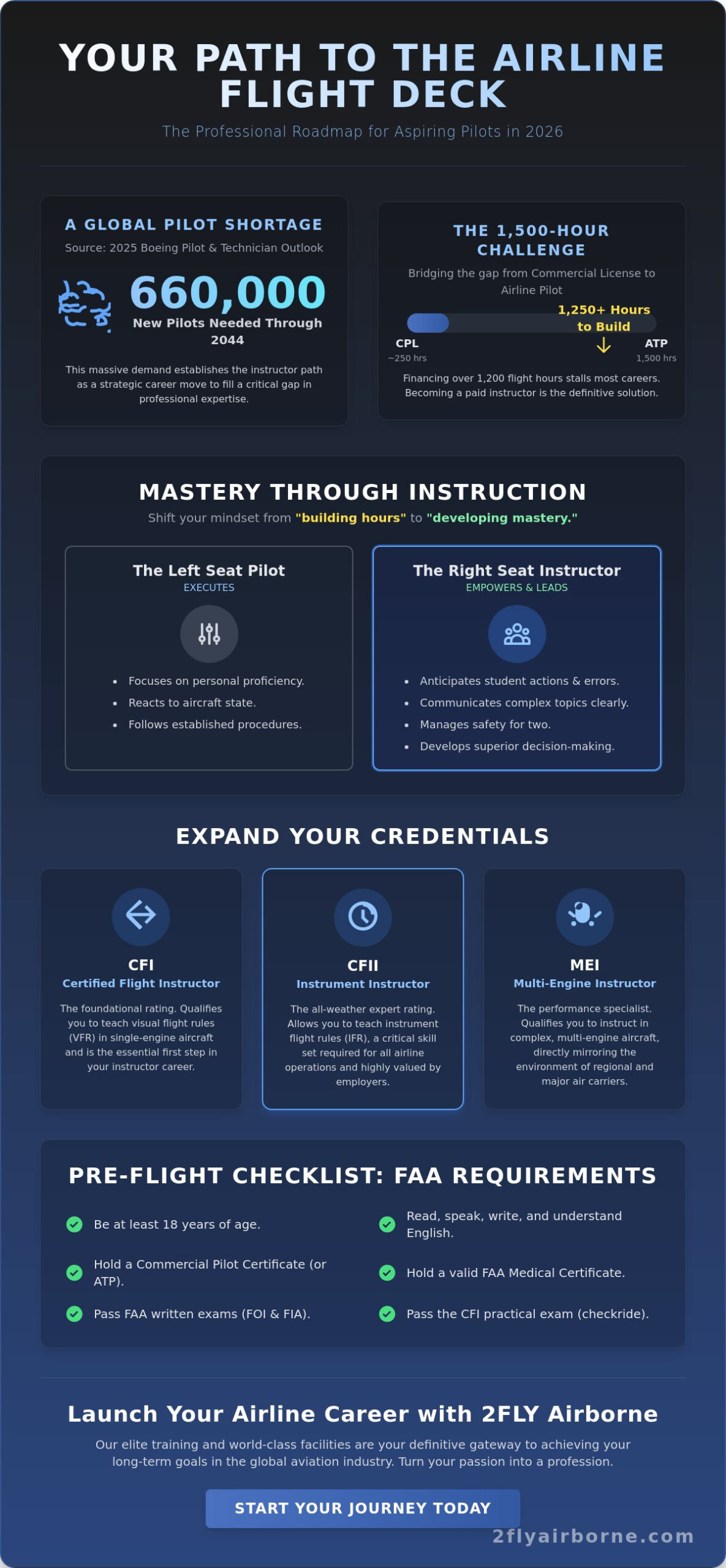
- Understand how the 2025 Boeing Pilot and Technician Outlook, forecasting a demand for 660,000 new pilots by 2044, establishes the instructor path as a strategic career move.
- Discover how a professional flying instructor course bridges the gap between technical flight proficiency and the elite pedagogical skills required for airline-ready mastery.
- Learn to strategically expand your career opportunities by comparing the professional advantages of obtaining CFI, CFII, and MEI instructor ratings.
- Identify the essential FAA regulatory requirements and knowledge test prerequisites needed to successfully transition from a commercial pilot to a certified educator.
- Explore how elite training at world-class facilities serves as the definitive gateway to achieving your long-term goals in the global aviation industry.
The Strategic Role of the Flying Instructor Course in 2026
The aviation industry is entering a period of unprecedented growth. It’s no longer enough to just fly; you must lead. Choosing a flying instructor course is the most strategic move for any aspiring commercial pilot in 2026. This path transforms a standard pilot into a professional educator capable of managing complex safety protocols and high-stakes environments. It’s the definitive bridge between basic certification and a long-term airline career.
The 2025 Boeing Pilot and Technician Outlook projects a global demand for 660,000 new commercial pilots through 2044. This data highlights a massive gap in professional expertise that only qualified instructors can fill. In the United States, the 1,500-hour flight time requirement for the Airline Transport Pilot (ATP) certificate remains the industry standard. This Flight Instructor Overview details how instructors manage these hours by teaching, ensuring they reach the flight deck with superior technical knowledge and thousands of repetitions in critical maneuvers.
Shift your mindset from "building hours" to "developing mastery." Teaching a student to recover from a stall or execute a perfect crosswind landing reinforces your own skills better than solo flight ever could. You’re not just waiting for a clock to hit 1,500; you’re refining the leadership traits airlines demand. Professional flight instruction is the forge where elite captains are made.
Meeting the Global Demand for Qualified Aviators
Airlines need "Global Pilots" who can operate within complex, multi-crew environments. Flight instruction forces you to communicate technical concepts to diverse students, building the cross-cultural communication skills required by major international carriers. You’ll learn to maintain rigorous safety standards while managing the high-pressure environment of a busy flight deck. This experience ensures you meet the safety expectations of elite global airlines that prioritize disciplined, standardized training backgrounds.
CFI as a Career Catalyst, Not Just a Requirement
Major airlines prioritize candidates with instructional backgrounds. These pilots possess superior situational awareness and decision-making skills compared to those who simply log time. Working within a professional flight academy puts you at the center of the industry. You’ll build a network of fellow professionals and mentors while earning a competitive income. You’re getting paid to sharpen your skills and mentor the next generation. Contact a 2FLY Airborne training advisor today to discuss how a flying instructor course can accelerate your timeline to the flight deck.
Mastery Through Instruction: What to Expect from CFI Training
Transitioning into a Certified Flight Instructor (CFI) role is the most significant pivot in a pilot’s professional development. It’s a pedagogical and technical deep dive that forces you to dismantle everything you know and rebuild it for the benefit of a student. This flying instructor course isn’t just about flying; it’s about the evolution from a pilot who executes to a mentor who empowers. You’ll move from the left seat to the right seat, a physical shift that mirrors a massive mental change. In the right seat, your hands stay off the controls while your mind stays ahead of the airplane and the student simultaneously.
The 2025 Boeing Pilot and Technician Outlook forecasts a demand for 660,000 new qualified pilots through 2044. This global need places an immense responsibility on instructors to produce airline-ready professionals. Earning your CFI rating is widely considered a badge of honor in the aviation community. It proves you’ve mastered the aircraft and the complex art of human factors and knowledge transfer.
The Fundamentals of Instructing (FOI)
Learning to teach begins with the psychology of how humans acquire skills. You’ll study the FAA Aviation Instructor’s Handbook to understand learning styles like visual, auditory, and kinesthetic. Every student processes information differently; your job is to identify those patterns and adapt your style to match theirs. You’ll learn to manage the delicate balance between critique and evaluation. A critique provides immediate, actionable feedback to improve performance, while evaluation measures progress against established standards.
Developing professional lesson plans is a core component of this phase. You won’t just talk about steep turns or stalls. You’ll build structured guides that cover objectives, completion standards, and common errors. These plans serve as your roadmap in the cockpit, ensuring every hour of flight time is purposeful and safe.
Technical Subject Matter Expertise
True mastery requires explaining complex systems at an expert level. You must be able to break down high-speed aerodynamics, intricate weather patterns, and evolving federal regulations so a beginner can grasp them. This "teaching to learn" philosophy is why instructors are often the most knowledgeable pilots on the field. When you explain the nuances of a constant-speed propeller or the physics of a spin, your own understanding reaches a level of clarity that solo flying can’t provide.
This phase relies heavily on the Airplane Flying Handbook as a primary resource for standardizing maneuvers. You’ll learn to demonstrate every procedure while narrating the "why" behind every control input. It’s a demanding process that refines your technical precision to meet elite commercial standards.
The CFI checkride is a marathon of knowledge and endurance, often lasting eight hours or more. It’s a rigorous test of your ability to maintain safety while a student makes mistakes. If you’re ready to transition from the cockpit to the head of the class, speak with a training advisor to see how our flying instructor course can accelerate your career toward the flight deck.
Expanding Your Credentials: CFI, CFII, and MEI Pathways
Earning your initial certificate through a flying instructor course is a significant professional milestone, but it’s only the start of your evolution into an elite aviator. To stand out in a competitive hiring market, you need a diverse instructional portfolio. The 2025 Boeing Pilot and Technician Outlook projects a global demand for 660,000 new qualified pilots through 2044. Meeting this demand requires more than basic teaching skills; it requires specialized expertise in instrument and multi-engine operations.
The Initial CFI vs. the CFII Add-on
The Certified Flight Instructor Instrument (CFII) allows you to teach students seeking their instrument ratings. It’s often the most sought-after qualification at high-volume flight schools because instrument training makes up a massive portion of the commercial pilot syllabus. While the FAA’s Airplane Flying Handbook provides the foundation for basic maneuvers, the CFII focuses on the precision of IFR procedures and advanced avionics. Mastering this rating ensures you remain billable even when the weather prevents VFR flight, making you an indispensable asset to any flight academy.
The Multi-Engine Instructor (MEI) Advantage
The MEI rating is a definitive game-changer for those eyeing a seat on a commercial flight deck. Teaching in complex twin-engine aircraft, such as the Piper Seneca, introduces high-workload scenarios like engine-out procedures and asymmetrical thrust management. Airlines place a high premium on MEI time because it directly mirrors the multi-crew environment of a regional or major carrier. You aren’t just teaching flight; you’re managing complex systems and safety margins where the room for error is significantly tighter than in a single-engine trainer.
Choosing which rating to pursue first depends on your immediate career goals. Most instructors prioritize the CFII immediately after their initial flying instructor course to increase their student load and build high-quality instrument hours. The MEI usually follows as the final step to secure the multi-engine experience recruiters demand. This strategic progression transforms you from a standard instructor into an airline-ready professional with a global perspective. Each rating you add doesn’t just fill your logbook; it builds the discipline and technical mastery required for a long-term career in the cockpit.
Ready to map out your professional progression? Contact a 2FLY Airborne training advisor today to discuss which instructor pathway best aligns with your timeline and career ambitions.
Prerequisites and Preparation for Flight Instructor Certification
Transitioning from the left seat to the right seat requires more than just a change in perspective. It marks the start of your career as a professional educator and a leader in the cockpit. According to the 2025 Boeing Pilot and Technician Outlook, the industry requires 660,000 new qualified pilots through 2044. Completing a flying instructor course is the most reliable method to build the flight hours necessary to meet this global demand while refining your own technical mastery.
FAA Requirements and Regulatory Compliance
To begin your training, you must hold a Commercial Pilot Certificate and a valid FAA medical certificate. Candidates must be at least 18 years old and demonstrate the ability to read, speak, and write English fluently. While federal regulations provide the baseline, individual school syllabi often vary in intensity. You’ll need to complete two essential FAA knowledge tests: the Fundamentals of Instructing (FOI) and the Flight Instructor Airplane (FIA). The FOI exam explores the psychology of learning and effective communication, while the FIA ensures your aeronautical knowledge meets professional standards. Passing these tests early allows you to focus entirely on flight proficiency during the course.
The Right Seat Transition and Maneuver Proficiency
Mastering the right seat is a physical and mental hurdle. You’re no longer simply flying the aircraft; you’re explaining the mechanics of flight while your student observes. Use this checklist to track your progress:
- Sight Picture: Recalibrate your visual references for landings and steep turns from the right side of the cockpit.
- Muscle Memory: Practice operating the throttle, flaps, and avionics with your left hand until it feels natural.
- Instructional Delivery: Work on "talking through" maneuvers, explaining every control input in real time without degrading flight precision.
- ACS Standards: Ensure you can perform all Private and Commercial maneuvers to the exact Airman Certification Standards (ACS) before the first day of class.
Mental and Professional Preparation
Successful candidates adopt an "Expert Mentor" mindset before the flying instructor course even begins. You aren’t just a pilot in training; you’re a representative of the aviation industry. Organization is vital to this transition. Assemble a professional flight instructor kit that includes the current FAR/AIM, the Pilot’s Operating Handbook (POH) for your specific aircraft, and a structured set of lesson plans. If you’re looking for a personalized assessment of your skills, you should speak with a training advisor for a readiness check. Choosing an academy that emphasizes professional mentorship ensures you develop the leadership traits required for a long-term airline career.
Ready to lead the next generation of pilots? Contact 2FLY Airborne today to secure your spot in our upcoming instructor program.
Launching Your Airline Career with 2FLY Airborne
Choosing the right flying instructor course is a strategic decision that shapes your entire professional trajectory. At 2FLY Airborne, we provide more than just a certificate; we offer a gateway to the global aviation industry. Our Florida-based training centers operate with the precision of a commercial airline, immersing you in a high-density airspace environment from day one. This exposure is vital. It builds the situational awareness and radio proficiency required at the highest levels of aviation. You will train in an atmosphere where professionalism is the standard, not the exception.
The transition from student to 2FLY instructor represents a proven career path for those dedicated to excellence. By joining our ranks, you gain access to an elite network of pilots and mentors who have successfully navigated the journey to the flight deck. Our instructors are held to rigorous standards, ensuring they are prepared to meet the demands of major carriers worldwide. This focus on "airline-ready" training ensures that your time spent instructing is not just about logging hours, but about refining the leadership skills necessary for a long-term career.
The 2FLY Advantage: Airline-Ready Training
We mirror the operational standards of global carriers to prepare you for the realities of commercial flight. Our Florida facilities feature a high-activity environment that mimics the complexity of major airport hubs. This setting allows you to master the flying instructor course while managing real-world traffic and weather challenges. We provide access to a diverse fleet and state-of-the-art simulators, ensuring you have the tools to develop technical mastery. This methodology is central to our FAA Airline Pilot Program, which integrates instructor training as a critical component of your professional development. You don’t just learn to fly; you learn to lead in a structured, professional setting.
Financing and Career Support
The path to the cockpit requires a clear financial strategy and a supportive community. We offer various financing options to help qualified candidates manage their professional training costs effectively. Beyond the technical curriculum, we provide ongoing mentorship and recruitment support. Our team helps you navigate the transition from instructor to airline pilot, offering guidance on interviews and career placement. The industry demand for your skills is at an all-time high. According to the 2025 Boeing Pilot and Technician Outlook, there is a global demand for 660,000 new qualified pilots through 2044. This projection highlights the vast opportunities available to those who complete their training at an elite level. We invite you to attend one of our upcoming events to meet our team and see how we can support your goals.
Take the first step toward your global aviation career. Contact a 2FLY Airborne training advisor today to discuss your goals and receive personalized guidance on your journey to the flight deck. Your future in the sky begins with the right foundation.
Launch Your Global Aviation Career Today
Earning your instructor ratings is the most strategic move you can make to bridge the gap between training and the airline cabin. The 2025 Boeing Pilot and Technician Outlook forecasts a global demand for 660,000 new qualified pilots through 2044, making this the ideal time to advance. Completing a flying instructor course at 2FLY Airborne gives you the competitive edge through technical mastery of flight instruction. You’ll train on a professional fleet and utilize modern simulators designed to mirror commercial environments. We’ve built a reputation for excellence by successfully placing our instructors into major airlines worldwide. It’s time to transition from student to mentor while building the flight hours necessary for your ultimate goal. Our team is ready to help you navigate the CFI, CFII, and MEI pathways with precision and authority. Take control of your professional trajectory and join the ranks of elite aviators.
Speak with a 2FLY Training Advisor to plan your instructor course and start your journey toward the flight deck.
Frequently Asked Questions
How long does a flying instructor course typically take to complete?
A flying instructor course typically takes between 4 and 8 weeks to complete when pursued on a full-time basis. This duration depends on your previous experience, weather conditions, and the consistency of your study schedule. You’ll spend this time mastering the Fundamentals of Instructing and refining your maneuvers from the right seat to meet professional standards.
What is the pass rate for the initial CFI checkride?
The national pass rate for the initial CFI checkride historically ranges between 20% and 30% according to FAA data. This rigorous testing process ensures that only the most disciplined and knowledgeable pilots earn the right to teach. Candidates who treat the preparation like a full-time job and utilize structured ground school programs significantly improve their chances of success on the first attempt.
Can I work as a flight instructor with only a Private Pilot License?
You can’t work as a flight instructor if you only hold a Private Pilot License. Federal regulations require you to possess at least a Commercial Pilot License or an Airline Transport Pilot License before you’re eligible for instructor certification. This requirement ensures you’ve reached a professional level of flight mastery and safety before you begin guiding students toward their own global pilot careers.
How much can I expect to earn as a Certified Flight Instructor in 2026?
Certified Flight Instructors in 2026 can expect to earn between $40,000 and $75,000 annually based on current industry trends and Bureau of Labor Statistics data. Your actual income will depend on your location, the type of flight school, and the number of hours you fly each month. Many elite training organizations now offer competitive packages to attract professional instructors who are ready to train the next generation of aviators.
Do I need to have a Multi-Engine Rating before taking the CFI course?
You don’t need a Multi-Engine Rating to begin your initial flying instructor course for single-engine aircraft. Most candidates earn their single-engine CFI first to establish a foundation in instructional techniques. If you plan to teach in twin-engine aircraft later, you’ll need to add a Multi-Engine Instructor (MEI) rating to your certificate after meeting the specific flight time requirements for that category.
What is the difference between a Part 61 and a Part 141 flight instructor course?
The primary difference is the structure of the training environment; Part 141 programs follow a strictly FAA-approved syllabus while Part 61 offers more flexibility for individual pacing. A Part 141 flying instructor course is often more intensive and features regular stage checks to monitor your progress. Part 61 training allows you to customize your learning experience, which suits students who have specific scheduling needs or unique learning styles.
How many flight hours do I need to start my CFI training?
You typically need at least 250 flight hours to start your training because you must hold a commercial pilot license first. These hours include specific requirements for cross-country, night, and instrument flight time. Reaching this milestone ensures you have the technical proficiency required to focus on the complex task of teaching others how to fly safely and effectively.
Is a flying instructor course worth the investment for an airline career?
Investing in instructor training is a strategic move for any pilot aiming for the flight deck, especially since the 2025 Boeing Pilot and Technician Outlook projects a demand for 660,000 new pilots through 2044. Instructing is the most common way to build the 1,500 hours required for airline employment while deepening your own technical knowledge. It prepares you to be an airline-ready professional by sharpening your communication and leadership skills. Contact 2FLY Airborne today to speak with a training advisor and start your professional journey.
Article by
2FLY Airborne
2Fly Airborne is a professional flight training organization dedicated to developing the next generation of skilled, confident, and safety-focused pilots. With decades of combined aviation experience, our team of certified instructors provides structured, real-world training designed to prepare students for both checkrides and long-term success in the aviation industry.
Content Disclaimer
Some blog content is generated with the assistance of automated tools and may not always be fully accurate or up to date. Please verify all aviation-related information with official sources or a certified instructor. For additional guidance or clarification, we encourage you to contact one of our training advisors at 2Fly Airborne.