
Imagine you’re taxiing for a sunset departure, only to be halted by a closed taxiway described in a cryptic string of text you skimmed over during your pre-flight briefing. It’s a high-stakes scenario that every pilot fears, yet the traditional notam often feels like a relic designed to be difficult to read. Deciphering these alerts shouldn’t feel like a barrier to your progress as a professional aviator or a source of anxiety before you even leave the ramp.
We understand that the sheer volume of data in the National Airspace System can be overwhelming. You’ll learn to master the essential skill of interpreting every notam with precision, ensuring your flight safety and regulatory compliance stay beyond reproach throughout your career. We’ll examine the FAA’s 2026 system modernization, provide a clear framework for decoding “teletype” formatting, and show you how to integrate these critical updates into a world-class pre-flight routine. This transition from a trainee to an industry-prepared professional starts with technical mastery of the information that keeps our skies safe.
Key Takeaways
- Recognize how critical safety alerts bridge the gap between static charts and the dynamic reality of the National Airspace System.
- Confidently decode a professional notam string by breaking down location identifiers and technical abbreviations.
- Establish a rigorous pre-flight routine focusing on high-impact variables like runway closures, Temporary Flight Restrictions (TFRs), and NAVAID availability.
- Navigate the FAA’s 2026 modernized search portal to access authoritative, real-time data for every phase of your flight.
- Transform from a trainee to a mission-ready professional by integrating advanced situational awareness tools into your daily training operations.
What is a NOTAM? Beyond the Aviation Acronym
Picture yourself on a clear morning, descending toward a coastal airport you’ve visited dozens of times. Your charts show a 5,000-foot runway, but as you turn final, you spot construction vehicles and a large yellow “X” at the threshold. You’ve just encountered the real-world consequence of a missed notam. This scenario happens more often than most trainees realize, turning a routine flight into a safety incident or a forced diversion that could have been avoided with a proper briefing.
To understand what a NOTAM is, you must view it as the dynamic pulse of the National Airspace System. While sectional charts provide a static foundation of geographical data, these notices deliver time-critical information that isn’t known far enough in advance to be publicized on a permanent chart. As of February 10, 2025, the FAA officially returned to the term “Notice to Airmen,” following a brief period where “Notice to Air Missions” was used to describe these essential alerts.
To better understand this concept, watch this helpful video:
The Evolution of the Notice to Airmen
The system began in the era of paper teletype machines, where brevity was a technical necessity of the hardware. This legacy explains the “teletype” style of all-caps abbreviations that many student pilots find intimidating during their initial flight training. Today, the FAA is modernizing this infrastructure through the new NOTAM Management Service (NMS), which went live on April 18, 2026. This move aligns U.S. standards more closely with the International Civil Aviation Organization (ICAO) to create a more resilient, digital-first environment that supports international professional mobility.
Why NOTAMs are Non-Negotiable for Flight Safety
Reviewing these notices isn’t just a best practice; it’s a legal mandate. Under FAA regulations, the pilot in command must become familiar with all available information concerning a flight before departure. With over 4 million NOTAMs issued annually in the United States, the volume is immense, but the safety implications are undeniable. They serve as the final filter that catches hazards which didn’t exist when your charts were printed.
Common “deal-breaker” notices that every pilot must look for include:
- Total runway or taxiway closures that could lead to ground incursions or require an alternate airport.
- Temporary Flight Restrictions (TFRs) around sporting events, space launches, or VIP movements.
- Outages of critical navigation aids (NAVAIDs) like VORs or ILS systems that could affect instrument approaches.
- New obstacles, such as temporary cranes near the airport, that aren’t yet depicted on obstacles charts.
Mastering this data is a hallmark of a professional pilot. It’s the difference between being a passenger in the cockpit and being a commander who anticipates hazards before they manifest. As you progress through your commercial pilot training, interpreting these strings of text becomes second nature, ensuring you’re always prepared for the real-time reality of the skies.
Decoding the Language: How to Read and Interpret NOTAMs
Reading a notam for the first time often feels like solving a complex puzzle under pressure. The all-caps, abbreviated format dates back to the era of teletype machines, where every character saved precious bandwidth. While modern systems move toward plain language, students at top-tier flight schools in Florida must still master the traditional string to navigate high-traffic airspace safely. It’s a technical skill that separates the amateur from the industry-prepared aviator.
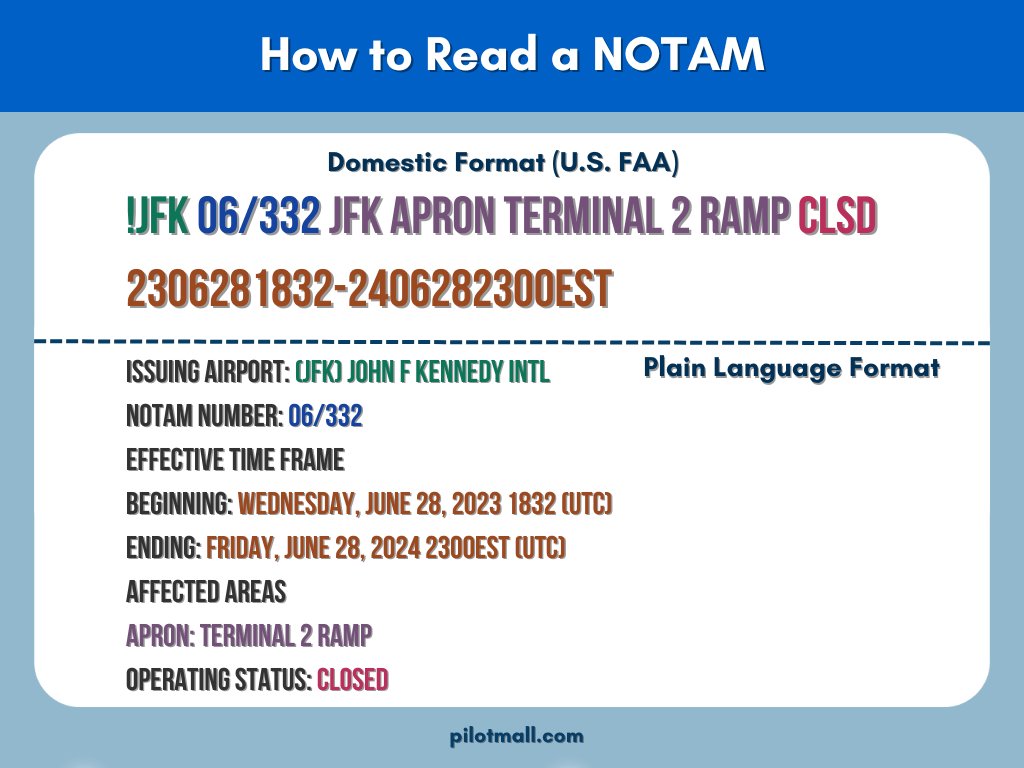
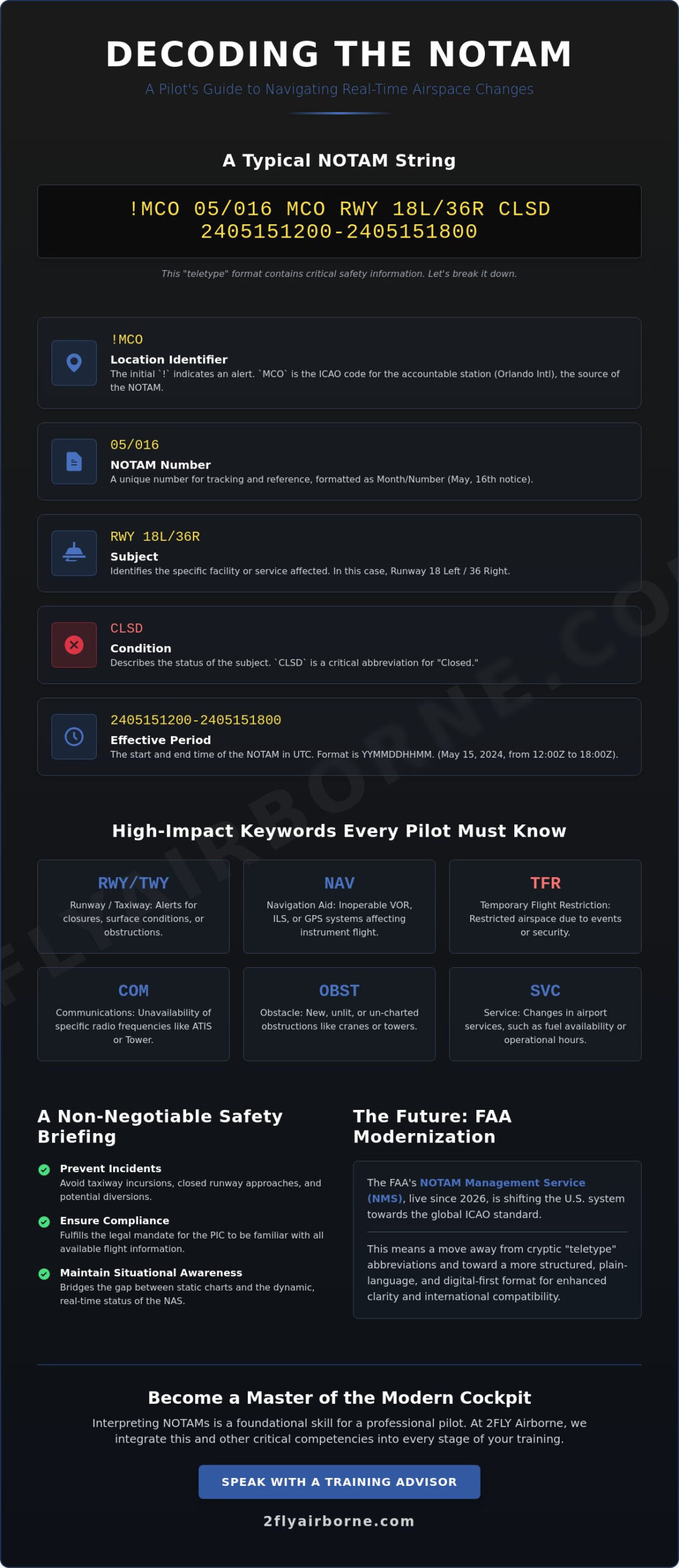
Every notice follows a logical structure designed to give you the most critical information first. It begins with the Location Identifier, such as KORL for Orlando Executive, followed by the Accountable Location. Next, you’ll find the Keyword, which identifies the subject like RWY (Runway), TWY (Taxiway), or NAV (Navigation). Understanding how to decode NOTAMs allows you to quickly identify the Condition, such as CLOSED or WIP (Work in Progress), before moving to the specific details of the alert.
Common Abbreviations Every Student Should Know
Building a mental library of abbreviations is essential for efficiency during your pre-flight briefing. You’ll frequently encounter terms like U/S (Unserviceable), OPR (Operative), or OBST (Obstacle). Learning these shorthand markers during your FAA Professional Pilot Program ensures that you spend less time decoding text and more time focusing on flight safety. It’s about developing a professional rhythm in your cockpit preparation.
- WIP: Work in Progress, often seen with runway or taxiway construction.
- CLSD: Closed, indicating a total restriction of use for that specific facility.
- SFC: Surface, usually referring to the ground level of an airspace.
- UNAVBL: Unavailable, commonly used for airport services or specific frequencies.
Time management in aviation always revolves around Coordinated Universal Time (UTC), also known as Zulu time. You must convert these timestamps to your local time zone to understand exactly when a restriction begins or ends. This prevents the dangerous mistake of assuming a closure has expired when it’s actually still active. Accuracy here is non-negotiable.
Understanding the Effective Period
The timestamp at the end of the string tells you exactly when the information is valid. It follows a Year/Month/Day/Time format, such as 2605201200, which translates to May 20, 2026, at 12:00 UTC. If you see “PERM,” the change is permanent until it’s officially added to the charts. Conversely, “EST” means the duration is an estimate. Always check for a follow-up notam if your flight falls near the end of an estimated period, as repairs or inspections often take longer than planned.
The Critical Role of NOTAMs in Pre-Flight Planning
A professional pre-flight routine begins long before you reach the cockpit. Checking every notam along your intended route is a fundamental step that must be integrated into your standard weather briefing. It’s about building a mental map of the obstacles, closures, and restrictions that could compromise your mission. This proactive approach is exactly what we instill in candidates during our FAA Airline Pilot Program, where technical precision meets real-world application.
You should prioritize the “Big Three” during your review: runway closures, Temporary Flight Restrictions (TFRs), and NAVAID outages. These factors dictate whether your flight is even possible. For instance, a closed runway at your destination isn’t just an inconvenience; it requires a complete recalculation of your fuel requirements and alternate airport selection. If the primary runway is unavailable, you must ensure your alternate has sufficient length and services to accommodate your aircraft safely.
Your fuel planning must account for these real-time variables. If a notice indicates that a taxiway is closed, your taxi time might double, burning more fuel than your standard performance charts suggest. Likewise, if a preferred NAVAID is out of service, you might be forced to fly a less efficient route or a more complex approach. Professional pilots anticipate these delays on the ground so they never face a fuel emergency in the air.
Temporary Flight Restrictions (TFRs)
A TFR is a non-negotiable airspace restriction that pilots must identify during their briefing. These are often issued for VIP movements, major sporting events, or emergency response areas like active wildfires. Violating a TFR carries severe consequences, including military interception and immediate FAA certificate action. Professional pilots treat TFR boundaries as invisible walls, planning their routes with a wide margin of safety to avoid even a momentary incursion.
NOTAMs and the IFR vs VFR Decision
The status of ground-based equipment often dictates your choice of flight rules. For pilots pursuing an Instrument Rating (IR), a NAVAID outage like a VOR being out of service can render a specific approach unusable. This could force a diversion if weather conditions are low. Even for VFR pilots, a notice regarding lighting outages, such as a PAPI or VASI system being unserviceable, significantly increases the risk during night arrivals. These details ensure you aren’t surprised by a dark runway or a missing glideslope indicator when you need them most.
Modernization: How Pilots Access NOTAMs in 2026
How much time do you spend squinting at a wall of capitalized text during your pre-flight? The days of manually hunting for coordinates in a notam string are fading as the industry embraces a visual-first approach. This evolution isn’t just about convenience; it is about providing the rapid situational awareness required for high-level professional operations.
The FAA’s NOTAM Search portal remains the single authoritative source for all digital data. Following the full implementation of the cloud-based NOTAM Management Service (NMS) on April 18, 2026, the system is now more resilient and centralized than ever. While the back-end is highly technical, the front-end experience for pilots has become significantly more intuitive.
Modern Electronic Flight Bags (EFBs) now serve as your primary tactical interface. Applications like ForeFlight version 18.3 and Garmin Pilot’s SmartCharts feature allow you to see graphical overlays of runway closures and taxiway restrictions directly on your moving map. This integration ensures that a critical alert is not just a line of text in a briefing pack, but a visual reality on your flight deck.
Start your journey toward a professional pilot career by mastering these advanced digital tools in a structured training environment.
Graphical NOTAMs and Situational Awareness
Seeing a Temporary Flight Restriction (TFR) as a red circle on your navigation display is infinitely superior to reading a list of latitude and longitude coordinates. Modern apps include proximity alerts that trigger as you approach restricted airspace, providing a final layer of protection against certificate-threatening errors. However, a professional pilot never relies solely on the app’s “Alert” feature. You must understand the raw data behind the visualization to verify that the software is rendering the restriction accurately.
Filtering the “Noise”
A common hurdle for student pilots is “NOTAM overload,” where critical safety data is buried under hundreds of routine “D” NOTAMs. On any given day, there can be as many as 35,000 active notices worldwide, making manual sorting nearly impossible. Modern EFBs address this by filtering alerts based on your specific route, altitude, and aircraft type. This technology allows you to prioritize high-impact notices, such as airport closures or NAVAID outages, while keeping lower-priority information accessible but out of your immediate focus.
Despite these digital advancements, the requirement for a formal briefing remains. Always cross-reference your EFB data with official sources to ensure no critical updates were missed during a sync delay. Reliability and technical mastery are the hallmarks of an industry-prepared professional.
Mastering NOTAMs During Your Professional Flight Training
Mastering the notam is more than a graduation requirement; it is a definitive marker of your readiness for the flight deck of a commercial airliner. At 2FLY Airborne, our instructors integrate these real-time briefings into the DNA of every training flight to build professional discipline. It is important to acknowledge that while our syllabus is structured for success, specific aviation regulations and individual training timelines vary based on student progress and regional requirements.
The 2025 Boeing Pilot and Technician Outlook projects a demand for 660,000 new pilots globally through 2044. This massive growth means the industry is looking for high-achievers who can demonstrate technical mastery from their very first solo. Your ability to decode complex alerts and assess their safety implications is a skill that will set you apart during airline recruitment in an increasingly digital environment.
To summarize the essential components of this skill set, every professional pilot must focus on these key takeaways:
- Decoding: Moving beyond simple abbreviations to understand the real-time condition of the National Airspace System.
- Planning: Seamlessly incorporating runway closures and NAVAID outages into your fuel and alternate airport strategies.
- Safety-First Mindset: Recognizing that the data you review on the ground is your primary defense against unexpected hazards in the air.
From Student to Airline Professional
The habits you form in a professional pilot school today are the same ones that will ensure safety in a heavy jet tomorrow. Professional standards aren’t switched on at the point of employment; they are forged through structured training and rigorous attention to detail. If you are currently researching Financing Your Training, remember that your investment is in a career built on technical excellence.
Take the Next Step in Your Aviation Journey
Transitioning from theory to practice happens the moment you step into the cockpit with an expert mentor who understands the rigors of the profession. We specialize in turning ambitious candidates into industry-prepared professionals through a syllabus that mirrors the exact demands of international airline operations. To learn more about our professional programs or to clarify your path, reach out to a 2FLY Training Advisor with any remaining questions.
Elevate Your Professional Standards for the Modern Flight Deck
Mastering the notam is a fundamental transition from being a student to becoming an industry-prepared professional. By integrating technical decoding skills with advanced situational awareness tools, you ensure that every flight is grounded in real-time safety and regulatory compliance. This disciplined approach to pre-flight planning is what separates elite aviators in a competitive global market where technical precision is non-negotiable.
Our programs provide the definitive gateway to an international career, featuring FAA and EASA standard training and access to state-of-the-art simulators. We leverage a global recruitment network to help you reach the highest levels of the profession, reinforcing the idea that your training is a direct pipeline to employment. Your journey toward technical mastery and vocational preparedness starts with a commitment to these rigorous, world-class standards.
Ready to master the skies? Speak with a 2FLY Training Advisor today to discuss your path toward a commercial pilot certificate. We invite you to reach out to a 2FLY Training Advisor with any remaining questions as you take the first step toward your professional goals.
Frequently Asked Questions
What does NOTAM stand for in 2026?
In 2026, the official term is Notice to Airmen. While the FAA briefly transitioned to “Notice to Air Missions” to be more inclusive of modern operations, the agency reverted to the original terminology on February 10, 2025. You will still see both terms used in various training materials, but “Airmen” remains the current regulatory standard.
Where is the best place for a student pilot to find NOTAMs?
The official FAA NOTAM Search portal is the most authoritative source for real-time data, especially following the April 18, 2026, transition to the cloud-based NOTAM Management Service (NMS). For daily training operations, most professional pilots use Electronic Flight Bags (EFBs) like ForeFlight or Garmin Pilot to visualize these alerts. These tools filter the notam data by your specific route, making it easier to identify critical safety information quickly.
What is the difference between a NOTAM (D) and an FDC NOTAM?
A NOTAM (D) focuses on “distant” or local aerodrome information, such as taxiway closures, runway lighting outages, or airport construction. In contrast, FDC NOTAMs are issued by the National Flight Data Center and cover regulatory changes. These include amendments to instrument approach procedures, Temporary Flight Restrictions (TFRs), and other safety-critical aeronautical changes.
How far in advance are NOTAMs usually published?
Publication timelines depend entirely on the nature of the information being reported. Scheduled items like runway construction are often published days or weeks in advance to allow for professional planning. However, emergency notices for sudden hazards, such as an unserviceable navigation aid, are issued immediately after the condition is verified by the airport manager.
Can I be penalized for not checking NOTAMs before a flight?
Yes, you can face significant FAA enforcement action for failing to check these notices. Federal Aviation Regulation 91.103 mandates that the pilot in command must become familiar with all available information concerning a flight. If an incident occurs due to an unread notam, it’s considered a violation of your professional duties and can result in certificate suspension.
What is a TFR and how does it relate to NOTAMs?
A TFR stands for Temporary Flight Restriction and is a specialized type of FDC NOTAM. These restrictions define a specific volume of airspace that is off-limits or restricted due to VIP movements, sporting events, or emergency response activities. Since TFRs are regulatory, violating one can lead to military interception and immediate legal consequences for your professional pilot certificate.
Why did the FAA change the name from Notice to Airmen?
The FAA briefly adopted the term “Notice to Air Missions” to better reflect the diverse nature of modern aviation, including unmanned aircraft and space operations. This change was part of a broader effort to modernize terminology across the National Airspace System. However, as of February 2025, the agency returned to the traditional “Notice to Airmen” designation for all official documentation.
How do I convert Zulu time in a NOTAM to my local time?
To convert Zulu time to your local time, you must apply the specific UTC offset for your region. For example, if you’re flying in Florida during Eastern Standard Time, you subtract five hours from the Zulu timestamp. Professional pilots often keep a UTC clock in the cockpit or on their tablet to ensure they never misinterpret the effective period of a critical safety alert.
Article by
2FLY Airborne
2Fly Airborne is a professional flight training organization dedicated to developing the next generation of skilled, confident, and safety-focused pilots. With decades of combined aviation experience, our team of certified instructors provides structured, real-world training designed to prepare students for both checkrides and long-term success in the aviation industry.
Content Disclaimer
Some blog content is generated with the assistance of automated tools and may not always be fully accurate or up to date. Please verify all aviation-related information with official sources or a certified instructor. For additional guidance or clarification, we encourage you to contact one of our training advisors at 2Fly Airborne.