
Every elite airline captain commanding a wide-body jet today began their journey by mastering the simple art of looking out the window. You likely believe that flying should be defined by freedom and clear skies, yet the dense thicket of FAA regulations regarding VFR flight can make your first hours in the cockpit feel daunting. It’s natural to feel uncertain when technical jargon replaces the thrill of takeoff, or when you worry about inadvertently violating complex airspace rules during your initial training phases.
This guide ensures you master the core principles of Visual Flight Rules so you can fly with the precision of a professional. You’ll gain a clear definition of these standards and understand the specific weather limitations that keep you safe. We also explain how these foundational skills serve as the critical first step toward securing a global pilot career by 2026. Understanding these basics is what separates a hobbyist from an airline-ready professional. To map out your specific path to the flight deck, contact a 2FLY Airborne training advisor for personalized guidance today.
Key Takeaways
- Master the "see and avoid" principles that serve as the fundamental safety standard for all visual flight operations.
- Identify the specific weather minimums, including visibility and cloud clearance, required to maintain legal and safe flight.
- Contrast the operational requirements of vfr with instrument flight to build a comprehensive understanding of pilot navigation.
- Discover how to integrate traditional pilotage and sectional charts with modern digital tools for precision navigation.
- Learn how a strong foundation in visual flight paves the definitive path toward a global airline career.
Understanding Visual Flight Rules (VFR): The Foundation of Flight
Visual Flight Rules, or VFR, represent the fundamental regulatory framework for all initial pilot training. These rules allow you to operate an aircraft primarily by using visual references outside the cockpit. For every student pursuing a Private Pilot Certificate (PPL), mastering VFR is the essential first step toward a professional career. This stage of training focuses on "stick and rudder" skills, where you learn to orient the airplane based on its relationship to the natural horizon. Aspiring professionals aiming for an elite career through programs like the FAA Airline Pilot Program start with these basics to build a foundation of total aircraft control.
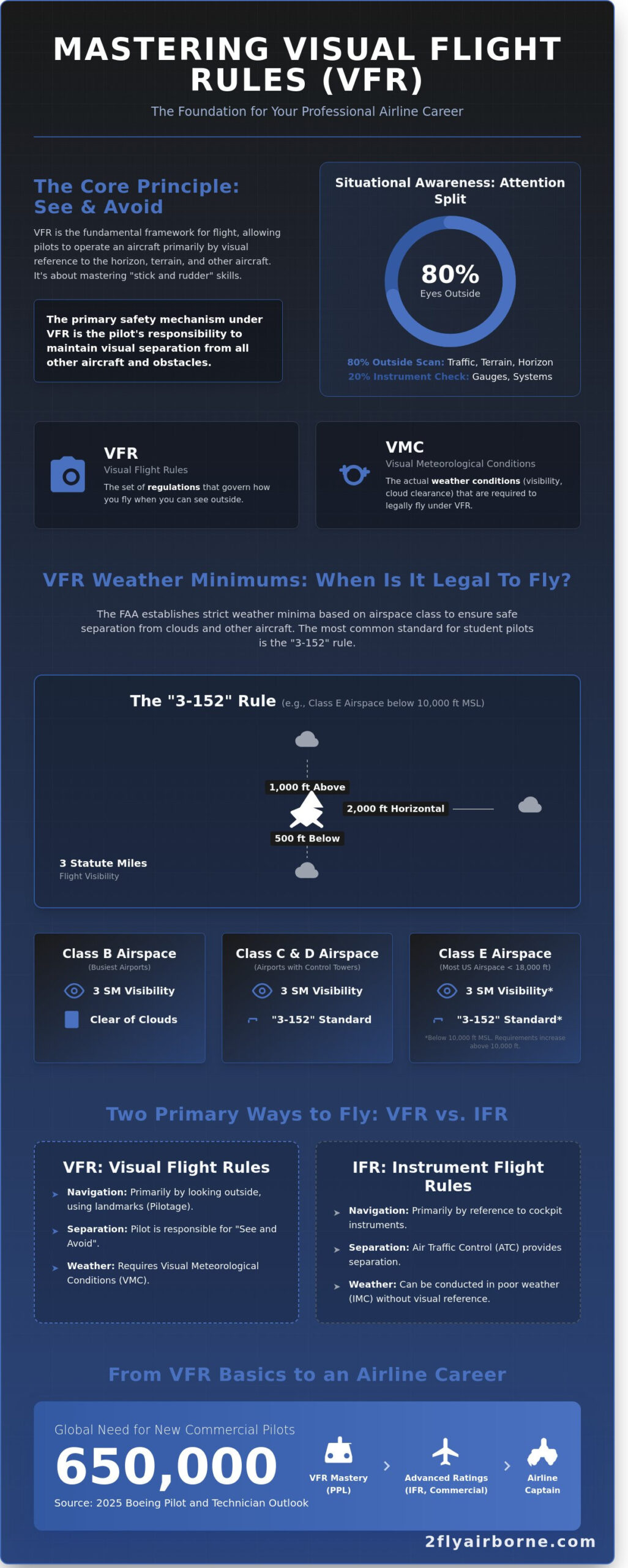
The 2025 Boeing Pilot and Technician Outlook projects a global need for 650,000 new commercial pilots. Every one of those pilots began their journey by learning to navigate the sky using landmarks, roads, and the horizon. This manual style of flying ensures that you develop the instinctual feel for the aircraft before you ever transition to complex instrument systems. It’s about building a connection between your inputs and the aircraft’s performance in the physical world. Pairing this hands-on experience with a thorough study of the airplane flying handbook gives you the theoretical foundation to accelerate your progress from day one.
The ‘See and Avoid’ Philosophy
In the early stages of flight training, your instructor will constantly remind you to keep your "eyes outside." While modern glass cockpits provide incredible data, they can become a distraction for a novice. Developing situational awareness means constantly scanning the sky for other traffic and monitoring your flight path relative to the ground. You’ll learn to divide your attention effectively, spending roughly 80 percent of your time looking outside and only 20 percent checking your gauges. This habit is vital for safety in busy practice areas where multiple training aircraft share the same airspace.
See and avoid is the primary safety mechanism where pilots take full responsibility for maintaining visual separation from all other aircraft and obstacles.
VFR vs. VMC: Knowing the Difference
It’s common for beginners to use the terms VFR and VMC interchangeably, but they represent different concepts. VMC, or Visual Meteorological Conditions, describes the actual state of the weather. These are the physical conditions, such as visibility and cloud clearance, that exist at a specific time and place. If the weather doesn’t meet the minimum standards for VMC, you simply cannot fly under visual rules. You must have the required clarity to navigate and avoid hazards without relying solely on instruments.
The FAA establishes these specific weather boundaries in 14 CFR Part 91.155 to ensure a high margin of safety. In most controlled airspace below 10,000 feet, the standard requirements include:
- A minimum of 3 statute miles of flight visibility.
- Maintaining a distance of 500 feet below clouds.
- Maintaining a distance of 1,000 feet above clouds.
- Maintaining a horizontal distance of 2,000 feet from any cloud.
If you’re ready to start your journey toward the flight deck, contact a training advisor at 2Fly Airborne to discuss your personalized path to becoming a professional pilot.
VFR Weather Minima: When is it Legal to Fly?
Operating under Visual Flight Rules requires more than just looking out the window. The FAA establishes strict weather minimums to ensure pilots maintain adequate separation from terrain and other aircraft. These requirements center on three specific variables: flight visibility, distance from clouds, and the cloud ceiling. If the weather drops below these standards, the flight must transition to Instrument Flight Rules (IFR) or remain on the ground. Professional aviators view these legal baselines as a starting point; they often set higher personal minimums to ensure a wider margin of safety during their training and career.
Standard Visibility and Cloud Clearance
The most common standard for student pilots is the "3-152" rule, which applies to Class E airspace below 10,000 feet Mean Sea Level (MSL). This rule mandates at least 3 statute miles of visibility. Additionally, you must stay 1,000 feet above, 500 feet below, and 2,000 feet horizontally from any clouds. Visibility is measured in statute miles because VFR flight relies on identifying ground references and landmarks. Maintaining horizontal and vertical separation gives you the necessary time to see and avoid other traffic that might emerge from a cloud bank unexpectedly.
Airspace Classes and VFR Variations
Weather requirements shift as you move through different airspace categories. In Class B airspace, which surrounds the nation’s busiest airports, the rule is simpler: you must remain clear of clouds with 3 miles of visibility. Class C and D airspaces generally follow the 3-152 standard. Class G airspace, which is uncontrolled, offers more flexibility at low altitudes but requires extreme vigilance. Conversely, Class A airspace, starting at 18,000 feet MSL, is strictly off-limits for VFR flight. Every pilot in Class A must be on an IFR flight plan. Mastering these complex transitions is a core component of the FAA First Officer Program, where cadets learn to navigate high-traffic environments with precision.
Becoming an airline-ready professional means understanding that "legal" doesn’t always mean "safe." While the FAA might allow a flight in 3 miles of visibility, a disciplined pilot might decide that 5 miles is their personal limit for a specific cross-country route. This mindset of risk management is what separates a student from a global pilot. If you’re ready to master these regulations and launch your commercial career, you should speak with a training advisor to build your roadmap to the flight deck.
VFR vs. IFR: Comparing the Two Primary Ways to Fly
Flying under VFR relies on your ability to see the world around you. It’s a visual experience where the natural horizon serves as your primary reference for controlling the aircraft. Instrument Flight Rules (IFR) shift that focus entirely to the flight deck. While VFR pilots look outside to maintain aircraft attitude, IFR pilots rely on a standardized six-pack of instruments or modern glass cockpit displays to navigate through clouds or low visibility. This fundamental difference dictates everything from how you plan a route to how you interact with technology.
The workload transition is stark. VFR flight is often more hands-on and spontaneous. You’re responsible for seeing and avoiding other aircraft at all times. IFR flight requires rigorous adherence to a pre-filed flight plan and constant communication with controllers. To fly IFR, your aircraft must meet specific equipment requirements under FAA Part 91.205, including a two-way radio, navigation equipment suitable for the route, and a slip-skid indicator. Most training aircraft at elite academies are equipped for both, allowing students to manage the 15% increase in cockpit complexity when switching to instrument flight.
Visual Reference vs. Instrument Data
VFR navigation uses pilotage and dead reckoning. You identify landmarks like a specific bridge or a highway intersection to track your progress. IFR pilots don’t need to see the ground; they use GPS, Very High Frequency Omnidirectional Range (VOR) stations, and vectors provided by Air Traffic Control. Mastering visual navigation first builds essential spatial awareness. This ground truth knowledge ensures you aren’t just following a purple line on a screen but actually understand the geography of your route. Pilots who excel at VFR navigation often develop a superior internal compass that serves them well during instrument failures.
The Role of Air Traffic Control
Autonomy defines the VFR experience. You’re the master of your path, provided you stay clear of restricted airspace and follow basic altitude rules. IFR pilots are never alone; they’re under ATC control from engine start to shutdown. However, VFR pilots can still leverage ATC services through Flight Following. This optional service provides radar alerts for nearby traffic, which is a critical safety tool used by roughly 85% of cross-country VFR flights. Starting your journey with an elite FAA airline pilot program ensures you master these VFR fundamentals before advancing to complex instrument operations. Contact a training advisor today at 2Fly Airborne to map out your path to the flight deck.
Practical VFR Navigation and Pilotage in 2026
Modern aviation relies on high-tech suites, yet the core of a professional pilot’s capability remains rooted in visual proficiency. By 2026, tools like ForeFlight have become standard in every cockpit, providing real-time weather overlays and synthetic vision. These digital resources enhance safety, but they don’t replace the fundamental need to look out the window. Mastering VFR flight requires a pilot to balance data from a tablet with the physical reality of the horizon. Stick-and-rudder skills, the very essence of manual flight control, are best honed in these conditions where you learn to feel the aircraft’s response to every atmospheric change.
Managing the transition into high-traffic areas demands sharp situational awareness and quick decision-making. When approaching busy Florida hubs like Merritt Island (KCOI) or Lakeland (LAL), you’ll often face complex airspace boundaries and high density traffic. You must communicate clearly with Air Traffic Control while maintaining a constant visual watch for other aircraft. This transition serves as a critical test of a student’s ability to process technical information without losing focus on basic flight path management.
Sectional Charts and Landmarks
The Sectional Chart is your primary roadmap for visual navigation. Scaled at 1:500,000, these maps detail everything from terrain elevation to restricted airspaces. You’ll learn to identify specific checkpoints like 1,000-foot radio towers, distinctively shaped lakes, or major highway interchanges from an altitude of 5,000 feet. Digital charts are powerful tools for efficiency, but your eyes must remain outside the cockpit 90% of the time to ensure safety and precision.
The Importance of VFR Flight Planning
Precision planning is what separates a hobbyist from a career-ready professional. You’ll calculate exact fuel burn rates, wind correction angles, and true airspeed for every cross-country leg. 2FLY instructors prepare students for the unpredictable by teaching them to anticipate weather shifts mid-flight. This rigorous preparation ensures you’re ready for the demands of a commercial flight deck. If you’re ready to begin your journey, explore our financing options to see how we support your career goals.
Becoming an elite pilot starts with mastering the basics of VFR navigation and building a foundation for a global career. For personalized guidance on starting your professional training, speak with a 2Fly Airborne training advisor today.
Transitioning from VFR to a Professional Airline Career
Airlines don’t just look for pilots who can follow a flight director or program an FMS. They want professionals with a deep-seated mastery of the basics. This career journey starts with VFR training. When you learn to fly by looking outside, you develop superior situational awareness. This skill is vital in a modern flight deck. It acts as a primary safeguard against automation dependency. If a system fails in a large jet, your ability to hand-fly the aircraft based on visual cues and raw data becomes your most valuable asset.
The progression from a student pilot to an airline captain follows a disciplined path:
- Private Pilot License: Establishing the vfr foundation and basic airmanship.
- Instrument Rating (IFR): Learning to fly solely by reference to instruments in all weather conditions.
- Commercial Certificate: Refining skills to meet professional legal and safety standards.
- Multi-Engine Rating: Managing complex systems and higher performance speeds.
Beyond the Private Pilot License
Moving from a hobbyist mindset to professional certification requires a shift in focus. You transition from flying for recreation to flying for a global career. The
[Boeing Pilot Outlook
](https://www.boeing.com/content/dam/boeing/v2/products/pilot-technician-outlook/pdf/2025-pto-download.pdf)projects a global demand for 674,000 new commercial pilots by 2043. To meet this demand, 2FLY cadets train in Florida’s complex airspace. This high-traffic environment forces you to sharpen your communication and navigation skills early. It prepares you for the density of major international hubs.
Becoming an Airline-Ready Professional
Professionalism is about consistency and standards. The
[FAA Professional Pilot Program
](https://www.2flyairborne.com/pilot-training/faa-training/faa-airline-pilot-program/)at 2FLY integrates these standards from your first hour of flight. You’ll stop thinking like a weekend flyer and start operating like a global pilot. This structured timeline ensures you’re ready for the right seat of a regional carrier. You’ll move through your ratings with a clear end goal: the airline flight deck.
The transition from visual flying to the complex world of commercial aviation is a rewarding challenge. It requires discipline, precision, and the right mentorship. To understand the full scope of what structured pilot training in 2026 looks like from cadet to airline-ready professional, explore our detailed breakdown of the modern commercial aviation career path. Speak with a 2FLY training advisor today to map out your personalized career path. We’ll help you bridge the gap between your first takeoff and your first airline uniform.
Launch Your Professional Pilot Career
Mastering vfr flight is more than a regulatory requirement; it’s the bedrock of your professional identity as an aviator. You’ve explored how weather minima dictate safety and how modern navigation tools in 2026 enhance traditional pilotage. These skills form the essential first chapter of your journey toward the flight deck. Transitioning from these fundamentals to a commercial cockpit requires a structured environment and expert mentorship. 2FLY Airborne delivers this through dual FAA and EASA certified training programs designed to meet global airline standards. Our Florida training center offers state-of-the-art flight simulators and on-campus housing to keep you focused on your 1,500-hour goal. You don’t have to navigate the complexities of flight hours and certifications alone. Our team provides the disciplined framework needed to transform a passion for flight into a career-ready reality. Every elite captain started exactly where you are today. It’s time to move beyond the basics and begin your ascent toward a global aviation career.
Speak with a 2FLY Training Advisor about starting your pilot career
The sky isn’t your limit; it’s your workplace. We’re ready to help you reach it.
Frequently Asked Questions
Can I fly VFR at night?
Yes, you can fly VFR at night in the United States if you meet the specific requirements of FAA FAR 61.109. This involves completing 3 hours of night flight training and 10 takeoffs and landings to a full stop. Night flight offers a unique perspective for a global pilot; it requires higher situational awareness and careful planning. Contact a 2Fly Airborne training advisor to learn how our elite programs prepare you for these professional demands.
What happens if the weather turns bad during a VFR flight?
You must immediately prioritize safety by diverting to an alternate airport or performing a 180 degree turn to find clearer skies. According to the NTSB, VFR flight into IMC remains a leading cause of accidents. Professional pilots always maintain a secondary plan and monitor weather updates via ADS-B or Flight Service. If you’re trapped, declare an emergency with Air Traffic Control to receive immediate radar vectors to safety.
Do commercial airline pilots ever use VFR?
Commercial airline pilots primarily operate under IFR, but they frequently use VFR procedures during visual approaches to landing. Under FAA Part 121 regulations, airlines may transition to visual flight when the ceiling is at least 1,000 feet and visibility is 3 miles or greater. This transition helps maintain efficient traffic flow at busy global hubs. Mastering these rules is the first step toward becoming an airline-ready professional in our elite career programs.
What is ‘Special VFR’ and when is it used?
Special VFR (SVFR) is an ATC clearance that allows you to operate within the lateral boundaries of controlled airspace when weather is below standard minimums. Under FAA Part 91.157, you need at least 1 statute mile of visibility and must remain clear of clouds. Between sunset and sunrise, the pilot must also hold an instrument rating. This tool is valuable for reaching your destination when local conditions at the airport are marginal.
Is there an altitude limit for VFR flights?
Yes, VFR flights in the United States are generally prohibited above 18,000 feet Mean Sea Level (MSL), which is where Class A airspace begins. At this altitude, all aircraft must operate under IFR. For flights above 3,000 feet AGL, pilots must follow the hemispherical cruising altitude rule. This requires flying at "thousands plus 500" foot increments, such as 4,500 or 6,500 feet, to ensure vertical separation between aircraft.
Do I need a flight plan to fly VFR in the United States?
You don’t need a formal flight plan for most domestic VFR flights, though filing one with Flight Service is a critical safety practice. A flight plan ensures that search and rescue operations begin if you’re 30 minutes overdue. However, flying through a Flight Restricted Zone or crossing international borders requires a mandatory flight plan. Our professional instructors emphasize these habits to ensure you’re prepared for a disciplined aviation career.
What is the difference between VFR and VMC?
VFR refers to the set of regulations you follow, while VMC (Visual Meteorological Conditions) describes the actual weather you’re flying in. You must have VMC to fly under VFR. For example, in Class E airspace below 10,000 feet, VMC requires 3 miles of visibility and specific cloud clearances. Understanding this distinction is vital for any cadet aiming for FAA certification and a successful journey to the flight deck.

Article by
2FLY Airborne
2Fly Airborne is a professional flight training organization dedicated to developing the next generation of skilled, confident, and safety-focused pilots. With decades of combined aviation experience, our team of certified instructors provides structured, real-world training designed to prepare students for both checkrides and long-term success in the aviation industry.
Content Disclaimer
Some blog content is generated with the assistance of automated tools and may not always be fully accurate or up to date. Please verify all aviation-related information with official sources or a certified instructor. For additional guidance or clarification, we encourage you to contact one of our training advisors at 2Fly Airborne.