You might think the number of hours in your logbook is the only factor dictating your career start date, but the real secret to a fast-tracked professional path lies in the structure of your training program. Many aspiring aviators focus solely on the 190 or 250-hour milestones without realizing that the training environment itself is what prevents hidden time-sinks. Consistency and high-quality instruction often matter more than the raw time spent in the air.
It’s common to feel a sense of uncertainty when comparing different regulatory pathways or calculating the jump from a student certificate to an airline flight deck. You want a clear, authoritative answer on how long to get commercial pilot license without the confusion of shifting FAA standards or vague timelines. Understanding the distinction between various training structures is the first step toward reaching your professional goals.
This guide provides a precise, realistic roadmap for 2026, detailing each phase of your progression from zero hours to a professional paycheck. We will examine the efficiency of accelerated programs, the impact of recent Part 141 modernizations, and the specific steps required to secure your place in the global aviation industry. Discover how a structured approach can transform your ambition into a tangible career timeline.
Key Takeaways
- Identify the critical distinction between earning a legal certificate at 250 hours and meeting the 1,500-hour requirement for major airline employment.
- Map out the specific phases of your training journey, starting with the foundational private pilot certificate followed by advanced instrument training.
- Compare the structured efficiency of Part 141 programs against traditional routes to determine how long to get commercial pilot license based on your professional goals.
- Learn why becoming a Certified Flight Instructor is the most effective strategy to bridge the gap between initial certification and the flight time needed for airlines.
- Evaluate how professional pilot programs streamline your transition from a student to an industry-prepared aviator through a goal-oriented curriculum.
Defining the Timeline: CPL vs. ATP Requirements
The journey to a professional cockpit is often clouded by a misunderstanding of what it actually means to be a “commercial pilot.” Many students start their journey asking exactly how long to get commercial pilot license credentials, only to discover that the license itself is just one specific milestone on a longer path. The Federal Aviation Administration (FAA) establishes strict FAA pilot certification requirements to ensure that every aviator in the sky meets a high standard of safety and technical proficiency. These regulations are designed to build experience progressively, moving from basic maneuvers to complex commercial operations.
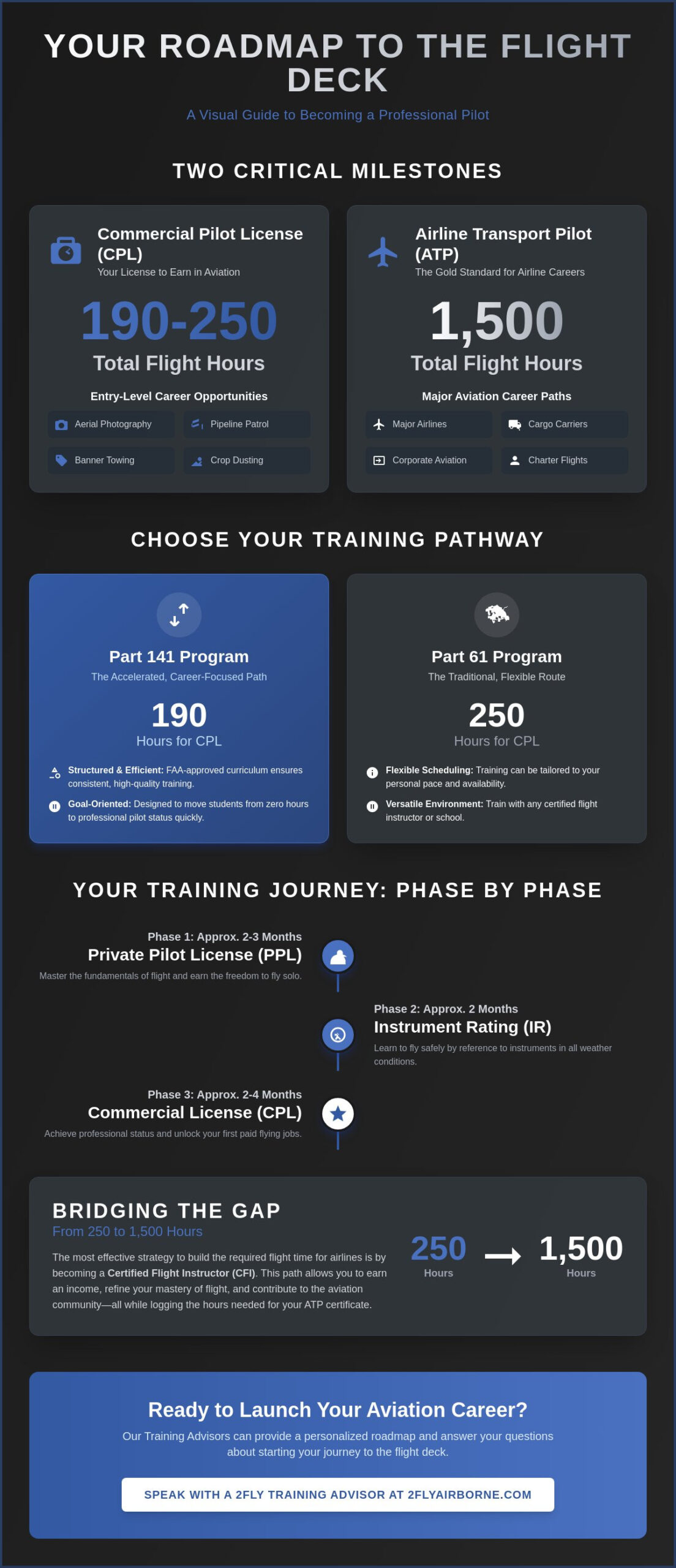
When calculating how long to get commercial pilot license status, you must account for the specific regulatory path you choose. While a standard Part 61 program requires 250 hours, FAA-approved Part 141 schools can reduce this requirement to 190 hours through a more structured curriculum. This distinction is vital for high-achievers who want to enter the workforce as quickly as possible. These minimums aren’t just arbitrary numbers; they’re the safety foundation of the entire global aviation industry.
To better understand the specific steps involved in this process, watch this helpful video:
The 250-Hour Milestone
Reaching the 250-hour mark is the primary threshold for earning your Commercial Pilot Certificate under traditional regulations. This certification is your legal “license to learn” while getting paid, allowing you to accept compensation for your services. In a dedicated, full-time training environment, most students reach this milestone in approximately 6 to 10 months. It’s a period of intense focus where you transition from a student to a professional aviator.
Earning your CPL opens doors to several entry-level professional roles that don’t require the advanced 1,500-hour certificate. You can begin working in sectors such as:
- Aerial Photography: Capturing high-resolution imagery for real estate or mapping.
- Pipeline Patrol: Monitoring critical infrastructure from the air.
- Crop Dusting: Supporting the agricultural industry through precision application.
- Banner Towing: Building hours while flying over coastal regions or major events.
The 1,500-Hour Airline Minimum
The distinction between a commercial pilot and an airline pilot is found in the Airline Transport Pilot (ATP) certificate. While a CPL allows you to fly for hire, major carriers require an ATP, which mandates a minimum of 1,500 total flight hours. This “time gap” between 250 and 1,500 hours is where many pilots feel the most pressure to find consistent flying opportunities. It’s a period of professional refinement where you develop the decision-making skills needed for heavy jet operations.
Accelerated programs, like the FAA First Officer Program, are designed to manage this transition efficiently. By helping you earn your instructor ratings shortly after your CPL, these programs provide a direct path to employment. You can build the remaining 1,250 hours while earning a paycheck as a Certified Flight Instructor (CFI). This approach ensures you aren’t just waiting for hours to accumulate; you’re actively contributing to the industry while advancing your own career.
The Step-by-Step Phases of Flight Training
Professional flight training is a systematic progression of specialized certifications and ratings. Each phase builds upon the last, adding layers of complexity that prepare you for the demands of a high-stakes aviation career. Understanding these building blocks is the best way to estimate how long to get commercial pilot license credentials and start your professional journey.
Phase 1 begins with earning your Private Pilot License (PPL). This foundational stage typically requires 40 to 60 flight hours and focuses on the core principles of aerodynamics and aircraft handling. It is your first taste of the cockpit and the starting point for every professional aviator.
Once you master the basics, you move to Phase 2, the Instrument Rating (IR). During this phase, you learn to fly solely by reference to instruments, which is a non-negotiable skill for modern commercial operations. It prepares you to handle adverse weather and complex air traffic environments with precision.
Phase 3 is the Commercial Pilot Certification itself. This is where you refine your maneuvers to meet the 14 CFR Part 61 requirements for professional flight. When people ask how long to get commercial pilot license status, they are usually referring to this milestone, as it represents your legal transition into a paid pilot role.
Phase 4 involves the Multi-Engine Rating, which is essential for operating the heavy aircraft used by airlines. Finally, Phase 5 often involves becoming a Certified Flight Instructor (CFI). This step allows you to gain the professional experience and leadership skills that major carriers prioritize during the hiring process.
From PPL to Instrument Rating
The transition from a private pilot to an instrument-rated pilot is often considered the steepest learning curve in aviation. You’ll spend significant time in ground school mastering advanced weather theory, navigation systems, and air traffic control procedures. While flight hours vary by student, the mental discipline developed during instrument flight sets the tone for your entire professional career.
Mastering the Multi-Engine Environment
Adding a multi-engine rating is a relatively short but intense process. It usually takes about 10 to 15 hours of flight time to master engine-out procedures and the complex systems of high-performance aircraft. Airlines prioritize this experience because it demonstrates your ability to manage multi-tasking and safety protocols in critical situations.
Modern training programs use advanced flight simulators to accelerate this learning curve safely and effectively. If you want to maximize your training efficiency and reach your career goals faster, enrolling in a structured FAA Airline Pilot Program can help you move through these phases without unnecessary delays.
Accelerated vs. Traditional Flight Training Timelines
The speed at which you progress through your ratings depends heavily on the regulatory environment of your chosen flight school. While the FAA provides two primary pathways, Part 61 and Part 141, the impact on your calendar can be vast. Choosing the wrong structure can add months or even years to your timeline, regardless of your personal drive or ambition.
Part 61 training is often described as the flexible, self-paced route. It’s ideal for hobbyists who can only fly once or twice a week. However, this flexibility often leads to “skill fade,” where students spend valuable flight time relearning maneuvers from previous lessons. This inconsistency is a primary reason why many people struggle with how long to get commercial pilot license certifications in a traditional setting.
In contrast, Part 141 programs utilize a structured, syllabus-based approach designed for career-track students. This immersion minimizes the time between lessons, ensuring that your skills remain sharp and your progression stays on schedule. For a deeper look at these requirements, the AOPA Commercial Pilot guide offers an excellent overview of the practical milestones involved in the professional journey.
The Part 141 Advantage
The most significant benefit of an FAA-approved Part 141 school is the potential for reduced flight hour requirements. Because the training is so structured and monitored, the FAA allows these schools to graduate commercial pilots with as few as 190 total hours. This efficiency is a major reason why candidates seeking a professional career prefer Choosing a Part 141 Flight School over more casual environments. It isn’t just about flying fewer hours; it’s about the quality and density of the instruction you receive.
Realistic Calendar Expectations
When you commit to a full-time accelerated program, you can realistically expect to reach commercial pilot status in 7 to 10 months. This timeline assumes a high level of consistency, typically flying four to five times per week. For part-time students, the journey often stretches to 2 or 4 years, as life commitments and scheduling conflicts inevitably slow the pace.
Geographic location plays a critical role in these expectations as well. Training in regions with unpredictable weather can lead to weeks of grounded aircraft, causing your timeline to balloon. Choosing a location with year-round flyable weather, such as Florida, ensures that you maintain momentum. When evaluating how long to get commercial pilot license credentials, always factor in the reliability of the local climate and aircraft availability.
Bridging the Gap: Moving from 250 to 1,500 Hours
Once you hold your commercial certificate, you face the most significant hurdle in your aviation career: the 1,250-hour gap. While you’ve answered the question of how long to get commercial pilot license status, the journey to the captain’s seat at a major airline requires reaching the 1,500-hour Airline Transport Pilot (ATP) minimum. This phase isn’t a waiting room; it’s a period of professional refinement where you transition from a trainee to an industry-ready professional.
The industry demand remains high for those who can navigate this transition successfully. The 2025 Boeing Pilot and Technician Outlook projects a demand for 660,000 new pilots globally through 2044. Meeting this demand requires a strategic approach to time-building that maximizes your learning while keeping you on a strict schedule. You need a role that offers consistent hours and professional growth.
The CFI Career Path
Choosing to become a Certified Flight Instructor (CFI) is the standard and most efficient path for most aviators. The CFI and CFII training courses typically take between 4 and 8 weeks to complete. Teaching others forces you to master aviation knowledge at a level far beyond what is required for your own checkrides. If you’re looking for a structured environment to earn these ratings, the FAA Airline Pilot Program provides the perfect foundation.
While instructing is the most common route, it’s not the only way to build professional experience. Some pilots choose alternative paths such as pipeline patrol, banner towing, or flying for skydiving operations. These roles offer unique challenges, but they often lack the consistent, high-volume flying hours found in a busy flight training environment. A full-time instructor at a high-tempo academy can expect to log between 60 and 100 hours per month, ensuring a steady march toward their goals.
Timeline to the 1,500-Hour Finish Line
The math behind the 1,500-hour finish line is straightforward but requires discipline. If you log an average of 80 hours per month, it takes approximately 15 to 16 months to bridge the gap from your initial commercial certificate. When you combine this with your initial training, the total timeline from zero experience to a regional airline cockpit is roughly 24 to 30 months. This timeline can vary based on your personal work ethic and the student volume at your flight school.
As you approach the 1,500-hour mark, your focus shifts toward the Airline Transport Pilot Certification Training Program (ATP CTP) and preparing for airline interviews. This is the final step before you transition into the world of heavy jet operations. To ensure you’re on the fastest track to this goal, enroll in the FAA First Officer Program today and start your journey toward the airline flight deck.
Navigating Your Career Path with 2FLY Airborne
Choosing the right training environment is the most influential decision you’ll make in your early aviation career. While many students focus exclusively on how long to get commercial pilot license credentials, the quality of your mentorship and the structure of your program determine your long-term professional mobility. 2FLY Airborne designs its curriculum to do more than just meet minimum hour requirements; it prepares you for the rigorous standards of international airline operations.
The FAA Professional Pilot Program streamlines your journey by eliminating the administrative and scheduling hurdles often found in smaller flight schools. By providing a fixed-price tuition model, the program allows you to focus entirely on your training without the stress of fluctuating costs or hidden fees. This financial predictability is essential for serious candidates who are planning a multi-year career transition.
A Structured Gateway to Aviation
Immersive training environments produce more confident and capable pilots. By living and training in a dedicated aviation community, you benefit from a focused peer group and constant access to professional resources. On-campus housing options at our facilities ensure that your commute is measured in steps rather than miles, maximizing your time in the cockpit and the simulator.
This level of immersion is a primary factor in reducing the total calendar time required to reach your goals. When you’re surrounded by other high-achievers, you maintain a momentum that is difficult to replicate in a part-time setting. If you’re concerned about the investment required for this level of training, you can explore various options for Financing Your Training to help bridge the gap to your first professional paycheck.
Speak with a Training Advisor
Every pilot’s journey is unique, and your specific timeline will depend on your previous experience and professional aspirations. Speaking with a training advisor allows you to map out a realistic schedule that accounts for your individual needs. They can provide clarity on how long to get commercial pilot license status within our specific accelerated tracks and help you prepare for the 1,500-hour milestone.
The global industry is currently seeking disciplined, well-trained aviators to fill a growing number of flight deck vacancies. The 2025 Boeing Pilot and Technician Outlook projects a demand for 660,000 new pilots globally through 2044. Starting your training in a safe, structured environment today ensures you’re positioned to meet this demand as a highly qualified professional.
Summary of Key Takeaways:
- Consistency and program structure are the most critical factors in your training timeline.
- Earning a CPL at 190 or 250 hours is a legal milestone, but the 1,500-hour ATP is the airline goal.
- Part 141 programs offer a more efficient, syllabus-driven path for career-track students.
- Flight instructing remains the most effective way to build professional experience while earning a paycheck.
The path to the flight deck requires dedication, but you don’t have to navigate the regulatory requirements alone. Our team is here to support your ambition with world-class training and professional guidance. Reach out to a 2FLY Training Advisor today with any remaining questions about your future in the skies.
Launch Your Professional Aviation Career
The total duration of your flight training is determined by the consistency of your schedule and the quality of your training environment. While individual progress varies, choosing a structured Part 141 program remains the most effective way to minimize the time spent reaching your goals. Understanding exactly how long to get commercial pilot license credentials allows you to plan your transition from the classroom to the cockpit with absolute certainty.
2FLY Airborne brings over 30 years of aviation training excellence to every student’s journey. Our Professional Pilot Program utilizes both FAA and EASA standards to ensure you’re prepared for a mobile, international career. With fixed-price tuition options, you can focus on mastering your skills while we provide the roadmap to your first officer seat.
Your future in the sky is closer than you think. Reach out to a 2FLY Training Advisor with any remaining questions you have about our specialized programs. Speak with a 2FLY Training Advisor to build your personalized career timeline. We look forward to supporting your ambition as you reach for the highest levels of your profession.
Frequently Asked Questions
Can I get a commercial pilot license in 6 months?
Reaching this milestone in six months is possible only within a highly accelerated, full-time training environment. You must fly almost daily and maintain a rigorous study schedule to pass the required written exams and checkrides. Most students find that seven to ten months is a more realistic timeframe to ensure they master the complex maneuvers and decision-making skills required of a professional aviator. Consistency is the key to meeting this aggressive goal.
How many flight hours are required for a commercial pilot license?
The total flight time depends on whether you train under FAA Part 61 or Part 141 regulations. Under Part 61, you must log a minimum of 250 flight hours to qualify for the certificate. However, FAA-approved Part 141 programs allow students to graduate with as few as 190 hours because of the highly structured curriculum. Understanding these requirements helps you determine exactly how long to get commercial pilot license status based on your chosen school.
Do I need a college degree to become a commercial pilot in 2026?
A college degree isn’t a legal requirement to earn your Commercial Pilot Certificate or even your Airline Transport Pilot certificate. You can begin your professional career and fly for many charter or regional operators without a four-year degree. While some major legacy carriers still prefer candidates with a bachelor’s degree for long-term career advancement, many modern pathways prioritize flight experience and technical proficiency over traditional academic credentials in the current hiring market.
How much does it cost to get a commercial pilot license from zero experience?
Training costs vary significantly based on your geographic location, the type of aircraft used, and the specific program structure. Prospective students should evaluate the total investment, which includes flight hours, ground school, and secondary costs like fuel surcharges or examiner fees. It’s vital to look for programs that offer transparent tuition structures to help you plan your finances accurately. Contacting a training advisor is the most reliable way to get an up-to-date estimate.
Is it possible to work while attending flight school full-time?
Working while enrolled in an accelerated professional program is generally discouraged due to the intense mental and physical demands of daily flight training. Professional programs require total immersion, with students often spending eight to ten hours a day on lessons, flight planning, and self-study. Dividing your attention can lead to slower progress and increased total costs. Most successful candidates treat their flight training as a full-time job to reach their career goals as quickly as possible.
What is the difference between FAA and EASA commercial pilot timelines?
FAA training is typically modular, allowing you to earn ratings sequentially, while EASA often utilizes integrated programs that take 18 to 24 months to complete. The FAA path allows you to reach the commercial milestone relatively quickly, though you’ll need additional time to build the 1,500 hours required for airlines. EASA programs are often more condensed in terms of ground school requirements but follow a different regulatory structure. Both pathways are designed to produce world-class professionals ready for international mobility.
How fast can I go from a Private Pilot to a Commercial Pilot?
You can bridge the gap from a private pilot to a commercial pilot in approximately four to six months if you’re training full-time. This phase includes earning your instrument rating and completing the cross-country flight requirements mandated by the FAA. Your personal dedication and the availability of aircraft at your pilot school will dictate the final pace. Maintaining a steady training rhythm prevents the need for costly review lessons and keeps your technical skills sharp for the checkride.
What happens after I reach the 1,500-hour requirement?
Reaching 1,500 hours makes you eligible for the Airline Transport Pilot (ATP) certificate, which is the highest level of pilot certification. At this stage, you can complete the ATP CTP course and begin the interview process for first officer positions at regional or major airlines. This milestone represents the culmination of your journey from a trainee to a fully qualified airline professional. It’s the point where your initial investment in flight training transforms into a long-term, high-level career.
Article by
2FLY Airborne
2Fly Airborne is a professional flight training organization dedicated to developing the next generation of skilled, confident, and safety-focused pilots. With decades of combined aviation experience, our team of certified instructors provides structured, real-world training designed to prepare students for both checkrides and long-term success in the aviation industry.
Content Disclaimer
Some blog content is generated with the assistance of automated tools and may not always be fully accurate or up to date. Please verify all aviation-related information with official sources or a certified instructor. For additional guidance or clarification, we encourage you to contact one of our training advisors at 2Fly Airborne.