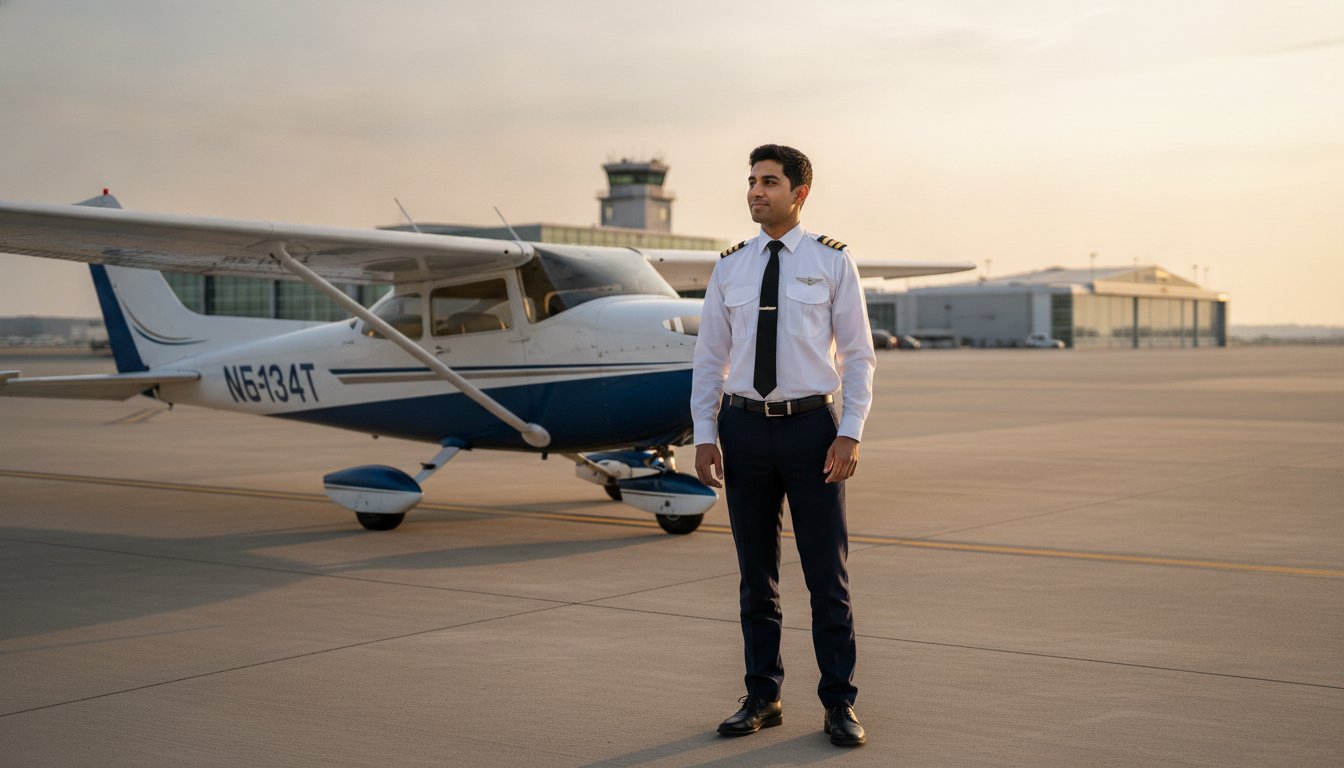
What if the most significant risk in your aviation journey isn’t the initial investment, but the potential cost of waiting to start? Many aspiring aviators are currently asking: is becoming a pilot a good career 2026? It’s completely normal to feel a mix of ambition and anxiety when you consider the dedication required to earn your stripes. You want to ensure that your path leads to a stable, high-reward profession rather than a period of uncertainty.
We recognize that you’re looking for a stable path that justifies your commitment and passion. You want to be certain that the cockpit remains a place of high reward and professional growth for decades to come. This guide provides a transparent look at the professional realities of the industry, from the current surge in compensation to the long-term security of an international career. We’ll help you move past the confusion of training pathways and economic headlines.
You’ll gain a clear understanding of salary trajectories, the stability of the 2026 market, and a practical roadmap for your journey through flight training. We’ll examine how the transition from trainee to industry-prepared professional works in practice. This overview ensures you have the facts needed to launch your career with total confidence and reach the flight deck on a timeline that works for you.
Key Takeaways
- Gain a comprehensive perspective on why is becoming a pilot a good career 2026 by exploring the professional stability and high-level rewards currently shaping the industry.
- Understand the structured progression from First Officer to Captain and how international professional mobility offers a versatile and elite career path.
- Learn the practical differences between Part 61 and Part 141 training environments to choose the most effective roadmap for your personal goals.
- Discover how a dedicated training pipeline transforms dedicated trainees into industry-prepared professionals through a global network of opportunities.
- Identify the essential certifications needed to reach the flight deck, including the critical transition from private pilot to commercial ratings.
Evaluating the Professional Aviation Landscape in 2026
Imagine standing on the ramp, watching a modern jet depart, and wondering if you’ve missed the peak of the industry’s hiring cycle. The reality is that the role of an Aircraft pilot has transformed into a high-level professional position that demands more than just basic flying skills. It’s now a career defined by complex systems management and global leadership in a highly regulated environment.
Many prospective candidates are asking is becoming a pilot a good career 2026 because they want to ensure their investment leads to a stable future. In truth, the sophistication of modern, technology-integrated flight decks has actually raised the bar for entry, making skilled aviators more valuable than ever. This evolution turns flight training into a disciplined vocational path rather than a traditional academic pursuit.
To better understand the current value of this career path, watch this helpful video:
The Shift from Trainee to Industry-Prepared Professional
Entering the industry in 2026 requires a specific mindset shift from the very first day of your flight training. You aren’t just a student learning a hobby; you’re an industry-prepared professional in the making. This distinction is vital because airlines now prioritize candidates who demonstrate technical mastery and a deep understanding of international standards from the start of their journey.
Structured, airline-oriented programs are more important now than they were in previous years. These programs provide the necessary framework to handle advanced automation and rigorous safety protocols used by major carriers. By treating your training as a professional obligation, you align yourself with the elite standards expected in a modern flight deck environment.
Addressing Modern Skepticism and Economic Timing
Economic fluctuations often cause hesitation, yet aviation remains a remarkably resilient sector. Unlike many industries, air travel serves as critical global infrastructure that continues to expand. The 2026 market is vastly different from previous decades, offering significantly higher starting salaries and more transparent career progression for those who commit to the path.
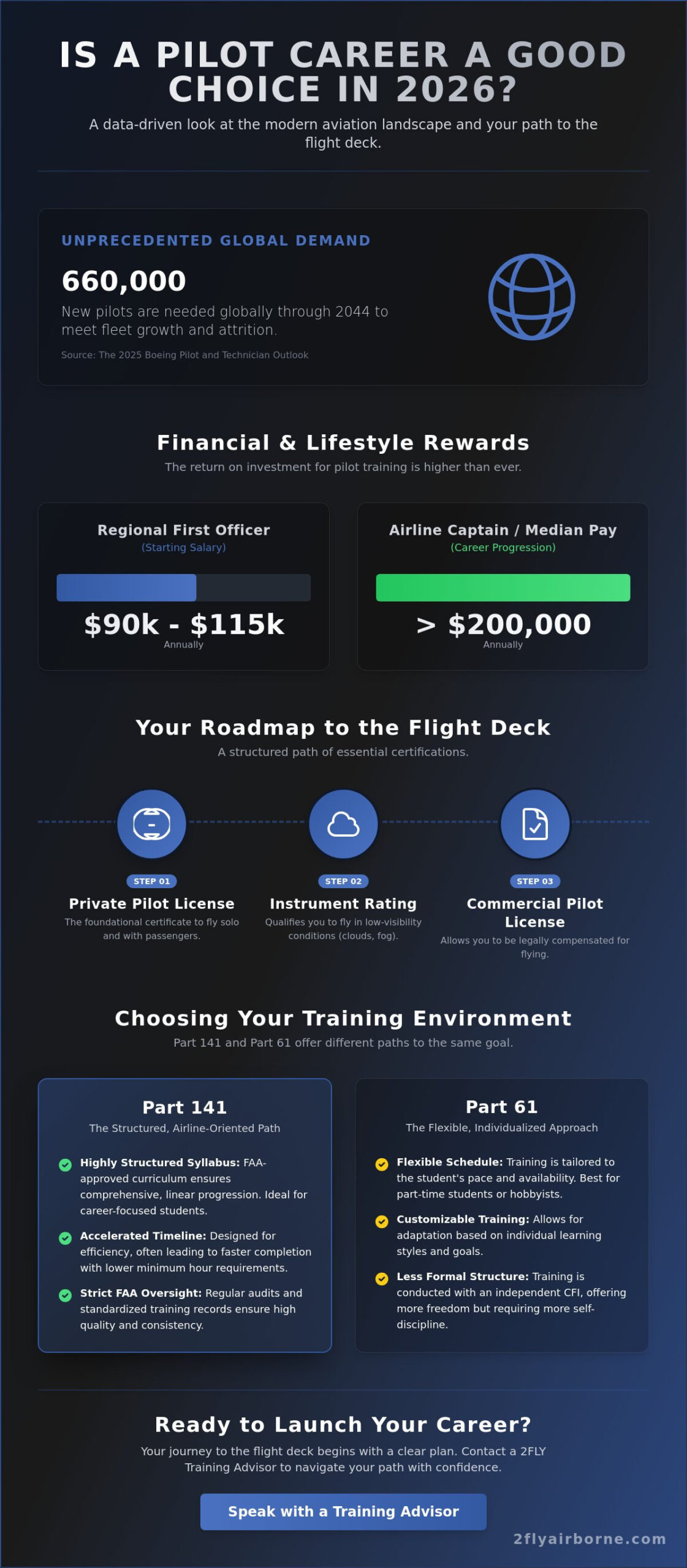
For example, new regional first officers can now expect to earn between $90,000 and $115,000 annually. This represents a massive shift from the entry-level pay scales seen in the past. Consider the journey of a student like Sarah, who began her training during a period of economic uncertainty. She focused on her Instrument Rating (IR) and Commercial Pilot Certificate (CPL) with a clear, goal-oriented mindset.
Sarah’s success proves that consistent demand for qualified professionals outweighs temporary market noise. With median pay for airline pilots now exceeding $200,000 per year, the financial return on your training investment is clearer than ever. Your focus should remain on the long-term stability of the profession and the immense rewards of international professional mobility.
The Financial and Lifestyle Rewards of a Modern Pilot Career
Have you ever imagined a workplace where the view changes every hour and your office sits at 35,000 feet? While the scenery is spectacular, the underlying structure of a pilot’s career is built on a foundation of significant financial and personal rewards. When asking is becoming a pilot a good career 2026, it’s essential to look beyond the initial training and see the long-term trajectory of the profession.
Transitioning into this elite field requires careful preparation, especially regarding the flight school cost. While the investment is substantial, the return on investment (ROI) in the current market is unprecedented. Data from the Occupational Outlook Handbook reflects a profession that highly values technical mastery and responsibility, with median pay for airline pilots now exceeding $200,000 per year.
Your journey typically begins as a First Officer, where you’ll gain the experience and hours necessary to eventually command your own aircraft. As you move toward the rank of Captain, your compensation and authority increase alongside your seniority. This progression is a structured ladder designed to reward longevity and safety within the airline ecosystem. Take a moment to review the FAA Professional Pilot Program to see how this career path is structured for success.
Beyond the paycheck, the lifestyle offers a level of flexibility rarely found in traditional corporate roles. Senior pilots often enjoy significant control over their rosters, with some working as few as 12 days a month. This freedom is coupled with international professional mobility, allowing you to leverage your skills across different global regions and cultures.
Salary Trajectories and Long-Term ROI
Seniority systems are the backbone of airline career progression. They determine everything from your hourly rate to the routes you fly and the holidays you spend at home. Breaking even on your initial training costs happens faster than many expect due to aggressive pay scales at regional carriers, where new first officers can earn between $90,000 and $115,000 annually. If you’re concerned about the upfront commitment, exploring financing options can help make this transition manageable.
Global Opportunities with FAA Certifications
Holding an FAA Commercial Pilot Certificate is effectively possessing a global passport in the sky. US-based training standards are respected worldwide, opening doors to careers in North America, Europe, Asia, and the Middle East. We define professional mobility as the ability to transition seamlessly between international markets, ensuring your skills remain in demand regardless of local economic shifts. This vocational preparedness is what separates a standard trainee from an industry-prepared professional.
Understanding Market Demand and the Global Pilot Shortage
You might see conflicting headlines about the aviation industry, leading you to wonder if the “pilot shortage” is just a marketing buzzword. It’s a fair question to ask when evaluating if is becoming a pilot a good career 2026. While hiring cycles naturally fluctuate, the structural demand for flight deck professionals is driven by non-negotiable factors like mandatory retirements and global fleet expansion.
The FAA mandates that airline pilots retire at age 65, creating a consistent and predictable vacancy rate at the top of the seniority list. This “pull-up” effect means that for every retiring captain, a chain of promotions and new hires follows. According to the BLS Pilot Career Outlook, this translates to thousands of annual openings that airlines must fill to maintain their flight schedules.
Beyond passenger airlines, the cargo and private charter sectors provide additional layers of career stability. E-commerce growth has turned cargo flying into a robust, high-paying alternative to traditional passenger routes. These sectors ensure that even if one part of the industry slows down, your skills as an industry-prepared professional remain highly liquid across the global market.
The 2025 Boeing Pilot and Technician Outlook
The 2025 Boeing Pilot and Technician Outlook projects a demand for 660,000 new pilots globally through 2044. For someone starting their journey in 2026, this represents a massive window of opportunity during the most productive years of their career. The gap between the global supply of trainees and the regional demand for captains is widening, particularly in North America and Asia. This supply-demand imbalance is the primary driver behind the “Golden Age” of pilot compensation we see today.
Cadet Programs and the Pipeline to Employment
Airlines are no longer waiting for pilots to find them; they’re actively partnering with elite training institutions to secure their future workforce. These cadet and airline-backed tracks provide a clearer roadmap from the classroom to the cockpit. By enrolling in a structured FAA Airline Pilot Program, you’re positioning yourself at the front of this recruitment pipeline.
This early integration into the airline ecosystem reduces the uncertainty often associated with career transitions. It allows you to focus on technical mastery while the industry builds the infrastructure for your eventual employment. The result is a seamless transition from a trainee to a professional pilot with a defined, reliable career path.
Navigating the Path: From Student Pilot to Flight Deck
You’ve analyzed the market demand and the potential rewards. Now, you need to understand the technical progression required to reach the flight deck. If you’re still weighing whether is becoming a pilot a good career 2026, the clarity of this professional roadmap should offer significant reassurance. It’s a journey of technical mastery that transforms a passionate individual into a highly disciplined aviator.
The journey begins with the Private Pilot Certificate (PPL), which focuses on the fundamental principles of flight and aircraft handling. From there, you’ll earn an Instrument Rating (IR), which is a critical qualification that allows you to fly in various weather conditions by relying solely on aircraft instruments. The final core milestone is the Commercial Pilot Certificate (CPL), which officially permits you to be compensated for your services as a professional pilot.
In the United States, most aspiring airline pilots must also navigate the 1,500-hour rule to earn their Airline Transport Pilot (ATP) certificate. This requirement often involves serving as a Certified Flight Instructor (CFI) after completing your initial training. This role is vital because it allows you to sharpen your instructional skills while building the flight hours necessary for major airline recruitment.
Accelerated vs. Modular Training Paths
Choosing between an accelerated program and a modular approach is a critical decision for your career timeline. Immersive, full-time environments are designed to move you through the syllabus at a professional pace, often resulting in higher knowledge retention and faster completion. For a deeper dive into these specific steps, review our comprehensive guide on how to become a pilot.
You should also consider the regulatory environment of your chosen flight school. Part 141 schools follow a more structured, FAA-approved syllabus that is often preferred by career-minded students seeking an airline-style training environment. Part 61 training offers more flexibility for those with varied schedules, but it requires a higher level of individual self-discipline to maintain a professional progression.
The Role of State-of-the-Art Simulation
Modern flight training relies heavily on advanced simulation to bridge the gap between theory and practical application. These systems allow you to master complex emergency procedures in a safe, controlled environment before you ever leave the ground. This integration of technology significantly reduces training timelines while enhancing the overall safety and vocational preparedness of the trainee.
It’s important to remember that every pilot’s journey is unique. Regulations and individual timelines vary based on personal aptitude, weather conditions, and training frequency. To start your own structured journey today, explore the FAA Professional Pilot Program and take the first step toward your future in the sky.
Strategic Training with 2FLY Airborne: Your Career Pipeline
Your success in the cockpit depends on more than just accumulating flight hours; it requires a mentor who understands the nuances of the global aviation market. Choosing a dedicated flight academy is a strategic move that positions you as a top-tier candidate for major airlines. We act as the definitive gateway to your international career, providing the discipline and technical mastery required by the world’s most elite carriers.
One of the most significant advantages of training in a specialized environment is the immediate access to a global recruitment network. This pipeline ensures that your transition from a trainee to an industry-prepared professional is seamless and goal-oriented. By training in a world-class setting, you develop the vocational preparedness that airlines prioritize when asking: is becoming a pilot a good career 2026?
Why a Dedicated Flight Academy Makes the Difference
Immersion is the key to mastering the rigorous demands of professional aviation. On-campus housing and a focused training environment allow you to live and breathe your profession from day one. This structured approach is especially beneficial for international students who require support with visa sponsorship and local logistics. Our team handles the complexities of international professional mobility so you can focus entirely on your certifications.
As one of the premier flight schools in Florida, we provide a stable and world-class setting for your professional development. This location offers ideal weather for consistent flight training, ensuring you stay on track with your individual timeline. For those seeking a more academic foundation, we offer degree program options that integrate airline pilot training with higher education, preparing you for long-term leadership roles.
Final Takeaways for the Class of 2026
The career outlook for new pilots remains exceptionally strong, characterized by high compensation, global flexibility, and long-term stability. As you’ve seen, the industry is entering a “Golden Age” where skilled aviators are the most valuable asset in the global travel infrastructure. To succeed, you must approach your training with the same methodical discipline you’ll eventually use in the flight deck.
- Pilot compensation is at historic highs, with clear pathways to six-figure salaries early in your professional journey.
- Global demand is driven by non-negotiable factors like mandatory retirements, ensuring your skills remain in high demand.
- Choosing an elite pilot school is the most critical factor in your training efficiency and eventual career placement.
- Safe, structured training environments are essential for those aiming to reach the highest levels of the profession.
Launching your career requires a partner who is as committed to your goals as you are. Safe and structured training is the only reliable way to ensure you reach the flight deck with the confidence of an industry leader. If you’re ready to take the first step toward your future in the sky, reach out to a 2FLY Training Advisor with any remaining questions.
Your Future on the Flight Deck Begins Now
Choosing a career path is a decision that defines your trajectory for decades. The answer to whether is becoming a pilot a good career 2026 is found in the robust salary growth and the structural global demand for skilled aviators. You’re entering an industry that values technical mastery and rewards it with unparalleled professional mobility and lifestyle flexibility.
Launching this journey requires a partner that offers more than just flight hours. We provide FAA and EASA compliant training within fixed-price professional programs, ensuring you have a clear financial and technical roadmap from day one. Our global recruitment network is specifically designed to bridge the gap between your final checkride and your first airline uniform.
Don’t let your ambition wait for a perfect moment that has already arrived. Speak with a 2FLY Training Advisor today to plan your career and secure your place in the next generation of elite pilots. If you have any remaining questions about the training process, reaching out to a 2FLY Training Advisor is the best way to gain the clarity you need.
Frequently Asked Questions
Is 30 too old to start a pilot career in 2026?
Starting your aviation journey at age 30 is a strategic move that still allows for a 35-year career before the mandatory retirement age of 65. Many airlines actually value the maturity and diverse professional backgrounds that older candidates bring to the flight deck. You’ll have ample time to reach the rank of Captain at a major carrier and maximize your earnings during your peak professional years.
How much do commercial pilots earn in their first five years?
New regional first officers typically earn between $90,000 and $115,000 annually in the current market. As you build seniority and transition to a major airline within those first five years, your compensation can scale rapidly. The median pay for airline pilots has now crossed the $200,000 threshold, reflecting the high value placed on industry-prepared professionals.
Is the pilot shortage still expected to last through 2030?
Industry analysts project that the pilot supply-demand gap in North America will remain at approximately 13,300 through at least 2032. This persistent shortfall ensures that is becoming a pilot a good career 2026 remains a resounding yes for those seeking long-term job security. Airlines continue to offer aggressive hiring incentives to secure the next generation of flight deck leadership.
How long does it take to go from zero experience to an airline job?
Most students can expect to reach a regional airline seat in approximately two to three years of full-time training and hour building. You’ll typically spend the first 12 to 18 months earning your Private, Instrument, and Commercial ratings. The remaining time is often spent working as a flight instructor to reach the 1,500-hour requirement for an ATP certificate.
Can I get financial aid or loans for pilot school in 2026?
Various specialized lending institutions provide flight training loans designed to cover the cost of professional pilot programs. These financial products often feature deferred payment options that don’t begin until you’ve reached a certain stage in your career. Many candidates find that these loans are a manageable way to fund their transition into a high-earning profession.
What is the difference between FAA and EASA pilot licenses?
FAA licenses are issued by the United States and are widely recognized for their global reach and accessibility. EASA licenses are the regulatory standard for the European Union and involve a different set of theoretical examinations. An FAA Commercial Pilot Certificate is often viewed as a global passport, offering significant international professional mobility for aviators worldwide.
Do I need a college degree to fly for a major airline?
While a four-year degree is no longer a strict requirement for many regional airlines, it remains highly preferred by major legacy carriers. Many pilots choose to earn their degree concurrently with their flight training or after they’ve secured a position at a regional airline. Your technical mastery and safety record are the most critical components of your professional profile.
Is pilot training difficult for those without a math background?
You don’t need to be a mathematician to excel in the cockpit. The role requires a practical understanding of basic algebra and mental arithmetic for tasks like fuel planning and descent calculations. Modern ground school programs are designed to teach these concepts in a way that is accessible and directly applicable to real-world flight operations.
Article by
2FLY Airborne
2Fly Airborne is a professional flight training organization dedicated to developing the next generation of skilled, confident, and safety-focused pilots. With decades of combined aviation experience, our team of certified instructors provides structured, real-world training designed to prepare students for both checkrides and long-term success in the aviation industry.
Content Disclaimer
Some blog content is generated with the assistance of automated tools and may not always be fully accurate or up to date. Please verify all aviation-related information with official sources or a certified instructor. For additional guidance or clarification, we encourage you to contact one of our training advisors at 2Fly Airborne.