Could the four walls around you be the deciding factor in how quickly you earn your wings? You’ve likely spent months comparing aircraft fleets and training syllabi, yet the logistical reality of where you’ll live is just as vital to your professional success. When evaluating flight school dorms vs apartments, it’s easy to assume an independent rental offers more freedom. For a high-achiever, the wrong choice can lead to unnecessary stress that eats into critical study hours.
We recognize that your goal is to focus entirely on mastering the cockpit, not negotiating short-term leases or furnishing a temporary home. You deserve a training environment that mirrors the discipline of the flight deck while providing a supportive community of fellow aviators. Choosing a residence is not just about a bed; it’s about protecting your investment in your future career.
This guide helps you discover whether on-campus dorms or independent apartments provide the optimal foundation for your FAA exam prep. We will examine the true costs of the current rental market, the hidden value of a zero-friction lifestyle, and how your daily environment impacts your transition into a professional pilot career.
Key Takeaways
- Understand how the typical 10-12 month training window creates logistical friction with standard 12-month apartment leases.
- Evaluate flight school dorms vs apartments to determine which environment better supports the high-intensity study habits required for the FAA Professional Pilot Program.
- Discover how eliminating a daily commute can save over 40 hours a month, allowing you to prioritize simulator time and ground school mastery.
- Identify the hidden financial impact of independent living, including utility connection fees, furniture costs, and high short-term rental premiums.
- Learn why integrated residential solutions provide a zero-friction entry point for international students navigating visa requirements and US credit standards.
The Relocation Challenge: Why Your Flight School Housing Choice Matters
Relocating for a career in the cockpit involves far more than simply finding a place to sleep. It is a strategic decision that directly impacts your ability to handle the rigors of a professional syllabus. When you evaluate flight school dorms vs apartments, you aren’t just looking at square footage. You’re choosing the environment that will either foster or hinder your technical mastery.
Every hour spent on logistics is an hour taken from ground school or flight preparation. A mission-first mindset is essential during this phase of your development. You must prioritize a living situation that minimizes friction and maximizes your focus on the flight deck.
To better understand this concept, watch this helpful video:
The Reality of Accelerated Training Timelines
The intensity of the FAA Professional Pilot Program dictates a schedule that leaves little room for external complications. Most students aim to complete their ratings within a 10 to 12-month window. This creates a significant conflict with the standard US rental market, where 12-month leases are the norm.
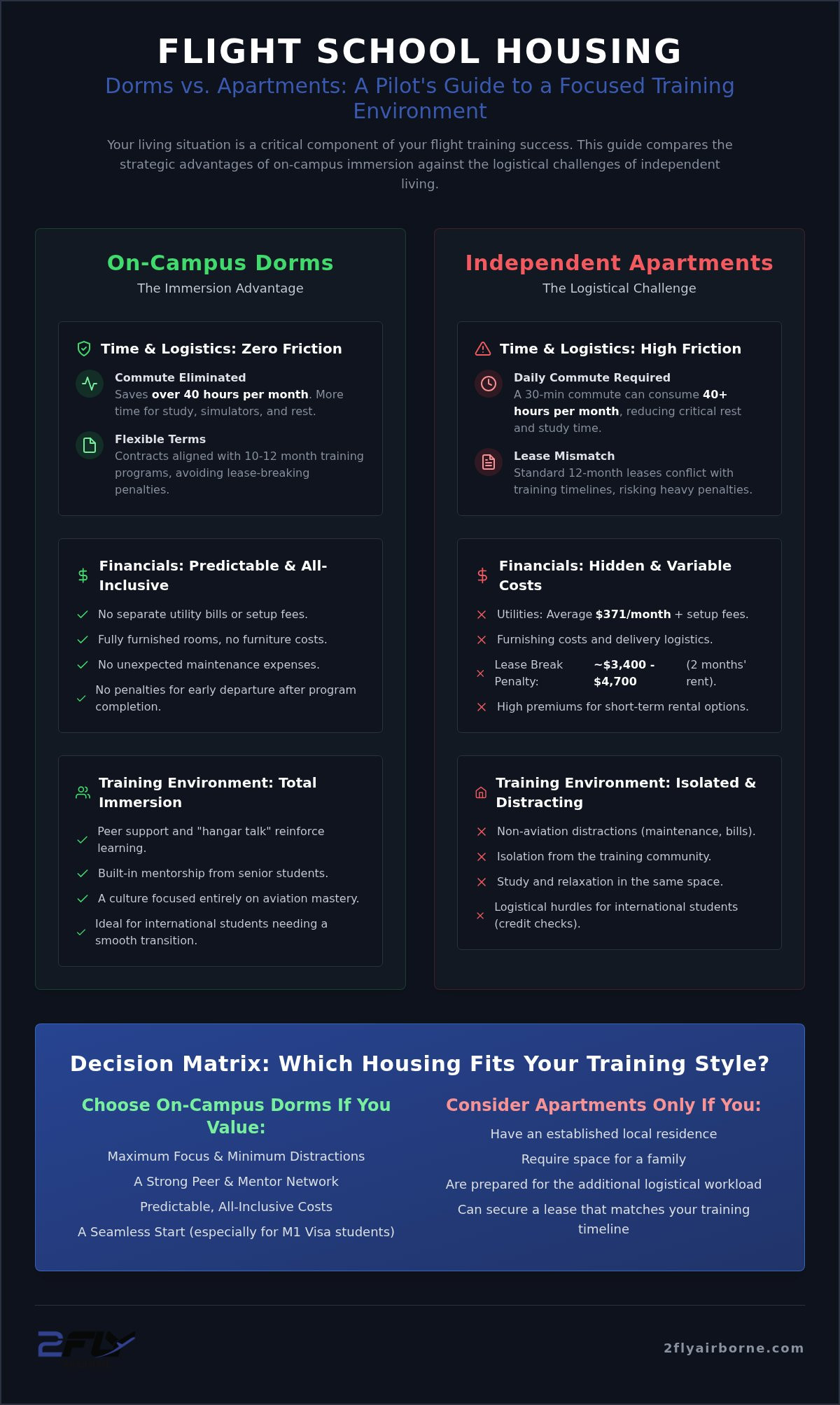
Breaking a Florida lease early often costs two months of rent. With average monthly rents ranging from $1,696 to $2,340 as of late 2026, these penalties represent a substantial financial drain on your training budget. Additionally, a 30-minute commute might seem manageable initially, but it quickly erodes your vital rest and recovery cycles during high-intensity training weeks.
Eliminating Non-Aviation Distractions
Managing utility bills, Wi-Fi setups, and furniture deliveries can easily derail your focus before your first solo flight. The concept of Student accommodation has evolved to meet these specific needs, offering all-inclusive solutions that remove the mental load of independent living.
Florida utility costs average approximately $371 per month. Coordinating these services adds layers of administrative stress you don’t need. Choosing a structured living environment mirrors the discipline required in airline operations. It allows you to treat your training like a professional job, ensuring you stay rested and free from the distractions that often plague students in traditional apartments.
On-Campus Dorms: The Case for Total Aviation Immersion
Does your living room feel like a flight deck? When you choose on-campus housing, your training environment extends far beyond the hangar. The choice between flight school dorms vs apartments often determines how quickly you can transition into a professional mindset. On-campus living creates a “study pod” effect where your daily life centers entirely around aviation mastery.
The 2025 Boeing Pilot and Technician Outlook projects a demand for 660,000 new pilots globally through 2044. To meet this objective, you need a training foundation that minimizes distractions and maximizes learning. Immersing yourself in a residential community of fellow aviators ensures you remain focused on the rigorous demands of the profession.
Built-In Support Systems and Peer Learning
A primary advantage of dorm life is the culture of “hangar talk.” These informal discussions with peers help solidify complex aerodynamic concepts or instrument procedures long after ground school ends. You aren’t just studying alone; you’re part of a cohort that pushes you toward excellence. Evaluating flight school dorms vs apartments requires you to consider the immense value of this shared experience.
Senior students often act as unofficial mentors, providing guidance through difficult ratings like the Instrument Rating (IR) or Multi-Engine Rating (ME). This built-in support system builds a professional network that will serve you throughout your entire career. You can speak with a training advisor to see how our residential community supports these goals.
Logistical Simplicity for the Professional Pilot
Transitioning into a professional program is demanding enough without the burden of setting up a new home. On-campus units are typically fully furnished, allowing you to focus on your flight manuals from Day 1. This simplicity directly impacts your overall flight school cost by eliminating utility deposits and furniture rentals.
Proximity to the flight line is a critical advantage for flight schools in Florida, where weather patterns change rapidly. Being on-site means you can maximize simulator time or jump into an open flight slot at a moment’s notice. It’s the gold standard for those training at an M1 visa approved flight school who treat their training as a full-time mission toward an international career.
Independent Apartments: Freedom vs. The Logistics of Flight Training
Is the promise of total privacy worth the logistical weight of a traditional lease? Many candidates initially favor an independent apartment to secure a “mental break” from the airfield environment. However, when comparing flight school dorms vs apartments, you must weigh that privacy against a heavy mountain of administrative requirements.
Navigating the US rental market is a complex undertaking for those without an established domestic history. Most landlords require high credit scores, thorough background checks, and security deposits often equaling two months of rent. If you’re only in the area for a 10-month program, finding a landlord willing to deviate from a standard 12-month contract is exceptionally difficult.
Hidden costs also quickly erode any perceived savings from off-campus living. Beyond the base rent, you’re responsible for internet, water, and electricity, which averages approximately $371 per month in Florida. There is also a “furniture tax” to consider; furnishing an empty apartment for a short stay is either expensive or logistically draining.
Perhaps the greatest risk is the potential for isolation. Being physically removed from the school environment means you miss the spontaneous study sessions and networking opportunities that occur in the dorms. This distance can lead to a slower training pace, as you lose the immediate support of your peers during high-pressure weeks.
The International Student Hurdle
For M-1 visa holders, the challenge of securing a private lease is even more pronounced. Most property management companies won’t approve an application without a US-based co-signer or a significant domestic credit history. This often forces international students into predatory short-term rental agreements with inflated monthly rates.
2FLY Airborne addresses this by providing company-managed residential options specifically for international aviators. This integrated approach serves as a critical logistical bridge, allowing you to bypass the hurdles of the US rental market entirely. It’s a zero-friction entry point that lets you focus on your flight hours from the moment you arrive.
The True Cost of ‘Cheap’ Off-Campus Housing
Selecting an apartment based solely on a lower monthly rent can be a false economy. You must calculate the cost of fuel, vehicle maintenance, and the significant amount of time lost in daily traffic. If a 45-minute commute prevents you from attending a morning weather briefing, your progress stalls.
Delays in training directly increase your total pilot training costs. Every month added to your timeline is a month of lost seniority and salary in the airline industry. When you account for lease-break fees and commuting hours, the “cheaper” apartment often becomes the more expensive choice.
Decision Matrix: Which Housing Fits Your Training Style?
How do you perform under pressure? Professional flight training is as much a mental game as a technical one. Your choice between flight school dorms vs apartments should align with your specific learning DNA and your long-term career velocity. We have developed this matrix to help you self-diagnose which environment will yield the highest return on your training investment.
The 2025 Boeing Pilot and Technician Outlook projects a demand for 660,000 new pilots globally through 2044. With such a significant industry need, your priority should be the fastest, most efficient timeline to the airlines. Analyze your financial liquidity and personality type before committing to a lease that might slow your progress.
When to Choose On-Campus Dorms
On-campus living is the definitive choice for students enrolled in an accelerated FAA Airline Pilot Program. This path is ideal if you are relocating from another region or arriving as an international student. You gain an immediate support network and a “zero-friction” entry into the US aviation environment.
Choose the dorms if you thrive in collaborative, high-discipline settings. Living among peers who share your professional ambitions keeps you accountable during difficult ground school phases. It’s the best option for those who want to compare the total cost of living, including utilities and furniture, against a single, predictable monthly fee. If you are ready to start your journey, apply for the Professional Pilot Program today to secure your residential placement.
When an Independent Apartment Might Work
An independent apartment is generally better suited for local residents who already have a support network in the area. If you are pursuing a non-accelerated, modular training path, you may have the luxury of a longer timeline. This allows you to manage the administrative burden of a traditional 12-month lease without it impacting your check-ride readiness.
Students with families or specific medical and lifestyle needs often require the flexibility of a private residence. If you have the financial liquidity for high security deposits and the time to manage household logistics, an apartment provides a clear boundary between the airfield and home. However, you must remain vigilant to ensure that off-campus distractions don’t lead to training delays or increased costs.
The 2FLY Residential Solution: A Gateway to Your Career
Relocating for professional training shouldn’t feel like a logistical battle. 2FLY Airborne bridges the gap between your ambition and the practical realities of flight training by offering an integrated residential solution. We understand that your focus belongs in the cockpit, not in a rental office. Our team manages the details so you can maintain a mission-first mindset from the moment you arrive.
Our company-managed housing is specifically designed for students in the FAA Professional Pilot Program. By removing the stress of lease negotiations and utility setups, we allow you to dedicate your energy to mastering flight manuals. Safe, structured training starts with a stable and supportive home environment. This stability mirrors the discipline you’ll eventually find in a professional airline operation.
Evaluating flight school dorms vs apartments often reveals that the “independent” route introduces unnecessary friction. We provide a zero-friction entry point that ensures you’re ready for ground school on day one. This residential foundation is where you’ll build your technical mastery and professional reputation alongside peers who share your drive.
The 2025 Boeing Pilot and Technician Outlook projects a demand for 660,000 new pilots globally through 2044. To meet this significant industry need, you must partner with an academy that understands the logistics of success. Our housing is more than just a place to stay; it’s a strategic asset that supports your journey toward an international aviation career.
A Seamless Transition for Global Aviators
International students face unique hurdles when moving to the United States for training. We provide integrated visa and housing support to ensure your arrival is as smooth as possible. This logistical bridge is essential for M-1 and F-1 visa holders who often struggle to secure leases without a domestic credit history.
We’re committed to maintaining a professional, airline-ready environment within our residences. Living among fellow trainees fosters a culture of excellence and shared accountability. This network is vital as you navigate the path to becoming a commercial pilot in a competitive global market. You aren’t just renting a room; you’re joining an elite institution.
Take the Next Step Toward the Flight Deck
Your journey toward the airlines requires a strategic approach to both training and lifestyle. We invite you to explore our comprehensive pilot training facilities and residential options firsthand. Our team is here to ensure that your environment supports your professional goals from the very beginning. We don’t just train pilots; we prepare industry-ready professionals.
Consult with a 2FLY Training Advisor to discuss your specific housing and training needs. We understand the logistics of success and are prepared to support your transition into the aviation industry. Start your journey with an academy that prioritizes your progress and your future as a professional aviator. Reach out today to see how our residential solutions can accelerate your career.
Securing Your Foundation for Professional Success
Your living environment serves as the launchpad for your aviation career. We’ve explored how the choice between flight school dorms vs apartments directly impacts your training velocity and mental focus. While apartments offer privacy, the zero-friction model of on-campus housing ensures you spend your time in the cockpit rather than managing leases.
To summarize, choosing an integrated residential solution provides:
- Total immersion with a peer-to-peer support network.
- Elimination of commuting stress and hidden utility costs.
- A seamless entry point for international students on M-1 visas.
Success in the skies begins with a stable foundation on the ground. We remain dedicated to providing the safe, structured training environment required to reach the highest levels of the profession. Our residential program is designed to mirror the discipline and standards of the global airline industry.
Reach out to a 2FLY Training Advisor with questions about our residential options or your path to the flight deck today.
Frequently Asked Questions
Are flight school dorms cheaper than renting a private apartment?
Dorms often provide superior value when you calculate the total cost of living. While a base rent for a Florida apartment might seem competitive, you must add approximately $371 per month for utilities plus the cost of furniture and renter’s insurance. When analyzing flight school dorms vs apartments, the school option typically offers a predictable, all-inclusive rate that avoids expensive short-term lease premiums and early termination fees.
Do I need to bring my own furniture to flight school dorms?
No, our residential solutions are fully furnished to ensure you can begin your training immediately upon arrival. Units include essential bedroom and living area furniture, allowing you to bypass the logistical burden and expense of moving household items. This simplicity is a core benefit of our company-managed housing, designed to let you focus entirely on your ground school and flight hours without the distraction of household setup.
Can international students on an M-1 visa rent apartments easily?
Securing a private lease on an M-1 visa is exceptionally difficult without a US credit history or a domestic co-signer. Most property managers require extensive documentation and high security deposits that international students cannot easily provide. Our integrated residential solution serves as a critical bridge for global aviators, offering a zero-friction entry point that bypasses the hurdles of the traditional rental market and standard US credit checks.
How much time does living on-campus actually save per day?
Living on-campus can save you over 40 hours per month in commute time. By eliminating daily traffic and the search for parking, you can repurpose this time for simulator sessions or morning weather briefings. This proximity to the flight line is essential for students in the FAA Professional Pilot Program who must maximize every available hour to stay on schedule and minimize their total training costs.
Are roommates mandatory in flight school housing?
Roommate arrangements vary depending on the specific housing package you select for your training. While shared accommodations foster a collaborative environment that can accelerate knowledge retention, private options are often available for those who prefer solo study time. We recommend discussing your specific lifestyle needs with a Training Advisor to find the residential configuration that best supports your individual learning style and your professional career goals.
What utilities are typically included in school-managed pilot housing?
School-managed housing typically includes all essential utilities in a single monthly fee for your convenience. This usually covers high-speed Wi-Fi, electricity, water, and trash removal services. In the private market, these services average approximately $371 per month in Florida and often require separate security deposits. Bundling these costs into your residential package simplifies your budgeting and prevents the administrative stress of managing multiple service providers.
Is it possible to switch from dorms to an apartment mid-training?
It is possible to transition between housing types, though it isn’t always recommended due to the potential for significant training disruption. Moving mid-program introduces logistical distractions that might derail your progress toward a critical check-ride. If you choose to move from dorms to a private apartment, you’ll need to manage the complexities of a new lease and utility connections while maintaining your rigorous flight training schedule.
How far in advance should I book my flight school housing?
You should ideally book your residential placement as soon as you are accepted into your training program. Housing demand is consistently high, especially for students arriving from international locations who require visa processing support. Securing your accommodation early ensures a seamless transition and guarantees that you have a stable, supportive home environment ready for your arrival. This preparation allows you to start your journey toward the airlines with confidence.

Article by
2FLY Airborne
2Fly Airborne is a professional flight training organization dedicated to developing the next generation of skilled, confident, and safety-focused pilots. With decades of combined aviation experience, our team of certified instructors provides structured, real-world training designed to prepare students for both checkrides and long-term success in the aviation industry.
Content Disclaimer
Some blog content is generated with the assistance of automated tools and may not always be fully accurate or up to date. Please verify all aviation-related information with official sources or a certified instructor. For additional guidance or clarification, we encourage you to contact one of our training advisors at 2Fly Airborne.