What if the only thing standing between you and a six-figure career in the flight deck is a precise set of checkboxes you haven’t yet decoded? Mastering the commercial pilot license requirements is the first major step in transitioning from a recreational flyer to a professional aviator. It’s an exhilarating leap, but the regulatory path often feels like navigating through a thick fog of legal jargon and complex FAA standards.
You’ve likely felt the frustration of trying to piece together conflicting information about medical classes, PIC time, and total flight hour totals. This guide cuts through the complexity to provide a definitive 2026 roadmap for your professional evolution. You’ll gain the clarity needed to move from zero experience to a commercial cockpit with total confidence in your eligibility.
We’ll break down the specific FAA eligibility criteria, essential medical standards, and the flight hour milestones required to launch your international aviation career. From age limits to the nuances of Part 61 versus Part 141 training structures, this checklist ensures you stay on the fastest path to your goals. Prepare to transform your passion for flight into a disciplined, high-achieving career.
Key Takeaways
- Understand the fundamental FAA eligibility standards, including the minimum age of 18 and the English proficiency required for global aviation communication.
- Identify the specific commercial pilot license requirements for flight hours and experience, ensuring you meet the 250-hour milestone for professional certification.
- Learn how to select the appropriate FAA medical certificate class to match your specific career ambitions and ensure long-term professional eligibility.
- Compare the efficiencies of Part 61 and Part 141 training structures to determine the most effective path for your personal timeline and learning style.
- Discover how integrating an Instrument Rating and a professional pilot program can accelerate your transition from a trainee to a career-ready aviator.
The Foundation of Flight: Basic FAA Eligibility and Entry Requirements
Every professional journey begins with a single step, but in aviation, that step is defined by rigorous regulatory standards. Meeting the baseline commercial pilot license requirements isn’t just about paperwork; it’s about proving you possess the maturity and communication skills necessary for a high-stakes environment. These prerequisites ensure that every candidate entering the system meets the high bar set for pilot certification in the United States.
To gain a visual overview of the experience needed for this journey, watch this helpful breakdown:
Initial Eligibility for Aspiring Aviators
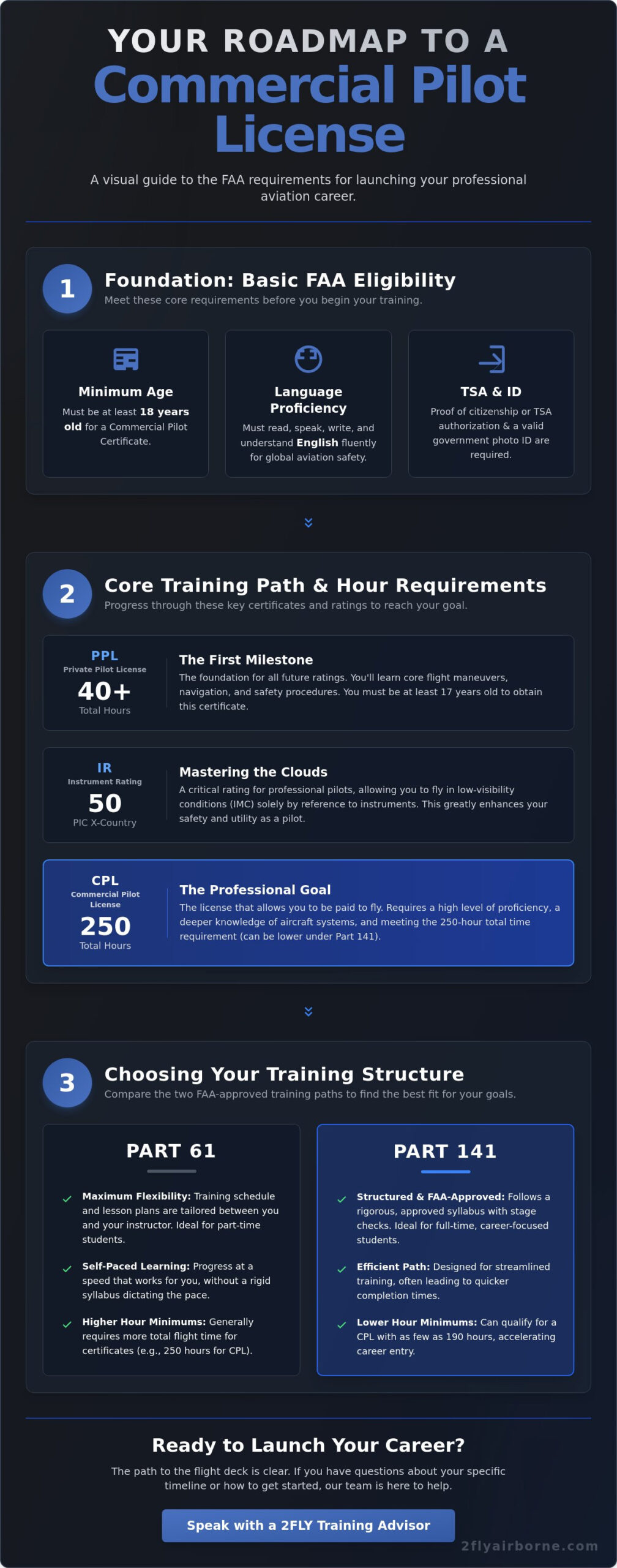
The FAA establishes clear age milestones that dictate when you can reach specific career peaks. While you can begin flight training at almost any age, you must be at least 17 years old to earn a Private Pilot Certificate. To hold the Commercial Pilot Certificate required for professional employment, you must be at least 18 years old. Planning your training timeline around these dates is essential for maintaining momentum in your career.
Communication is the lifeblood of aviation safety. You’re required to read, speak, write, and understand the English language fluently. This is the global standard for aviation, ensuring that instructions from Air Traffic Control are never misinterpreted. You’ll also need to provide proof of citizenship or TSA authorization, along with a valid government photo ID, before your first lesson at a pilot school.
Securing Your Student Pilot Certificate
Think of the Student Pilot Certificate as your official learner’s permit for the sky. It’s a critical prerequisite because you cannot legally fly solo without it. Obtaining this certificate is one of the first tasks you’ll tackle with your instructor. It signals to the FAA that you’ve officially entered the training pipeline and are ready to begin logging PIC (Pilot-in-Command) time during your solo flights.
The application process is handled through the Integrated Airman Certification and Rating Application (IACRA) system. This digital portal is where you’ll track every rating and certificate you earn throughout your professional life. To complete your application, you’ll need to follow these steps:
- Register an account as an ‘Applicant’ on the official IACRA website.
- Complete the electronic Form 8710-1 for a student pilot certificate.
- Meet with a Certified Flight Instructor (CFI) who will verify your identity and process the application.
The FAA will process your digital file and mail a hard-copy plastic certificate to your address. This process confirms your eligibility and sets the stage for your transition from a student to a career-ready professional. It’s a simple but vital administrative hurdle that marks the beginning of your official flight record.
Mastering the Basics: Private Pilot Certificate (PPL) Requirements
Think back to the first time you sat in a cockpit and looked at the horizon. That initial spark of excitement is what carries you through the rigorous training required to become a professional. The Private Pilot Certificate (PPL) is the essential first milestone for every aspiring aviator. It’s more than just a license; it’s the foundation upon which all commercial pilot license requirements are built.
While the PPL allows you to fly for personal enjoyment, its primary purpose in a professional track is to instill the core habits of a safe pilot. You’ll move from basic aircraft control to complex decision-making and navigation. This phase of training transforms a student into a pilot who can operate independently in the National Airspace System. Mastering these basics ensures you’re prepared for the high-intensity training that follows.
Aeronautical Knowledge and Ground School
Ground school is where you develop the theoretical expertise required for safe flight. You’ll dive deep into subjects like aerodynamics, weather patterns, and FAA regulations. This knowledge is eventually validated through the FAA Private Pilot Knowledge Test, commonly known as the “written.” Understanding how to interpret a METAR (aviation weather report) or plot a course using a sectional chart is critical. These skills build the mental framework needed to handle the responsibilities of a professional cockpit.
Flight Proficiency and Logged Milestones
The FAA mandates a minimum of 40 hours of flight time for the PPL, though most students require more to reach full proficiency. This time is carefully structured to expose you to various flying conditions and scenarios. You’ll spend at least 20 hours receiving flight instruction from a certified professional. These dual lessons focus on maneuvers, takeoffs, landings, and emergency procedures until they become second nature.
Solo flight time is perhaps the most significant part of this journey. You must log at least 10 hours of solo flight, proving you can manage the aircraft without an instructor’s assistance. Within these hours, you’ll complete specific milestones required by 14 CFR Part 61 Subpart F, including:
- Five hours of solo cross-country flight, which involves flying to airports more than 50 nautical miles away.
- Three hours of night flight training, including 10 takeoffs and landings to a full stop.
- Three hours of flight training solely by reference to instruments, preparing you for the transition to professional instrumentation.
Success at this stage is about consistency and discipline. If you’re ready to turn this foundation into a career, enrolling in a structured FAA Professional Pilot Program can help you stay on track. This structured approach ensures that every hour you log contributes directly to your ultimate goal of flying for a major carrier.
Navigating the Professional Path: Commercial Pilot and Instrument Ratings
Imagine flying into a thick layer of clouds and losing sight of the horizon. For a private pilot, this is a high-stress emergency; for a professional, it’s a routine part of the job. The transition from visual flight to instrument proficiency is what separates hobbyists from career aviators. This stage of your training is where you shift your focus from basic aircraft control to the precision required for commercial operations.
The journey from a private certificate to professional certification is a building-block process. You aren’t just adding hours to a logbook; you’re evolving your decision-making and technical skills. Every rating you earn acts as a bridge, moving you closer to the moment you can legally accept payment for your expertise in the cockpit.
The Instrument Rating: Flying in Any Weather
The Instrument Rating (IR) is arguably the most critical safety upgrade in a pilot’s career. It grants you the authority to fly under Instrument Flight Rules (IFR), meaning you can navigate solely by referencing your flight instruments. This capability is essential because professional schedules don’t stop for low clouds or reduced visibility. You’ll learn to trust your dials over your physical sensations, a skill that requires intense discipline and practice.
To qualify for this rating, the FAA requires a minimum of 40 hours of actual or simulated instrument time. You’ll master complex navigation procedures, holding patterns, and precision approaches to airports. This training expands your operational capabilities, allowing you to fly in the same sophisticated airspace used by major airliners. It’s the technical foundation that prepares you for the advanced maneuvers of the commercial certificate.
Commercial Privileges and Professional Standards
Reaching the 250-hour milestone is the defining moment of your early career. This is where you finally meet the core FAA commercial pilot license requirements. While your previous training focused on safety, the commercial certificate focuses on mastery and professional standards. You’ll be expected to perform advanced maneuvers with a much smaller margin for error than during your private pilot training.
The most significant change at this level is the legal privilege to fly for compensation or hire. Earning your Commercial Pilot Certificate is the gateway to your first paycheck as an aviator. Whether you plan to fly cargo, conduct aerial tours, or teach others as an instructor, this certificate is the mandatory prerequisite. Most pilots also add a Multi-Engine Rating at this stage to prepare for the complexities of larger, faster aircraft.
As you build these professional skills, keep the long-term objective in view. The 2025 Boeing Pilot and Technician Outlook projects a demand for 660,000 new pilots globally through 2044. This massive demand makes meeting your commercial pilot license requirements a strategic move for your future. Each hour logged is an investment in a career that offers both international mobility and exceptional professional rewards.
Regulatory Hurdles: FAA Medical Certification and Knowledge Tests
How do you know if you’re physically and mentally prepared for the high-pressure environment of a professional cockpit? Clearing the commercial pilot license requirements involves more than just mastering flight maneuvers; it requires passing rigorous medical and theoretical evaluations. These standards act as a filter, ensuring only the most capable and healthy individuals hold the responsibility of commercial flight.
FAA Medical Certification Classes
Your medical certificate is your “fit to fly” passport. You’ll need to visit an Aviation Medical Examiner (AME) to undergo a physical exam that covers vision, hearing, and general health. While the FAA doesn’t set the fees for these exams, you can expect to pay between $100 and $200 depending on the examiner. It’s best to secure the highest class of medical you’ll eventually need early in your training to confirm your long-term eligibility.
- First-Class: This is the stringent standard required for airline transport pilots. It requires the most frequent renewals and the highest level of physical health.
- Second-Class: You must hold at least a second-class certificate to exercise commercial pilot privileges. This is the baseline for non-airline professional work like aerial photography or charter flights; for example, you can check out UK Skydiving to see how specialized air-to-air filming is managed professionally.
- Third-Class: This serves as the entry-level certificate for student and private pilots. While sufficient for training, it won’t allow you to fly for compensation.
Acing the FAA Knowledge and Practical Tests
The path to professional certification includes a three-pronged testing approach. First, you must pass the FAA Knowledge Test, a computer-based exam that costs approximately $175 per attempt. High scores here demonstrate your mastery of the complex regulations and technical data you’ll use daily. Once the written exam is behind you, you’ll face the “Checkride,” which consists of an oral exam and a practical flight test.
During the oral exam, a Designated Pilot Examiner (DPE) will quiz you on aviation law, weather theory, and emergency procedures. You must demonstrate a deep understanding of safety standards rather than just reciting facts. The practical test follows immediately, where you’ll prove your flight skills under the watchful eye of the DPE. This is your chance to show you can operate an aircraft within the strict tolerances required for a commercial certificate.
Maintaining your license requires a commitment to both currency and proficiency. Currency is the legal minimum required to stay active, while proficiency is the actual skill level that keeps you safe. If you’re ready to start this rigorous process, contact a training advisor to learn more about our FAA Professional Pilot Program. This structured path ensures you’re prepared for every regulatory hurdle you’ll encounter on your way to a professional career.
Accelerating Your Career: Choosing the Right FAA Training Structure
Imagine standing at a crossroads where one path is a winding trail and the other is a high-speed expressway. In flight training, your choice between Part 61 and Part 141 regulations determines how quickly you transition from the classroom to the cockpit. While both paths lead to the same destination, the structure you choose can significantly impact your timeline and professional readiness.
Selecting the right training environment is a strategic decision that goes beyond simple logistics. It’s about finding a system that mirrors the disciplined environment of a professional airline. By aligning your education with industry standards from day one, you ensure that meeting the commercial pilot license requirements is just the beginning of a seamless career progression.
Why Structure Matters for Professional Success
Part 141 flight schools operate under a highly structured, FAA-approved syllabus that allows for greater training efficiency. One of the most significant advantages is the potential for reduced flight hour requirements. Under a Part 141 program, you can often qualify for your commercial certificate with as few as 190 total flight hours, compared to the 250 hours required under the more flexible Part 61 structure.
Beyond the hours, a dedicated academy environment provides an immersive experience that individual modular training cannot match. You’ll be surrounded by high-achievers and expert mentors who understand the demands of international aviation. This professional atmosphere prepares you for the rigorous standard operating procedures (SOPs) you’ll encounter at the airline level. Enrolling in an integrated FAA Professional Pilot Program is often the fastest way to bridge the gap between a trainee and an industry-prepared professional.
The Global Outlook for New Pilots
The aviation industry is currently entering a period of unprecedented growth and opportunity. The 2025 Boeing Pilot and Technician Outlook projects a demand for 660,000 new pilots globally through 2044. This massive requirement means that pilots who complete their training now are entering a market with strong demand and rising salary potential. Meeting your commercial pilot license requirements today positions you at the forefront of this global expansion.
Investing in your future requires careful planning, which is why exploring various financing options is a critical step for many aspiring aviators. Securing the necessary resources allows you to focus entirely on your technical mastery and vocational preparedness. This focus is what ultimately transforms a passion for flight into a stable, world-class career.
Your journey from zero experience to a professional cockpit requires a clear, sequential roadmap tailored to your specific goals. Safe, structured training is the only reliable way to ensure you meet the rigorous standards of today’s aviation industry. To take the first step toward your international career, reach out to a 2FLY Airborne Training Advisor who can help map your personal timeline and answer any remaining questions about the certification process.
Launch Your Professional Aviation Career
Mastering the commercial pilot license requirements is more than a regulatory hurdle; it’s the foundation of your professional identity. You now have a clear roadmap covering everything from basic FAA eligibility and medical standards to the critical flight hour milestones. Choosing a structured training environment ensures you aren’t just logging time, but building the technical mastery required for a global career in the flight deck.
Since 1994, we’ve provided comprehensive, career-focused programs backed by both FAA and EASA accreditation. This dual-standard approach prepares you for the highest levels of international professional mobility. It’s about transforming your passion into a disciplined, high-achieving profession with a proven track record of success. Every hour you spend in the cockpit should be a deliberate step toward your ultimate goal.
Ready to start your journey? Speak with a 2FLY Training Advisor today to map out your personal path to the cockpit. If you have any remaining questions, don’t hesitate to reach out to a 2FLY Training Advisor. The sky is waiting for those with the drive to reach it.
Frequently Asked Questions
How many hours are required for a private pilot license?
The FAA requires a minimum of 40 flight hours to earn a Private Pilot Certificate. This total must include at least 20 hours of flight training with an instructor and 10 hours of solo flight time. While 40 is the legal minimum, most students reach proficiency between 60 and 75 hours. This initial stage builds the core skills necessary to eventually meet more advanced commercial pilot license requirements.
Can I become a pilot if I wear glasses or contacts?
You can absolutely become a pilot while wearing glasses or contact lenses. The FAA requires that your vision be corrected to 20/20 in each eye for a first-class or second-class medical certificate. If you require corrective lenses to meet this standard, your medical certificate will simply state that you must wear them while exercising your pilot privileges. This is a very common scenario among professional aviators.
What is the difference between a Part 61 and a Part 141 flight school?
The primary difference lies in the level of FAA oversight and the flexibility of the training syllabus. Part 141 schools use a rigid, FAA-approved curriculum that often allows students to qualify for a commercial certificate in fewer hours. Part 61 training is more flexible and can be tailored to an individual student’s schedule. Choosing the right structure is vital for meeting commercial pilot license requirements efficiently and professionally.
How much does it cost to meet all FAA pilot requirements?
Total training costs depend on the type of aircraft used and the frequency of your flight lessons. While specific tuition varies between schools, you should account for fixed regulatory fees like the $175 FAA knowledge test and the medical exam, which typically costs between $100 and $200. Investing in a structured program often provides better long-term value by streamlining your progression toward a professional salary.
Do I need a college degree to become a commercial pilot?
A college degree is not a requirement to earn your FAA pilot certificates. While some major legacy airlines traditionally preferred candidates with a four-year degree, many regional airlines and cargo operators focus primarily on your flight experience and technical proficiency. You can launch a successful professional career with high-quality flight training and the necessary FAA certifications alone.
What is an FAA Checkride and how do I prepare for it?
An FAA Checkride is the final practical examination conducted by a Designated Pilot Examiner (DPE) to verify your flight proficiency. It consists of an oral exam to test your theoretical knowledge and a flight test to evaluate your technical skills. Preparation involves conducting mock checkrides with your instructor to ensure you can perform every maneuver within the strict tolerances defined by the FAA.
How long does it take to go from zero experience to a Commercial Pilot Certificate?
Transitioning from zero experience to a Commercial Pilot Certificate typically takes between six and twelve months in a full-time, accelerated program. Your specific timeline depends on your training frequency, local weather conditions, and personal dedication to ground school study. Students who commit to a structured daily schedule often see the fastest results and enter the workforce sooner.
What happens if I fail an FAA medical exam?
Failing a medical exam does not always mean your flying career is over. If an Aviation Medical Examiner (AME) cannot issue a certificate immediately, they may defer your application to the FAA for a more detailed review. Many pilots obtain a Special Issuance medical certificate after providing additional documentation or undergoing further testing. This process allows the FAA to clear you for flight while monitoring specific health conditions.
Article by
2FLY Airborne
2Fly Airborne is a professional flight training organization dedicated to developing the next generation of skilled, confident, and safety-focused pilots. With decades of combined aviation experience, our team of certified instructors provides structured, real-world training designed to prepare students for both checkrides and long-term success in the aviation industry.
Content Disclaimer
Some blog content is generated with the assistance of automated tools and may not always be fully accurate or up to date. Please verify all aviation-related information with official sources or a certified instructor. For additional guidance or clarification, we encourage you to contact one of our training advisors at 2Fly Airborne.