Securing your f1 visa for flight school is not just a paperwork hurdle; it’s the first professional checkride of your international pilot career. With the 2025 Boeing Pilot and Technician Outlook projecting a global demand for 660,000 new pilots through 2044, the stakes for entering the U.S. training system have never been higher. You’ve likely spent hours researching the nuances of student status, only to feel overwhelmed by conflicting advice regarding the U.S. Embassy interview and strict financial requirements. It’s a high-stakes environment where a single administrative oversight can ground your ambitions before you even reach the tarmac.
We understand that the path to a commercial cockpit feels complex, but it shouldn’t be a source of anxiety. This guide provides a definitive roadmap to master the 2026 regulatory landscape with the precision of an industry leader. You’ll gain a clear understanding of how to obtain your I-20 form with confidence and prove your solvency to consular officers. We also explore how your specific visa choice dictates your ability to build flight hours and transition into a professional airline role, ensuring your training serves as a direct pipeline to international employment.
Key Takeaways
- Distinguish between the vocational M-1 and academic F-1 paths to align your training with your long-term airline career goals.
- Plan for a realistic 3 to 6 month administrative timeline and ensure you meet the mandatory 22 clock hour weekly requirement for full-time status.
- Learn how the f1 visa for flight school provides a strategic advantage for building professional flight hours through post-graduation work opportunities.
- Successfully manage the TSA security vetting process and assemble the financial evidence required to prove solvency during your training.
- Select a SEVP-certified academy that offers integrated support services, including on-campus housing, to streamline your international transition.
Understanding F-1 and M-1 Visa Sponsorship for Flight Schools
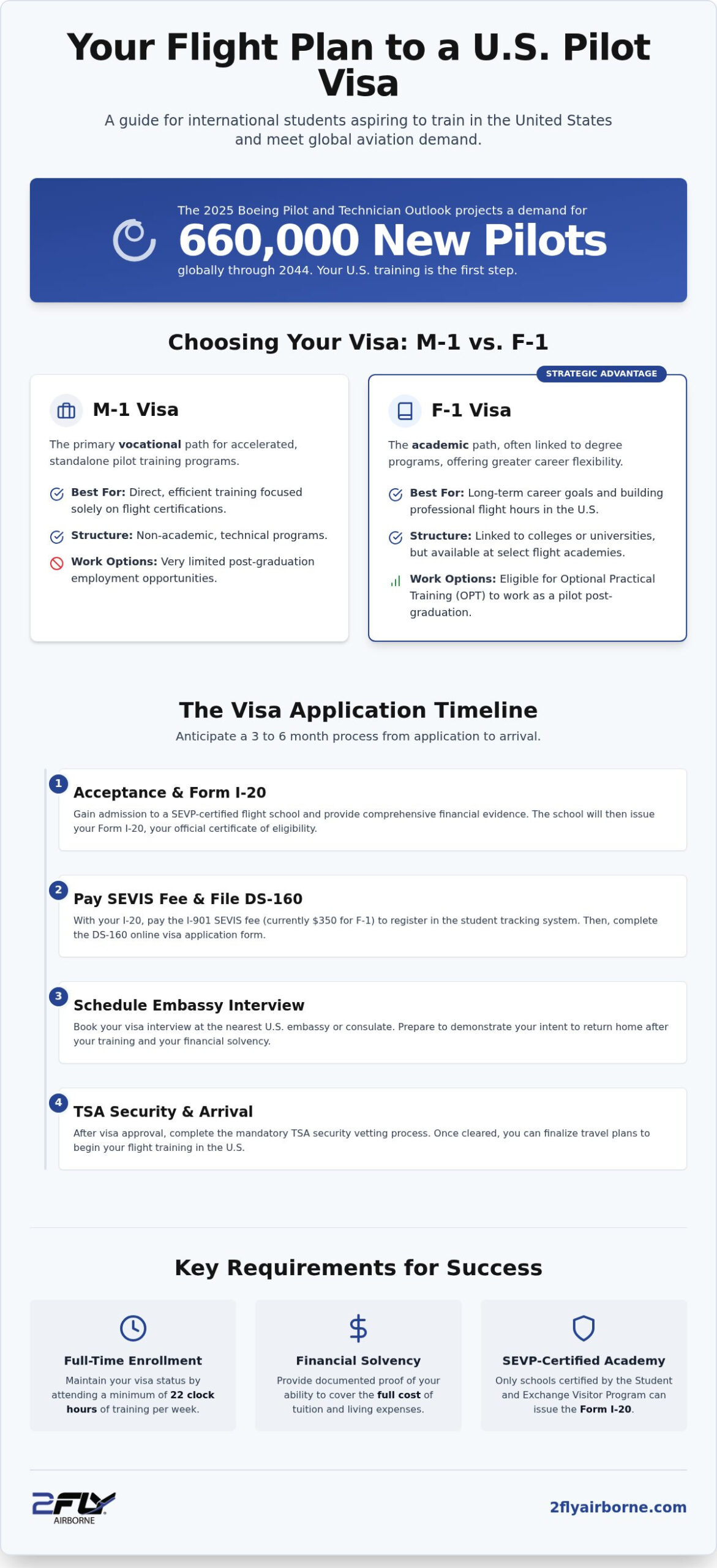
Visa sponsorship is a mandatory legal commitment made by a SEVP-certified flight academy to the U.S. Department of Homeland Security. It serves as the foundation of your international training. When you apply for an f1 visa for flight school, the academy acts as your professional sponsor, vouching for your intent and financial capability. This process is the gateway to a massive global opportunity. The 2025 Boeing Pilot and Technician Outlook projects a demand for 660,000 new pilots globally through 2044. Securing sponsorship is your first step toward meeting that demand.
Choosing between the M-1 and F-1 depends on your specific career timeline. The M-1 is the primary vocational visa for those in accelerated pilot training programs. It’s direct and efficient. The F-1 path is often linked to academic degrees at colleges or universities. While an F-1 visa overview shows it’s widely used for general studies, in aviation, it provides unique work opportunities like Optional Practical Training (OPT). Understanding these distinctions ensures you don’t choose a path that limits your future employment options.
To better understand this concept, watch this helpful video:
The Role of a SEVP-Certified Academy
Only institutions with SEVP certification can issue the Form I-20, the document required to pay your SEVIS fee and schedule an embassy interview. The academy handles the administrative heavy lifting, monitoring your attendance and progress to protect your legal status. If you’re mapping your trajectory, our guide on How to Become a Pilot breaks down the entire certification process from start to finish.
Why Sponsorship is Your Gateway to FAA Standards
FAA certifications are the gold standard for airline careers. Sponsored training in the U.S. provides access to the world’s most sophisticated aviation infrastructure and a 24/7 professional environment. This level of focus is essential for mastering the complex regulations and technical skills required by modern carriers. You’ll graduate as an industry-prepared professional ready for a global stage. The discipline you learn during your f1 visa for flight school application mirrors the precision required in the cockpit.
The Step-by-Step Timeline for Securing Your Student Visa
Success in the cockpit starts with a disciplined approach to your administrative timeline. For 2026, international candidates should anticipate a preparation period of 3 to 6 months before arriving on campus. This window accounts for rigorous vetting processes and the high demand for training slots. Professional guidance from an educational consultancy like AusPak International can be invaluable when navigating these complex international requirements. You must also understand that maintaining your status requires full-time enrollment. This is strictly defined as a minimum of 22 clock hours per week. Completing these administrative steps is a prerequisite; you cannot engage in flight training activities until your legal status is fully secured.
Phase 1: Acceptance and the Form I-20
The first milestone is gaining admission to an elite training environment. Start by submitting your application to 2FLY Airborne to receive an official acceptance letter. Once accepted, you’ll need to provide comprehensive financial evidence. This dossier must prove your ability to cover both program tuition and international living expenses. Upon verification, the academy issues your physical Form I-20 via secure international courier. This document is your official certificate of eligibility. It’s only available through academies that maintain SEVP Certification for Flight Schools, ensuring they meet the highest federal standards for international student management.
Phase 2: SEVIS Fees and the DS-160
Once your I-20 is in hand, you must pay the I-901 SEVIS fee. For an f1 visa for flight school, this fee is currently $350. This payment registers you in the Student and Exchange Visitor Information System, which is a critical prerequisite for your interview. Next, you’ll complete the DS-160, which is the primary online application form for U.S. non-immigrant visas. With these steps finished, you can schedule your interview at the nearest U.S. Embassy or Consulate. Preparing for this stage with the same precision you’d use for a flight plan is essential to your success.
As you move through these phases, it’s wise to finalize your housing arrangements. Securing on-campus housing alongside your visa approval ensures a seamless transition into the flight environment. If you’re ready to begin this journey, exploring our FAA Airline Pilot Program is the best way to understand the full scope of your future training. Navigating the requirements for an f1 visa for flight school is simpler when you have an expert mentor handling the administrative heavy lifting.
Comparing M-1 vs. F-1 Visas for Professional Pilot Training
Selecting the right visa is a strategic decision that defines your training intensity and post-graduation options. It’s more than just a legal requirement; it’s a choice between a vocational sprint and an academic marathon. While both pathways lead to FAA certification, the regulatory frameworks governing your stay in the United States differ significantly. Understanding these nuances helps you avoid common pitfalls, such as the restrictive M-1 transfer rules that prevent students from switching academies after their first six months of training.
The primary distinction lies in the legal designation of the program. The M-1 is strictly vocational, tailored for accelerated, technical instruction. Conversely, an f1 visa for flight school is typically reserved for academic programs that integrate flight training into a broader educational curriculum. This distinction dictates how long you can remain in the country after your final checkride to gain professional experience through Practical Training.
The M-1 Path: Accelerated Career Training
The M-1 visa is the preferred route for high-achievers who want to earn their ratings and return to their home countries for airline employment as quickly as possible. This pathway is perfectly aligned with the FAA Professional Pilot Program, which moves students through PPL, IR, and CPL ratings in a structured, full-time block. It’s an efficient, immersive experience designed for those who value technical mastery and a fast track to the cockpit. Practical training for M-1 students is generally limited to one month for every four months of study, providing a brief but valuable window to polish skills before heading home to join a commercial carrier.
The F-1 Path: Academic and Work Opportunities
For students who envision a longer stay in the U.S. aviation system, the degree program under an f1 visa for flight school offers distinct advantages. The F-1 status allows for up to 12 months of Optional Practical Training (OPT). Many pilots utilize this time to work as a Certified Flight Instructor (CFI), building the critical flight hours required by international airlines while earning a professional income in the field. Because the F-1 path involves a more complex application process and a longer time commitment, we recommend consulting a Training Advisor to ensure your academic background and career goals align with this specific visa type.
Financial Requirements and TSA Security Clearance for International Pilots
Mastering the f1 visa for flight school requires more than just academic acceptance; it demands a clear demonstration of financial stability and security compliance. Consular officers and TSA officials act as the final gatekeepers to your training. You must approach this vetting with the same meticulous attention to detail you’d apply to a pre-flight inspection. Failure to present a cohesive financial plan or delaying your security registration can lead to significant delays in your professional timeline. It’s a test of your discipline and preparedness before you ever touch the flight controls.
Beyond the academy’s tuition, your budget must account for international living expenses, housing, and comprehensive insurance. Accurate financial planning is essential for a stress-free experience. For a detailed breakdown of these anticipated expenses, consult our 2026 guide on flight school costs. Starting the TSA registration process before you depart for the United States is critical to ensuring you can begin training immediately upon arrival. This proactive approach demonstrates the vocational preparedness that airlines value in their future captains.
Proving Your Financial Solvency
Your financial dossier must be undeniable. Consular officers look for evidence of stable, accessible funds that guarantee you won’t seek unauthorized employment. Valid proof includes original bank statements from the last three to six months, notarized affidavits of support from sponsors, or official financing letters. You must show liquid funds covering the first full year of training and living expenses. When you present these documents at the embassy, organize them logically in a professional binder. Confidence during the interview stems from knowing your documentation is complete and transparent. It shows you’re a high-achiever who understands the long-term rewards of this profession.
Navigating the TSA Background Check
The TSA Alien Flight Student Program (AFSP) is the essential security layer that ensures the safety of the U.S. National Airspace System. It’s a rigorous vetting process that every non-U.S. citizen must undergo. A common misconception is that this is a one-time clearance. In reality, you require separate TSA clearances for Private Pilot, Instrument Rating, and Multi-Engine training stages. The process involves an online application, a fee ranging from $130 to $140, and a fingerprinting session that occurs once you arrive in the United States. Completing the initial registration early allows the TSA to begin its threat assessment while you’re still in your home country, preventing delays in your f1 visa for flight school timeline.
Securing your financial and security clearances is the final step in launching your international career. If you’re ready to take command of your future, apply for the FAA Professional Pilot Program today and let our expert mentors guide you through every administrative requirement.
Launching Your Career at an Authorized FAA Flight Academy
Transitioning from a candidate to a professional officer requires a training environment that mirrors the standards of global airlines. Choosing an academy with an established international recruitment network simplifies the logistical complexities of moving across borders. On-campus housing is more than a convenience; it creates a 24/7 immersive aviation environment where your focus remains entirely on technical mastery. You’re surrounded by peers and mentors who share your ambition, fueling a culture of excellence that is difficult to replicate in a commuter flight school setting. This immersion is the definitive gateway to an international career.
We act as your expert mentor throughout this entire journey. Managing SEVIS registration and ongoing visa compliance is a rigorous demand, but our dedicated support network handles the administrative heavy lifting. This allows you to focus on the syllabus without the weight of regulatory anxiety. If you’re ready to explore these opportunities in person or virtually, we encourage you to take the first step by attending an informational event to see how our global network supports your goals.
The 2FLY Advantage for International Aviators
Our fixed-price FAA Professional Pilot Program is a strategic asset for your f1 visa for flight school application. It provides the concrete financial figures required for your solvency dossier, eliminating the ambiguity that often leads to interview delays. This model ensures financial certainty for both you and the consular officer. Beyond the initial paperwork, our administrative support team assists with ongoing visa maintenance, ensuring your status remains secure as you transition from a sponsored student to an industry-prepared professional. We don’t just provide training; we provide a direct pipeline to employment through a world-class development setting.
Next Steps: Your Interview and Arrival
Your embassy interview is the final hurdle before your journey begins. Approach it with honesty, clarity, and a firm demonstration of your non-immigrant intent. Consular officers value candidates who can clearly articulate their plan to return home and contribute to their local aviation industry after completing their FAA certifications. Remember that safe, structured training is the foundation of your global mobility. Once you arrive, our team is ready to integrate you into our professional environment immediately. Don’t let administrative confusion ground your dreams. Contact a 2FLY Training Advisor today to begin your M-1 or f1 visa for flight school sponsorship process and secure your place in the cockpit.
Take Command of Your International Pilot Career
Navigating the requirements for an f1 visa for flight school is the first professional milestone in your journey toward a commercial cockpit. By selecting the strategic visa path that aligns with your specific career goals and preparing your financial dossier with meticulous precision, you eliminate the uncertainty that often grounds international ambitions. Success in the U.S. training system requires a disciplined approach to both the flight deck and the consulate. It’s a high-stakes process, but it’s also the definitive gateway to the global aviation industry.
As an authorized SEVP-certified institution, we serve as your expert mentor, providing the administrative expertise and global support network required to manage your transition seamlessly. Our comprehensive on-campus housing ensures you remain fully immersed in a professional aviation environment, surrounded by the resources needed for technical mastery. This structured foundation is what transforms a trainee into an industry-prepared professional ready for global mobility. You don’t have to navigate these complex regulations alone when you have an elite institution supporting your progress.
Speak with a 2FLY Training Advisor about M-1 Visa Sponsorship
Your professional aviation career starts with a single, disciplined step. Take it today and begin your ascent.
Frequently Asked Questions
How long does it take to get an M-1 visa for flight school?
It typically takes 3 to 6 months to complete the entire process from your initial application to visa issuance. This timeline accounts for receiving your I-20, paying the SEVIS fee, and securing an appointment at a U.S. Embassy. Delays can occur during peak seasons at specific consulates. We recommend starting your application at least half a year before your intended start date to ensure a seamless transition into the cockpit.
Can I work in the U.S. while training on an M-1 visa?
You cannot engage in off-campus employment while actively training on an M-1 visa. This status is strictly for vocational study. However, you may be eligible for Practical Training (PT) after you complete your ratings. This allows for one month of authorized work for every four months of study. Many students use this period to gain professional experience before returning home for airline employment.
What is the minimum bank balance required for flight school visa sponsorship?
You must demonstrate a bank balance that covers the total cost of your first year of tuition plus all living expenses. This includes housing, insurance, and personal costs. While the specific figure varies based on your chosen program, your financial proof must be liquid and accessible. Consular officers require this evidence to ensure you won’t seek unauthorized work while pursuing an f1 visa for flight school or an M-1 vocational path.
Do I need a TOEFL or IELTS score for flight school in the U.S.?
The FAA requires all pilots to be proficient in the English language, but specific test scores like TOEFL or IELTS depend on the academy’s admissions policy. We evaluate your ability to read, write, and speak English as part of the enrollment process. Clear communication is a critical safety standard in the U.S. National Airspace System. If your proficiency meets FAA standards, you can move forward with sponsorship.
Can my spouse or children join me on an M-1 visa?
Your legal spouse and unmarried children under age 21 can join you under M-2 dependent status. You must provide additional financial evidence to prove you can support them during your training. While dependents can reside with you, they aren’t authorized to work in the United States. Finalizing housing arrangements that accommodate your family is essential before you arrive for your FAA Professional Pilot Program.
What happens if my student visa application is denied?
If your application is denied, you can typically reapply after addressing the specific reasons provided by the consular officer. Common reasons for denial include insufficient financial proof or a failure to demonstrate strong ties to your home country. Our administrative support network helps you review your documentation to ensure your next attempt is stronger. Persistence is a trait found in every successful international aviator.
Can I transfer from an M-1 to an F-1 visa after I start training?
You generally cannot transfer from an M-1 to an F-1 visa once your training has commenced in the United States. USCIS regulations are very strict regarding changes from vocational to academic status. If you believe the f1 visa for flight school is the better long-term fit for your career, you must make that decision before your initial visa interview to avoid legal complications or the need to depart the country.
How long can I stay in the U.S. after my flight training ends?
M-1 students have a 30-day grace period to depart the United States after their training or practical training ends. F-1 students receive a 60-day grace period. You must use this time to finalize your affairs and prepare for your transition to a professional airline role. Staying beyond these limits can jeopardize your ability to return to the U.S. for future training or professional opportunities.
Article by
2FLY Airborne
2Fly Airborne is a professional flight training organization dedicated to developing the next generation of skilled, confident, and safety-focused pilots. With decades of combined aviation experience, our team of certified instructors provides structured, real-world training designed to prepare students for both checkrides and long-term success in the aviation industry.
Content Disclaimer
Some blog content is generated with the assistance of automated tools and may not always be fully accurate or up to date. Please verify all aviation-related information with official sources or a certified instructor. For additional guidance or clarification, we encourage you to contact one of our training advisors at 2Fly Airborne.